Commentary: The changing face of terrorism 25 years after 9/11评论:9/11事件25年后恐怖主义面貌的转变
Twenty-five years after the September 11 terror attacks, Singapore and the region face a rapidly evolving landscape of terrorism and extremism threats, says RSIS’ Kumar Ramakrishna.
新闻视频
Twenty-five years after the September 11 terror attacks, Singapore and the region face a rapidly evolving landscape of terrorism and extremism threats, says RSIS’ Kumar Ramakrishna.
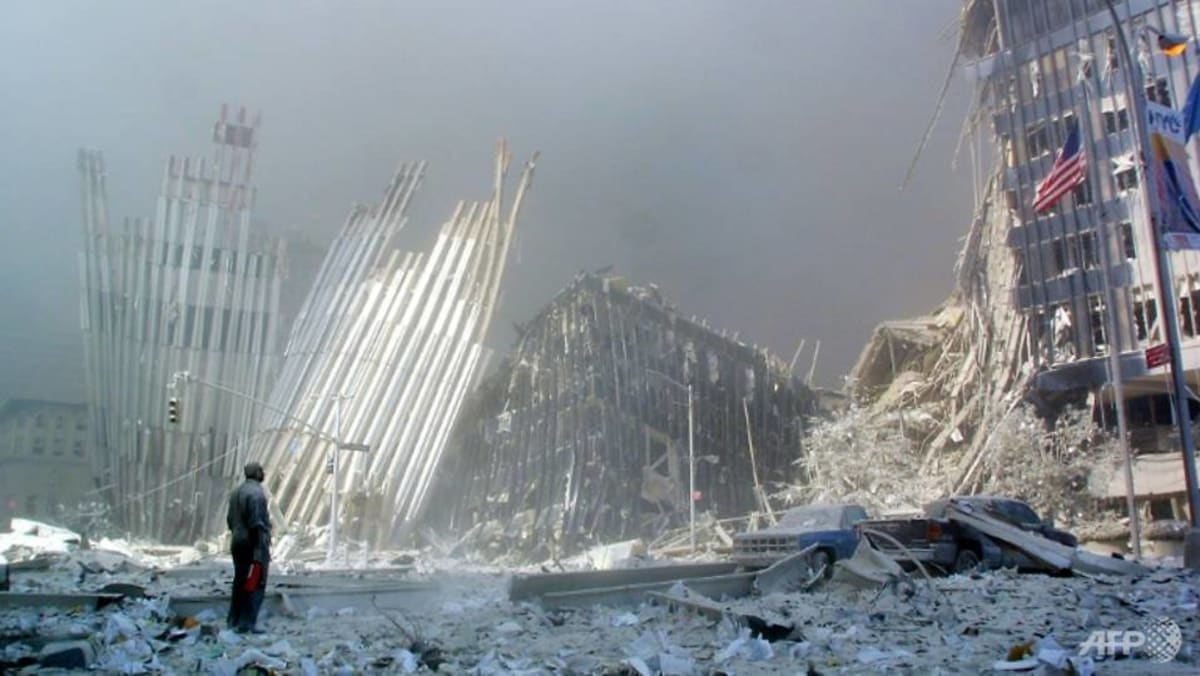
More than 2,750 people were killed when two passenger jets crashed into the World Trade Center during the 9/11 attacks in 2001. (Photo: AFP/Doug Kanter)
This audio is generated by an AI tool.
SINGAPORE: The attacks in New York and Washington on September 11, 2002, that killed nearly 3,000 people were a catalyst for transnational terrorism.
Southeast Asia felt its repercussions through the terror bombings of two nightclubs in Bali, Indonesia on Oct 12, 2002, perpetrated by the Al-Qaeda-linked Jemaah Islamiyah (JI) terrorist network.
The threat of organised terrorist networks gripped regional governments throughout the 2000s, but risks have evolved significantly. Since the mid-2000s, militant groups like Islamic State have exploited the internet and social media to spread propaganda, leading to the radicalisation of vulnerable youth.
The landscape is now also defined by the rise of far-right extremism and “salad bar” extremism , which adds complexity to counterterrorism efforts by states and watchdogs.
CNA Games Guess Word Crack the word, one row at a time Buzzword Create words using the given letters Mini Sudoku Tiny puzzle, mighty brain teaser Mini Crossword Small grid, big challenge Word Search Spot as many words as you can Show More Show Less
BEWILDERING RANGE OF EXTREMIST ONLINE CONTENT
The threat from Islamic State-linked regional groups persists, especially in Indonesia and the southern Philippines, though at a generally lower level than in the past.
The bewildering and diverse range of extremist content on social media has enabled even further ideological mutation. Disaffected youth worldwide have idiosyncratically combined individual grievances and diverse ideological elements, producing “composite violent extremism”, or “salad bar extremism”.
In Southeast Asia, young individuals are being influenced by Islamic extremism, far-right extremism, antisemitism, and most recently, nihilistic violent ideas. Nihilistic violent extremism appears to be of increasing importance. Violence is carried out for non-ideological, personal reasons, with the violence often being the end in and of itself.
This trend has been particularly apparent regionally in the form of the so-called True Crime Community – an online community of supporters of mass shooters and serial killers.
Such supporters idolise school shooters and have attempted to carry out similar attacks in real life . For instance, in November 2025, an Indonesian youth attempted to bomb his high school in Jakarta. While he had inscribed on his fake rifle a slew of far-right extremist concepts and names, Indonesian police assessed that the youth had been influenced by the True Crime Community.
In addition, Singapore has experienced a few cases of “salad bar” extremism involving youth . While these cases had been variously influenced by a diverse mix of jihadist, far-left, far-right and misogynistic ideas, they had also been exposed to nihilistic True Crime Community ideas online.
THREE LESSONS LEARNED
Three key lessons emerge from this survey of the ever-evolving terrorism and extremism terrain since 9/11.
First, while for the past decade there has been much policy attention on the youth radicalisation issue, it is clear that transnational militant networks remain a challenge in the region.
It is generally understood today that a judicious mix of military or police power and softer measures addressing extremist narratives and underlying grievances is needed to deal with the threat.
Hence while Indonesian authorities have applied kinetic force against Islamic State-linked networks, they have complemented these with persuasion and negotiations. Through such a mixed strategy, the old JI network formally disbanded in 2024.
Likewise, in the southern Philippines, militant violence has declined since the longstanding issue of Bangsamoro political autonomy was addressed with the setting-up of the Bangsamoro Autonomous Region of Muslim Mindanao (BARMM) in 2019. Counterterrorism legislation, cross-border intelligence sharing and operational cooperation have also been vital for dealing with the physical terror threat across the region.
Second, in the increasingly complex domain of countering youth radicalisation, simply debunking extremist ideologies alone is insufficient. With the rise of composite, nihilistic violent extremism, broader measures are required to build overall youth resilience to violent ideologies.
Such broad-ranging resilience includes building digital literacy among youth; embedding them in stable family, peer and community relationships; providing balanced perspectives on hot-button geopolitical issues like the Gaza conflict; and shielding them as far as possible from online extremist propaganda and disinformation – increasingly AI-enhanced – through legislation like the Online Criminal Harms Act .
Counterterrorism agencies aside, such a holistic approach must involve other stakeholders, including civil society groups, social media firms, think tanks, religious bodies, educators, counsellors and rehabilitated extremists.
Finally, the boundary between counterterrorism and other national security domains such as cybersecurity for instance, may be blurring. A 19-year-old Singaporean youth recently detained under Singapore’s internal security legislation had planned cyberattacks against the websites of local and foreign Muslim organisations he considered deviant.
Twenty-five years after 9/11, Singapore and the region face a rapidly evolving terrorism and extremism threat environment. They will need to apply strategic clarity and a diverse suite of policy tools on a whole-of-society basis.
Kumar Ramakrishna is Professor of National Security Studies, President’s Chair in National Security Studies and Dean of the S Rajaratnam School of International Studies.
Get our pick of top stories and thought-provoking articles in your inbox
Stay updated with notifications for breaking news and our best stories
Join our channel for the top reads for the day on your preferred chat app
RSIS的库马尔·拉马克里希纳表示,在9·11恐怖袭击事件发生25年后,新加坡和该地区面临着恐怖主义和极端主义威胁的快速演变。
2001年9月11日恐怖袭击事件中,两架客机撞入世界贸易中心,造成超过2750人死亡。(图片:法新社/道格·坎特)
这段音频是由人工智能工具生成的。
新加坡:2002 年 9 月 11 日发生在纽约和华盛顿的恐怖袭击造成近 3000 人死亡,成为跨国恐怖主义的催化剂。
2002 年 10 月 12 日,与基地组织有关联的伊斯兰祈祷团 (JI) 恐怖网络在印度尼西亚巴厘岛的两家夜总会实施恐怖爆炸,东南亚也感受到了其影响。
2000年代,有组织的恐怖主义网络的威胁一直困扰着地区各国政府,但风险已发生显著变化。自2000年代中期以来,像“伊斯兰国”这样的极端组织利用互联网和社交媒体散布宣传,导致易受影响的青年群体走向极端化。
如今,极右翼极端主义和“沙拉吧”极端主义的兴起也改变了局势,这给各国和监督机构的反恐努力增加了复杂性。
CNA游戏 猜词游戏 逐行破解单词 流行词游戏 用给定的字母组成单词 迷你数独 小小谜题,挑战你的大脑 迷你填字游戏 小方格,大挑战 单词搜索 尽可能多地找出单词 显示更多 显示更少
令人眼花缭乱的极端主义网络内容
与伊斯兰国有关联的地区性组织的威胁依然存在,尤其是在印度尼西亚和菲律宾南部,尽管总体上比过去要低。
社交媒体上令人眼花缭乱、五花八门的极端主义内容,进一步加剧了意识形态的变异。世界各地心怀不满的青年以独特的方式将个人不满和各种意识形态元素结合起来,产生了“复合型暴力极端主义”或“大杂烩式极端主义”。
在东南亚,年轻人正受到伊斯兰极端主义、极右翼极端主义、反犹主义以及最近兴起的虚无主义暴力思想的影响。虚无主义暴力极端主义似乎日益盛行。暴力行为并非出于意识形态,而是出于个人原因,暴力本身往往成为最终目的。
这种趋势在某些地区表现得尤为明显,即所谓的“真实犯罪社区”——一个由大规模枪击案凶手和连环杀手的支持者组成的在线社区。
这类支持者将校园枪击案凶手奉为偶像,并试图在现实生活中实施类似的袭击。例如,2025年11月,一名印尼青年试图在雅加达的高中引爆炸弹。虽然他在一把假步枪上刻下了一系列极右翼极端主义的理念和名称,但印尼警方评估认为,这名青年受到了“真实犯罪社区”(True Crime Community)的影响。
此外,新加坡也出现过几起涉及青少年的“沙拉吧式”极端主义案件。虽然这些案件受到圣战主义、极左、极右和厌女主义等多种思想的影响,但这些青少年也接触到了网络上虚无主义的“真实犯罪社区”思想。
三个经验教训
通过对 9/11 事件以来不断演变的恐怖主义和极端主义形势的调查,可以得出三个关键教训。
首先,虽然过去十年来,政策制定者对青年激进化问题给予了高度关注,但很明显,跨国武装网络仍然是该地区面临的一个挑战。
如今人们普遍认为,要应对这一威胁,需要巧妙地将军事或警力与应对极端主义论调和潜在不满的温和措施相结合。
因此,印尼当局在对与伊斯兰国有关联的网络采取武力打击的同时,也辅以劝说和谈判。通过这种混合策略,原先的伊斯兰祈祷团网络于2024年正式解散。
同样,在菲律宾南部,自2019年邦萨摩罗穆斯林棉兰老自治区(BARMM)成立以来,长期存在的邦萨摩罗政治自治问题得到解决,武装暴力事件有所减少。反恐立法、跨境情报共享和行动合作对于应对该地区的恐怖主义威胁也至关重要。
其次,在日益复杂的青少年激进化问题上,仅仅揭露极端主义意识形态是不够的。随着复合型、虚无主义暴力极端主义的兴起,需要采取更广泛的措施来增强青少年抵御暴力意识形态的整体能力。
这种广泛的韧性包括培养青少年的数字素养;让他们融入稳定的家庭、同伴和社区关系;提供关于加沙冲突等热点地缘政治问题的平衡观点;并通过《网络犯罪危害法》等立法,尽可能地保护他们免受网络极端主义宣传和虚假信息(越来越多地借助人工智能)的影响。
除了反恐机构之外,这种整体方法还必须包括其他利益相关者,包括民间社会团体、社交媒体公司、智库、宗教团体、教育工作者、咨询师和已改过自新的极端分子。
最后,反恐与其他国家安全领域(例如网络安全)之间的界限可能正在变得模糊。一名19岁的新加坡青年最近因违反新加坡国内安全法而被拘留,他曾计划对一些他认为“离经叛道”的本地和外国穆斯林组织的网站发动网络攻击。
9·11事件25年后,新加坡和该地区面临着快速演变的恐怖主义和极端主义威胁环境。他们需要在全社会层面运用清晰的战略和多元化的政策工具。
Kumar Ramakrishna 是国家安全研究教授、国家安全研究主席和 S Rajaratnam 国际研究学院院长。
订阅我们的邮件,即可获取精选热点新闻和引人深思的文章。
订阅通知,第一时间获取突发新闻和精彩报道。
加入我们的频道,即可在您常用的聊天应用上获取当日热门文章。