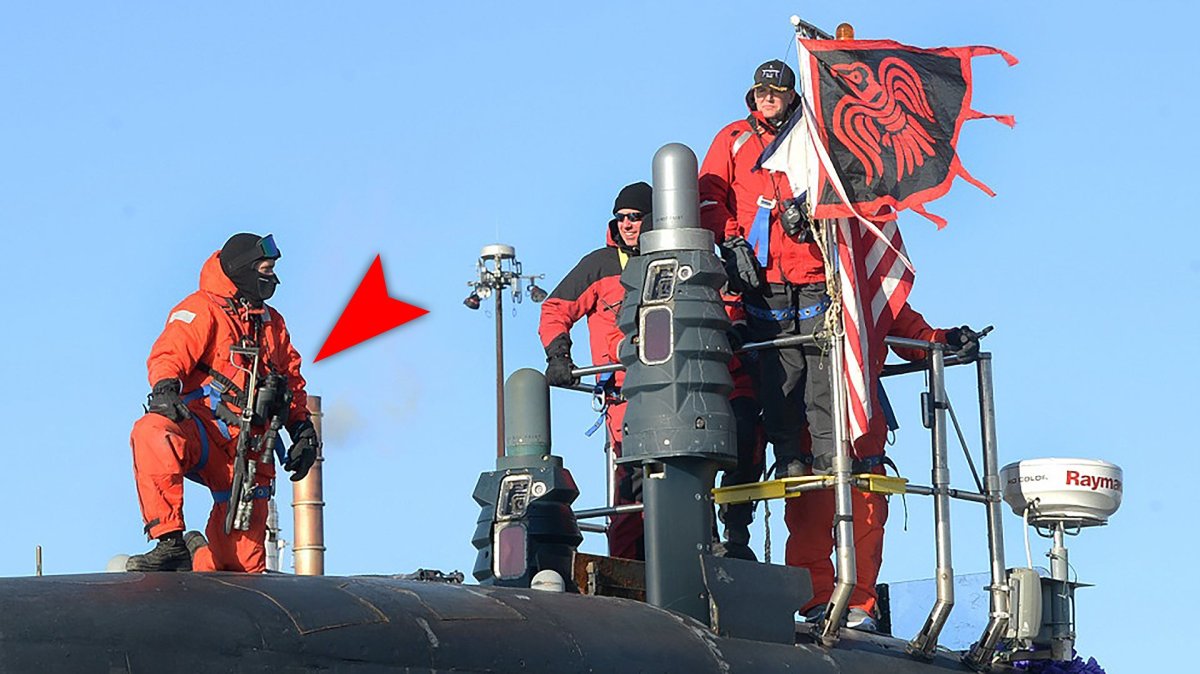
Check Out This Sailor Holding A Laser Rifle Aboard The Nuclear Submarine USS Minnesota看看这位在“明尼苏达”号核潜艇上手持激光步枪的水兵
The dazzler helps defend submarines when they are at their most vulnerable when traversing tight waterways while surfaced.
新闻视频
Updated Jul 26, 2020 5:39 PM EDT
The U.S. Navy posted an image on Twitter of the USS Minnesota , the 10th Virginia class nuclear fast attack submarine, congratulating its crew for earning the Meritorious Unit Commendation. The image shows sailors atop the sub’s conning tower and has some interesting details, but the weapon that one of the submarine’s crewmen is holding really stands out.
Submarines are at their most vulnerable when transiting on the surface in busy waterways. As such, force protection is critical in order to shield them from everything from explosive-laden boats to drones. When just a number of seconds can mean the difference between a possible threat and an imminent attack, having a less-than-lethal option for deterring nearby potential threats and repelling actual attacks is highly valuable. Enter the laser dazzler.
These light projection devices fire highly powerful and sometimes modulated laser beams with pinpoint precision over long distances. The idea is they will temporarily blind and disorient an attacker, or even the electronic optics being used by a threat. What you can’t see you cannot attack, or at the very least the disorienting nature of the dazzler will buy precious seconds to better assess the situation and apply lethal force, if necessary.
The weapon we see in this image is the B.E. Meyers Glare LA-9/P. The manufacturer’s website describes the system as such:
For long-distance hail and warning, especially during maritime security, the GLARE® LA-9/P combines a powerful green beam with Eye Safe® technology. The laser rapidly determines if an unintended observer is within the nominal ocular hazard distance (NOHD) and immediately shuts off the glaring output to prevent accidental eye injury. Once the bystander has moved out of the NOHD, the laser output instantly resumes. Warnings can be sent out to 4 km at night and 1.5 km during daylight. Offensive glaring is achievable out to 500m to hinder and prevent further aggression. In theater, GLARE lasers have been proven to save lives of both civilians and soldiers by providing a rapid warning method across cultural and linguistic boundaries.
For long-distance hail and warning, especially during maritime security, the GLARE® LA-9/P combines a powerful green beam with Eye Safe® technology. The laser rapidly determines if an unintended observer is within the nominal ocular hazard distance (NOHD) and immediately shuts off the glaring output to prevent accidental eye injury. Once the bystander has moved out of the NOHD, the laser output instantly resumes.
Warnings can be sent out to 4 km at night and 1.5 km during daylight. Offensive glaring is achievable out to 500m to hinder and prevent further aggression. In theater, GLARE lasers have been proven to save lives of both civilians and soldiers by providing a rapid warning method across cultural and linguistic boundaries.
The main idea behind the system is that it modulates its output based its range to the target via using an internal laser range-finder. Thus the maximum eye-safe setting can be used throughout the engagement. This is also important because international law prohibits the employment of any such system that is deliberately designed to cause permanent blindness.
LA-9/P., B.E. Meyers
A Navy fact sheet on what it calls ‘non-lethal optical distractors’ reads:
Non-lethal optical distracters are visible laser devices that have reversible optical effects on human targets. These types of non-blinding laser devices use highly directional optical energy to support several non-lethal capabilities, including: • Temporarily overwhelming an adversary’s visual sense by emitting a credible glare source • Providing an unequivocal, non-verbal warning • Providing the target an opportunity to clarify intent Although these capabilities are generic to any high-intensity light source, laser light sources are ideal for non-lethal applications, as the optical energy is collimated and very directional. This allows the user to precisely deliver the optical energy to a target at long ranges, while minimizing the total power output of the device and minimizing collateral effects to other bystanders.
Non-lethal optical distracters are visible laser devices that have reversible optical effects on human targets. These types of non-blinding laser devices use highly directional optical energy to support several non-lethal capabilities, including:
• Temporarily overwhelming an adversary’s visual sense by emitting a credible glare source
• Providing an unequivocal, non-verbal warning
• Providing the target an opportunity to clarify intent
Although these capabilities are generic to any high-intensity light source, laser light sources are ideal for non-lethal applications, as the optical energy is collimated and very directional. This allows the user to precisely deliver the optical energy to a target at long ranges, while minimizing the total power output of the device and minimizing collateral effects to other bystanders.
While defending checkpoints and disorienting potential threats during raids are major applications for these weapons, you can see how well suited they can be to protecting vulnerable maritime assets, too. At the very least, they can make it clear to nearby boaters and pilots that they shouldn’t come closer without having to communicate audibly, by radio, or by firing actual warning shots.
Laser dazzlers aboard a US Navy ship., US Navy
With suicide and unmanned vessel attacks being among the biggest potential threats to ships these days, laser dazzlers offer an essential layer of protection. Even lower-end drones, whether airborne or waterborne, could be repelled via dazzlers by blinding their electro-optical systems. The ability to pinpoint the laser’s aim is why they are mounted on a rifle stock that is also equipped with a scope.
The Navy has deployed these systems on many of its ships, including its aircraft carriers, but the service is already fielding a far more powerful, hard-mounted, laser dazzler that will have a much greater range and a better ability to blind more advanced electronic optics. Named ODIN, it’s already deployed on one of the Navy’s destroyers and will be on seven more in just three years .
LA-9P laser dazzler training aboard the aircraft carrier USS Nimitz ., US Navy
Laser dazzlers are becoming increasingly common among other militaries around the world, as well. China, in particular, has embraced them to a high degree , and they have used them against U.S. assets in troubling ways .
When it comes to lasers on submarines, there was a recent report that U.S. submarines may receive a laser mast of some sort in the future. Although some conjecture was likely overblown as to what is feasible in terms of such a system’s capabilities, it would likely only be able to engage drones and small craft, if at all, and more likely it would be a dazzler system similar to ODIN.
Also seen in the picture of the Minnesota that the Navy posted is the submarine’s dual AN/BVS-1 photonics masts . Unlike traditional periscopes, these do not penetrate the main hull. Instead, they send their electro-optical and infrared video and imagery to the sub’s control room digitally. This allows the control room to be placed lower in the main hull on the Virginia class as the periscopes don’t have to reach it physically.
The system has high-power infrared and electro-optical cameras, a laser rangefinder, as well as a modular top unit that can be swapped out with electronic warfare, electronic surveillance, and communications payloads. The mast is coated in radar-absorbent material and is designed to avoid detection when extended.
So, the big takeaway here is if you are sailing near a U.S. Navy warship and suddenly get hit with a green beam of light, turn around. The next opportunity to pull away may come via a burst from a machinegun, or not at all.
Contact the author: Tyler@thedrive.com
Comments couldn’t be loaded. Please refresh the page.
更新于美国东部时间2020年7月26日下午5:39
美国海军在推特上发布了一张“明尼苏达”号(USS Minnesota)的照片,祝贺其艇员荣获“功勋部队嘉奖”(Meritorious Unit Commendation)。“明尼苏达”号是第10艘弗吉尼亚级核动力攻击潜艇。照片显示,水兵们站在潜艇的指挥塔上,画面中包含一些有趣的细节,但其中一名艇员手中的武器格外引人注目。
潜艇在繁忙水道水面航行时最为脆弱。因此,部队防护至关重要,以保护它们免受从装满炸药的船只到无人机等各种威胁。短短几秒钟就可能决定潜在威胁和迫在眉睫的攻击之间的区别,因此,拥有一种非致命的威慑手段来阻止附近潜在威胁和击退实际攻击就显得尤为重要。激光眩目器应运而生。
这些光投射装置能以极高的精度远距离发射高功率、有时甚至是调制的激光束。其原理是暂时使攻击者,甚至是威胁所使用的电子光学设备失明并使其失去方向感。看不见的目标就无法攻击,或者至少这种眩晕效果能为攻击者争取宝贵的几秒钟,以便更好地评估形势并在必要时使用致命武力。
图片中展示的武器是BE Meyers Glare LA-9/P。制造商的网站对该系统是这样描述的:
GLARE® LA-9/P 激光雷达结合了强大的绿色光束和 Eye Safe® 技术,可用于远距离预警,尤其是在海上安全领域。该激光雷达能够快速判断是否有非目标观察者处于标称眼部危险距离 (NOHD) 内,并立即关闭强光输出,以防止意外眼部损伤。一旦旁观者离开 NOHD 范围,激光输出将立即恢复。夜间预警距离可达 4 公里,白天可达 1.5 公里。攻击性强光照射距离可达 500 米,用于阻碍和阻止进一步的侵略行为。在实际应用中,GLARE 激光雷达已被证明能够跨越文化和语言障碍,提供快速预警,从而挽救平民和士兵的生命。
GLARE® LA-9/P 激光雷达专为远距离预警而设计,尤其适用于海上安保,它将强劲的绿色光束与 Eye Safe® 技术相结合。该激光雷达能够快速判断是否有非目标观察者处于标称眼部危险距离 (NOHD) 内,并立即关闭强光输出,以防止意外眼部损伤。一旦观察者离开 NOHD 范围,激光输出将立即恢复。
夜间预警范围可达4公里,白天可达1.5公里。攻击性激光照射范围可达500米,可有效阻止和预防进一步的侵略行为。在实战中,GLARE激光已被证明能够跨越文化和语言障碍,提供快速预警,从而挽救平民和士兵的生命。
该系统的核心理念是利用内置激光测距仪,根据与目标的距离来调节输出功率。因此,在整个交战过程中都可以使用对眼睛最安全的设置。这一点至关重要,因为国际法禁止使用任何故意设计用于造成永久性失明的系统。
LA-9/P.,BE Meyers
海军一份关于其所谓的“非致命性光学干扰器”的情况说明书写道:
非致命性光学干扰器是一种可见激光装置,可对人体目标产生可逆的光学效应。这类非致盲激光装置利用高定向性的光能,具备多种非致命功能,包括:• 通过发出可信的眩光暂时干扰对手的视觉;• 提供明确的非语言警告;• 为目标提供澄清意图的机会。虽然任何高强度光源都具备这些功能,但激光光源尤其适用于非致命应用,因为其光能具有准直性和高度定向性。这使得用户能够远距离精确地将光能传递给目标,同时最大限度地降低装置的总功率输出,并最大程度地减少对其他旁观者的附带影响。
非致命性光学干扰器是一种可见激光装置,可对人体目标产生可逆的光学效应。这类非致盲激光装置利用高定向性的光能,可实现多种非致命功能,包括:
• 通过发出逼真的眩光,暂时扰乱对手的视觉。
• 提供明确的非语言警告
• 为目标对象提供澄清意图的机会
虽然这些特性是任何高强度光源的通用特性,但激光光源尤其适用于非致命性应用,因为其光能具有准直性和高度方向性。这使得用户能够远距离精确地将光能传递给目标,同时最大限度地降低设备的总功率输出,并最大程度地减少对其他旁观者造成的附带影响。
虽然这些武器的主要用途是防御检查站和在突袭中迷惑潜在威胁,但它们在保护脆弱的海上资产方面也同样适用。至少,它们可以明确地告诉附近的船只和飞行员,在无需发出语音、无线电或鸣枪示警的情况下,不应靠近。
美国海军舰艇上的激光眩目器。
如今,自杀式袭击和无人船袭击是船舶面临的最大潜在威胁之一,激光眩目器提供了一层至关重要的防护。即使是低端无人机,无论是在空中还是在水下,都可以通过眩目器使其光电系统失明而被击退。为了能够精确瞄准目标,这些眩目器通常安装在带有瞄准镜的步枪枪托上。
海军已在其多艘舰艇上部署了这些系统,包括航空母舰,但海军目前正在部署一种威力更强大的硬装式激光眩目器,其射程更远,并且能够更好地干扰更先进的电子光学设备。该设备名为“奥丁”(ODIN),已部署在海军的一艘驱逐舰上,并将于三年内部署到另外七艘驱逐舰上。
美国海军在“尼米兹”号航空母舰上进行LA-9P激光眩目器训练。
激光眩目武器在世界其他国家的军队中也越来越普遍。尤其中国,已经高度重视并大量使用这种武器,而且他们还以令人不安的方式将其用于攻击美国目标。
关于潜艇激光武器,最近有报道称,美国潜艇未来可能会配备某种激光桅杆。尽管对于这种系统的实际能力,一些推测可能有些夸大其词,但它即便能够发挥作用,也可能只能攻击无人机和小艇,而且更有可能是一种类似于ODIN的眩目激光系统。
从海军发布的“明尼苏达”号潜艇照片中还可以看到其双AN/BVS-1型光电桅杆。与传统潜望镜不同,这些桅杆无需穿透主艇体,而是将光电和红外视频图像以数字方式传输到潜艇的控制室。由于潜望镜无需物理延伸至控制室,因此“弗吉尼亚”级潜艇的控制室可以设置在主艇体更低的位置。
该系统配备高功率红外和光电摄像机、激光测距仪,以及可更换的模块化顶部单元,可搭载电子战、电子监视和通信载荷。桅杆表面涂有雷达吸波材料,设计用于在伸展状态下避免被探测到。
所以,关键在于:如果你在美国海军军舰附近航行,突然被一道绿光照射,赶紧掉头。下一次脱身的机会可能来自一阵机枪扫射,也可能根本没有。
联系作者:Tyler@thedrive.com
评论加载失败,请刷新页面。