US absent as western powers meet on wartime protections for civilians美国缺席西方列强就战时平民保护问题召开的会议。
A multinational group meets this week at NATO headquarters in Belgium to discuss protections for civilians during combat. Even though the U.S. co-founded this effort, no American delegation will be in the room.
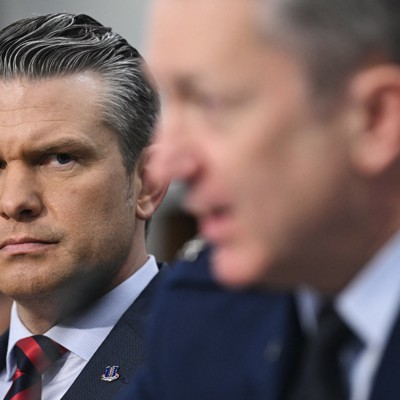
Defense Secretary Pete Hegseth looks on as Joint Chiefs chairman Gen. Dan Caine testifies to Congress on May 12, 2026. SAUL LOEB / AFP via Getty Images
A multinational group meets this week at NATO headquarters in Belgium to discuss protections for civilians during combat. Even though the U.S. co-founded this effort, no American delegation will be in the room.
Hannah Allam and Megan Rose , ProPublica
Three years ago, the Defense Department led an ambitious international effort to better protect civilians during combat, a movement built on the bloody lessons of Afghanistan and Iraq.
The Pentagon created a network with European partners, driving the creation of shared standards. Civilian harm experts described the moment as a “unique opportunity” for American leadership by example.
Today, those efforts continue — without the United States, after Defense Secretary Pete Hegseth dismantled the civilian protection mission.
And Thursday, no U.S. delegation will be in the room when the international forum the U.S. cofounded meets at NATO headquarters in Belgium.
The country’s absence from the International Contact Group on Civilian Harm Mitigation and Response summit reinforces the abandonment of a mission the Pentagon had encouraged partners to embrace, said current and former officials. Most spoke to ProPublica on condition of anonymity for fear of retaliation from President Donald Trump’s administration.
They called the step back “humiliating” and “dangerous,” pointing to reports of rising civilian casualties in Iran following strikes on schools and homes.
“There will be a day when people who care about mitigating civilian harm can come back and say, ‘OK, are we ready to solve this problem?’” said Jenny McAvoy, a former Defense Department official who helped shape the U.S. civilian protection program. “But there are already enormous consequences of abandoning this work.”
The Pentagon declined to comment about the lack of U.S. participation in the Brussels talks. A spokesperson previously told ProPublica that the Defense Department factors civilian protections into all phases of operational planning and “remains committed to fulfilling its civilian harm mitigation and response responsibilities.”
The Pentagon adopted the civilian harm mitigation and response mission in 2022 after years of bloodshed in the post-9/11 “forever wars.” Known as CHMR and pronounced “chimmer,” the framework called for a specialized center to collect strike data and for advisers embedded with regional commands to help mitigate the risk to noncombatants.
Not long after, the U.S. teamed up with the Netherlands to coordinate efforts internationally. The two countries had been frequent partners in recent military campaigns, including the fight against the Islamic State group, and were both coming to terms with high-profile civilian casualty incidents. For the United States, years of harm in Iraq and Afghanistan had drawn international outrage and pledges from commanders to better collect data and learn from deadly mistakes.
The Dutch were still addressing the fallout from a 2015 operation in Iraq in which air strikes targeting a car-bomb factory ignited a nearby munitions depot, setting off an enormous explosion that killed at least 70 civilians and wounded hundreds. Dutch responsibility wasn’t revealed until 2019, causing a national scandal and accusations of a cover-up.
In 2023, the U.S. and the Netherlands formed the loose coalition on CHMR. Participants described a small, informal group that has met half a dozen times since 2023 to share best practices and hear briefings on civilian casualty trends.
Advocacy groups said it had taken years to get the U.S. military to think of civilian casualties as more than “collateral damage,” showing commanders how the deaths of innocents were anathema to their morals and strategically harmful to their missions. The eventual adoption of CHMR guidelines by American defense officials helped their counterparts abroad make the case for programs in their own countries.
“By the U.S. putting itself out there and saying, ‘We learned, we can do better,’ it gives permission and makes it OK for other governments to similarly acknowledge, ‘Yeah, we can do better too,’” said McAvoy.
As participants gather this week in Brussels to discuss how to continue strengthening CHMR, however, the early momentum from the U.S. side has evaporated.
Hegseth, who derides rules of engagement as “woke,” gutted the CHMR program over the objections of the nation’s top commanders , ProPublica reported last month. Staff plunged from nearly 200 to about two dozen.
Days before the latest summit in Brussels, the United States wasn’t listed as a participant and there was no sign anyone from the Defense Department would attend. Current and former officials predicted either a no-show or, at most, a single delegate from one of the commands showing up.
To experts, the message was clear: The era of U.S. leadership on civilian protection was over.
Foreign ambassadors and heads of diplomatic missions visit Resalat Square in Tehran, Iran, on April 20, 2026, where photos of civilians killed in recent U.S.-Israeli strikes are displayed. Fatemeh Bahrami/Anadolu via Getty Images
“The U.S. stopped participating in this group last year and people assumed that meant the group would die,” said McAvoy. “But the group continued to exist and to meet — without the U.S. — under the leadership of the U.K. and the Netherlands.”
The two-day summit opens with a broad discussion of CHMR, such as how it applies in coalitions or in operations at sea, that includes advocacy groups and academics, a draft agenda reviewed by ProPublica shows. Day 2 is a closed-door session for more intimate talks among senior representatives of member states. The meeting wraps with a “looking ahead” panel.
Past attendees included Austria, Australia, Belgium, Denmark, Finland, Germany and Norway. The nations represent a wide variation in approaches and needs when it comes to CHMR, participants said.
The U.K., for example, doesn’t have a formal framework for civilian harm mitigation and response, and advocates have spent years pushing the British Ministry of Defense to adopt policies similar to those of the United States. Though humanitarian groups generally regarded the American CHMR enterprise as nascent and imperfect, the overall framework provided a worthy standard, said Mae Thompson of the Ceasefire Centre for Civilian Rights, a London-based advocacy group.
Advocates have framed the Pentagon’s rollback as an opportunity for the U.K. to step into a leadership role, Thompson said, and they’ve been encouraged by a recent internal report by the defense ministry that calls for formalization of a program in Britain, including systems to track civilian harm, investigate, and make amends and offer post-harm response.
NATO boasts a civilian protection policy that predates the American model, but the organization is now incorporating elements of the U.S. approach, said Andrew Hyde, who studies U.S.-European relations at the Stimson Center, a nonpartisan foreign policy think tank.
Hyde said international talks are important for sorting out how CHMR applies in joint operations when the United States, NATO and European nations all have different interpretations of harm mitigation. The diminished U.S. role, he said, means NATO and other partners must step up on coordination.
The shift in leadership could end up shielding civilian protection work from the whims of whichever U.S. administration is in power and leading to more enduring reforms, Hyde said.
“NATO has continued to push forward without U.S. support or participation, keeping up the momentum and ready for U.S. re-engagement,” Hyde said.
NEXT STORY: Top Air and Space Force leaders will gather amid unresolved Iran war, budget uncertainty
2026年5月12日,国防部长皮特·赫格塞斯在参谋长联席会议主席丹·凯恩将军向国会作证时旁听。图片来源:SAUL LOEB / AFP via Getty Images
本周,一个多国小组在比利时北约总部举行会议,讨论如何在战斗中保护平民。尽管美国是这项倡议的共同发起者,但没有美国代表团会出席会议。
Hannah Allam 和 Megan Rose,ProPublica
三年前,美国国防部牵头开展了一项雄心勃勃的国际行动,旨在更好地保护平民在战斗中免受伤害。这项行动建立在阿富汗和伊拉克惨痛的教训之上。
五角大楼与欧洲伙伴建立了合作网络,推动制定共同标准。平民伤害专家称,这是美国以身作则发挥领导作用的“独特机遇”。
今天,这些努力仍在继续——只是没有了美国的参与,因为国防部长皮特·赫格塞斯解散了平民保护任务。
周四,当美国共同创立的国际论坛在比利时北约总部举行时,不会有任何美国代表团出席。
现任和前任官员表示,美国缺席“减少和应对平民伤害国际联络小组”峰会,进一步表明美国放弃了五角大楼曾鼓励合作伙伴参与的这项使命。由于担心遭到特朗普政府的报复,大多数受访者在接受ProPublica采访时要求匿名。
他们称这一倒退“令人羞辱”且“危险”,并指出有报道称,在伊朗学校和民宅遭到袭击后,平民伤亡人数不断上升。
“总有一天,那些关心减少平民伤害的人们会回来问:‘好了,我们准备好解决这个问题了吗?’”曾参与制定美国平民保护计划的国防部前官员珍妮·麦卡沃伊说,“但放弃这项工作已经造成了极其严重的后果。”
五角大楼拒绝就美国缺席布鲁塞尔会谈一事置评。此前,一位发言人曾告诉ProPublica,国防部在作战计划的各个阶段都考虑了平民保护,并且“始终致力于履行其减轻和应对平民伤害的责任”。
在经历了“9·11”事件后持续多年的流血冲突之后,五角大楼于2022年采纳了平民伤害缓解和应对任务(CHMR)。该任务框架要求设立一个专门的中心来收集打击数据,并向各区域指挥部派遣顾问,以帮助降低非战斗人员面临的风险。
不久之后,美国与荷兰联手,协调国际行动。两国在近期的军事行动中一直是合作伙伴,包括打击伊斯兰国组织的行动,而且都正努力应对造成大量平民伤亡的重大事件。对美国而言,多年来在伊拉克和阿富汗造成的伤害引发了国际社会的强烈愤慨,也促使指挥官们承诺更好地收集数据,并从致命的错误中吸取教训。
荷兰仍在应对2015年伊拉克军事行动的后续影响。当时,荷兰对一家汽车炸弹制造厂的空袭引燃了附近的一个弹药库,引发了一场巨大的爆炸,造成至少70名平民死亡,数百人受伤。直到2019年,荷兰才被证实对此事负有责任,这引发了全国性的丑闻,并招致了掩盖真相的指控。
2023年,美国和荷兰组建了关于人身伤害和精神损害的松散联盟。与会者描述了一个小型非正式小组,该小组自2023年以来已经举行了六次会议,分享最佳实践并听取有关平民伤亡趋势的简报。
倡导团体表示,他们花了数年时间才让美军意识到平民伤亡不仅仅是“附带损害”,并向指挥官们阐明无辜者的死亡违背了他们的道德准则,且对战略任务造成了损害。美国国防官员最终采纳了“平民伤亡管理”(CHMR)指南,这有助于其他国家的同行们在本国推行相关项目。
麦卡沃伊说:“美国公开表示,‘我们吸取了教训,我们可以做得更好’,这给了其他国家政府许可,也让其他国家政府可以同样地承认,‘是的,我们也可以做得更好’。”
然而,尽管本周与会者齐聚布鲁塞尔,讨论如何继续加强CHMR,但来自美国方面的早期势头已经消失殆尽。
据ProPublica上月报道,赫格塞斯不顾国家最高指挥官的反对,削减了CHMR项目,他曾嘲讽交战规则是“觉醒主义”的产物。该项目人员从近200人骤减至约24人。
在布鲁塞尔最新峰会召开前几天,美国并未被列入参会名单,也没有任何迹象表明国防部会有人出席。现任和前任官员预测,要么美国不会出席,要么最多只会派一名来自某个司令部的代表到场。
专家们认为,这传递出的信息很明确:美国在保护平民方面发挥领导作用的时代已经结束了。
2026年4月20日,外国大使和外交使团团长参观了位于伊朗德黑兰的雷萨拉特广场,广场上展示着近期美以空袭中丧生的平民照片。图片来源:Fatemeh Bahrami/Anadolu via Getty Images
麦卡沃伊说:“美国去年停止参与这个组织,人们以为这意味着该组织会消亡。但该组织在英国和荷兰的领导下继续存在并举行会议——尽管没有美国的参与。”
据ProPublica审阅的议程草案显示,为期两天的峰会首先就“共同海事责任和风险管理”(CHMR)展开广泛讨论,内容涵盖其在联盟或海上行动中的应用,参与者包括倡导团体和学术界人士。第二天为闭门会议,成员国高级代表将进行更深入的会谈。会议最后以“展望未来”小组讨论结束。
往届与会者包括奥地利、澳大利亚、比利时、丹麦、芬兰、德国和挪威等国。与会者表示,这些国家在儿童和青少年精神健康管理方面的方法和需求存在很大差异。
例如,英国没有正式的平民伤害缓解和应对框架,倡导者们多年来一直敦促英国国防部采纳与美国类似的政策。总部位于伦敦的倡导组织“停火平民权利中心”的梅·汤普森表示,尽管人道主义组织普遍认为美国的平民伤害缓解和应对机制尚处于起步阶段且不够完善,但其总体框架提供了一个值得借鉴的标准。
汤普森说,支持者们将五角大楼的倒退视为英国发挥领导作用的机会,他们也受到了国防部最近一份内部报告的鼓舞,该报告呼吁在英国正式推行一项计划,包括建立追踪平民伤害、调查和弥补以及提供事后应对措施的系统。
史汀生中心(一家无党派外交政策智库)研究美欧关系的安德鲁·海德表示,北约拥有早于美国模式的平民保护政策,但该组织现在正在吸收美国做法的某些要素。
海德表示,国际对话对于厘清《人道主义和军事伤害缓解原则》(CHMR)在联合行动中的应用至关重要,因为美国、北约和欧洲国家对伤害缓解的理解各不相同。他指出,美国作用的减弱意味着北约和其他伙伴必须加强协调。
海德表示,领导层的更迭最终可能会使平民保护工作免受任何一届美国政府的反复无常的影响,并带来更持久的改革。
海德表示:“北约在没有美国支持或参与的情况下继续推进,保持着发展势头,并已做好迎接美国重新参与的准备。”
下一篇报道:在伊朗战争悬而未决、预算不确定性加剧的情况下,空军和太空部队高级领导人将齐聚一堂。