The Pentagon is using polygraphs to hunt leakers, but the tests are more theater than fact五角大楼正在使用测谎仪来追捕泄密者,但这些测试更多的是一种作秀而非事实。
My 27-year career with the CIA makes me wary of the certainty their use can appear to convey.
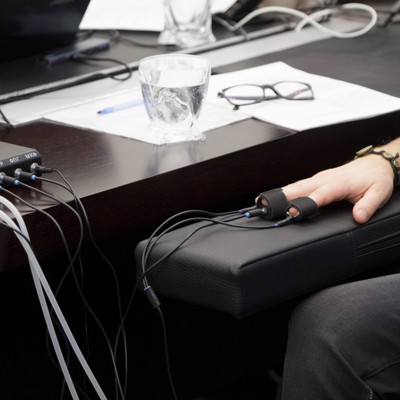
Kirill Chubotin / Ukrinform/Future Publishing via Getty Image
My 27-year career with the CIA makes me wary of the certainty their use can appear to convey.
Brian O'Neill , The Conversation
In August, government investigators subjected roughly 50 military officers and civilian employees on the Joint Staff to polygraph tests as part of an inquiry into press leaks about the Iran war and depleted U.S. munitions, according to The New York Times . The newspaper described the scope of the investigation as unprecedented in the modern military.
This is not the first time the Trump administration has used polygraphs in this way; in 2025, it directed that a wave of tests be administered across the executive branch to expose minor leaks.
As someone who has taken roughly a dozen polygraphs during my 27-year career with the CIA , I am wary of how the process is understood – and of the certainty its use can appear to convey.
Polygraphs carry an ominous, almost mythological reputation among Americans. The more familiar and unofficial term – lie detector tests – likely fuels that perception. Television crime dramas have done their part, too, often portraying the device as an oracle for uncovering the truth when conventional methods fail.
In those portrayals, the polygraph is not merely a tool – it’s a window into the soul.
Among those entering government service, especially in national security, the greater anxiety is not the background check but passing the polygraph. My advice is always the same: Don’t lie. It’s the best – and perhaps only – guidance for a process that most assessments have concluded is a more subjective interpretation than empirical science .
Why the polygraph persists
Polygraphs are “ pseudo-scientific ” in that they measure physiological responses such as heart rate, blood pressure and perspiration. The assumption is that liars betray themselves through spikes in those signals. But this presumes a kind of psychological transparency that simply doesn’t hold up. A person might sweat and tremble simply from fear, anger or frustration – not deceit.
There also are no specific physiological reactions associated with lying. The National Academy of Sciences in 2003, and the American Psychological Association in a 2004 review, concluded that the polygraph rests more on theater than fact. A 2019 assessment reached the same conclusion.
Accordingly, polygraph results are not generally admissible in U.S. courts . Only a handful of states – such as Georgia, Arizona and California – permit their use even under limited conditions. And they typically require that both parties agree to admission and a judge to approve it. Unconditional admissibility remains the exception, not the rule.
And yet, inside many national security agencies, polygraphs remain central to the clearance process – a fact I observed firsthand during my time overseeing personnel vetting and analytic hiring within the intelligence community.
While not treated as conclusive, polygraph results often serve as a filter. A candidate’s visible discomfort – or the examiner’s subjective judgment that a response seems evasive – can stall or end the hiring process. For instance, I know that government agencies have halted clearances after an examiner flagged elevated reactions to questions about past drug use or foreign contacts, even when no disqualifying behavior was ultimately documented.
The FBI’s J. Edgar Hoover headquarters building in Washington in 2016. AP Photo/Cliff Owen
In some cases, an examiner’s suggestion that a chart shows an anomaly has led otherwise strong applicants to volunteer details they hadn’t planned to share – such as minor security infractions, undeclared relationships, or casual drug use from decades earlier – that, while not disqualifying on their own, reshape how their trustworthiness is perceived.
The polygraph’s power lies in creating the conditions under which deception is confessed.
A predictable pattern
No administration has been immune to the impulse to investigate leaks . The reflex is bipartisan and familiar: An embarrassing disclosure appears in the press – contradicting official statements or exposing internal dissent – and the White House vows to identify and punish the source. Polygraphs are often part of this ritual.
During his first term, Trump intensified efforts to expose internal dissent and media leaks. Department guidelines were revised to make it easier for agencies to obtain journalists’ phone and email records , and polygraphs were reportedly used to pressure officials suspected of talking to the press. That trend has continued – and, since 2025, escalated.
Policies at the Pentagon now restrict unescorted press access , revoke office space for major outlets and favor ideologically aligned networks. The line between legitimate leak prevention and the surveillance or sidelining of critical press coverage has grown increasingly blurred.
At agencies such as the Department of Homeland Security and the FBI , polygraphs reportedly have been used frequently – and more punitively – to identify internal dissenters. Even “ cold cases ,” such as the leak of the Supreme Court’s Dobbs opinion ahead of its overturning of Roe v. Wade, were reopened, despite prior investigations yielding no definitive source.
Government reaction varies
Not all leaks are treated the same. Disclosures that align with official narratives or offer strategic advantage may be quietly tolerated, even if unauthorized. Others, especially those that embarrass senior officials or reveal dysfunction, are more likely to prompt formal investigation.
In 2003, for example, the leak of CIA officer Valerie Plame’s identity – widely seen as retaliation for her husband’s criticism of the Iraq War – triggered a federal investigation. The disclosure embarrassed senior officials, led to White House aide Scooter Libby’s conviction for perjury , later commuted, and drew intense political scrutiny .
Lewis Libby, Vice President Dick Cheney’s chief of staff, rides in the backseat of a limousine on Oct. 27, 2005, in McLean, Va. Win McNamee/Getty Images
Leaks involving classified material draw the sharpest response when they challenge presidential authority or expose internal disputes. That was the case in 2010 with Chelsea Manning , whose disclosure of diplomatic cables and battlefield reports embarrassed senior officials and sparked global backlash. Government reaction often depends less on what was disclosed than on who disclosed it – and to what effect.
A narrow set of disclosures, such as those involving espionage or operational compromise, elicit broad consensus as grounds for prosecution. But most leaks fall outside that category. Most investigations fade quietly. The public rarely learns what became of them. Occasionally, there is a vague resignation, but direct accountability is rare.
What the future holds
The Pentagon polygraph campaign is not likely to eliminate leaks to the press. But it may have a chilling effect that discourages internal candor while diverting investigative energy away from core security priorities.
Even if such campaigns succeed in reducing unauthorized disclosures, they may come at the cost of institutional resilience. Historically, aggressive internal enforcement has been associated with declining morale and reduced information flow – factors that can hinder adaptation to complex threats.
Some researchers have suggested that artificial intelligence may eventually offer reliable tools for detecting deception but caution that the technology is nowhere near operational readiness.
For now, institutions will have to contend with the tools they have – imperfect, imprecise and more performative than predictive.
This is an updated version of a story that was first published on July 9, 2025 .
NEXT STORY: We can buy more weapons. We can’t buy more time.
Kirill Chubotin / Ukrinform/Future Publishing via Getty Image
我在中央情报局工作了 27 年,这让我对他们使用这种手段所表现出的确定性持谨慎态度。
Brian O'Neill,《对话》
据《纽约时报》报道,8月份,政府调查人员对参谋部联合参谋部约50名军官和文职人员进行了测谎,作为对有关伊朗战争和美国弹药耗尽的泄密事件调查的一部分。该报称,此次调查的规模在现代军事史上前所未有。
这并非特朗普政府第一次以这种方式使用测谎仪;2025年,它指示在整个行政部门进行一系列测试,以揭露轻微的泄密行为。
在我为中央情报局工作的 27 年职业生涯中,我接受过大约 12 次测谎,因此我对测谎过程的理解以及测谎结果所传递的确定性持谨慎态度。
测谎仪在美国人心中有着一种不祥的、近乎神话般的名声。人们更熟悉的非正式说法——“测谎仪测试”——可能加剧了这种印象。电视犯罪剧也推波助澜,常常将测谎仪描绘成传统方法失效时揭露真相的灵丹妙药。
在这些描述中,测谎仪不仅仅是一种工具,它还是一扇通往灵魂的窗户。
对于那些即将进入政府部门工作的人来说,尤其是在国家安全领域,他们最大的焦虑并非背景调查,而是通过测谎。我的建议始终如一:不要撒谎。这是对测谎过程的最佳——或许也是唯一——指导原则,因为大多数评估都认为测谎更多的是一种主观解读,而非实证科学。
为什么测谎仪依然存在?
测谎仪之所以被称为“伪科学”,是因为它测量的是心率、血压和出汗等生理反应。其假设是,说谎者会通过这些信号的波动暴露自己。但这预设了一种心理上的透明性,而这种透明性根本站不住脚。一个人出汗和颤抖可能仅仅是因为恐惧、愤怒或沮丧,而不是因为说谎。
说谎并没有任何特定的生理反应。美国国家科学院在2003年以及美国心理学会在2004年的一项审查中均得出结论:测谎仪更多地依赖于表演而非事实。2019年的一项评估也得出了同样的结论。
因此,测谎结果通常不被美国法院采纳。只有少数几个州——例如佐治亚州、亚利桑那州和加利福尼亚州——允许在特定条件下使用测谎结果。而且,这些州通常要求双方同意采纳,并由法官批准。无条件采纳测谎结果仍然是例外,而非普遍做法。
然而,在许多国家安全机构中,测谎仍然是安全审查流程的核心——我在负责情报界人员审查和分析招聘期间亲眼目睹了这一事实。
虽然测谎结果并非决定性证据,但它通常可以起到筛选作用。应聘者表现出的明显不适,或者测谎员主观判断其回答似乎有所回避,都可能导致招聘流程停滞甚至终止。例如,我知道有些政府机构在测谎员发现应聘者对有关过去吸毒史或与外国人士接触的问题反应过度后,即使最终没有发现任何不合格的行为,也会中止安全审查。
2016年,位于华盛顿的联邦调查局J·埃德加·胡佛总部大楼。美联社照片/克利夫·欧文
在某些情况下,考官认为图表显示异常情况,导致原本优秀的申请人主动透露了他们原本不打算分享的细节——例如轻微的安全违规行为、未申报的关系或几十年前的偶尔吸毒行为——这些细节本身虽然不足以取消资格,但却改变了人们对他们可信度的看法。
测谎仪的威力在于创造一种条件,使人承认说谎。
可预测的模式
历届政府都无法抵挡调查泄密事件的冲动。这种反应不分党派,而且十分常见:一旦媒体爆出令人尴尬的消息——与官方声明相悖或暴露内部异议——白宫便誓言要找出并惩罚泄密者。测谎往往是这一程序的一部分。
在特朗普的第一任期内,他加大了打击内部异议和媒体泄密的力度。国务院修改了相关指导方针,使各机构更容易获取记者的电话和电子邮件记录,据报道,测谎仪还被用来向涉嫌与媒体接触的官员施压。这一趋势仍在继续,并且自2025年以来愈演愈烈。
五角大楼目前的政策限制记者在没有陪同的情况下进入大楼,撤销主要媒体的办公场所,并偏袒与其意识形态相符的媒体。合法的泄密防范与监视或排挤批评性新闻报道之间的界限日益模糊。
据报道,在国土安全部和联邦调查局等机构,测谎仪被频繁使用,且惩罚力度加大,以识别内部异议者。甚至像最高法院在推翻“罗诉韦德案”前泄露多布斯意见这样的“悬案”,尽管之前的调查未能找到确凿的泄密源,也被重新开启调查。
政府反应各不相同
并非所有泄密事件都会受到同等对待。与官方说法相符或能带来战略优势的泄密信息,即使未经授权,也可能被悄悄容忍。而其他泄密事件,尤其是那些令高层官员难堪或暴露内部运作失灵的泄密事件,则更有可能引发正式调查。
例如,2003年,中央情报局官员瓦莱丽·普莱姆的身份泄露——普遍认为这是对她丈夫批评伊拉克战争的报复——引发了联邦调查。这一泄密事件令高级官员难堪,导致白宫助理斯库特·利比因作伪证被定罪(后被减刑),并招致了强烈的政治审查。
2005年10月27日,副总统迪克·切尼的幕僚长刘易斯·利比在弗吉尼亚州麦克莱恩乘坐一辆豪华轿车的后座。图片来源:Win McNamee/Getty Images
涉及机密材料的泄密事件,如果挑战总统权威或暴露内部纷争,往往会引发最强烈的反应。2010年切尔西·曼宁的泄密事件就是如此,她泄露的外交电报和战场报告令高级官员难堪,并引发了全球范围内的强烈反弹。政府的反应往往与其说是取决于泄露的内容,不如说是取决于泄密者及其行为的影响。
某些特定类型的泄密事件,例如涉及间谍活动或行动泄露的泄密,往往能引发广泛的共识,成为起诉的理由。但大多数泄密事件并不属于此类。大多数调查悄无声息地不了了之,公众很少得知最终结果。偶尔会出现含糊其辞的默认,但直接追究责任的情况却极为罕见。
未来会怎样?
五角大楼的测谎行动不太可能杜绝向媒体泄密,但它可能会产生寒蝉效应,阻碍内部坦诚沟通,并将调查精力从核心安全优先事项上转移开来。
即使此类行动成功减少了未经授权的信息披露,也可能损害机构的韧性。历史上,强硬的内部执法往往会导致士气低落和信息流通减少——这些因素都会阻碍机构适应复杂的威胁。
一些研究人员认为,人工智能最终可能会提供可靠的工具来检测欺骗行为,但他们也警告说,这项技术距离投入实际应用还很遥远。
目前,各机构只能依靠现有的工具——这些工具并不完美、不够精确,而且更多的是表演性质的,而不是预测性质的。
这是 2025 年 7 月 9 日首次发表的故事的更新版本。
下一篇报道:我们可以购买更多武器,但我们买不到更多时间。