Fogbank Is Mysterious Material Used In Nukes That’s So Secret Nobody Can Say What It Is雾库是一种用于核武器的神秘材料,其性质极其隐秘,无人知晓。
What we do know is that it's immensely complicated to make and has to be purified using a dangerously volatile chemical.
By Joseph Trevithick
Published Apr 3, 2020 1:40 PM EDT
To this day, details about the weapons in America’s nuclear arsenal, especially regarding their warheads , remain some of the most secretive, while still publically known, elements America’s nuclear weapons enterprise. There is no better single example of this than a material that the U.S. Department of Energy has used to build thermonuclear warheads, also known as hydrogen bombs, that is so secret that no one knows exactly what it does or exactly what it’s made of, and that is only ever referred to publicly by a codename , Fogbank.
Fogbank first gained relatively widespread public attention between 2007 and 2008 as it emerged that the material was at the root of technical delays in the life extension program for the W76 warhead . The W76 series is employed on Trident II submarine-launched ballistic missiles, also known as Trident D5s , in service with both the U.S. Navy and U.K. Royal Navy . The National Nuclear Security Administration delivered the last life-extended W76-1 warheads in 2018.
“There is a material that we currently use and it’s in a facility that we built … at Y-12,” then-NNSA director Thomas D’Agostino told members of the House of Representatives in 2007, referring to the Y-12 National Security Complex , a nuclear weapons production facility located near the Oak Ridge National Laboratory in Tennessee. “It’s a very complicated material that – call it the Fogbank. That’s not classified, but it’s a material that’s very important to, you know, our [W76] life extension activity.”
“There’s another material in the [W76] – it’s called interstage material, also known as Fogbank, but the chemical details, of course, are classified,” then-NNSA director Tom D’Agostino told senators later that year.
NNSA director Thomas D’Agostino in 2009., CTBTO
D’Agostino’s description of Fogbank as an “interstage material” has led experts to largely conclude that it sits between the primary and secondary stages of a two-stage thermonuclear weapon. When the first stage, which is a normal fission reaction, goes off, the interstage material would turn into superheated plasma and then trigger a fusion reaction in the second stage.
Experts also believe that Fogbank is an aerogel , a category of ultralight gels in which the traditionally liquid component is instead a gas. Jeffrey Lewis, an expert on missiles and nuclear weapons at the Middlebury Institute of International Studies at Monterey, posted in 2008 that the codename Fogbank might be derived from nicknames for aerogels, such as “frozen smoke” and “San Franciso fog.” In that same post on the Arms Control Wonk blog , he laid out a number of other known and highly likely details about the material and its production.
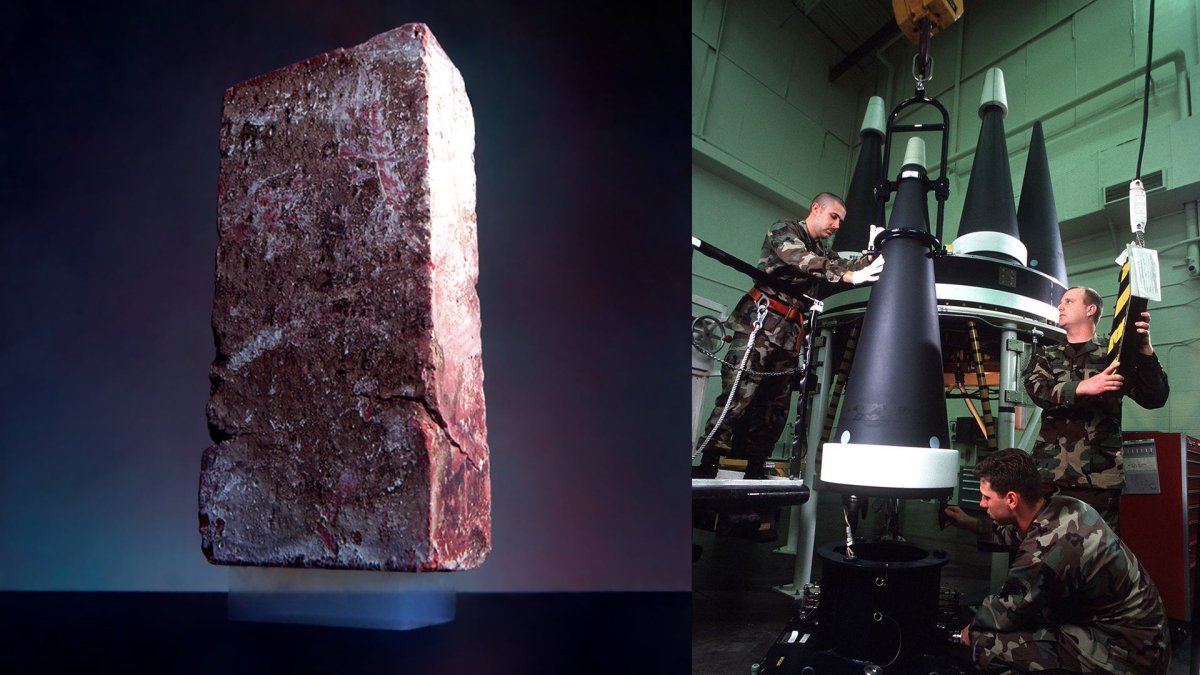
A clay brick, weighing 2.5 kilograms, sits on top of a block of aerogel weighing just 2 grams., NASA
Lewis noted that, in 2007, NNSA’s D’Agostino had also told legislators that Fogbank’s production included purifying the material in a process that “uses a cleaning agent that is extremely flammable.” In a talk that same year at the Woodrow Wilson Center, the NNSA director had also “another material that requires a special solvent to be cleaned” and identified the solvent as “ACN,” the abbreviation for acetonitrile , which is commonly used in aerogel production.
“That solvent is very volatile,” D’Agostino said at the time. “It’s very dangerous. It’s explosive.”
A 2007 NNSA briefing slide on a program known as the Reliable Replacement Warhead (RRW), which sought to develop a new warhead design to replace various existing types, further points to Fogbank’s potential aerogel composition. Congress de-funded the RRW effort in 2008 and President Barack Obama formally canceled it the following year.
The NNSA briefing slide from 2007 that offers various details about the interstage and other design features of the then-still-in-development Reliable Replacement Warhead (RRW)., NNSA
The NNSA slide specifically noted a desire to replace an “expensive ‘specialty’ material” in the interstage section. This would also have resulted in “eliminating [the] need for unique facilities.”
Y-12 had closed down a top-secret and specialized site known as Facility 9404-11, which was used to produce Fogbank, following the completion of the final W76 warhead in 1989. The complex established what it called a “Purification Facility” in its place.
“It [the Purification Facility] reprocesses a material that we’re taking out of weapons so that we can reuse it in refurbished weapons. That’s probably all I can say,” Dennis Ruddy, who served for a time as President and General Manager of BWXT Y-12, the division of the Babcock & Wilcox Company that operated Y-12 under contract to the U.S. government between 2000 and 2014 , once said . “The material is classified. Its composition is classified. Its use in the weapon is classified, and the process itself is classified.”
The Middlebury Institute’s Jeffery Lewis noted in 2008 that it was public knowledge that the Purification Facility at Y-12 worked with ACN. “On three separate occasions in March 2006, workers evacuated the Purification Facility after alarms went off. According to DOE [Department of Energy] documents, the Purification Facility is alarmed to monitor for acetonitrile (ACN) levels,” he explained.
There was also an ACN spill the forced the evacuation of the Purification Facility in December 2014, which thankfully caused no injuries. It took months to get the facility back up and running. An alert about another potential accident in March 2015 turned out to be a false alarm.
The Purification Facility, also known as Facility 9225-3, at Y-12., Y-12
In 2009, an article had also appeared in an issue of Nuclear Weapons Journal , an official publication of the Los Alamos National Laboratory (LANL), which disclosed that the decision to re-start manufacturing Fogbank came in 2000 and confirmed that this decision was linked directly to the W76-1 warhead project. It also explained that in the intervening years, NNSA had lost virtually all of its institutional knowledge base regarding Fogbank and how to make it.
“Most personnel involved with the original production process were no longer available,” the article said. As such, NNSA personnel had reconstructed the production process from historical records.
In addition, “a new facility had to be constructed, one that met modern health and safety requirements.” That facility is very likely the Purification Facility at Y-12.
In a bizarre twist, the new production facility and reverse-engineered production process yielded a version of Fogbank that was of a higher purity than it had been in the past, according to the article. The problem, however, was that for Fogbank to work as intended in existing warhead designs, that previous level of impurity was actually essential. NNSA had to revise the process to ensure the final product was just as impure .
Extremely rudimentary diagrams showing the production process the NNSA initially developed to produce Fogbank in the 2000s, above, and the revised “impure” process, below., LANL
NNSA only succeeded in recertifying the production process in 2008, the better part of a decade after first deciding to restart Fogbank production. The production of life-extended W76-1 warheads began that same year.
It’s not clear how many U.S. nuclear warhead types, past and present, used Fogbank. Jeffery Lewis’ has posited that the W78 and W80, used on the U.S. Air Force’s LGM-30G Minuteman III intercontinental ballistic missile and the AGM-86B Air-Launched Cruise Missile (ALCM), respectively, might have it based on when NNSA designed and produced those warheads.
Fogbank, or at the least the story of re-booting its production, has come up more recently amid the broad U.S. efforts to modernize America’s nuclear arsenal in recent years. This has included the fielding of a controversial low-yield variant of the W76, which entered service on some U.S. Navy’s Trident II submarine-launched ballistic missiles earlier this year, and the development of a new warhead, the W93 , for those same missiles.
The official program logo for the W76-2 low-yield variant., NNSA
Work on the W93, in particular, has raised concerns about whether the Department of Energy, which oversees warhead construction, has adequate facilities and other resources to avoid potentially serious delays in the production of large numbers of new nuclear weapons. In March 2020, Allison B. Bawden, a Director on the Natural Resources and Environment team at the Government Accountability Office highlighted the past difficulties with the production of Fogbank in relation to the production of new nuclear weapons.
“Future weapon programs will require newly produced explosives, including some that NNSA has not produced at scale since 1993,” Bawden said during a hearing on Capitol Hill. “As we reported in March 2009, NNSA had to delay first production of the W76-1 from September 2007 to September 2008 when it encountered problems restarting production of a key material, known as Fogbank. NNSA is working to reconstitute its high explosives capabilities, as we reported in June 2019.”
You can read more about the production of specialized high explosives for nuclear weapons in this past War Zone piece .
The exact origins of the W93 design are unclear. Senior Department of Energy and U.S. military officials have shied away from calling it all-new, but it is certainly set to the be the first new warhead design to enter U.S. military service since the introduction of the W88 for the Trident II in 1989.
A non-official diagram showing the general arrangement and features of the W88 warhead., Dan Stober and Ian Hoffman via Wikimedia
The W93 is based on “previously nuclear-tested designs, it’s not going to require any nuclear testing,” a senior defense official had told reporters in February. However, U.S. Navy Admiral Charles Richard, head of U.S. Strategic Command, told legislators that same month that the W93 itself “hasn’t been designed yet.”
The Reliable Replacement Warhead (RRW) program had raised similar questions. NNSA had picked Lawrence Livermore National Laboratory (LLNL) to build the initial production version of the RRW, leading to speculation that it might be derived from LLNL’s W89 . Work on the W89, which was intended to arm the Air Force’s air-launched AGM-131A Short Range Attack Missile II (SRAM II) and the Navy’s RUM/UUM-125A Sea Lance anti-submarine missile, officially ended in 1991. Neither the SRAM II nor the Sea Lance entered service, either.
It is possible that the W93 project will now leverage work from the RRW program, regardless of the latter’s origins. If the W93 does follow on from that earlier effort, there is also a distinct possibility that it will not use Fogbank in its interstage section.
Whatever happens, Fogbank will continue to be a prime example of both the complexity surrounding the construction of nuclear warheads, as well as the immense secrecy surrounding America’s nuclear weapon enterprise.
Contact the author: joe@thedrive.com
Comments couldn’t be loaded. Please refresh the page.
作者:约瑟夫·特雷维西克
发布于美国东部时间2020年4月3日下午1:40
时至今日,美国核武库中武器的细节,尤其是其弹头,仍然是美国核武器体系中最神秘的部分之一,尽管公众对此也知之甚少。美国能源部用于制造热核弹头(也称氢弹)的一种材料就是一个绝佳的例子。这种材料的保密程度之高,以至于无人知晓其确切用途或组成成分,而它对外仅以代号“雾库”(Fogbank)指代。
2007年至2008年间,由于发现这种物质是导致W76核弹头延寿计划技术延误的根源,Fogbank核弹头首次引起公众的广泛关注。W76系列核弹头用于美国海军和英国皇家海军服役的“三叉戟II”潜射弹道导弹(也称“三叉戟D5”导弹)。美国国家核安全管理局于2018年交付了最后一批延寿后的W76-1核弹头。
“我们目前正在使用一种材料,它存放在我们自己建造的设施里……位于Y-12,”时任美国国家核安全管理局局长托马斯·达戈斯蒂诺在2007年对众议院议员们说道,他指的是位于田纳西州橡树岭国家实验室附近的Y-12国家安全综合设施,这是一个核武器生产设施。“这是一种非常复杂的材料——姑且称之为‘雾库’吧。这并非机密,但这种材料对我们的[W76]延寿活动至关重要。”
“[W76]中还有另一种材料——它被称为级间材料,也称为雾库,但其化学细节当然是机密的,”当时的美国国家核安全管理局局长汤姆·达戈斯蒂诺在那年晚些时候告诉参议员们。
2009 年,国家核安全局局长托马斯·达戈斯蒂诺 (Thomas D'Agostino)。 CTBTO
达戈斯蒂诺将福格班克描述为“级间材料”,这使得专家们普遍认为它位于两级热核武器的第一级和第二级之间。当第一级(即正常的裂变反应)引爆时,级间材料会转化为超高温等离子体,然后触发第二级的聚变反应。
专家们还认为,“雾库”(Fogbank)是一种气凝胶,属于超轻凝胶,其传统液态成分变为气体。蒙特雷米德尔伯里国际研究学院的导弹和核武器专家杰弗里·刘易斯(Jeffrey Lewis)在2008年发表文章称,“雾库”(Fogbank)这个代号可能源自气凝胶的别称,例如“冻结的烟雾”(frozen smoke)和“旧金山雾”(San Franciso fog)。在同一篇发表于“军控专家”(Arms Control Wonk)博客的文章中,他还列出了关于这种材料及其生产的其他一些已知且极有可能的细节。
一块重2.5公斤的粘土砖放在一块仅重2克的凝胶块上。(美国宇航局)
刘易斯指出,2007年,美国国家核安全管理局(NNSA)局长达戈斯蒂诺也曾告诉立法者,福格班克公司的生产过程包括使用一种“极易燃的清洁剂”来提纯材料。同年,在伍德罗·威尔逊中心的一次演讲中,NNSA局长还提到“另一种需要特殊溶剂清洗的材料”,并指出该溶剂是“ACN”,即乙腈的缩写,乙腈常用于气凝胶的生产。
“那种溶剂非常易挥发,”达戈斯蒂诺当时说道。“它非常危险,而且会爆炸。”
美国国家核安全管理局 (NNSA) 2007 年一份关于“可靠替代弹头 (RRW)”项目的简报幻灯片进一步指出,Fogbank 弹头可能由气凝胶构成。该项目旨在开发一种新型弹头设计,以取代现有的各种弹头。国会于 2008 年停止了 RRW 项目的拨款,巴拉克·奥巴马总统于次年正式取消了该项目。
2007 年美国国家核安全管理局 (NNSA) 的一份简报幻灯片,详细介绍了当时仍在研发中的可靠替代弹头 (RRW) 的级间结构和其他设计特点。
美国国家核安全管理局的幻灯片特别指出,他们希望替换级间段中一种“昂贵的‘特种’材料”。这样做还可以“消除对特殊设施的需求”。
在 1989 年完成最后一枚 W76 核弹头的生产后,Y-12 关闭了一个名为 9404-11 的绝密专业设施,该设施曾用于生产雾库核弹。该设施在原址上建立了一个所谓的“净化设施”。
“它(提纯设施)对我们从武器中取出的一种材料进行再加工,以便我们可以将其重新用于翻新武器。我大概只能透露这么多了。”丹尼斯·鲁迪曾担任BWXT Y-12的总裁兼总经理,该公司是巴布科克-威尔科克斯公司(Babcock & Wilcox Company)旗下的一个部门,在2000年至2014年间根据与美国政府的合同运营Y-12。他曾表示:“这种材料是机密的。它的成分是机密的。它在武器中的用途是机密的,整个过程也是机密的。”
米德尔伯里学院的杰弗里·刘易斯在2008年指出,Y-12号净化设施使用乙腈(ACN)是公开信息。“2006年3月,净化设施曾三次响起警报,工作人员被迫撤离。根据美国能源部的文件,该净化设施的警报系统用于监测乙腈(ACN)的浓度,”他解释道。
2014年12月,净化设施发生一起乙腈泄漏事故,导致人员疏散,所幸未造成人员伤亡。该设施耗时数月才恢复运行。2015年3月,另一起潜在事故的警报最终被证实为虚惊一场。
净化设施,又称9225-3号设施,位于Y-12。
2009年,洛斯阿拉莫斯国家实验室(LANL)的官方刊物《核武器杂志》也刊登了一篇文章,披露重启“雾库”(Fogbank)核弹头生产的决定是在2000年做出的,并证实该决定与W76-1核弹头项目直接相关。文章还解释说,在此期间,美国国家核安全管理局(NNSA)几乎完全丧失了关于“雾库”核弹头及其制造方法的机构知识。
文章指出,“参与最初生产过程的大部分人员已经不在岗”。因此,美国国家核安全管理局(NNSA)的工作人员根据历史记录重建了生产过程。
此外,“必须建造一座符合现代健康和安全要求的新设施。”该设施很可能就是位于 Y-12 的净化设施。
令人匪夷所思的是,据文章所述,新的生产设施和逆向工程生产工艺生产的“雾库”(Fogbank)纯度竟然比以往更高。然而,问题在于,“雾库”要想在现有的弹头设计中按预期发挥作用,之前那种程度的杂质实际上是必不可少的。美国国家核安全管理局(NNSA)不得不修改生产工艺,以确保最终产品的杂质含量保持不变。
上图为极其简略的示意图,展示了美国国家核安全管理局 (NNSA) 在 2000 年代最初开发的用于生产 Fogbank 的生产工艺,下图为修订后的“不纯”工艺。(洛斯阿拉莫斯国家实验室)
美国国家核安全管理局(NNSA)直到2008年才成功重新认证生产流程,距离首次决定重启“雾库”核弹头生产已过去了近十年。同年,延寿型W76-1核弹头的生产也正式启动。
目前尚不清楚美国过去和现在有多少种核弹头使用过“雾库克”技术。杰弗里·刘易斯推测,美国空军的LGM-30G“民兵III”洲际弹道导弹和AGM-86B空射巡航导弹(ALCM)分别使用的W78和W80弹头可能使用了该技术,这是基于美国国家核安全管理局(NNSA)设计和生产这些弹头的时间推测的。
近年来,随着美国大力推进核武库现代化,Fogbank核弹头,或者至少是其重启生产的故事,再次成为人们关注的焦点。这其中包括部署备受争议的W76低当量改进型核弹头(该弹头已于今年早些时候装备美国海军部分“三叉戟II”潜射弹道导弹),以及为这些导弹研发新型核弹头W93。
这是W76-2低当量型导弹的官方项目标志。(美国国家核安全管理局)
特别是W93的研发工作引发了人们的担忧,即负责核弹头制造的能源部是否拥有足够的设施和其他资源,以避免大规模新型核武器生产过程中可能出现的严重延误。2020年3月,美国政府问责局自然资源与环境团队主任艾莉森·B·鲍登强调了过去在生产“雾库”(Fogbank)核弹头时遇到的困难,并将其与新型核武器的生产联系起来。
鲍登在国会山的一次听证会上表示:“未来的武器计划将需要新生产的炸药,其中包括一些自1993年以来美国国家核安全管理局(NNSA)未曾大规模生产的炸药。正如我们在2009年3月报道的那样,由于在重启一种名为‘雾库’(Fogbank)的关键材料的生产方面遇到问题,NNSA不得不将W76-1炸药的首次生产从2007年9月推迟到2008年9月。正如我们在2019年6月报道的那样,NNSA正在努力重建其高爆炸药生产能力。”
您可以在之前的《战区》文章中阅读更多关于核武器专用高爆炸药生产的信息。
W93设计的确切起源尚不清楚。美国能源部和军方高级官员一直不愿称其为全新设计,但它无疑将成为自1989年三叉戟II导弹采用W88弹头以来,首个进入美国军方服役的新型弹头设计。
一张非官方的示意图,展示了W88核弹头的总体结构和特征。(图片来自Wikimedia,由Dan Stober和Ian Hoffman提供)
一位高级国防官员在2月份告诉记者,W93导弹是基于“之前进行过核试验的设计,它不需要进行任何核试验”。然而,美国战略司令部司令、海军上将查尔斯·理查德在同月告诉立法者,W93导弹本身“尚未设计完成”。
可靠替代弹头(RRW)计划也引发了类似的疑问。美国国家核安全管理局(NNSA)选择劳伦斯·利弗莫尔国家实验室(LLNL)建造RRW的初始生产版本,这导致人们猜测它可能源自LLNL的W89弹头。W89弹头的研发工作于1991年正式结束,该项目旨在装备空军的空射型AGM-131A短程攻击导弹II(SRAM II)和海军的RUM/UUM-125A海矛反潜导弹。SRAM II和海矛反潜导弹最终均未服役。
W93项目有可能借鉴RRW项目的工作成果,无论RRW项目的起源如何。如果W93项目确实沿用了RRW项目早期的研究成果,那么它很可能不会在其级间段使用Fogbank火箭。
无论发生什么,福格班克核设施都将继续成为核弹头制造的复杂性以及美国核武器事业的巨大保密性的一个典型例子。
联系作者:joe@thedrive.com
评论加载失败,请刷新页面。