The Soviet Meteorit Mach-3 Cruise Missile Was A Colossal Cold War Oddity苏联的“流星”3马赫巡航导弹是冷战时期一个巨大的怪胎
The missile was designed to fly thousands of miles at over Mach 3 and 80,000 feet before diving onto its target and detonating its nuclear payload.
新闻视频
Updated Nov 9, 2021 2:17 AM EST
Long-range subsonic cruise missiles are now a familiar part of the strategic arsenals of multiple countries, whether launched from aircraft, surface warships, submarines, or from mobile ground launchers. But in the Soviet Union, in particular, there was a little-known battle for preeminence between cruise missiles like those and much more ambitious heavyweight supersonic missiles. By the early 1980s, Moscow was sponsoring two distinctly different approaches to cruise missiles, although the mighty Meteorit — planned as a Mach-3-capable twin-warhead weapon with a range of over 3,000 miles — was ultimately doomed to failure.
The background to this impressive weapon was a decree from the Soviet government in December 1976 calling for the development of new strategic cruise missiles that would be suitable for adaptation in air-launched, sea-launched (surface warships and/or submarines), and land-based versions. The result would be a Soviet answer to the American AGM-86 Air-Launched Cruise Missile (ALCM) and the Tomahawk , which were fast emerging as a survivable and cost-effective means of delivering nuclear warheads over standoff distances, with great precision.
An air-to-air view of a BGM-109 Tomahawk missile after being launched from the destroyer USS Merrill (DD-976) on the Pacific Missile Test Center Range in 1983., U.S. Department of Defense
On Moscow’s order, three design teams began work and, of these, Raduga’s offering was closest to the AGM-86, comprising the small, subsonic Kh-55 cruise missile . This featured broadly the same aerodynamic configuration as the American missile, with a straight folding wing and folding tail surfaces. It was powered by a pop-out turbofan engine and had an inertial navigation system with terrain contour matching ( TERCOM ).
The Novator design bureau came up with an analogous solution, with the 3M10 Granat missile. In fact, so similar were the Kh-55 and the 3M10 that, for many years, Western sources erroneously suggested they were different variants of the same basic weapon.
A Raduga Kh-55 cruise missile preserved at the Ukrainian Air Force Museum in Vinnytsia., George Chernilevsky/Wikimedia Commons
Then there was NPO Mashinostroyeniya, which came up with a very different — far more advanced — idea for a ‘universal’ cruise missile (one that would be employed by the air force, navy, and ground forces), with its 3M25 Meteorit. Unlike its rivals, this was a huge supersonic missile, conceptually and visually more akin to the high-speed cruise missile projects explored in the 1950s in the Soviet Union and the United States. These were typified by the ground-launched Burya, which you can read about in detail here, and the Navaho , both of which were abandoned in favor of intercontinental ballistic missiles (ICBMs). Some work continued, however, the conceptual study behind the Meteorit dating back to the late 1960s.
The Meteorit was designed to have a range of around 5,000 kilometers (3,100 miles), flying most of its route at up to 24,000 meters (almost 80,000 feet) at a maximum speed of Mach 3, before performing a steep terminal dive onto its target.
The missile was around 42 feet long — more than twice the length of a Kh-55 cruise missile — and had cropped delta wings that folded in three locations, plus canard foreplanes, a vertical tailfin, and twin horizontal tailplanes. An air intake below the fuselage fed the ramjet engine and turbojet sustainer, while the submarine-launched and ground-launched versions also featured two liquid-fuel rocket boosters for launching. Launch weight with the booster section was nearly 30,000 pounds, or around 14,000 pounds without. Guidance was a combination of an inertial system and TERCOM.
Two images showing the wing-deployment sequence of the Meteorit missile., YOUTUBE SCREENCAP
Improvements in air defenses meant that special measures had to be taken to ensure the Meteorit would be able to get to the target unscathed, not reliant only on speed and altitude. The missile was equipped with a towed decoy, and there are also persistent but unsubstantiated reports that it also used some kind of ‘plasma stealth’ technologies , cruising in a pocket of ionized air to mask its radar signature. This could also relate to the so-called Marabou plasma stealth system , which different reports suggest may have been intended for use on the production Meteorit or otherwise used the missile as a testbed.
A Russian-language cutaway artwork showing the Meteorit-M (top) together with its booster section, and the Meteorit-A (below)., via TWITTER
Another unusual aspect of the missile was its payload. The Meteorit was planned to carry two 90-kiloton nuclear warheads that would be ejected to strike targets up to 100 kilometers (62 miles) apart, each powered by an individual rocket engine. While this was initially attractive, the dual warhead was banned under the 1978 Strategic Arms Limitation Talks (SALT) II treaty, removing this innovation.
A Meteorit mock-up with its wings spread., YOUTUBE SCREENCAP
Befitting its ‘universal’ ethos, three separate versions of the Meteorit were envisaged: the air-launched Meteorit-A, submarine-launched Meteorit-M, and the ground-launched Meteorit-N.
Interviewed by the state-published Rossiyskaya Gazeta in September 2020, former NPO Mashinostroyenia chief designer Herbert Yefremov recalled that the Soviet leadership had envisaged the Meteorit as a counter to the U.S. Tomahawk (and presumably ALCM) and noted that “one Meteorite was equal in efficiency to dozens of Tomahawks.”
The former NPO Mashinostroyenia chief designer Herbert Yefremov., Russian Government
As far as Western intelligence was concerned, the new missile first broke cover when it was identified at the missile test range at Barnaul, and it was therefore given the temporary designation of BL-10. The first launch from a ground test rig took place in May 1980, but the missile failed to properly leave its container. In all, the first four test launches were unsuccessful. Finally, in December of that same year, the missile managed to cover a distance of around 30 miles, woefully short of the design performance.
Air-launched Meteorit-A
The Meteorit-A was to be carried externally by a version of the venerable Bear strategic bomber, the Tu-95MA version being adapted from an early-series Tu-95MS missile carrier. The aircraft had underwing hardpoints for two missiles. Although models exist showing a four-missile arrangement, it’s not clear if this was ever a serious plan. With a pair of Meteorit-A missiles on underwing pylons, the internal weapons bay was able to accommodate six Kh-15P nuclear-tipped defense-suppression missiles, equivalent to the American AGM-69 SRAM.
A model of a Tu-95 bomber carrying four Meteorit-A missiles, rather than the usual two., YOUTUBE SCREENCAP
The first air launch was in January 1984, but was unsuccessful, ending in the self-destruction of the missile after 61 seconds of flight. Another launch in May 1984 ended in a similar failure, and the Meteorit-A was canceled at the end of the same year.
A test launch of a Meteorit-A from a Tu-95MA bomber. The missile wings are part-way deployed., YOUTUBE SCREENCAP
To Western observers, the Meteorit-A was known as the AS-X-19 Koala, and it was, for a while, expected to arm the Tu-160 Blackjack supersonic bomber , since its existence was apparently confirmed to the then U.S. Secretary of Defense Frank Carlucci at the same time that he was shown around one of these aircraft during a visit to the Soviet Union in 1988.
Submarine-launched Meteorit-M
The Project 667 Yankee class SSBN was chosen as the basis for an SSGN version that would carry the Meteorit-M, after plans to adapt an existing SSGN, the Project 949 Oscar class , were ruled out as being too complex, due to the missile’s prodigious length. Thought was also given to adapting a Project 675 boat as a testbed, before modifying Project 667A K-420 as the sole Project 667M Yankee Sidecar class, which was also intended to take the Meteorit into service.
The Project 667M had its SLBM tubes removed, and 12 Meteorit-M launch canisters were added instead, these being angled at 45 degrees. In the process, the length of the boat was increased by around 66 feet and the width increased by around 10 feet.
Work on modifying the submarine began in June 1980, and it was back in the water in October 1982, followed by sea trials that lasted until August 1983. Official state tests were then undertaken until November 1983, initially without the missiles fitted. Meanwhile, more than 30 missile launches took place from test stands at Kapustin Yar and in the Black Sea.
An artist’s concept of a Soviet Yankee class nuclear-powered ballistic missile submarine after conversion into a test platform for the SS-NX-24 cruise missile, NATIONAL ARCHIVES
The first submarine launch was in the Barents Sea in December 1983. But the program was fraught with difficulty, including due to the underwater launch sequence (previous generations of Soviet SSGNs had to surface to launch their missiles). Other problems also emerged related to the guidance system and self-defense equipment.
Official joint tests of the Meteorit-M began only in 1988, initially using ground test rigs, and then with the Project 667A boat. Only around half of these launches were successful. With that, industry and the navy decided to abandon work on Meteorit-M at the end of 1989, and the Project 667A was returned to the fleet with torpedo-only armament.
The Meteorit-M received the Western reporting name SS-NX-24 Scorpion. Had it been successful, Yefremov says that, by the beginning of the 1990s, the missile could have been installed on 10-12 Project 667A submarines.
A graphic from the Soviet Military Power almanac published by the U.S. Defense Intelligence Agency (DIA), showing the supposed SS-NX-24 and its ground-launched version compared to other cruise missiles., NATIONAL ARCHIVES
Ground-launched Meteorit-N
The most elusive version of NPO Mashinostroyeniya’s missile was the Meteorit-N version intended for launch from, presumably, a road-mobile transporter-erector-launcher (TEL). As far as can be ascertained, no imagery has ever been revealed of the proposed TEL and there is no confirmation that the ground-launched missile was ever tested. On the other hand, U.S. intelligence was certainly aware of the weapon, or plans for it, and the designation SSC-X-5 was assigned accordingly.
The Meteorit-N, and the sub-launched Meteorit-M, both required this huge underslung booster section., via Twitter
Perhaps surprisingly, considering the paucity of information, some Russian sources suggest that the development of the Meteorit-N was the most advanced of the three versions. “Almost the entire volume of tests required for adoption and series production was completed,” a TASS
Ultimately, 37 Meteorit missiles were launched, but reportedly only one managed to reach the design range of 5,000 kilometers. The program was “a complete fiasco” in the words of Steven J. Zaloga in his book
The Kremlin’s Nuclear Sword .
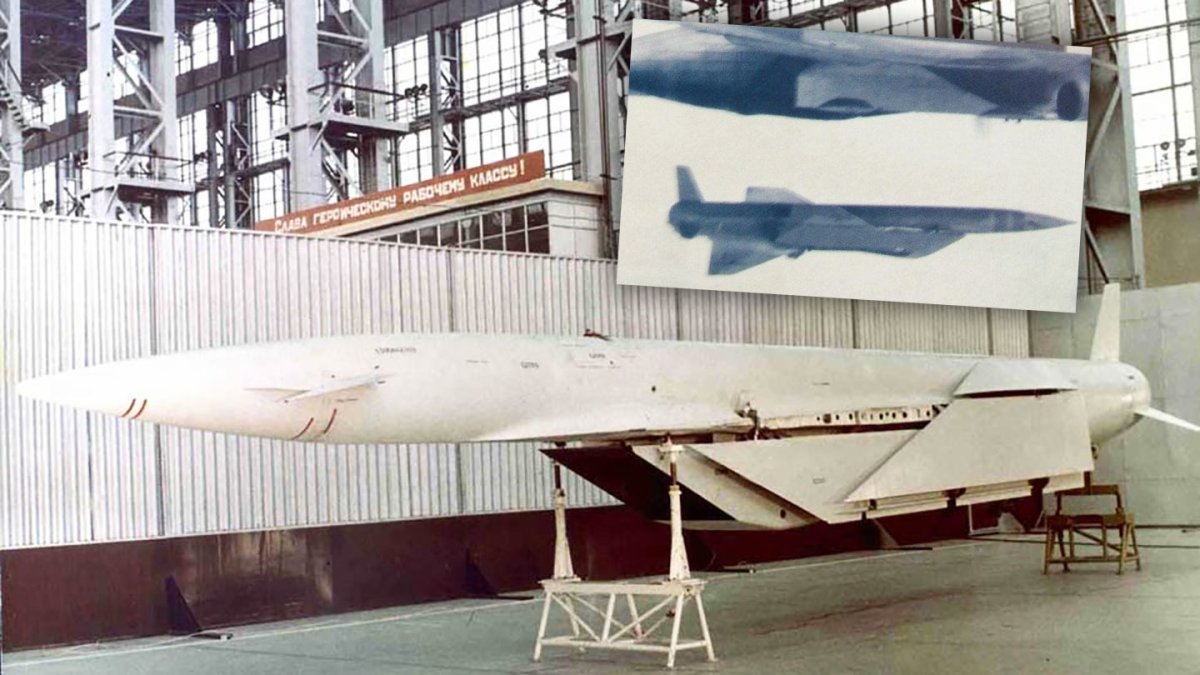
A prototype or full-scale mockup of the Meteorit at the Konstantin E. Tsiolkovsky State Museum of the History of Cosmonautics, Kaluga, seen bottom right in the second set of photos:
Instead of the proposed ‘universal’ cruise missiles, the Soviet military ended up with two different subsonic designs for the different land/sea/air applications.
Novator’s 3M10 Granat (SS-N-21 Sampson) missile was deployed on submarines, while the Raduga Kh-55 (AS-15 Kent) become the new air-launched cruise missile. A ground-launched version of the Granat, the RK-55 (SSC-X-4 Slingshot) was deployed only briefly before it fell victim to the Intermediate-Range Nuclear Forces (INF) Treaty signed in December 1987, which saw it outlawed.
A view of the transporter-erector-launcher (TEL) for the SSC-X-4 Slingshot ground-launched cruise missile system with a close-up view of the missile in the insert., U.S. Department of Defense
While the Meteorit program was ultimately a failure, the technology involved and the basic premise of a high-flying, high-speed strategic cruise missile has never really gone away, in Russia at least.
Attempts have apparently even been made to resurrect the Meteorit, including a low-cost version reportedly offered in 1998. A decade later, at the MAKS 2007 airshow, a mockup of the Meteorit made a surprise public appearance. At the time, the TASS news agency reported that undisclosed developments in electronics finally made the missile viable. Since then, mock-ups and models have made repeat appearances at MAKS and at other arms exhibitions while others have gone on public display in museums and industrial sites.
A desktop model of the Meteorit at MAKS in 2009., ALLOCER/WIKIMEDIA COMMONS
Industry officials in Russia have also periodically made reference to the program, shedding a little more light on it and the hopes that were pinned to it. Speaking to TASS in October 2020, former NPO Mashinostroyenia chief Yefremov noted that Russia’s current military-industrial complex compared less than favorably with that in Soviet times: “The unique Meteorite strategic cruise missile can hardly be put into production again,” he lamented. “The restoration of a very complex and expensive project even by the standards of Soviet times is impossible in modern conditions.” Certainly, the huge distance the missile was supposed to cover (when working properly) puts it firmly in a class of its own, even today.
Workers prepare to unload a full-scale replica of a Meteorit before putting it on public display., YOUTUBE SCREENCAP
A Meteorit-A on display at the Patriot Park theme park in Kubinka, outside of Moscow., Vitaly V. Kuzmin/Wikimedia Commons
While a production version of the Meteorit has so far remained unrealized, Russia has since returned to the concept of high-speed cruise missiles for more strategic missions, but now with hypersonic flight performance — generally regarded as anything over Mach 5. Russia is now widely considered one of the leading developers of weapons in this category, with the Kinzhal air-launched ballistic missile already in limited service. The Avangard , which mounts a hypersonic glide vehicle (HGV) atop a heavy ICBM employs a very different concept but is also now fielded. So, while the Meteorit may have proven a dead-end, the legacy of the high-performance strategic cruise missile remains alive and well in Russia today.
Contact the author: thomas@thedrive.com
Comments couldn’t be loaded. Please refresh the page.
更新于美国东部时间2021年11月9日凌晨2:17。
远程亚音速巡航导弹如今已成为多个国家战略武器库中常见的组成部分,无论从飞机、水面舰艇、潜艇还是地面移动发射装置发射。但在苏联,尤其是在苏联,曾发生过一场鲜为人知的巡航导弹与更具雄心壮志的重型超音速导弹之间的竞争。到20世纪80年代初,莫斯科正在推进两种截然不同的巡航导弹研发方案,尽管威力强大的“流星”导弹——计划将其研发成射程超过3000英里、射速可达3马赫的双弹头武器——最终还是以失败告终。
这种威力强大的武器的诞生源于苏联政府1976年12月的一项法令,该法令要求研发新型战略巡航导弹,使其能够适配空射、海基(水面舰艇和/或潜艇)和陆基三种发射方式。其最终目标是研制出能够与美国AGM-86空射巡航导弹(ALCM)和战斧巡航导弹抗衡的新型导弹。当时,AGM-86和战斧巡航导弹正迅速崛起,成为一种生存能力强、成本效益高、能够远距离精确投送核弹头的武器。
1983年,美国国防部拍摄的BGM-109“战斧”导弹从驱逐舰“梅里尔”号(DD-976)在太平洋导弹试验中心靶场发射后的空对空照片。
奉莫斯科之命,三个设计团队开始着手研发,其中“彩虹”设计局的方案与AGM-86最为接近,该方案采用了小型亚音速Kh-55巡航导弹。Kh-55的气动布局与美国导弹大致相同,采用直折叠翼和折叠尾翼。它由一台弹出式涡扇发动机提供动力,并配备了带有地形匹配功能的惯性导航系统(TERCOM)。
诺瓦托设计局提出了类似的解决方案,即3M10“石榴石”导弹。事实上,Kh-55和3M10非常相似,以至于多年来,西方媒体一直错误地认为它们是同一种基本武器的不同变型。
保存在文尼察乌克兰空军博物馆的拉杜加 Kh-55 巡航导弹。, George Chernilevsky/Wikimedia Commons
随后,机械制造科研生产联合体(NPO Mashinostroyeniya)提出了一个截然不同、更为先进的“通用”巡航导弹方案(即空军、海军和陆军均可使用的导弹),其代表作是3M25“流星”导弹。与竞争对手不同,这是一款巨型超音速导弹,其概念和外观更接近于苏联和美国在20世纪50年代探索的高速巡航导弹项目。这些项目的典型代表是陆基“布里亚”(Burya)导弹(详情请点击此处阅读)和“纳瓦霍”(Navaho)导弹,但这两个项目最终都被洲际弹道导弹(ICBM)所取代。不过,相关研究并未就此结束,“流星”导弹的概念研究可以追溯到20世纪60年代末。
“流星”导弹的设计射程约为 5,000 公里(3,100 英里),其大部分航线飞行高度可达 24,000 米(近 80,000 英尺),最大速度为 3 马赫,然后进行陡峭的末端俯冲攻击目标。
该导弹长约42英尺(约12米),是Kh-55巡航导弹长度的两倍多,采用三点折叠的截短三角翼,加上鸭式前翼、垂直尾翼和双水平尾翼。机身下方的进气口为冲压式发动机和涡轮喷气式助推器供气,而潜射型和陆基型还配备了两个液体燃料火箭助推器用于发射。含助推器的发射重量接近30000磅(约13.6吨),不含助推器的发射重量约为14000磅(约6.3吨)。制导系统采用惯性制导和终端制导(TERCOM)相结合的方式。
两张图片展示了“流星”导弹的机翼展开顺序。(YouTube截图)
防空技术的进步意味着必须采取特殊措施,以确保“流星”导弹能够毫发无损地抵达目标,而不能仅仅依靠速度和高度。该导弹配备了拖曳式诱饵,并且一直有未经证实的报道称,它还采用了某种“等离子隐身”技术,在电离空气层中巡航以掩盖其雷达信号。这可能与所谓的“马拉布”等离子隐身系统有关,不同的报道表明,该系统可能原本计划用于量产型“流星”导弹,或者以该导弹作为试验平台。
一张俄语剖面图,展示了流星-M(上)及其助推器部分,以及流星-A(下)。(图片来自推特)
这枚导弹的另一个独特之处在于其有效载荷。“流星”导弹原计划携带两枚9万吨级的核弹头,分别由两台独立的火箭发动机提供动力,在相距100公里(62英里)的范围内弹射,打击目标。虽然这种设计最初颇具吸引力,但1978年的《第二次战略武器限制谈判条约》(SALT II)禁止了双弹头设计,使这项创新成为历史。
一架展开双翼的陨石模型。(YouTube 截图)
为了契合其“通用”理念,流星导弹设想了三种不同的版本:空射流星-A、潜射流星-M 和陆基流星-N。
2020 年 9 月,苏联官方报纸《俄罗斯报》采访了前机械制造科研生产联合体总设计师赫伯特·叶夫列莫夫,他回忆说,苏联领导层曾设想“流星”导弹是用来对抗美国的“战斧”导弹(以及可能的空射巡航导弹),并指出“一枚‘流星’导弹的效能相当于几十枚‘战斧’导弹”。
前机械制造科研生产联合体总设计师赫伯特·叶夫列莫夫,俄罗斯政府
就西方情报部门而言,这种新型导弹首次暴露是在巴尔瑙尔导弹试验场被发现的,因此被临时命名为BL-10。1980年5月,该导弹进行了首次地面试射,但未能顺利脱离发射箱。总共四次试射均告失败。最终,在同年12月,该导弹成功飞行了约30英里(约48公里),远低于设计性能。
空射流星-A
“流星-A”导弹计划由老式“熊”式战略轰炸机的改进型——图-95MA——外挂携带,该机由早期系列的图-95MS导弹载机改装而来。该机机翼下挂架可挂载两枚导弹。虽然有模型显示其挂载四枚导弹,但尚不清楚这是否曾是认真的计划。在机翼下挂架挂载两枚“流星-A”导弹后,其内部弹舱还能容纳六枚Kh-15P核弹头压制导弹,其威力相当于美国的AGM-69 SRAM导弹。
图-95轰炸机模型,携带四枚“流星-A”导弹,而非通常的两枚。(YouTube截图)
首次空中发射是在1984年1月,但以失败告终,导弹在飞行61秒后自毁。1984年5月的另一次发射也以类似的失败告终,流星-A导弹项目于同年年底被取消。
图-95MA轰炸机试射“流星-A”导弹。导弹翼部分展开。(YouTube截图)
对西方观察家来说,“流星-A”导弹被称为 AS-X-19“考拉”,并且一度被认为将装备图-160“海盗旗”超音速轰炸机,因为该导弹的存在显然在1988年美国国防部长弗兰克·卡卢奇访问苏联期间,在他参观其中一架飞机时得到了证实。
潜艇发射的流星-M
由于“流星-M”导弹长度过长,改装现有949“奥斯卡”级SSGN的计划因过于复杂而被否决,因此最终选择了667型“扬基”级SSBN作为搭载该导弹的SSGN版本的基础。此外,还曾考虑过改装675型潜艇作为试验平台,但最终还是选择了667A型K-420型潜艇,作为唯一的667M型“扬基”级Sidecar潜艇,该型潜艇也计划装备“流星”导弹。
667M型潜艇拆除了潜射弹道导弹发射管,取而代之的是12个“流星-M”导弹发射筒,这些发射筒呈45度角倾斜安装。在此过程中,潜艇的长度增加了约66英尺,宽度增加了约10英尺。
潜艇改装工作始于1980年6月,并于1982年10月重新下水,随后进行了持续到1983年8月的海上试验。之后,官方测试一直持续到1983年11月,最初测试并未安装导弹。与此同时,在卡普斯京亚尔和黑海的试验台上进行了30多次导弹发射。
艺术家绘制的苏联“扬基”级核动力弹道导弹潜艇改装成SS-NX-24巡航导弹试验平台后的概念图,图片来自美国国家档案馆。
首次潜艇发射于1983年12月在巴伦支海进行。但该项目困难重重,其中一个原因是水下发射程序(此前几代苏联SSGN潜艇必须浮出水面才能发射导弹)。此外,制导系统和自卫设备也出现了其他问题。
“流星-M”导弹的正式联合测试直到1988年才开始,最初是在地面试验台上进行,后来才在667A型潜艇上进行。但这些发射中只有大约一半成功。因此,工业界和海军决定在1989年底放弃“流星-M”导弹的研发工作,并将仅装备鱼雷的667A型潜艇重新交付舰队。
“流星-M”导弹的西方代号为SS-NX-24“蝎子”。叶夫列莫夫表示,如果研发成功,到20世纪90年代初,这种导弹本可以安装在10到12艘667A型潜艇上。
美国国防情报局(DIA)出版的《苏联军事实力年鉴》中的一幅图表,展示了所谓的SS-NX-24及其陆基版本与其他巡航导弹的对比。(国家档案馆)
地面发射的流星-N
NPO Mashinostroyeniya导弹中最神秘的版本是“流星-N”型,据推测,该导弹计划从公路机动运输-起竖-发射车(TEL)上发射。据目前所知,从未公开过该TEL的任何图像,也没有证据表明该陆基导弹曾进行过测试。另一方面,美国情报部门显然了解这种武器或其研发计划,并据此将其命名为SSC-X-5。
流星-N火箭和潜射型流星-M火箭都需要这种巨大的下挂式助推器。(来自推特)
考虑到相关信息的匮乏,一些俄罗斯消息来源或许令人惊讶地指出,在三种型号中,“流星-N”导弹的研发进展最为成熟。塔斯社报道称:“几乎所有达到量产标准所需的测试都已完成。”
最终,共发射了37枚“流星”导弹,但据报道只有一枚达到了5000公里的设计射程。正如史蒂文·J·扎洛加在他的书中所说,该计划“彻底失败”。
克里姆林宫的核剑。
在第二组照片的右下角,可以看到位于卡卢加康斯坦丁·E·齐奥尔科夫斯基国家航天历史博物馆的“陨石”原型或全尺寸模型:
苏联军方最终没有采用提议的“通用”巡航导弹,而是针对不同的陆地/海洋/空中应用设计了两种不同的亚音速导弹。
诺瓦托公司的3M10“石榴石”(SS-N-21“桑普森”)导弹部署在潜艇上,而“彩虹”Kh-55(AS-15“肯特”)则成为新型空射巡航导弹。“石榴石”的陆基版本RK-55(SSC-X-4“弹弓”)仅短暂部署,便因1987年12月签署的《中导条约》而被禁用。
图为SSC-X-4“弹弓”陆基巡航导弹系统的运输-起竖-发射车(TEL),图中还包含导弹的特写照片。(美国国防部)
虽然“流星”导弹计划最终以失败告终,但其中涉及的技术和高空高速战略巡航导弹的基本理念,至少在俄罗斯从未真正消失。
显然,人们甚至曾尝试复活“流星”导弹,包括据报道在1998年推出的低成本版本。十年后,在2007年的莫斯科航展(MAKS 2007)上,“流星”导弹的模型意外亮相。当时,塔斯社报道称,电子技术的未公开进展最终使该导弹具备了可行性。此后,该导弹的模型多次出现在莫斯科航展和其他武器展览会上,还有一些模型在博物馆和工业场所公开展出。
2009年MAKS展会上展出的Meteorit桌面模型。(图片来源:ALLOCER/WIKIMEDIA COMMONS)
俄罗斯的工业界人士也曾多次提及该项目,进一步揭示了该项目及其所承载的希望。2020年10月,俄罗斯机械制造科研生产联合体(NPO Mashinostroyenia)前负责人叶夫列莫夫在接受塔斯社采访时指出,俄罗斯目前的军工联合体与苏联时期相比逊色不少:“独特的‘流星’战略巡航导弹几乎不可能再次投入生产,”他感叹道,“即使以苏联时期的标准来看,在当今条件下,恢复这样一个极其复杂且昂贵的项目也是不可能实现的。” 诚然,即使在今天,该导弹(在正常工作的情况下)所拥有的巨大射程也使其独树一帜。
工作人员准备卸载一块与实物大小相同的陨石复制品,之后将其公开展示。(YouTube 截图)
莫斯科郊外库宾卡爱国者公园主题公园展出的“流星-A”模型。(图片来源:Vitaly V. Kuzmin/Wikimedia Commons)
尽管“流星”导弹的量产型至今仍未实现,但俄罗斯此后重拾高速巡航导弹的概念,用于执行更具战略意义的任务,但如今的导弹具备高超音速飞行性能——通常指速度超过5马赫。俄罗斯目前被广泛认为是此类武器的主要研发国之一,“匕首”空射弹道导弹已投入有限使用。“先锋”导弹则采用了截然不同的设计理念,它将高超音速滑翔飞行器(HGV)搭载在重型洲际弹道导弹上,目前也已投入使用。因此,尽管“流星”导弹最终被证明是一条死路,但高性能战略巡航导弹的理念在当今俄罗斯依然蓬勃发展。
联系作者:thomas@thedrive.com
评论加载失败,请刷新页面。