This Ancient Suit Of Elephant Armor Holds The Record For The Largest Of Its Kind这套古代象甲保持着同类盔甲中最大的纪录。
Eclipsed in western pop culture by the war horse, elephants were devastating in combat and used for millennia as far west as the Mediterranean.
Updated Jan 20, 2018 7:26 PM EST
Cavalry is heavily celebrated and romanticized in western culture. From the knights of Europe, to the charging forces of 19th century America, to the war in Afghanistan , the fascination with the horse as a war animal continues to this day in popular culture. But farther to the east, the war elephant reigned supreme on the front lines in some of the greatest battles in ancient history.
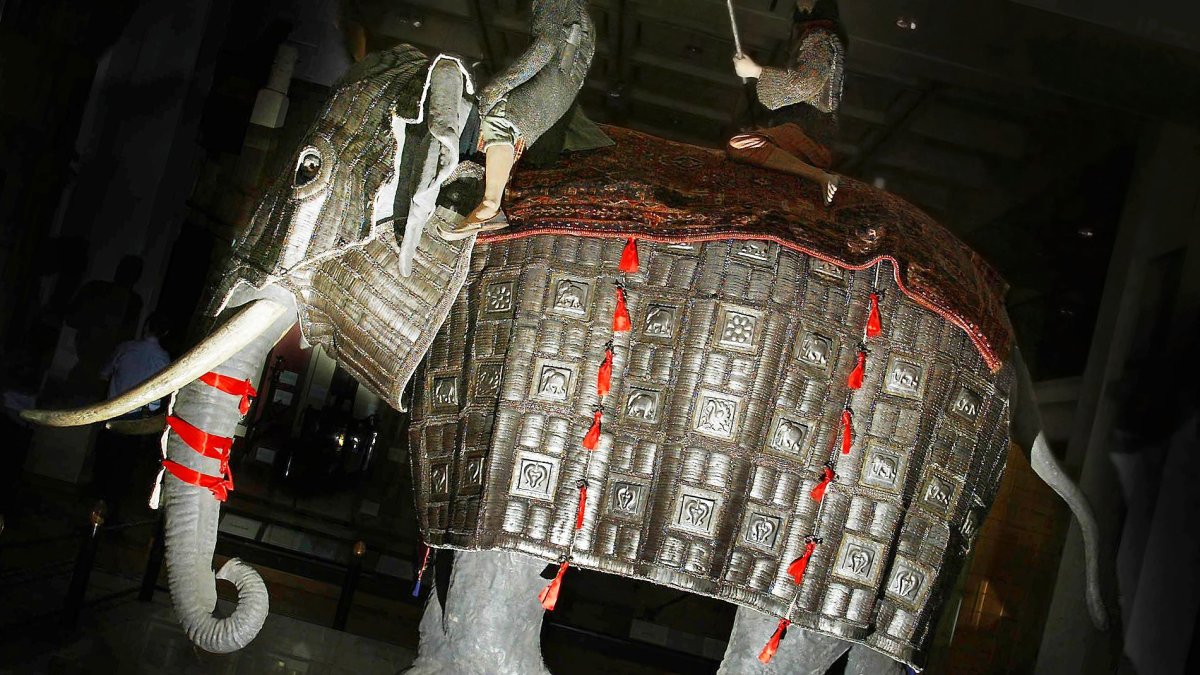
Something of the main battle tank of their day, these huge beasts were often sent charging towards the enemy’s lines, and unlike horses, spears and common blades had little impact on them when fighting at full tilt. To increase the survivability and improve the lethality of these creatures in combat, increasingly elaborate sets of armor were built for them, with the one above being the most extensive of its kind still surviving to this day.
The armor is displayed on a life-size elephant model in the Oriental Gallery at the Royal Armouries National Museum of Arms and Armour in Leeds. This specific set of armor was brought to Britain by the wife of the second lord of Clive, who was the governor of Madras in 1801. It was originally displayed Powis Castle before it was transferred to London Tower in 1949 for conservation. It was acquired by the Royal Armouries in 1962 in lieu of death duties .
Designed with charging in mind, the elephant’s head and much of its trunk is extensively covered by the metal armor. , Gilgamesh/wikicommons
The highly embellished metal suit, which includes elaborate depictions of various animals, was designed for an adult Asiatic Elephant in the 16th century. It emanates from Northern India during the Mughal Empire, and is made up of 5,840 individual plates weighing some 260 pounds. Part of the suit is missing, but complete it is estimated that it would be made up of a total of 8,439 metal plates, and would weigh over 350 pounds. Regardless, even in its current form it is the Guinness World Record holder for the largest suit of animal armor.
You can see the two missing panels from this angle, and how the elephant’s neck is fully covered. , Geni/Wikicommons
What’s not displayed, but also part of this armor set, are a pair of long, crescent shaped tusk swords (also called elephant swords) that would have been mounted on a war elephant’s partially sawn-off tusks. During a charge they would have slashed and pierced their way through whatever they came in contact with. Some armies coated these attachments with poison, making them even more lethal and instilling greater fear among the opposing army’s ranks.
Tusk swords were used for centuries but just a handful exist today. The left goes with the armor suit discussed above, the right is another example, likely from an earlier age. , Left: Royal Armouries. Right: TheMet
The use of war elephants dates back millennia. Their use is mentioned as far back as the 4th century BC, likely originating in India. From there the use of elephants as weapons propagated through the centuries and eventually ranged as far west as the Mediterranean. The tactical employment of elephants on the battlefield played a major role in the conquests of Alexander the Great, who was so fearful of their impact in combat that he eventually commandeered some and employed them in his own ranks.
Hundreds of years later, the Romans put war elephants to use en masse during their own campaigns, including the conquest of Greece. Even as the widespread use of elephants for warfare died off in Europe in the early middle ages, farther east they remained a staple in large standing armies. It wasn’t until the introduction of gunpowder that elephants finally began to fade from militaries in Asia, but this was a slow process. In fact, President Lincoln was offered elephants to use against the Confederates during the Civil War by the King of Siam, which was politely turned down .
What seems to be the last major use of elephants on the front lines was in Vietnam in 1885 during the Sino-French War where they were used as mobile firing platforms more than anything else. But long before then, cannon fire made the lumbering beasts increasingly vulnerable during combat, which led to their tactical utility being questioned. As early as the 1500s, elephants began to disappear from major battles in south central Asia.
Painting of an elephant in battle, made in Kota, Rajasthan, India circa 1750, Public Domain
Traditionally speaking, the war elephant was used to charge enemy lines or to counter an impending enemy charge. They could crash through seemingly impenetrable walls of infantry, breaking a gaping hole in the enemy’s formation, with the elephant slashing with its augmented tusks, stampeding over soldiers, and giving archers a near ideal platform to pick off fighters below.
Above all else, they were major psychological warfare elements that would instill terror and the feeling of dream and hopelessness in the enemy. Their thick hides and massive size made traditional edged weapons nearly useless against them. Their unfamiliar stench could send enemy cavalry running in fear as well. They could also work as mobile command and control platforms or even to dump soldiers right into an ongoing skirmish.
War elephants, equipped according to General d’Orgoni’s instructions. , De Agostini Picture Library
Countermeasures against elephants included targeting their tusks, as cutting them off could send them running mad. The use of special javelins, fire (including igniting screaming pigs covered in oil), and eventually specially built crossbow artillery that would send an iron bolt through their thick hide were also tactics employed over the centuries to stop elephant onslaughts. Still, many of these tactics were opportunistic in nature and adding armor to elephants could help harden them from some known vulnerabilities.
A major factor that kept war elephants around so long is that they could be turned into beasts of burden when not in combat, helping to construct fortifications, bridges, and other installations, or transporting materiel over long distances. Still, they will be remembered most for their crushing impact on the battlefield.
One can only imagine how terrifying it must have been for a soldier to face down such a huge and heavily armored animal on an ancient battlefield, many of which may not have ever seen an elephant before. Not to mention how terrifying the chaos of combat must have been for the elephants themselves, which are incredibly intelligent and social creatures.
Contact the author: Tyler@thedrive.com
Comments couldn’t be loaded. Please refresh the page.
更新于美国东部时间2018年1月20日晚上7:26。
在西方文化中,骑兵备受推崇,并被赋予了浪漫色彩。从欧洲的骑士,到19世纪美国冲锋陷阵的军队,再到阿富汗战争,人们对马匹作为战争动物的迷恋在当今流行文化中依然延续。然而,在更遥远的东方,战象在古代历史上一些最伟大的战役中,在前线占据了至高无上的地位。
这些巨兽堪称当时的主力战车,经常被派往敌军阵地发起冲锋。与战马不同,长矛和普通刀剑在它们全力作战时几乎无法对其造成伤害。为了提高这些巨兽的生存能力和战斗力,人们为它们打造了越来越精良的盔甲,其中上图所示的这套盔甲便是迄今为止保存最完好的同类盔甲。
这套盔甲陈列在利兹皇家军械博物馆东方展厅内一个与真人大小相同的象形模型上。这套盔甲由第二代克莱夫勋爵的妻子带到英国,克莱夫勋爵于1801年担任马德拉斯总督。盔甲最初在波伊斯城堡展出,后于1949年被移至伦敦塔进行修复。1962年,皇家军械博物馆以抵偿遗产税的方式获得了这套盔甲。
为了便于冲锋陷阵,这头大象的头部和大部分象鼻都被金属盔甲覆盖。(图片来源:吉尔伽美什/维基共享资源)
这套装饰华丽的金属盔甲,上面精雕细琢着各种动物的图案,是16世纪为一头成年亚洲象设计的。它出土于莫卧儿帝国时期的北印度,由5840块金属板组成,重约260磅。盔甲的部分部件已经遗失,但据估计,如果完整的话,它将由8439块金属板组成,重量超过350磅。即便如此,它仍然是吉尼斯世界纪录中最大的动物盔甲。
从这个角度可以看到缺失的两块面板,以及大象的脖子是如何被完全遮盖住的。(图片来源:Geni/Wikicommons)
这套盔甲中除了展示之外,还包括一对长长的、新月形的象牙剑(也称象剑),它们原本安装在战象部分锯断的象牙上。冲锋时,它们会劈砍、刺穿一切接触到的物体。有些军队会在这些配件上涂抹毒药,使其更具杀伤力,令敌军胆寒。
象牙剑曾使用数个世纪,但如今仅存极少数。左图所示为与上文所述盔甲配套的象牙剑,右图所示为另一件,可能来自更早的时期。左图:皇家军械库。右图:大都会艺术博物馆
使用战象的历史可以追溯到数千年前。早在公元前4世纪,就有关于战象使用的记载,其起源可能在印度。此后,战象作为武器的使用在几个世纪中不断传播,最终远至地中海沿岸。在亚历山大大帝的征服战争中,战象的战术运用发挥了重要作用。亚历山大大帝对战象在战场上的影响极为忌惮,最终征用了一些战象,并将其纳入自己的军队。
数百年后,罗马人在包括征服希腊在内的战役中大规模使用战象。尽管在中世纪早期,战象在欧洲的战争中逐渐式微,但在更东方的地区,战象仍然是庞大常备军的重要组成部分。直到火药的出现,战象才最终开始在亚洲军队中逐渐消失,但这并非一朝一夕之功。事实上,在南北战争期间,暹罗国王曾向林肯总统提出提供战象以对抗南方邦联,但被林肯婉言拒绝了。
大象最后一次大规模出现在前线似乎是在1885年的中法战争期间的越南,当时它们更多地被用作移动火力平台。但在此之前很久,炮火就使得这些笨重的野兽在战斗中越来越容易受到攻击,这也导致人们对它们的战术效用产生了质疑。早在16世纪,大象就开始从中亚南部的重大战役中消失。
一幅描绘战象的画作,约创作于1750年,印度拉贾斯坦邦科塔,公共领域
传统上,战象用于冲锋陷阵或抵御敌军的冲锋。它们能够冲破看似坚不可摧的步兵防线,在敌军阵型中撕开一个巨大的缺口,战象用其锋利的象牙劈砍,践踏士兵,并为弓箭手提供近乎完美的射击平台,以便射杀下方的敌人。
最重要的是,它们是重要的心理战力量,能够给敌人带来恐惧、绝望和无助。它们厚实的皮毛和庞大的体型使得传统的冷兵器几乎无法对付它们。它们散发出的异味也能让敌方骑兵闻风丧胆。此外,它们还可以作为移动指挥控制平台,甚至可以直接将士兵投入到正在进行的战斗中。
根据奥尔戈尼将军的指示装备的战象。(图片来自德阿戈斯蒂尼图片库)
对抗大象的措施包括攻击象牙,因为切断象牙会使它们发狂。几个世纪以来,人们还采用了其他战术来阻止大象的进攻,例如使用特制标枪、火(包括点燃涂满油的嘶鸣猪),以及最终研制出的特制弩炮,用铁箭射穿大象厚厚的皮毛。然而,这些战术大多带有机会主义色彩,而为大象加装盔甲则有助于增强它们抵御某些已知弱点的能力。
战象之所以能长期服役,一个重要原因是它们在非战斗状态下可以作为驮畜,帮助修建防御工事、桥梁和其他设施,或长途运输物资。然而,它们最令人难忘的还是其在战场上造成的巨大破坏力。
可以想象,对于一名士兵来说,在古代战场上面对如此庞大且身披重甲的动物该是多么恐怖,要知道,许多士兵可能从未见过大象。更不用说,对于极其聪明且具有社会性的动物——大象而言,混乱的战斗场面该是多么可怕。
联系作者:Tyler@thedrive.com
评论加载失败,请刷新页面。