Airbus announces missile-slinging drone for air defense空客公司宣布推出用于防空的导弹投掷无人机
The European aerospace giant hopes to get new mileage out of a training dummy drone design from the early 2000s.
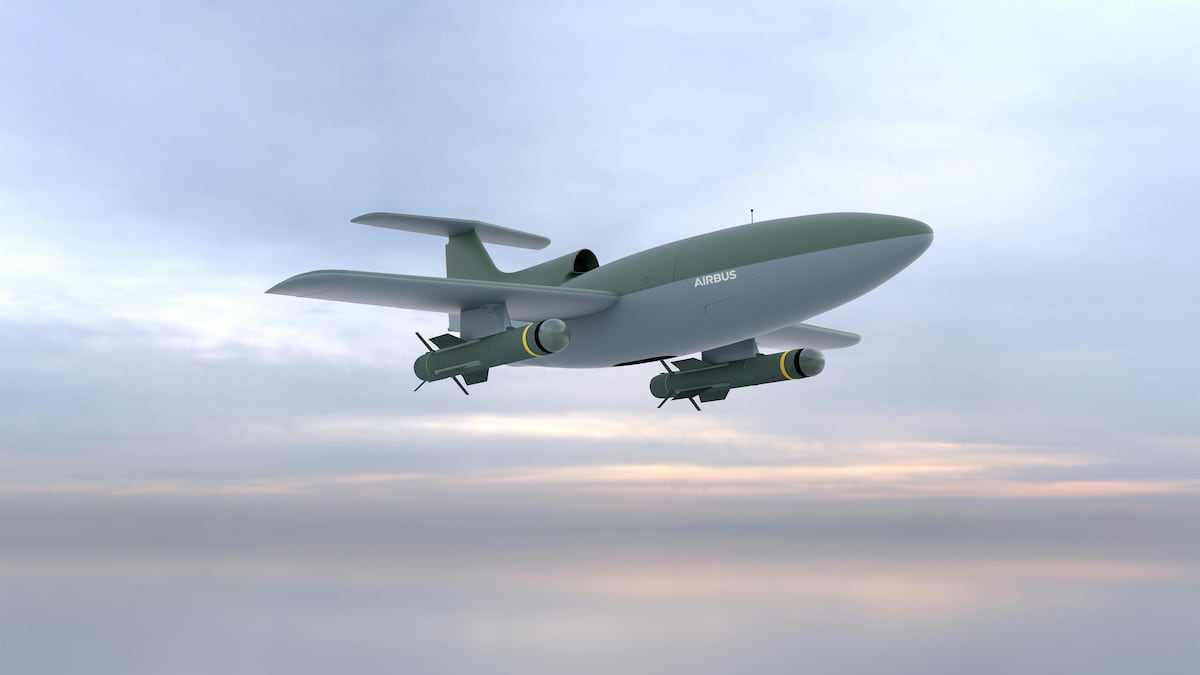
THE HAGUE, Netherlands — Airbus unveiled a European-made anti-drone drone concept with elements of autonomy this week, piggybacking on a training dummy design from 20 years ago.
With LOAD — short for Low-Cost Air Defence — the European aerospace giant seeks to address one of the main challenges in modern air defense: the massive cost of intercepting cheap threats.
Executives announced the drone design at an unmanned systems trade show in Bonn, Germany, on March 26. It will be based on a platform from the early 2000s, the Do-DT25, an unmanned aerial system used for target practice. Because of that use case, it was designed to be both cheap and disposable, according to the manufacturer.
The modified UAV will be able to carry three guided missiles. According to Airbus, its operational range will be 100 kilometers or about 160 miles, and it will be launched via catapult. After a successful mission, the drone is designed to return to base and land by parachute, ready to be reused. A prototype with two missiles will fly by the end of the year, the company said, with the final product ready two years from now, by 2027.
While no details have been provided for LOAD specifically, the Do-DT25 on which it is built is 3.1 meters long and has a 2.5-meter wingspan. Its top speed is 300 knots, and it can stay airborne for about an hour.
From Airbus’ promotional materials, it appears that LOAD will somewhat straddle the line between a loitering munition and air combat drone. The UAV will be “supervised from a ground control station,” the company’s press statement reads. It “coordinates the drones on the basis of radar data or air situation images and can therefore autonomously search for, detect and – following the approval of their engagement – combat enemy kamikaze drones.”
For years, experts have raised concerns over growing autonomy in defense and questioned whether provisions to keep a human in the loop when making kill decisions — as Airbus promised in this case — will hold up when push comes to shove.
The autonomous capability promised for LOAD likely builds on Airbus’s previous work with the Do-DT25 platform. In March 2023, the company demonstrated the autonomous guidance and control of several DT-25 drones from an A310 MRTT tanker aircraft, showcasing advances in precise relative navigation, in-flight communication and cooperative control algorithms.
As a further step, Airbus plans to integrate LOAD with other unmanned airborne platforms, such as the company’s Eurodrone project. According to the company, this would allow LOAD to operate in regions “not yet fully covered by ground-based air defense radars.”
In line with Europe’s push to decouple from a dependency on the United States, the new drone contains no U.S. technology, Airbus boasted in its press release. This means it will be ITAR-free, referring to the International Traffic in Arms Regulations imposed by Washington, leaving future export decisions solely to European user nations.
Linus Höller is Defense News' Europe correspondent and OSINT investigator. He reports on the arms deals, sanctions, and geopolitics shaping Europe and the world. He holds master’s degrees in WMD nonproliferation, terrorism studies, and international relations, and works in four languages: English, German, Russian, and Spanish.
荷兰海牙——本周,空中客车公司推出了一款欧洲制造的反无人机概念机,该概念机具备自主飞行能力,其设计借鉴了 20 年前的一款训练假人。
欧洲航空航天巨头 LOAD(低成本防空系统的缩写)旨在解决现代防空领域面临的主要挑战之一:拦截廉价威胁的巨大成本。
3月26日,在德国波恩举行的无人系统展上,高管们公布了这款无人机的设计方案。该无人机将基于2000年代初期的Do-DT25平台,Do-DT25是一款用于靶场训练的无人机系统。据制造商称,正是由于这种用途,该无人机的设计理念是既经济又可一次性使用。
这款改进型无人机将能够携带三枚制导导弹。据空客公司称,其作战半径为100公里(约160英里),并将通过弹射器发射。任务成功后,该无人机将自动返回基地并降落伞着陆,以便重复使用。该公司表示,一架携带两枚导弹的原型机将于今年年底前进行试飞,最终产品将于两年后,即2027年问世。
虽然尚未公布LOAD的具体细节,但其所基于的Do-DT25飞机长3.1米,翼展2.5米,最高速度为300节,续航时间约为1小时。
从空客的宣传资料来看,LOAD无人机似乎介于巡飞弹和空战无人机之间。该公司的新闻稿称,该无人机将“由地面控制站进行监控”。它“根据雷达数据或空中态势图像协调无人机,因此能够自主搜索、探测,并在获得交战许可后打击敌方自杀式无人机。”
多年来,专家们一直对国防领域日益增长的自主性表示担忧,并质疑在做出击落决定时,让人类参与决策的条款(正如空客公司在本案中承诺的那样)在关键时刻是否能够得到落实。
LOAD所承诺的自主飞行能力很可能建立在空客此前在Do-DT25平台上的研究成果之上。2023年3月,该公司演示了从A310 MRTT加油机上自主引导和控制多架DT-25无人机,展示了其在精确相对导航、飞行中通信和协同控制算法方面的最新进展。
作为进一步举措,空客计划将LOAD与其他无人机平台整合,例如该公司的Eurodrone项目。据该公司称,这将使LOAD能够在“尚未被地面防空雷达完全覆盖”的地区运行。
为了响应欧洲摆脱对美国依赖的号召,空客在新闻稿中宣称,这款新型无人机不含任何美国技术。这意味着它将不受《国际武器贸易条例》(ITAR)的约束,未来的出口决定权完全掌握在欧洲用户国家手中。
林努斯·霍勒是《防务新闻》的欧洲记者和开源情报调查员。他报道影响欧洲乃至全球的军火交易、制裁和地缘政治。他拥有大规模杀伤性武器不扩散、恐怖主义研究和国际关系三个硕士学位,并精通英语、德语、俄语和西班牙语四种语言。