Top US general in Korea talks maps, China, and getting Patriots back驻韩美军最高将领谈地图、中国以及如何收复爱国者导弹系统
“It begins with looking from an enemy’s perspective and then seeing where you are and how you might array your capabilities,” Gen. Xavier Brunson said.
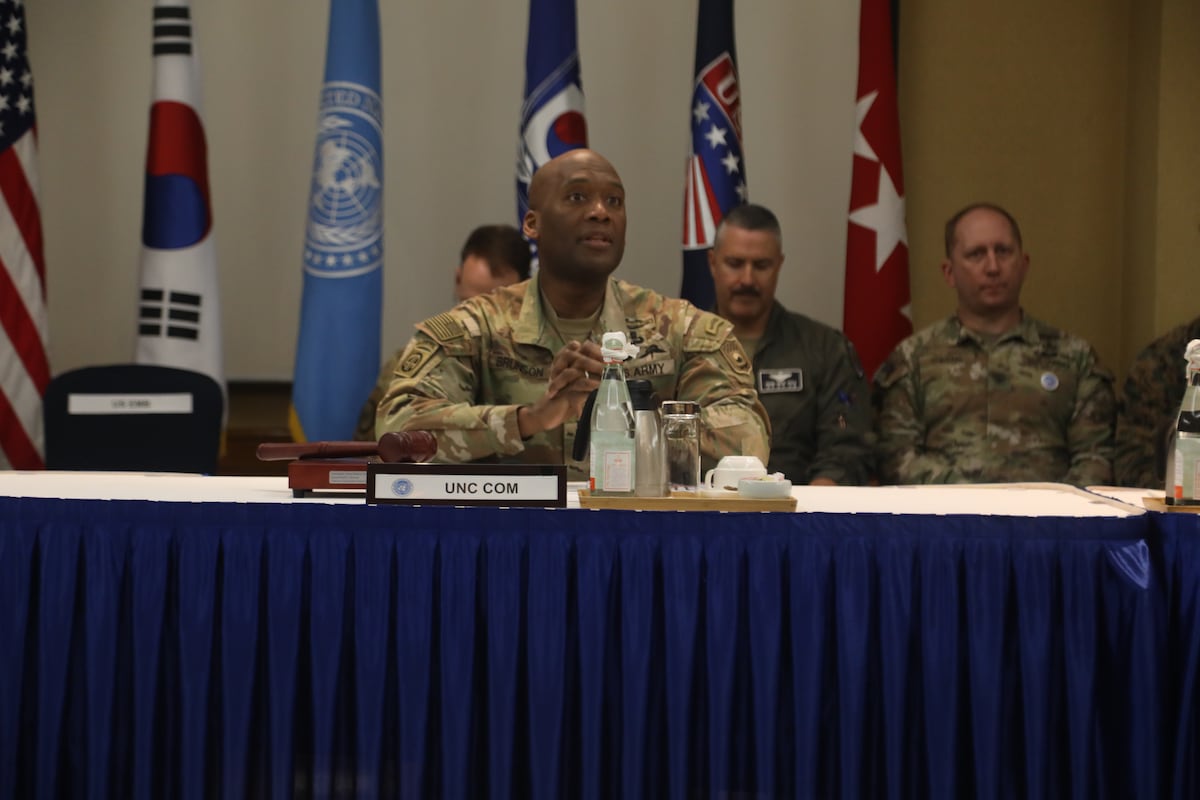
Sitting at a desk in a remote Pentagon office, last Wednesday, Gen. Xavier Brunson has two maps displayed beside him.
One hung on the wall shows the entire world, displayed in a wide rectangle. Another, printed on a paper sheet in front of him, depicts Seoul and its distance from other nearby capitals: Tokyo, Taipei, Manila and Beijing, among others. Rather than showing the usual north-to-south view of Asia, this one displays what the region would look like if peering out from China’s eastern coast.
Brunson has been sharing this second map in his many meetings in Washington, while arguing for the value of his command — overseeing the 28,500 U.S. troops in Korea. Seoul has one of Asia’s strongest militaries and sits inside the vital “first island chain” of countries that arc off China’s coast like a parenthesis.
“It begins with looking from an enemy’s perspective and then seeing where you are and how you might array your capabilities,” Brunson said.
But South Korea also has one of the world’s most alarming neighbors. In the last year, North Korea has traded troops and ammunition in exchange for Russian technology — on missiles, satellites, submarines, drones and most alarmingly a rogue nuclear program. Last year, North Korea conducted 47 ballistic missile tests, a number Brunson now expects to go down with Russia’s aid.
All this makes Brunson’s job — or jobs — harder. Alongside U.S. forces on the peninsula, he would also lead South Korean troops in the case of a war, an arrangement known as Combined Forces Command, or CFC. He also helms United Nations Command, the group of 18 countries that have helped keep the peace on the Korean Peninsula since 1950.
Brunson sat down with Defense News on May 7 to discuss the 75th anniversary of UN Command, the future of U.S. forces in Korea and the assumptions he’s trying to upend with the help of his maps.
This interview has been edited for brevity.
North Korea has changed its policies — more emphasis on sovereignty, a new view of the southern border. How does UN Command need to change as well?
The North Koreans have changed fundamentally. The associations amongst the adversaries — those authoritarian colluders, if you will — in China and Russia and the [Democratic People’s Republic of Korea], those relationships have changed and matured.
We have to do the same thing. What’s really in the offing is that year 76 forward is going to be different for UN Command. The mandate remains, but our composition, our posture even may change in the future. And we’ve got to be flexible enough to do that.
Do you expect big changes to posture or membership, potentially the addition of new member states?
I won’t mention these nations because those are bilateral things that are going on with the Republic of Korea, but there are nations that want to participate. We just recently got a New Zealand contingent that’s come to the peninsula. And if you talk about things that excite me, it’s when I talk to those ambassadors and they look at me and they say: ‘Hey, we’re working to get our soldiers here.’
I wanted to ask about one of the other hats that you wear, which is the CFC. Has the timeline for handing over operational control of South Korean forces moved up?
I’ve heard some mention of the urgency of that. My piece is to continue to talk to leadership about where we stand. We’re continually trying to assess where we are along the bilaterally agreed upon conditions-based [operational control] transfer.
If that decision is made, then my job is to now develop the strategy that lets us keep that policy moving forward. When leadership has made a decision, it’s my job to make it work.
To be clear, there’s no decision that has been made yet, though?
None that I know of.
There were a few Patriot air defense batteries that were brought away from the peninsula to help with the campaign in the Middle East. Now we’ve reached a ceasefire in Yemen, do you know when those are coming back?
No, I don’t know when exactly those capabilities are going to come back. But I do know that the [Indo-Pacific Command] commander has been able to ensure that we had other capabilities for an extended period of time within the Republic Korea. This is not the first time that capabilities have left the peninsula. In rough order, between 50 and 60 times, capabilities have gone to other places to support [military needs] around the globe.
My job is to ensure that we’re able to meet the strictures of the Mutual Defense Treaty. I can say unequivocally, we can do everything that we’re supposed to do. I just want the stuff back because those are my people.
The increasing adversary that people in this building are concerned about is China. How are you working with South Korea to reorient around that threat?
Nations are going to make decisions that align with their own interests — always.
There are economic relationships in the Indo-Pacific. There are security relationships in the Indo-Pacific. What I find is that our ability to see, sense, and understand in and around the peninsula is coming closer in alignment.
For example, in the West Sea right now, there are structures being erected by the Chinese. The Koreans see that. There are encroachments in and around the northern limit line by Chinese fishing vessels and Chinese naval vessels that cause concern to the Koreans.
They understand that those are threats that may have to be dealt with at some point in time.
South Korea has an election in June after the last president was impeached for declaring martial law. Regardless of who wins, do you think the recent work with Japan, South Korea and the U.S. will last?
I think it will survive because the threat will continue to metastasize. If there’s a thing that our adversaries have learned over time is the power of alliances, the power of proxies.
You can look in the Middle East and see a proxy fight that’s going on. You can look in our region now, and we’ve got North Korea sending troops and materiel to Russia to participate in the conflict, not their own. We see China is still a benefactor for North Korea.
The new leader in the Republic of Korea from 4 June forward has to take on the fact that his nation sits at the juncture of an alliance of sorts that he’s got to counter.
How many North Korean troops are now in Russia?
I think 10 to 12 [thousand] is where we throw our estimates at.
This alignment gives North Korea different options than they’ve had previously facing sanctions. How do you continue to counter that?
It’s capability on capability. What can our adversaries do? What do we need to be able to do?
That really leads me to a sort of integrated assurance. It’s using all the elements of power, of national power to assure our friends, partners and allies of our commitment to the alliance.
What we have that’s unique in South Korea is we have diplomacy, and we’ve got the military there, partnered for the past 70 years.
We have the means to continue to assure our ally that we are there. That also sounds the bell every day that we’re on the peninsula to Russia and China. We’re in the neighborhood.
Noah Robertson is the Pentagon reporter at Defense News. He previously covered national security for the Christian Science Monitor. He holds a bachelor’s degree in English and government from the College of William & Mary in his hometown of Williamsburg, Virginia.
上周三,泽维尔·布伦森将军坐在五角大楼一间偏僻办公室的办公桌前,旁边摆放着两张地图。
墙上挂着一幅画,用宽阔的矩形框出了整个世界。他面前的一张纸上印着另一幅画,描绘了首尔及其与附近其他首都的距离,包括东京、台北、马尼拉和北京等等。这幅画并没有展现通常的亚洲南北视角,而是从中国东部沿海地区向外望去,展现了亚洲的景象。
布伦森在华盛顿的多次会议上都展示了这张地图,并以此论证他所指挥的部队——驻韩美军28500人——的重要性。首尔拥有亚洲最强大的军队之一,并且位于至关重要的“第一岛链”内,这条岛链像括号一样环绕着中国海岸线。
布伦森说:“首先要从敌人的角度看待问题,然后看看你身处何处,以及如何部署你的能力。”
但韩国也拥有世界上最令人担忧的邻国之一。去年,朝鲜以兵力和弹药换取俄罗斯的技术——包括导弹、卫星、潜艇、无人机,以及最令人震惊的朝鲜核计划。去年,朝鲜进行了47次弹道导弹试验,布伦森预计,在俄罗斯的援助下,这一数字将会下降。
这一切都让布伦森的工作——或者说他的多项工作——变得更加艰难。除了驻扎在朝鲜半岛的美军之外,一旦发生战争,他还将指挥韩国军队,这种安排被称为联合部队司令部(CFC)。此外,他还领导着联合国军司令部,这个由18个国家组成的机构自1950年以来一直致力于维护朝鲜半岛的和平。
5月7日,布伦森接受了《防务新闻》的采访,讨论了联合国军成立75周年、美国在韩国的未来以及他试图借助地图颠覆的一些假设。
为了简洁起见,本次采访内容经过编辑。
朝鲜的政策发生了变化——更加强调主权,对南部边界的看法也发生了改变。联合国军司令部是否也需要做出相应的改变?
朝鲜人已经发生了根本性的变化。敌对双方——或者说那些威权主义的勾结者——在中国、俄罗斯和朝鲜民主主义人民共和国之间的关系也发生了变化,变得更加成熟。
我们也必须这样做。实际上,从第76年开始,联合国军司令部将会发生很大的变化。授权任务不变,但我们的组成,甚至我们的部署方式,未来都可能改变。我们必须足够灵活,才能应对这些变化。
你预计在立场或成员构成方面会发生重大变化吗?例如,是否会增加新的成员国?
我不会提及这些国家,因为这些都是与韩国进行的双边合作,但确实有一些国家希望参与。我们最近就迎来了新西兰的一支部队来到朝鲜半岛。要说让我兴奋的事情,那就是当我与这些大使交谈时,他们看着我说:“嘿,我们正在努力让我们的士兵来这里。”
我想问一下您担任的另一个职务,即联合部队司令(CFC)。韩国军队作战指挥权的移交时间表是否有所提前?
我听说此事十分紧迫。我的建议是继续与领导层沟通,了解我们目前的处境。我们一直在努力评估我们在双边商定的基于条件的[运营控制权]移交过程中所处的阶段。
如果这项决定做出,那么我的任务就是制定策略,确保这项政策得以顺利推进。领导层做出决定后,我的职责就是让它有效实施。
需要明确的是,目前还没有做出任何决定。
据我所知没有。
有一些“爱国者”防空导弹系统从伊比利亚半岛调往中东支援作战。现在也门已经停火,你知道这些系统什么时候会撤回吗?
不,我不知道这些能力何时才能恢复。但我知道印太司令部司令已经确保我们在韩国境内拥有其他能力,并且这种能力可以维持相当长一段时间。这并非首次将军事能力撤离朝鲜半岛。粗略估计,为了支持全球各地的军事需求,类似的军事能力撤离事件已发生过50到60次。
我的职责是确保我们能够遵守《共同防御条约》的各项规定。我可以毫不含糊地说,我们能够做到我们应该做的一切。我只是想要回那些东西,因为那些是我的人民。
这座大楼里的人越来越担心来自中国的威胁。你们如何与韩国合作,调整战略以应对这一威胁?
各国总是会做出符合自身利益的决定。
印太地区存在经济关系,也存在安全关系。我发现,我们对半岛及其周边地区的观察、感知和理解能力正日益趋于一致。
例如,目前中国正在西海建造一些设施,韩国方面注意到了这一点。中国渔船和海军舰艇在北部边界线附近活动,也引起了韩国方面的担忧。
他们明白,这些威胁迟早都需要应对。
韩国将于六月举行大选,此前总统因宣布戒严令而被弹劾。无论谁当选,您认为近期韩国与日本、韩国和美国之间的合作能够持续下去吗?
我认为它会继续存在下去,因为威胁会不断扩散。我们的对手随着时间的推移学到的最重要的一点就是联盟的力量,代理人的力量。
看看中东,你会发现一场代理人战争正在进行。再看看我们所在的地区,朝鲜向俄罗斯派遣军队和物资参与冲突,而不是自己作战。我们看到中国仍然是朝鲜的援助者。
从6月4日起,韩国新领导人必须面对这样一个事实:他的国家正处于某种联盟的十字路口,他必须应对这一联盟带来的挑战。
目前有多少朝鲜军队驻扎在俄罗斯?
我认为我们的估计范围在 1 万到 1.2 万之间。
这种联盟为朝鲜提供了与以往面临制裁时不同的选择。您将如何继续应对这种情况?
这是能力上的较量。我们的对手能做什么?我们需要具备哪些能力?
这让我想到一种综合保障。它指的是运用所有力量要素,包括国家力量,来向我们的朋友、伙伴和盟友保证我们对联盟的承诺。
韩国的独特之处在于,我们拥有外交关系,而且在过去的70年里,我们一直与军队保持合作关系。
我们有能力继续向我们的盟友保证我们的存在。这也能每天向俄罗斯和中国发出警示,表明我们身处伊比利亚半岛。我们就在他们的附近。
诺亚·罗伯逊是《防务新闻》的五角大楼记者。他此前曾为《基督教科学箴言报》报道国家安全新闻。他拥有弗吉尼亚州威廉斯堡威廉与玛丽学院的英语和政治学学士学位。