SMRT completes inspection of tunnel doors after metal layer fell on track in 2025 incidentSMRT在2025年事故中金属层掉落轨道后,已完成隧道门的检查。
SMRT inspected and reinforced tunnel cross-passage doors after a metal cladding fell onto the track, highlighting maintenance gaps and safety improvements. Read more at straitstimes.com.
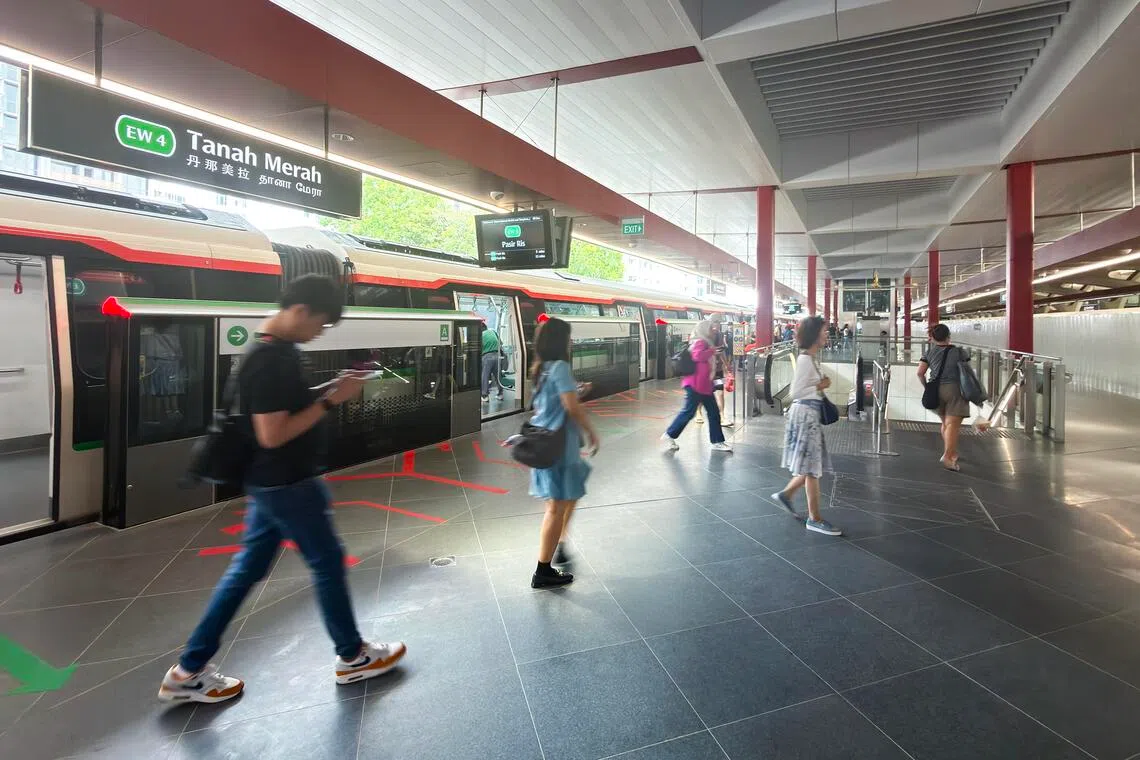
A metal cladding detached from a tunnel door between Expo and Changi Airport stations on the East-West Line in Sept 2025. (ST PHOTO: LIM YAOHUI)
Published Sep 03, 2026, 08:47 PM
Updated Sep 03, 2026, 08:47 PM
SMRT inspected all cross-passage tunnel doors after metal cladding fell onto tracks between Expo and Changi Airport stations in Sept 2025, reinforcing doors with structural issues and planning renewals with LTA.
The incident was caused by an open door with damaged locking parts and poorly secured metal cladding that failed to meet wind load requirements, unknown to SMRT at the time.
SMRT improved defect recording and inspection processes post-incident, and is also exploring better detection of thin objects on tracks to enhance safety.
SINGAPORE – Rail operator SMRT has inspected all cross-passage doors in tunnels – meant to prevent the spread of fire and smoke from one track tunnel to another – and reinforced the outer layers of doors with structural issues.
It conducted the checks after an incident on Sept 10, 2025 when a metal layer came loose from a tunnel door between Expo and Changi Airport stations on the East-West Line, and fell on the left side of the rail track.
An investigation report on the incident was published on Aug 21 by the Transport Safety Investigation Bureau (TSIB) , which falls under the Transport Ministry.
SMRT told The Straits Times it is working with the Land Transport Authority (LTA) to carry out renewal works for these doors, particularly those on the older North-South, East-West and Circle Lines.
The TSIB report said thin and flat objects like the metal cladding can pose a hazard to train operations and even lead to a train derailment.
No one was injured in the incident, which took place from 5.57pm on Sept 10, 2025 , when the captain of a train travelling from Expo to Changi Airport stations reported that he heard a thumping sound.
Later, the train captain of an eastbound train and the station manager of Expo station – who was onboard to investigate the sound – checked the tracks.
At 6.13pm , the station manager sent a photo of the object to the control centre.
Photo of the object taken by the station manager of Expo station. Transport Safety Investigation Bureau (TSIB)
Photo of the object taken by the station manager of Expo station.
Transport Safety Investigation Bureau (TSIB)
The station manager of Tanah Merah station then boarded the next train bound for Changi Airport station to check the tracks. At about 6.26pm , he informed the control centre that there was a metal object on one of the running rails and that it was not safe for the train to proceed.
Photo of the object taken by the station manager of Tanah Merah station. Transport Safety Investigation Bureau (TSIB)
Photo of the object taken by the station manager of Tanah Merah station.
The control centre closed the track between Expo and Changi Airport stations at 6.30pm before routing the train back to Expo station and getting passengers to alight from the train.
The object was later removed.
Train run-over marks on the metal cladding retrieved from the track. Transport Safety Investigation Bureau (TSIB)
Train run-over marks on the metal cladding retrieved from the track.
The investigation found that the affected door was open when the metal cladding got detached, although cross-passage doors must be closed during normal train operations.
While the bureau was unable to pin down the reason for the door opening, it surmised that either the strike plate – a part of the door frame that the latch engages to lock the door – was damaged, or that the lockset of the affected door was loose.
Metal cladding not secured properly
The bureau found that SMRT did not know about the wind load requirements for the doors, which were set by rail asset owner LTA.
The 15 cross-passage doors along the Changi Airport branch on the East-West Line connecting Tanah Merah, Expo, and Changi Airport were installed in 2001 .
According to LTA, these doors have to withstand a differential pressure of +/-2,000Pa due to the piston effect which causes air to flow in a confined space when a train approaches a door. Pa is a measure of air pressure.
The affected door from which the metal cladding fell off was replaced by SMRT in 2016 . However, the rail operator was unaware of the wind load requirements and believed it was a “straightforward one-to-one replacement” of the door with no modification involved.
LTA said the document containing design specifications for cross-passage doors was made available online since 2010, and that it was the rail operators’ responsibility to see the document. But LTA added that it was unable to locate records informing rail operators of the document.
The bureau, in its report, said rail operators were not obligated to access and review materials uploaded online, unless specifically required to do so by LTA.
It also felt that it may not be a “reasonable expectation” for rail operators to request documents from LTA even if they were not published online.
This is because LTA should “clearly communicate” its requirements and expectations to rail operators, instead of assuming that they will proactively request for documents that they may not know about.
As for the affected door, the metallic frame structure and paper honeycomb filling were glued between two metallic claddings or outer layers. The bureau found no evidence that the claddings were secured via mechanical fasteners or welding.
The investigation team doubted that metal-to-metal glueing would provide the structural strength needed to withstand the wind loads experienced by such doors. It was likely that the glue bonding the cladding to the door frame had deteriorated.
Damaged strike plate. Transport Safety Investigation Bureau (TSIB)
Damaged strike plate.
The strike plate was also damaged, possibly because its mounting screws were inserted wrongly and of the incorrect length. The incorrect type of screws were also used.
SMRT carried out inspections on these doors every six months, but did not check for the splitting or peeling of metal cladding.
It also only recorded defects that could not be rectified during the inspection, while those fixed during the inspection were not reported.
A strike plate is a metal piece on a door frame that secures the door latch or bolt.
As a result, there was no way to determine whether the screws securing the affected door’s lockset or strike plate had ever been replaced or removed, after the new door was installed in 2016.
The bureau concluded that opportunities to identify recurrent issues across these doors were missed, even though they might have prompted closer monitoring or troubleshooting.
The last two inspections of these doors on Jan 27 and July 24, 2025 did not record any defect on the affected door.
Limitations of track detection system
While there is a track circuit detection system in place to detect metallic foreign objects that lie across both left and right running rails, the metal cladding in this incident rested only on the left running rail. As such, it did not generate an alarm to alert the control centre.
The front of each train is also equipped with an obstacle deflector about 105mm above the running rails, to activate the train’s emergency braking system when a sufficiently large foreign object is detected.
In this incident, the door cladding was flat and only 1mm thick, and could not trigger the train’s emergency braking system.
Hence, it remained undetected when five trains drove past, before the train captain heard the thumping sound at 5.57pm.
The bureau said the early detection of such foreign objects could reduce operational safety risks while preventing minor incidents from escalating into serious accidents.
It added that it would be “desirable” for technologies to be used to allow the identification of such objects on tracks, to which SMRT responded that it is exploring ways to detect thin flat objects on tracks such as mounting suitable sensors on trains.
After the incident, SMRT mandated the recording of all defects identified during inspections – whether or not they are resolved on-site.
It also made sure to carry out monthly sampling checks on the maintenance records for these doors to ensure proper compliance.
LTA also sent an e-mail to rail operators on July 20, 2026 , to inform them that specifications of critical infrastructure – including cross-passage doors – are available online and provided a link to access them.
Responding to The Straits Times’ queries, Lam Sheau Kai, president of SMRT trains, said: “We acknowledge the findings of the TSIB investigation report and take this matter seriously.”
Noting that cross-passage doors undergo regular maintenance and inspections, he said this is the first occurrence of such an incident.
Lam added that following the incident, SMRT has enhanced its inspection regime to include checks on door claddings and worked with LTA to include wind-load specifications into the door replacement criteria.
TSIB is the air, marine and rail accidents and incidents investigation authority in Singapore. It aims to promote transport safety by carrying out independent investigations into air, marine and rail accidents and incidents. The safety investigations do not seek to apportion blame or liability.
Esther Loi is a journalist at The Straits Times, where she covers transport issues.
2025年9月,东西线博览站和樟宜机场站之间的隧道门上的金属覆层脱落。(海峡时报照片:林耀辉)
发布于 2026 年 9 月 3 日晚上 8:47
更新于2026年9月3日晚上8:47
2025 年 9 月,博览站和樟宜机场站之间的金属覆层掉落到轨道上后,SMRT 检查了所有横通道隧道门,加固了存在结构问题的门,并与陆路交通管理局 (LTA) 协商了更新计划。
事故原因是由于一扇敞开的门,其锁具损坏,金属包层固定不牢,未能满足风荷载要求,而SMRT当时对此并不知情。
事故发生后,SMRT改进了缺陷记录和检查流程,并且正在探索更好地检测轨道上的薄物体,以提高安全性。
新加坡——地铁运营商SMRT已检查了隧道内所有横向通道门(旨在防止火灾和烟雾从一个轨道隧道蔓延到另一个轨道隧道),并加固了存在结构问题的门的外部层。
2025 年 9 月 10 日,东西线博览站和樟宜机场站之间的隧道门上的金属层脱落,掉落在铁轨左侧,之后该公司进行了检查。
交通运输部下属的交通安全调查局(TSIB)于 8 月 21 日发布了关于这起事件的调查报告。
SMRT 告诉《海峡时报》,他们正与陆路交通管理局 (LTA) 合作,对这些车门进行翻新工程,特别是那些位于较老的南北线、东西线和环线上的车门。
TSIB 的报告指出,像金属外壳这样的薄而扁平的物体可能会对列车运行构成危险,甚至导致列车脱轨。
事件中无人受伤。事件发生在 2025 年 9 月 10 日下午 5 点 57 分,当时一列从博览站开往樟宜机场站的列车长报告说,他听到一声砰砰的响声。
后来,一列开往东方的列车的列车长和世博站的站长(当时他正在车上调查声音)检查了铁轨。
下午 6 点 13 分,站长向控制中心发送了该物体的照片。
博览站站长拍摄的物体照片。运输安全调查局(TSIB)
这是世博会车站站长拍摄的该物体的照片。
运输安全调查局(TSIB)
丹那美拉车站站长随后登上下一班开往樟宜机场站的列车,检查轨道情况。大约下午6点26分,他向控制中心报告说,其中一条运行轨道上有金属物体,列车继续行驶不安全。
丹那美拉火车站站长拍摄的物体照片。交通安全调查局(TSIB)
这是丹那美拉车站站长拍摄的物体照片。
下午 6 点 30 分,控制中心关闭了世博站和樟宜机场站之间的轨道,然后让列车返回世博站,并让乘客下车。
该物体后来被移除。
从铁轨上回收的金属护板上留有列车碾压痕迹。运输安全调查局(TSIB)
从铁轨上回收的金属护板上留有火车碾压痕迹。
调查发现,金属外壳脱落时,受影响的门是打开的,而正常列车运行期间,横向通道门必须关闭。
虽然该局无法确定门打开的原因,但它推测可能是门锁扣板(门框的一部分,门闩与该扣板啮合以锁定门)损坏,或者受影响门的锁具松动了。
金属覆层未正确固定
该局发现,SMRT公司并不知道铁路资产所有者陆路交通管理局(LTA)设定的车门风荷载要求。
2001 年,连接丹那美拉站、博览站和樟宜机场的樟宜机场线东西线安装了 15 个横向通道门。
根据陆路交通管理局(LTA)的说法,由于列车接近车门时,活塞效应会导致密闭空间内的空气流动,这些车门必须能够承受±2000帕的压差。帕是气压的计量单位。
2016年,SMRT更换了金属包层脱落的受损车门。然而,这家铁路运营商当时并不了解风荷载要求,认为这只是一个“简单的一对一更换”车门,无需任何改造。
陆路交通管理局表示,包含横向通道门设计规范的文件自2010年起就已在网上公开,铁路运营商有责任查阅该文件。但陆路交通管理局补充说,他们未能找到任何告知铁路运营商该文件的记录。
该局在报告中表示,除非陆路交通管理局 (LTA) 特别要求,否则铁路运营商没有义务访问和审查上传到网上的资料。
它还认为,即使文件没有在网上公布,铁路运营商向陆路交通管理局索取文件可能也不是“合理的期望”。
这是因为陆路交通管理局应该“明确地”向铁路运营商传达其要求和期望,而不是假设他们会主动索取他们可能并不知道的文件。
至于受影响的门,其金属框架结构和纸质蜂窝填充物被粘合在两层金属包层或外层之间。该局未发现任何证据表明包层是通过机械紧固件或焊接固定的。
调查小组怀疑金属对金属的粘合能否提供足够的结构强度来承受此类门所承受的风荷载。很可能是连接覆层和门框的胶水已经老化失效。
防撞板损坏。运输安全调查局(TSIB)
撞击板损坏。
锁舌板也损坏了,可能是因为其安装螺丝安装错误,而且螺丝长度不合适。此外,使用的螺丝类型也不正确。
SMRT 每六个月对这些门进行一次检查,但没有检查金属包层是否开裂或剥落。
它还只记录了检查期间无法纠正的缺陷,而检查期间已纠正的缺陷则没有被记录下来。
门锁扣板是门框上的一块金属片,用于固定门闩或门栓。
因此,无法确定在 2016 年安装新门后,固定受影响门锁或锁舌板的螺丝是否曾经被更换或拆除过。
该局得出结论,尽管有机会发现这些门上反复出现的问题,但这些机会却被错失了,而这些问题本可以促使人们进行更密切的监控或故障排除。
2025 年 1 月 27 日和 7 月 24 日对这些门进行的最后两次检查均未记录到受影响的门有任何缺陷。
航迹检测系统的局限性
虽然轨道电路检测系统能够探测横跨左右两条钢轨的金属异物,但此次事故中的金属包覆层仅位于左侧钢轨上。因此,该系统并未发出警报通知控制中心。
每列火车的车头还装有距离运行轨道约 105 毫米的障碍物偏转器,当检测到足够大的异物时,该偏转器会启动列车的紧急制动系统。
本次事故中,车门覆层是平的,厚度仅为 1 毫米,无法触发列车的紧急制动系统。
因此,在五列火车驶过时,它一直没有被发现,直到下午 5 点 57 分,火车司机才听到砰砰的响声。
该局表示,及早发现此类异物可以降低运行安全风险,同时防止小事故升级为严重事故。
报告还指出,如果能利用相关技术来识别轨道上的此类物体,将会是“可取的”。对此,SMRT回应称,他们正在探索检测轨道上薄而扁平物体的方法,例如在列车上安装合适的传感器。
事件发生后,SMRT 强制要求记录检查过程中发现的所有缺陷——无论这些缺陷是否在现场得到解决。
它还确保每月对这些门的维护记录进行抽样检查,以确保符合相关规定。
2026 年 7 月 20 日,陆路交通管理局还向铁路运营商发送了一封电子邮件,告知他们关键基础设施(包括过道门)的规格可在网上查阅,并提供了访问链接。
针对《海峡时报》的询问,SMRT地铁总裁林秀佳表示:“我们认可TSIB的调查报告结果,并将严肃对待此事。”
他指出,过道门会定期进行维护和检查,这是此类事件首次发生。
林先生补充说,事件发生后,SMRT加强了检查制度,将门板检查纳入其中,并与陆路交通管理局合作,将风荷载规范纳入门更换标准。
新加坡交通安全调查局(TSIB)是新加坡负责航空、海事和铁路事故及事件调查的机构。其宗旨是通过对航空、海事和铁路事故及事件进行独立调查,促进交通安全。安全调查并不旨在追究责任或追究过错。
埃丝特·罗伊是《海峡时报》的记者,主要报道交通运输问题。