France orders its fifth and final FDI frigate from Naval Group, completing fleet plan法国向法国海军集团订购了第五艘也是最后一艘FDI护卫舰,完成了舰队计划。
The first frigate in the class, the Amiral Ronarc’h, was delivered in October, and is currently on a long-term deployment.
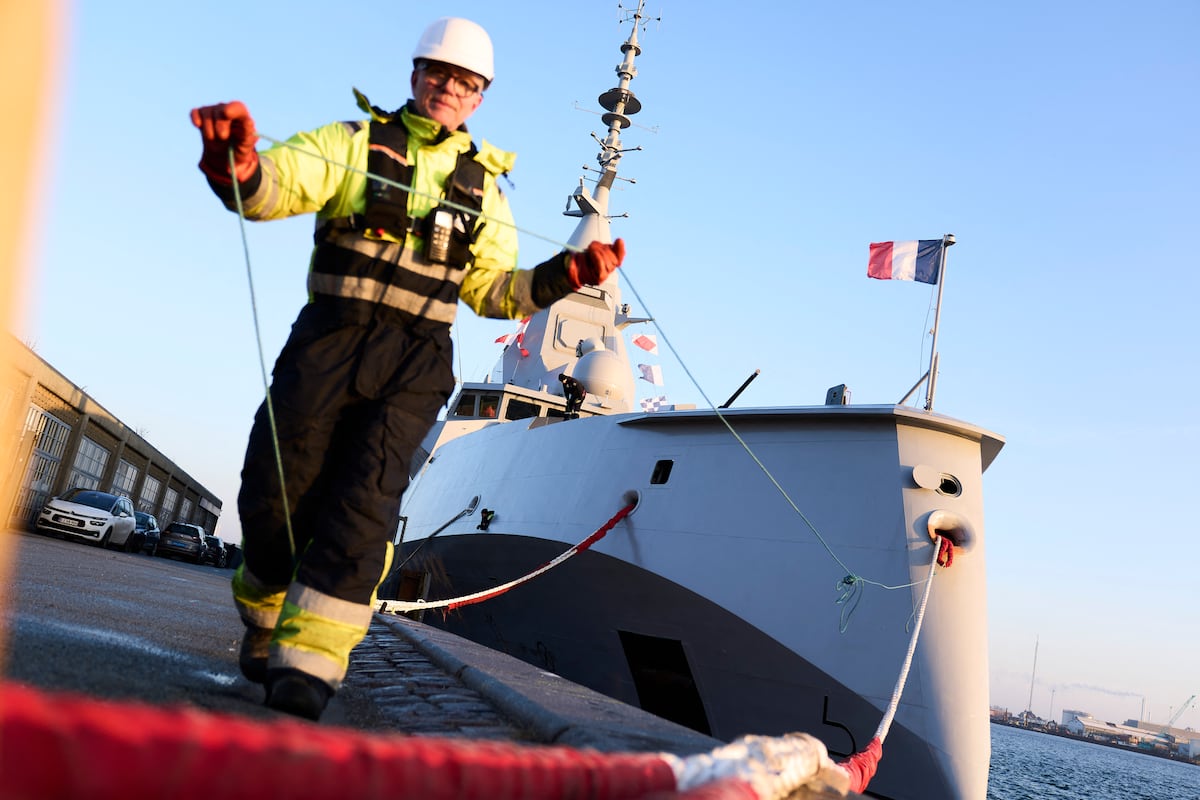
PARIS — France placed an order with shipbuilder Naval Group for the country’s fifth Defense and Intervention Frigate, known by its French acronym FDI and recognizable for its inverted bow, the final vessel currently planned in the class for the French Navy.
The fifth vessel ordered at the end of March will be delivered in 2032, the French Armed Forces Ministry said in a statement late Thursday. France ordered the fourth vessel in the class in December, and both units will be built at Naval Group’s site in Lorient in western France, according to the company.
“The Ministry of the Armed Forces renews its confidence in us to complete the series of defense and intervention frigates,” Naval Group Chief Executive Officer Pierre Éric Pommellet said in a statement. “We are thus fully mobilized to provide the French Navy with the means to achieve naval superiority, in the service of France’s sovereignty.”
Delivery of the last FDI will complete France’s program for a fleet of 15 first-rate frigates, a number that French Navy commander Adm. Nicolas Vaujour has said was dictated by budgetary constraints. Vaujour has maintained his force needs 18 frigates for a “coherent format,” and some lawmakers have been calling to increase the latest FDI order to eight vessels.
The program for the five FDI frigates was budgeted at €4.28 billion ($4.9 billion), according to France’s 2019 accounts. The fifth vessel will be handed over three years later than the original 2029 schedule, in part due to industrial difficulties for the first unit, the Covid-19 pandemic, delays with weapon integration, and reallocation of production slots to accommodate an order by Greece.
The first frigate in the class, the Amiral Ronarc’h, was delivered in October, and is currently on a long-term deployment. The frigate joined the carrier strike group around the aircraft carrier Charles de Gaulle in the north Atlantic in February to test its radars, electronic warfare suite and combat system in a tactical environment .
Naval Group said the FDI can handle rough seas, with the crew of Amiral Ronarc’h “able to observe its aptitude” during trials in Sea State 6 in the Atlantic Ocean. That sea state corresponds to “very rough” conditions with waves of 4 to 6 meters, according to the World Meteorological Organization.
With a length of 122 meters and displacement of around 4,500 tons, the FDI is smaller than new-generation frigates being built or planned in the U.K., Spain, Italy and Germany. The FDIs are designed for high-intensity combat, armed with Exocet anti-ship missiles, Aster air-defense missiles, MU90 torpedoes and a 76 mm cannon, and equipped with a Thales Sea Fire radar with four fixed panels.
Naval Group’s FDI is in competition for a Swedish order for four frigates, with a decision expected in coming months. France has touted its ability to supply a fully equipped and armed frigate in 2030, the target set by the Swedish government for first deliveries, with Naval Group saying in October the yard is able to produce two FDI frigates a year.
Norway in August last year picked the United Kingdom’s Type 26 frigate , primarily manufactured by BAE Systems, over the smaller French design.
Greece in November exercised an option for a fourth FDI frigate, on top of three vessels previously ordered, and in March sent the frigate Kimon, its first vessel in the class, to Cyprus .
While the first two French vessels in the class will be equipped with 16 vertical launch cells due to previously made budget decisions, numbers three to five are to be equipped with 32 cells , similar to the configuration for Greece. The first two frigates will be upgraded to double the number of launch cells at a later stage, according to the government.
France describes the frigate as fully digital, equipped with “significant computer power” to process the information gathered by the vessel’s onboard sensors, as well as a redundant data center.
Rudy Ruitenberg is a Europe correspondent for Defense News. He started his career at Bloomberg News and has experience reporting on technology, commodity markets and politics.
巴黎——法国向法国海军集团订购了该国第五艘防御与干预护卫舰(简称FDI),该舰以其反向船首而闻名,是法国海军目前计划建造的该级舰艇的最后一艘。
法国国防部周四晚间发表声明称,3月底订购的第五艘舰艇将于2032年交付。法国于去年12月订购了该级舰艇的第四艘,据法国海军集团称,这两艘舰艇都将在法国西部洛里昂的海军造船厂建造。
法国海军集团首席执行官皮埃尔·埃里克·波梅莱在一份声明中表示:“法国武装部队部再次对我们充满信心,相信我们能够完成一系列防御和干预型护卫舰的建造。因此,我们已做好充分准备,为法国海军提供必要的装备,以维护法国的主权,从而取得海上优势。”
最后一艘FDI的交付将完成法国建造15艘一流护卫舰的计划。法国海军司令尼古拉斯·沃茹尔海军上将曾表示,15艘护卫舰的数量是受预算限制所致。沃茹尔坚持认为,法国海军需要18艘护卫舰才能形成“统一的舰队规模”,一些议员也呼吁将最新FDI订单增加到8艘。
根据法国2019年的财务报表,五艘FDI护卫舰项目的预算为42.8亿欧元(49亿美元)。第五艘舰艇的交付时间将比原计划的2029年推迟三年,部分原因是首舰的生产遇到困难、新冠疫情的影响、武器集成方面的延误,以及为了满足希腊的订单而重新分配生产名额。
该级首舰“罗纳克海军上将”号于10月交付,目前正在进行长期部署。这艘护卫舰于2月加入位于北大西洋的“戴高乐”号航空母舰周围的航母打击群,以在战术环境下测试其雷达、电子战系统和作战系统。
法国海军集团表示,FDI型潜艇能够应对恶劣海况,在大西洋6级海况的试航中,“阿米拉尔·罗纳尔奇”号的船员“能够亲身验证其性能”。根据世界气象组织的定义,6级海况属于“非常恶劣”的海况,浪高可达4至6米。
FDI级护卫舰全长122米,排水量约4500吨,比英国、西班牙、意大利和德国正在建造或计划建造的新一代护卫舰要小。FDI级护卫舰专为高强度作战而设计,配备飞鱼反舰导弹、紫菀防空导弹、MU90鱼雷和一门76毫米舰炮,并装有泰雷兹公司生产的带有四个固定面板的“海火”雷达。
法国海军集团旗下的FDI公司正在竞标瑞典的四艘护卫舰订单,预计将在未来几个月内做出决定。法国一直标榜其有能力在2030年交付一艘装备齐全、武装到牙齿的护卫舰,这是瑞典政府设定的首批交付目标。法国海军集团在10月份表示,其船厂每年能够生产两艘FDI护卫舰。
去年 8 月,挪威选择了英国的 26 型护卫舰(主要由 BAE 系统公司制造),而不是较小的法国设计。
希腊在 11 月份行使了第四艘 FDI 护卫舰的选择权,此前已订购了三艘;3 月份,希腊将该级的第一艘护卫舰“基蒙”号送往塞浦路斯。
由于此前预算安排,该级舰艇的前两艘将配备16个垂直发射单元;而第三至第五艘将配备32个发射单元,与希腊的配置类似。据政府称,前两艘护卫舰将在后期升级,使发射单元数量翻倍。
法国方面称这艘护卫舰完全数字化,配备了“强大的计算机能力”来处理舰载传感器收集的信息,此外还有一个冗余的数据中心。
鲁迪·鲁伊滕贝格是《防务新闻》的欧洲记者。他的职业生涯始于彭博新闻社,拥有报道科技、大宗商品市场和政治方面的经验。