Chinese defense firms saw mixed results, corruption fallout in 2023中国国防企业业绩喜忧参半,腐败问题将在2023年显现。
A push for innovation, production expansion and enforced party loyalty animated China's defense-industrial complex last year.
The seven Chinese state-owned enterprises included in the Defense News Top 100 saw mixed results in 2023. The two largest companies performed well, with double-digit growth in their defense-related revenues between 2022 and 2023. Two other companies maintained steady revenue growth ; however, of the remaining three, two in the ground and aerospace sector saw declining profits and another failed to report results at all.
Overall, companies sought to deepen their innovation investments, and some benefited from stronger civilian sector market demand as well as continued People’s Liberation Army modernization developments.
However, allegations of corruption within China’s defense industrial base in 2023 led to leadership change and renewed calls for political loyalty among industry chiefs.
Between 2022 and 2023, AVIC’s defense production-related revenue increased by 52.6% (45% in U.S. dollars, given the weaker yuan). Though the company ranks first in defense-related profitability from all Chinese defense-related , state-owned enterprises (SOEs) for the fifth year in a row, it also ranks second in this year’s Top 100 company ranking, coming in behind Lockheed Martin.
The company’s strong growth in 2023 was attributed to its main subsidiaries — Chengdu Aircraft Industrial Group Co. Ltd., Xi’an Aircraft Industry Group Company Ltd. and Shenyang Aircraft Company Ltd. — having exceeded targets in their annual batch production and delivery missions.
In addition to producing new technologies, the PLA continues to replace legacy aircraft, such as the J-7 fighter jets, with new ones. New production lines are also being implemented to improve production and quality.
Visitors look at the Chinese military's J-16D electronic warfare airplane, September 2021. (Ng Han Guan/AP)
Ranking second in this year’s list of Chinese SOEs, the China State Shipbuilding Corporation Ltd. Group’s defense-related revenue grew by 25.7% year-on-year (19% in U.S. dollars).
The group’s results have been the largest year-on-year growth since the merger of China’s two largest shipbuilding conglomerates in 2018, and reflect the continued strength of China’s shipbuilding sector within the global market. In particular, the company refers to growing demand for “green” ship orders in the civilian shipbuilding sector.
In addition to strong demand, CSSC reports having benefited from “relatively friendly” global market improvements, such as ship and steel prices, as well as exchange rates.
At its 2024 annual company work conference in January, priorities for the company in 2024 were outlined as: focusing on the primary responsibility of military industry; strengthening and improving international competitiveness; increasing volume and improving quality; accelerating S&T self-reliance; and accelerating labor productivity of all employees, deepening the governance of loss-making enterprises and disposing of inefficient ones.
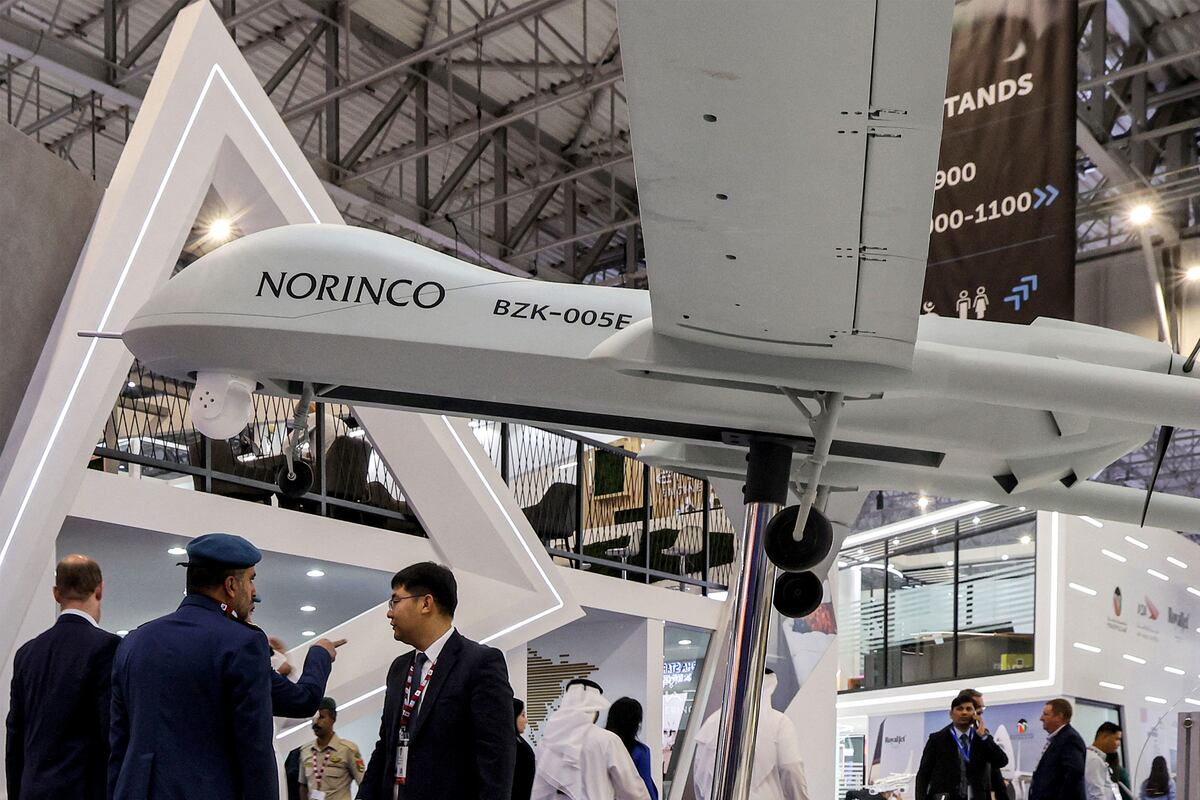
Though NORINCO still ranks third in the Chinese defense SOEs list and 9th in Defense News’ Top 100, the company’s year-on-year defense-related revenue dipped by 2.6% (8% in U.S. dollars).
In 2023, the company acquired two Chinese subsidiaries linked to universities: Xi’an Jiaotong University Aisheng Group and Beijing Beihang University’s Tianyu Changying UAV Technology Co. Ltd.
Both companies specialize in unmanned aerial vehicle research and development, and NORINCO hopes they will in turn increase the company’s “new war industries” offering — in addition to its current supply — to the PLA’s ground forces.
For example, in 2023 the PLA deployed NORINCO’s PHL-16 Multiple Launch Rocket System in the 73rd Group Army of the Eastern Theatre Command.
Further in the land domain, China South Industries Group fared slightly better, with a 7.6% year-on-year growth (2% in U.S. dollars) result for its defense-related revenue.
The company reported a significant improvement in production quality following internal reforms focused on optimizing industrial layout and strengthening the military ecosystem, though no details were provided.
CSGC highlighted that its combat equipment in particular had a 100% pass rate for the first inspection of major products. A total of 208 institutes and its Jianshe Group have passed third-level maturity evaluations. The company’s growth was driven by its civilian automobile sector, particularly in electronic vehicles.
As noted by other defense-related SOEs, CSGC has invested heavily in innovation, including adding three new innovation centers. As a result, the company reports “breakthroughs” in more than 30 key technologies, including light alloy multi-field pressure casting systems and wire-controlled chassis.
In addition to developing its own R&D capabilities, CSGC has also partnered with other Chinese firms such as Huawei, Horizon Robotics and CATL.
(Mark Schiefelbein/AP/REX/Shutterstock)
CETC came in fourth in China’s defense-related SOE rankings for a third consecutive year, reporting 5.6% year-on-year growth (0% in U.S. dollars) despite being added to the U.S. Commerce Department’s Entity List for supporting China’s military modernization and PLA aerospace programs following the 2023 Chinese balloon incident in the United States.
In order to withstand U.S. pressures, CETC absorbed state-owned digital services provider China Hualu Group — its second takeover in two and a half years.
China’s state-owned Assets Supervision and Administration Commission has promoted the merging of SOEs in critical sectors in order to boost efficiency, competitiveness and innovation.
In CETC’s case, results have been mixed. Some of CETC’s other parent company subsidiaries noted small losses in the first three quarters of 2023, such as Chips Technology Inc. and the recently acquired Potevio Co. Ltd.
Others, however, such as CETC’s Cyberspace Security Technology Co. Ltd, which predominantly focuses on data security and cryptography technology, reported increases throughout the first three quarters of 2023.
Overall competitiveness has reportedly been improved in recent years due to integration between industrial chains and a focus on R&D investment, though the latter has also come at a financial cost. The company spends roughly 11.8% of its profits on R&D investment, which is expected to grow in the future.
Nevertheless, the company’s dominant position in providing military electronics — at a time when the PLA continues to focus on achieving informatization and intelligentization — means CETC’s revenue has further room to grow.
China’s Aerospace Science and Technology Corporation (CASC) reported a surprising 77% year-on-year loss (79% in U.S. dollars) in 2023. The company’s defense-related revenue represented less than 5% of AVIC’s 2023 defense revenue. CASC ranked 52nd in this year’s Defense News Top 100, a drop of 37 places.
The company reported that its business was affected by floods in North China, which resulted in asset losses, equipment and infrastructure maintenance requirements and other related expenses.
Some contracts were delayed in delivery. And larger market factors, such as intensified market competition and rising production costs, also played a role.
Elsewhere in the aerospace sector, CASIC has not yet published its annual report.
China’s space sector and the PLA Rocket Force experienced political challenges in 2023.
The PLA Rocket Force and Equipment Development Department were at the center of a corruption investigation, in which multiple high-level officials were implicated.
China’s defense industrial base has similarly been investigated. CASC’s former Chairman Wu Yansheng’s membership in the Chinese People’s Political Consultative Conference (CPPCC) National Committee — China’s top political advisory body — was revoked at the end of 2023. He was replaced by Chen Mingbo.
CASIC’s chairman Yuan Jie also stepped down in 2024 after the company’s Vice President Wang Changqing was removed from the CPPCC National Committee.
Liu Shiquan, chair of NORINCO, was also stripped of his CPPCC seat.
Though these industry leaders have not been officially implicated in the corruption investigation, the decisions to strip them of their CPPCC seats is a sign that Beijing is increasing its scrutiny of a sector that is of key importance to its defense missions.
Meia Nouwens is a senior analyst specializing on Chinese security and defense policy at the International Institute for Strategic Studies.
入选《防务新闻》百强榜的七家中国国有企业在2023年的业绩喜忧参半。其中两家规模最大的公司表现突出,其国防相关收入在2022年至2023年间实现了两位数增长。另外两家公司保持了稳定的收入增长;然而,其余三家公司中,两家(分别位于地面和航空航天领域)利润下滑,还有一家未能公布业绩。
总体而言,各公司都在寻求加大创新投入,一些公司受益于民用市场需求的增强以及中国人民解放军现代化进程的持续推进。
然而,2023 年中国国防工业基地内部的腐败指控导致了领导层更迭,并再次引发了对行业领导人政治忠诚的呼吁。
2022年至2023年间,中航工业的国防生产相关收入增长了52.6%(考虑到人民币贬值,以美元计价增长45%)。尽管该公司连续第五年位居中国所有国防相关国有企业国防相关盈利能力榜首,但在今年的百强企业排名中,其位列第二,落后于洛克希德·马丁公司。
该公司2023年的强劲增长归功于其主要子公司——成都飞机工业集团有限公司、西安飞机工业集团有限公司和沈阳飞机有限公司——在年度批量生产和交付任务中超额完成目标。
除了研发新技术外,解放军还持续用新型飞机替换老旧飞机,例如歼-7战斗机。同时,新的生产线也在不断投入使用,以提高生产效率和产品质量。
2021年9月,参观者观看中国军方歼-16D电子战飞机。(吴汉关/美联社)
在今年的中国国有企业排名中位列第二的中国船舶集团有限公司,其国防相关收入同比增长25.7%(以美元计价增长19%)。
该集团的业绩实现了自2018年中国两大造船集团合并以来最大的同比增长,反映出中国造船业在全球市场持续强劲的竞争力。该公司特别指出,民用造船领域对“绿色”船舶的需求不断增长。
除了强劲的需求外,中船集团表示,还受益于“相对友好”的全球市场改善,例如船舶和钢材价格以及汇率。
在1月份举行的2024年度公司工作会议上,公司2024年的工作重点被列为:聚焦军工产业的首要责任;加强和提高国际竞争力;提高产量和质量;加快科技自主;提高全体员工的劳动生产率,深化亏损企业的治理,淘汰低效企业。
尽管北方工业在中国国防国有企业排名中仍位列第三,在《防务新闻》百强企业排名中位列第九,但该公司与国防相关的年收入下降了 2.6%(按美元计算下降了 8%)。
2023年,该公司收购了两家与大学有关联的中国子公司:西安交通大学爱生集团和北京航空航天大学天宇长鹰无人机技术有限公司。
这两家公司都专注于无人机的研究和开发,北方工业公司希望它们反过来能够增加该公司向解放军地面部队提供的“新军工产品”——除了目前供应的产品之外。
例如,2023年,解放军在东部战区第73集团军部署了北方工业公司的PHL-16多管火箭炮系统。
在陆上领域,中国南方工业集团的表现略好一些,其国防相关收入同比增长 7.6%(以美元计价增长 2%)。
该公司表示,通过内部改革,重点优化工业布局和加强军事生态系统,生产质量得到了显著提高,但没有提供任何细节。
中车集团强调,其作战装备主要产品首次检验合格率达到100%。旗下共有208个研究院及建设集团通过了三级成熟度评估。公司增长主要得益于民用汽车业务,尤其是电动汽车领域的发展。
正如其他国防相关国有企业所指出的那样,中国造船集团(CSGC)在创新方面投入巨资,包括新建三个创新中心。因此,该公司报告称在30多项关键技术领域取得了“突破性进展”,其中包括轻合金多场压力铸造系统和线控底盘。
除了发展自身的研发能力外,CSGC 还与其他中国公司建立了合作关系,例如华为、地平线机器人和宁德时代。
(图片来源:Mark Schiefelbein/AP/REX/Shutterstock)
中国电子科技集团(CETC)连续第三年位列中国国防相关国有企业排名第四,同比增长5.6%(以美元计价为0%)。尽管在2023年美国发生中国气球事件后,CETC因支持中国军事现代化和解放军航空航天项目而被美国商务部列入实体清单,但其业绩仍同比增长5.6%(以美元计价为0%)。
为了抵御美国的压力,中国电子科技集团(CETC)收购了国有数字服务提供商中国华路集团——这是CETC在两年半内的第二次收购。
中国国有资产监督管理委员会推动关键领域国有企业的合并,以提高效率、竞争力和创新能力。
就中国电子科技集团(CETC)而言,业绩喜忧参半。CETC旗下其他一些母公司子公司,例如Chips Technology Inc.和最近收购的Potevio Co. Ltd.,在2023年前三个季度均出现小幅亏损。
然而,其他一些公司,例如主要专注于数据安全和密码技术的中国电子科技集团公司网络空间安全技术有限公司,则报告称在 2023 年前三个季度均实现了增长。
据报道,近年来,由于产业链整合和研发投入的加强,公司整体竞争力有所提升,但研发投入也带来了一定的财务成本。公司目前将约11.8%的利润用于研发,预计未来这一比例还将继续增长。
尽管如此,在解放军继续致力于实现信息化和智能化之际,中国电子科技集团公司在提供军用电子产品方面的主导地位意味着,中国电子科技集团公司的收入还有进一步增长的空间。
中国航天科技集团公司(CASC)公布2023年业绩,同比亏损高达77%(按美元计算为79%),令人意外。该公司国防相关收入仅占中航工业集团(AVIC)2023年国防总收入的不到5%。CASC在今年的《防务新闻》百强企业排名中位列第52位,较上年下降37位。
该公司报告称,其业务受到华北地区洪灾的影响,导致资产损失、设备和基础设施维护需求以及其他相关费用。
部分合同的交付有所延迟。此外,市场竞争加剧、生产成本上升等更大的市场因素也发挥了作用。
在航空航天领域的其他方面,中国航天科工集团尚未发布年度报告。
2023年,中国的航天领域和解放军火箭军面临政治挑战。
解放军火箭军装备发展部卷入了一起腐败调查,多名高级官员牵涉其中。
中国的国防工业基础也受到了类似的调查。中国航天科技集团公司前董事长吴彦生的全国政协委员资格于2023年底被撤销,由陈明波接任。全国政协是中国最高政治协商机构。
中国航天科工集团董事长袁杰在公司副总裁王长青被免去全国政协委员职务后,于2024年辞职。
北方工业公司董事长刘世权也被剥夺了全国政协席位。
尽管这些行业领袖尚未被正式牵涉到腐败调查中,但剥夺他们全国政协席位的决定表明,北京正在加强对这个对其国防任务至关重要的行业的审查。
梅亚·努文斯是国际战略研究所专门研究中国安全和国防政策的高级分析师。