North Korea seeks to mirror the South’s defense sector boom朝鲜力图效仿韩国国防工业的蓬勃发展。
Opinion: The defense sector in North Korea makes up between 30% and 60% of the nation's total economy.
South Korea’s arms producers, recently dubbed members of the K-defense industry , are rising stars on the international stage, much like K-pop and K-drama. Because of the Russia-Ukraine war, many European countries have increased their defense budgets and become major customers of the K-defense industry.
On the other side of the coin — or the border — North Korea’s defense industry also has a new major customer: Russia.
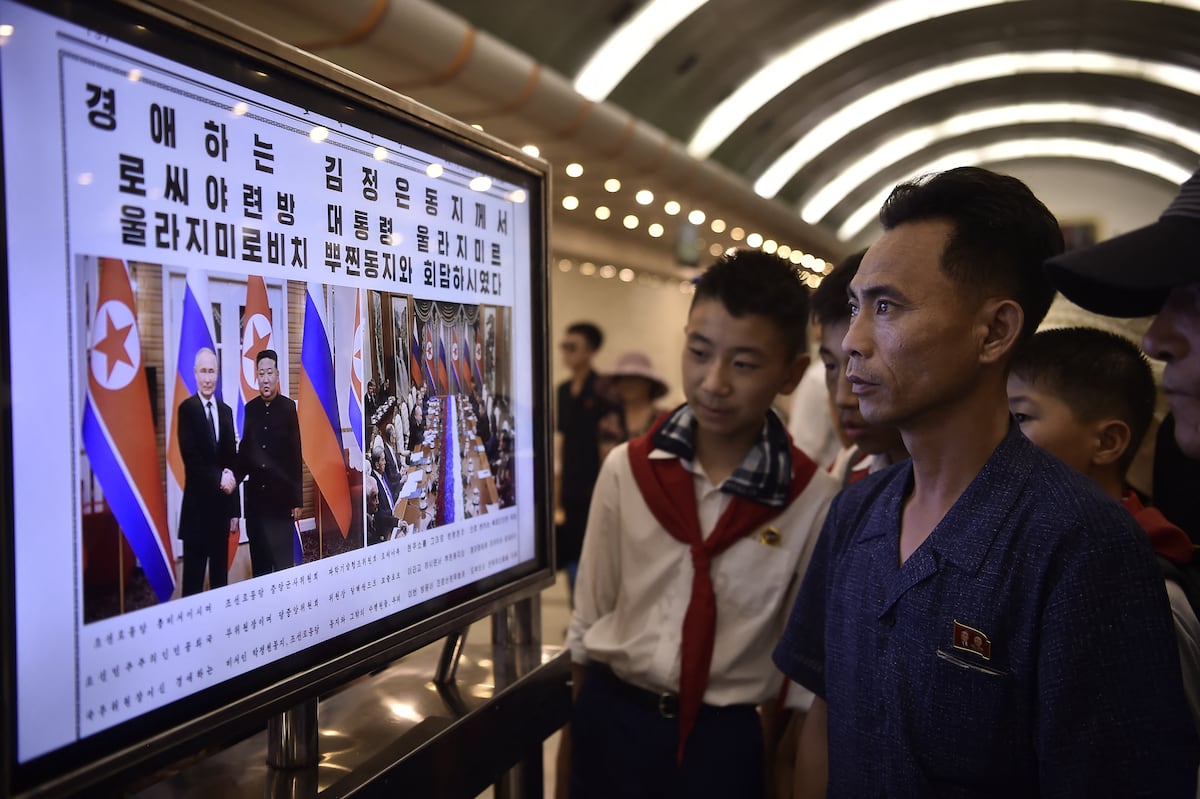
A recent visit to Pyongyang by Russian leader Vladimir Putin attracted the world’s attention. Russia needs North Korean ammunition, while North Korea needs to send its labor force to Russia to gather information about defense technologies like intercontinental ballistic missiles, submarine-launched ballistic missiles and satellites.
In North Korea, about 500,000 workers and 300 defense industry factories exist in the Second Economy Commission , which oversees nearly all aspects of materiel production and sales. Most factories are located in the North and South Pyongan provinces, the North and South Hamgyong provinces, the Chagang province and the Kangwon province.
The defense sector makes up about 30% to 60% of North Korea’s total economy , or approximately $10 billion. About $700 million goes to nuclear development, and about $600 million goes to missile development.
Recently, North Korean media openly showed Kim Jong Un’s visit to defense industry factories.
Usually, the nation’s media does not report on defense industry facilities as such, describing them as ordinary factories. But the transparency this time represents how important Kim considers the sector.
Since 2022, Rodong Sinmun has run at least eight articles discussing 18 visits to defense industry factories. The openness and timing is significant, given Russia launched its full-scale invasion of Ukraine that year.
During this period, Kim has emphasized a desire to prepare for war and modernize the domestic industry’s weapons production processes.
This year, North Korea began reorganizing entities under the Second Economic Commission in order to achieve Kim’s directives. He appointed a new chairman of the Second Economic Commission, and has dropped mentions of tests for the country’s 240mm multiple rocket launcher as well as construction efforts to support the weapon’s production.
Kim’s recent interactions with Putin and his emphasis on North Korea’s defense industry amid the war has a clear strategic purpose.
For one, these moves are meant to serve as a response to security cooperation between the United States, South Korea and Japan.
Secondly, North Korea has benefited from providing arms to Russia during the war. Decades ago, during the Korean War, the Soviet Union supported the creation of the Korean People’s Army , and the Soviet Army was a role model for the North.
Now, North Korea is able to support Russia by sending ammunition and other conventional weapons. The partnership provides opportunities for North Korea’s labor force to travel to Russia to learn about advanced defense technologies.
North Korea considers its version of the K-defense industry to be an engine for economic development. From the North’s point of view, Russia is just the beginning, as other potential customers could follow suit.
Indeed, if North Korea accepts an invitation from Russia to join a Russia-China combined military exercise, this would be a great turning point for the government and a game changer to Northeast Asia’s security architecture.
The worst-case scenario would be the North’s export of weapons of mass destruction, including, but not limited to, nuclear war heads.
Kim’s ambition has grown beyond selling access to the Wonsan spa resort. Now, North Korea is seeking its own version of the K-defense industry.
Youngjun Kim is a professor at the Korea National Defense University and a nonresident fellow at the National Bureau of Asian Research think tank.
韩国的武器生产商,最近被称为“韩国国防工业”,正像韩国流行音乐和韩剧一样,在国际舞台上迅速崛起。由于俄乌战争,许多欧洲国家增加了国防预算,成为韩国国防工业的主要客户。
硬币的另一面——或者说边界的另一面——朝鲜的国防工业也有了一个新的主要客户:俄罗斯。
俄罗斯领导人弗拉基米尔·普京最近访问平壤,引起了全世界的关注。俄罗斯需要朝鲜的弹药,而朝鲜则需要向俄罗斯派遣劳动力,以获取洲际弹道导弹、潜射弹道导弹和卫星等国防技术的信息。
在朝鲜,第二经济委员会下辖约50万名员工和300家国防工业工厂,负责监管几乎所有物资生产和销售环节。大多数工厂位于平安北道、平安南道、咸镜北道、咸镜南道、慈江道和江原道。
朝鲜国防工业约占该国经济总量的30%至60%,约合100亿美元。其中约7亿美元用于核武器研发,约6亿美元用于导弹研发。
近日,朝鲜媒体公开报道了金正恩视察国防工业工厂的画面。
通常情况下,朝鲜媒体不会专门报道国防工业设施,而是将其描述为普通工厂。但这次的透明度表明,金正恩对该领域的重视程度。
自2022年以来,《劳动新闻》至少刊登了八篇文章,报道了对18家国防工业工厂的参观。鉴于俄罗斯同年发动了对乌克兰的全面入侵,这种公开透明的报道方式和时机选择意义重大。
在此期间,金正恩强调了备战的愿望,以及实现国内武器生产工业现代化的愿望。
今年,朝鲜开始重组第二经济委员会下属机构,以落实金正恩的指示。他任命了第二经济委员会的新主席,并停止提及该国240毫米多管火箭炮的试验以及支持该武器生产的建设工作。
金正恩近期与普京的互动以及他在战争期间对朝鲜国防工业的重视,具有明确的战略目的。
首先,这些举措旨在回应美国、韩国和日本之间的安全合作。
其次,朝鲜在战争期间从向俄罗斯提供武器中获益。几十年前,在朝鲜战争期间,苏联支持朝鲜人民军的建立,苏联军队成为朝鲜的榜样。
如今,朝鲜能够通过向俄罗斯输送弹药和其他常规武器来支持俄罗斯。这种伙伴关系也为朝鲜劳动力提供了前往俄罗斯学习先进国防技术的机会。
朝鲜将其国防工业视为经济发展的引擎。在朝鲜看来,俄罗斯仅仅是个开始,其他潜在客户也可能效仿。
事实上,如果朝鲜接受俄罗斯的邀请,参加俄中联合军事演习,这将是朝鲜政府的重大转折点,也将改变东北亚的安全格局。
最糟糕的情况是朝鲜出口大规模杀伤性武器,包括但不限于核弹头。
金正恩的野心早已超越了出售元山温泉度假村的使用权。如今,朝鲜正寻求打造属于自己的“朝鲜国防工业”。
金永俊是韩国国防大学教授,也是国家亚洲研究局智库的非常驻研究员。