The Army Nearly Adopted This Stealthy OH-58X Kiowa Warrior Variant陆军差点采用这款隐蔽性极佳的OH-58X“基奥瓦勇士”改进型直升机
As the Army hunts for a new stealthy, high-speed, long-range attack reconnaissance helicopter, it's interesting to look back at what might have been.
新闻视频
By Joseph Trevithick
Updated Dec 1, 2019 6:48 AM EST
The U.S. Army wants a new high-speed, long-range, stealthy attack reconnaissance helicopter to finally succeed the OH-58D Kiowa Warrior scout helicopter, which the service decided to retire prematurely in 2014 . The service says it needs the new helicopter to meet the operational demands of a potential high-end conflict with a “great power” adversary, such as Russia or China. With all this in mind, it’s interesting to remember that the Army had at least a smaller number of Kiowas with various stealthy features, known as the OH-58X, nearly thirty years ago.
Secretary of the Army Mark Esper underscored the importance of the Future Attack Reconnaissance Aircraft (FARA) program to the service’s overall modernization goals during a press conference at the Pentagon on Apr. 17, 2019 . He also highlighted work on new long-range artillery , air and missile defenses , heavy armored vehicles , and communications and data sharing networks. The Army says it has made cuts to more than 90 existing programs to free up funding to support these efforts and Esper, along with other senior officials, has faced criticism from Congress and others over many of these decisions.
“What I don’t have right now is an attack reconnaissance aircraft,” Esper told reporters . “That’s what I need to penetrate Russian or Chinese air defenses.”
The Army’s plan is for whatever design wins the FARA competition, the first phase of which will begin this year , to replace AH-64 Apaches in the Army’s Attack Reconnaissance Squadrons . This represents roughly half of the total number of these gunships that the service has at present.
These units emerged after the Army retired the OH-58D Kiowa Warrior, ostensibly due to the budget reasons, with the last of those scout helicopters finally leaving the service in 2017. The Army has been without a true replacement ever since.
An OH-58D Kiowa Warrior, in front, flies with an AH-64 Apache., US Army
“The Apache is the best attack helicopter in the world, but it’s not the best armed reconnaissance helicopter,” U.S. Army Brigadier General Walter Rugen, head of the Future Vertical Lift (FVL) Cross-Functional Team (CFT) within the new Army Futures Command, told Aviation Week earlier in April 2019. “We need a smaller form factor that can hide in the radar clutter and that has reach.”
Previous attempts to replace the OH-58Ds directly, which led right to the ultimate decision to retire the helicopters entirely, suffered from repeated missteps and mismanagement, becoming its own saga, which you can read about in more detail here and here . The Army had, of course, also expected to have replaced the Kiowa Warriors with the RAH-66A Comanche stealth helicopter in the mid-2000s, before canceling that program, which had ballooned in cost and suffered serious delays, in 2004.
It is also important to note that the service had been very interested in the idea of stealthy helicopters for decades before Comanche and had invested heavily in related research and development before that particular program started. As early as 1978, Sikorsky had produced a detailed report on low radar cross-section fuselage concepts for its then still relatively new UH-60A Black Hawk.
But, had things gone differently, the Army might have already been flying the advanced OH-58X years before the Comanche program came to a close. The origins of the X model in many ways actually trace all the way back to the service’s decision to buy the original OH-58A Kiowa in 1967.
Two years earlier, the Army had chosen the Hughes OH-6A Cayuse to be its new scout helicopter, passing over Bell’s YOH-4 , the progenitor of the Kiowa and its commercial Model 206 Jet Ranger .
Bell’s YOH-4A during tests in the early 1960s., US Army via Ray Wilhite
As it turned out, Hughes had grossly overstated its production capacity and the Army turned back to Bell and the Kiowa to fulfill its requirements. The OH-58As, as well as improved OH-58Cs with its more powerful engine and other updates, outlasted the Cayuse in regular Army use.
However, the Cayuse, and further improved variants of the Hughes design, commonly known as Little Birds , found a second life in the Army’s burgeoning special operations aviation community in the 1980s. AH-6 light attack helicopters and MH-6 light transports quickly became a core component of what eventually became known as the new 160th Special Operations Aviation Regiment , also known as the Nightstalkers.
One of the 160th Special Operations Aviation Regiment’s MH-6 Little Birds equipped with side-mounted planks for special operators to ride on during insertions and extractions., US Army
At the same time, the Army was experimenting with various light, rapidly deployable unit concepts that would also leverage state-of-the-art technology to help keep them viable against a more robust opponent. An Army test force emerged known first as the High Technology Testbed (HTTB), then the High Technology Light Division (HTLD), and finally as the 9th Infantry Division (Motorized).
Over more than a decade, these organizations evaluated all sorts of different vehicles, weapons, and equipment, including, but hardly limited to heavily armed dune buggies , light tanks , ground-launched AGM-114 Hellfire missiles, and ultra-light aircraft . In the course of this experimentation, the question of what kind of helicopters a rapidly deployable light force might use also came up.
The original plan was to acquire Little Birds to support the force. This made good sense since the 160th was already demonstrating concepts for rapidly moving these small helicopters to forward locations, even in austere environments, and quickly establishing aviation operations at those sites. But the Army rejected those requests.
A much more recent picture of members of the 160th Special Operations Aviation Regiment unloading an AH-6 Little Bird from an MC-130 special operations transport aircraft., DOD
Instead, the Army’s high-technology test force managed to acquire a number of JOH-58C Light Combat Helicopters (LCH). The Army had modified these Kiowas for the 160th, but that unit had rejected them in favor of the JOH-6A LCH. The JOH-6A eventually got redesignated as the AH-6C and became the first of the Nightstalkers’ armed Little Birds.
The JOH-58Cs received additional modifications as part of the high-technology testing, including one extreme example with a three-barrel 20mm M197 cannon mounted in the co-pilot’s seat and firing out through the helicopter’s nose. This proved to be impractical and dangerous, since firing the gun could fill the cockpit with residential propellant gasses that could choke and blind the pilot.
The JOH-58C with the M197 cannon installation., US Army via Ray Wilhite
Another example, with the serial number 70-15349, served as a surrogate for an advanced configuration known as the OH-58X. In 1985, the Army’s Aviation Engineering Flight Activity conducted limited airworthiness and flight characteristics testing of this particular helicopter. This initial OH-58X surrogate did not have any stealthy features, though it did contain a number of other advanced systems, many of which the Army obtained commercially.
This included a new stabilization and control augmentation system (SCAS) from French avionics firm SFENA , a Direct View Optics (DVO) roof-mounted sight from Ferranti in the United Kingdom, and an unspecified roof-mounted, turreted forward-looking infrared (FLIR) sensor. The DVO, the same model used on some French and British Aérospatiale Gazelle light scout helicopters , had a laser designator, which would have given the OH-58X the ability to fire Hellfire missiles.
The JOH-58C configurated as the OH-58X surrogate., US Army via Ray Wilhite
70-15349 also carried over various modifications from its original life as a possible special operations platform. This included modified landing skids that could collapse to lower the helicopter’s overall profile, as well as folding tail assembly, all to make it easier to load and unload the helicopter from a cargo aircraft. It also had the improved tail rotor assembly found on Bell’s Model 206L-3 Jet Rangers . Lastly, there were range-extending fuel tanks and added communications and navigation gear.
The Aviation Engineering Flight Activity reported that the helicopter had significantly improved performance over a standard OH-58C, but that it was also more complicated to fly, especially at lower speeds. The test pilots recommended modifications to the SCAS and to alert pilots to potential limitations in certain flight regimes until the helicopter received further upgrades to fully mitigate these issues.
That didn’t happen. Separately from the high-technology testing, the Army had also initiated an Army Helicopter Improvement Program (AHIP) to modernize its Kiowas in 1981. AHIP led directly to the introduction of the OH-58D in 1985. The OH-58D, also known as the Bell Model 406, was a significantly more powerful design with an improved four-bladed main rotor.
The helicopters also eventually gained a mast-mounted sighting unit with electro-optical and infrared cameras, as well as a laser designator. The Army ultimately bought hundreds of new OH-58Ds and converted older Kiowas to this new standard. The first armed examples, sometimes referred to as AH-58Ds, entered combat for the first time in January 1988 as part of Operation Prime Chance . Flying from U.S. Navy ships in the Persian Gulf, the helicopters engaged against Iranian boats threaten U.S.-flagged oil tankers sailing through the region.
An OH-58D Kiowa Warrior., US Army
The OH-58X effort, which was certainly duplicative of AHIP in many ways, threatened to compete for funding and other resources with the OH-58D program. The Army ultimately canceled the OH-58X project in favor of the Kiowa Warrior.
But the idea of an even further advanced OH-58, now based on the D model’s more powerful design didn’t go away. Bell eventually took a Kiowa it had converted to the OH-58D configuration, serial number 69-16322, and turned it into a new OH-58X demonstrator with a major focus on stealthy features.
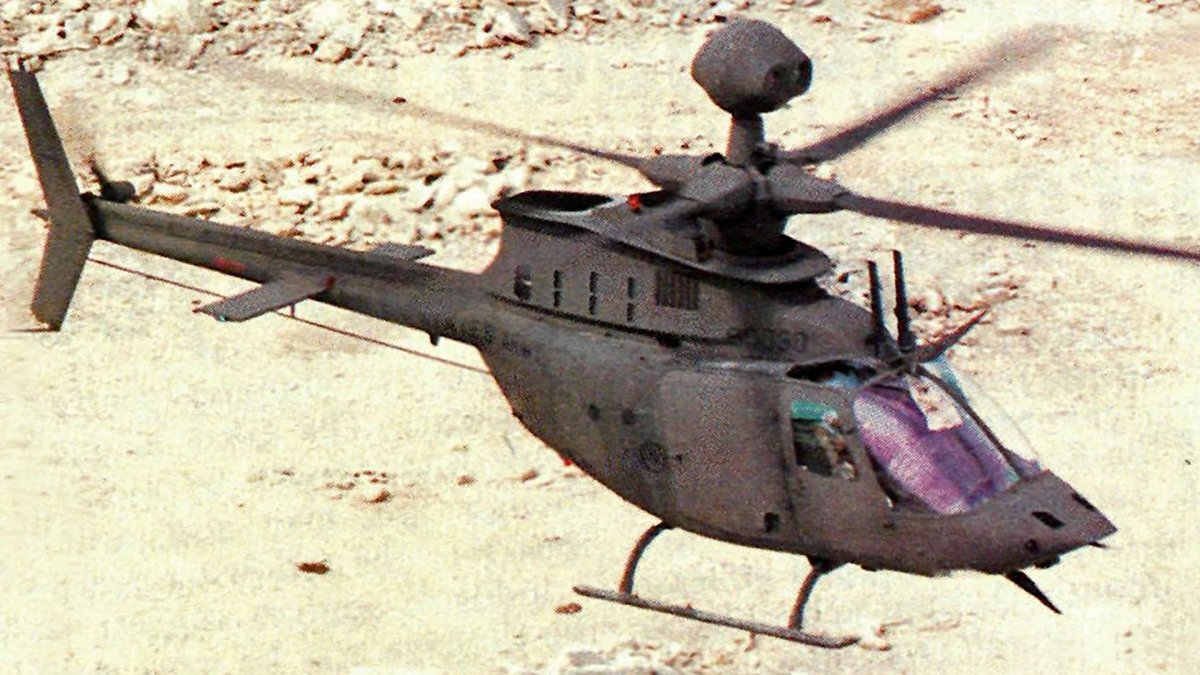
The new helicopter had a chiseled nose profile, making it visually distinct from a standard OH-58D. Bell replaced the “doghouse” on top where the engine and main gearbox sat with one made of a radar absorbent material, according to a 1992 Flight International article . The design also included radar-absorbing “cuffs” on the main rotor mast and hub and on the tail rotor assembly. The rotor blades, mast-mounted sight, and skids all received a special coating to reduce their radar reflectivity.
A low-quality image of the OH-58X demonstrator. Note the chisel nose and the “cuffs” on the main rotor to reduce its radar signature., US Army
The configuration “works extremely well,” Jack Gallagher, Bell’s OH-58D program manager at the time, told Flight International . It “performs [against known threats] better than anything out there.”
Bell also pitched it as a cost-effective conversion for existing Kiowa Warriors, claiming each stealth kit would cost just $200,000, less than $365,000 in today’s dollars. In 1992, the flyaway cost of a new OH-58D was $6.7 million, or the equivalent of more than $12 million today.
Another picture of the OH-58X demonstrator, but without the “cuffs” installed on the main or tail rotors., Bell via 1000aircraftphotos.com
This was an important selling point for the U.S. Army, which, as already noted, had been very interested in a stealthy light scout helicopter to completely replace all of its OH-58s since the early 1980s and had been investing heavily in research into stealth helicopters, in general, years before that. The stealthy scout helicopter effort, known as the Light Helicopter Experimental (LHX) program, had itself spawned the Advanced Composite Airframe Program (ACAP), which involved experiments with two different helicopters – Bell’s D-292 and Sikorsky’s S-75 – with composite airframes to reduce their radar signatures.
But by 1991, when the Gulf War started, despite all of the Army’s investments, none of these projects had yielded an actual production-ready design, at least publicly . So the service turned to Bell, which reportedly modified 18 OH-58Ds into the X configuration for operations in Southwest Asia, but they arrived too late to see action against Iraqi forces, according to Flight International .
An OH-58X in US Army colors., Bell via Flight Global
As of January 1996, the stealth kits were still in storage and available for use, if necessary, according to Army , the official publication of the Association of the U.S. Army. At that time, Bell was reportedly still working on improving the stealthy configuration.
It’s not entirely clear what happened to these remnants of the OH-58X program in the end. The War Zone reached out to the U.S. Army Aviation and Missile Command’s history office, but they said they could not find any specific records about the final status of the project. Bell’s public relations team similarly said that there did not appear to be any additional information beyond what the company had shared publicly in the past, but added that some details might remain classified.
It seems very possible that defense budget cuts in the years following the collapse of the Soviet Union may have killed the OH-58X for good, in favor of LHX, which evolved into the Light Helicopter (LX) program and led to the selection of Boeing and Sikorsky’s RAH-66A design in April 1991. The Army had touted Comanche as a stealthy Kiowa replacement, making it easy to see how it could have subsumed the OH-58X project. But the RAH-66A was also significantly more advanced and capable than the Kiowa, with various features, especially its armament package , that were more in line with an attack helicopter, such as the AH-64.
In something of a throwback to the original JOH-58C LCH concept, in 1992, Bell had also introduced a non-stealthy Multi-Purpose Light Helicopter kit, which featured similar “squatting” landing skids to reduce the helicopter’s overall height. Sometimes referred to as the UH-58E , this configuration also had a cargo hook under the fuselage for carrying small loads slung below, as well as mounts on either side of the fuselage to fit external platforms for carrying cargo, wounded personnel on stretchers, or inserting and extracting special operations forces. This arrangement was similar in general concept to the planks on the 160th’s MH-6 Little Bird light transports.
Bell says that the Army purchased dozens of MPLH
kits, but rarely used anything besides the landing skids. There are various pictures that show OH-58D Kiowas over the years with the MLPH skids, but there does not appear to be any photographic evidence of the service using any other part of that kit operationally.
An OH-58D Kiowa Warrior with the MPLH skids in Iraq in 2004., US Army
Whatever the case, the Army shifted its stealth helicopter focus to Comanche for more than a decade, before canceling that program in 2004. The War Zone has previously explored in depth how the service may have been able to keep the stealth helicopter brain trust alive in the classified domain, helping to produce such things as a stealthy UH-60 Black Hawk transport helicopter. The existence of this Stealth Hawk became public in 2011, when one of them crashed during the raid that led to the death of Osama Bin Laden in Abbottabad, Pakistan.
However, the stealthy Kiowa seems to have faded into obscurity. When the Army looked into upgrading the OH-58Ds to new OH-58F configuration in the early 2010s, there were no stealth features as part of the package.
The OH-58F prototype., US Army
The Army has now come back around to the idea of a stealthy attack reconnaissance rotorcraft with the FARA program. The service’s requirements also demand a design with a top speed of at least 230 miles per hour – nearly 100 miles per hour faster than the Kiowa Warrior – and greatly extended range over previous scout helicopters. Beyond stealth features, this next generation attack reconnaissance platform will also have a robust electronic warfare suite to detect and jam enemy radars and other cutting-edge defensive systems.
The Army says it will announce the companies that will take part in the first phase of the FARA program this year and it hopes to down-select to just two competitors in 2020. There will then be a fly-off between the two, leading to the selection of a final winner in 2024.
So, while the Army may have largely passed over OH-58X, it may finally get a helicopter with far higher performance and that is more survivable and stealthy than the Kiowa Warrior could ever have been.
Contact the author: jtrevithickpr@gmail.com
Comments couldn’t be loaded. Please refresh the page.
作者:约瑟夫·特雷维西克
更新于美国东部时间2019年12月1日上午6:48。
美国陆军希望研发一种新型高速、远程、隐形攻击侦察直升机,以最终取代OH-58D“基奥瓦勇士”侦察直升机。陆军已于2014年决定提前退役OH-58D。陆军表示,需要这种新型直升机来满足与俄罗斯或中国等“大国”对手可能发生的高端冲突的作战需求。考虑到这一点,值得注意的是,早在近30年前,陆军就拥有过数量较少的、具备各种隐形功能的“基奥瓦”直升机,即OH-58X。
2019年4月17日,陆军部长马克·埃斯珀在五角大楼举行的新闻发布会上强调了未来攻击侦察机(FARA)项目对陆军整体现代化目标的重要性。他还重点介绍了新型远程火炮、防空和导弹防御系统、重型装甲车辆以及通信和数据共享网络方面的工作。陆军表示,为了腾出资金支持这些项目,已经削减了90多个现有项目。埃斯珀和其他高级官员因其中许多决定而受到国会和其他方面的批评。
埃斯珀告诉记者:“我现在缺少的是攻击侦察机。我需要它来突破俄罗斯或中国的防空系统。”
陆军的计划是,无论最终赢得FARA竞标的设计方案是什么(第一阶段将于今年开始),都将用该方案取代陆军攻击侦察中队的AH-64“阿帕奇”武装直升机。这将大约占陆军目前拥有的此类武装直升机总数的一半。
这些部队是在陆军因预算原因退役OH-58D基奥瓦勇士侦察直升机后出现的,最后一架该型侦察直升机于2017年最终退役。自那以后,陆军一直没有真正的替代机型。
一架OH-58D“基奥瓦勇士”直升机(位于前方)与一架AH-64“阿帕奇”直升机(位于后方)一同飞行。(美国陆军)
“阿帕奇是世界上最好的攻击直升机,但它并不是最好的武装侦察直升机,”美国陆军准将沃尔特·鲁根(Walter Rugen)在2019年4月初接受《航空周刊》采访时表示。鲁根是新成立的陆军未来司令部下属未来垂直起降(FVL)跨职能团队(CFT)的负责人。“我们需要一种体积更小、能够隐藏在雷达杂波中且具有足够航程的直升机。”
此前直接替换OH-58D的尝试,最终导致彻底退役该型直升机的决定,由于屡次失误和管理不善而失败,这段经历本身就成了一段传奇,您可以在这里和这里阅读更多详情。当然,陆军也曾计划在2000年代中期用RAH-66A“科曼奇”隐形直升机替换“基奥瓦勇士”直升机,但由于成本飙升和严重延误,该项目于2004年被取消。
值得注意的是,早在“科曼奇”隐形直升机项目启动前的几十年里,美国空军就对隐形直升机的概念表现出浓厚的兴趣,并在该项目开始前就对相关研发进行了大量投资。早在1978年,西科斯基公司就为其当时相对较新的UH-60A“黑鹰”直升机撰写了一份关于低雷达反射截面机身概念的详细报告。
但如果情况有所不同,陆军或许早在“科曼奇”计划结束前几年就已经装备了先进的OH-58X直升机。从很多方面来看,OH-58X的起源实际上可以追溯到1967年陆军决定购买最初的OH-58A“基奥瓦”直升机。
两年前,陆军选择了休斯 OH-6A Cayuse 作为其新的侦察直升机,而放弃了贝尔的 YOH-4(Kiowa 的原型机)及其商用 206 型 Jet Ranger。
20世纪60年代初贝尔公司的YOH-4A无人机测试照片,美国陆军提供,雷·威尔海特摄
事实证明,休斯公司严重高估了其产能,陆军最终还是选择了贝尔公司及其生产的基奥瓦直升机来满足需求。OH-58A以及配备更强劲发动机和其他改进的OH-58C,在陆军的常规使用中都比卡尤斯直升机服役时间更长。
然而,卡尤斯直升机以及休斯公司进一步改进的型号(俗称“小鸟”)在 20 世纪 80 年代陆军蓬勃发展的特种作战航空部队中找到了第二次生命。AH-6 轻型攻击直升机和 MH-6 轻型运输直升机迅速成为后来被称为第 160 特种作战航空团(又称“夜行者”)的核心组成部分。
美国陆军第160特种作战航空团的一架MH-6“小鸟”直升机,机身侧面装有跳板,供特种作战人员在渗透和撤离行动中使用。
与此同时,陆军正在试验各种轻型、快速部署的部队概念,这些部队也将利用最先进的技术来增强自身对抗更强大对手的能力。一支陆军试验部队应运而生,最初被称为高科技试验基地(HTTB),随后更名为高科技轻型师(HTLD),最终定名为第九步兵师(摩托化)。
十多年来,这些机构评估了各种不同的车辆、武器和装备,包括但不限于重型武装沙滩车、轻型坦克、陆基AGM-114“地狱火”导弹和超轻型飞机。在这一试验过程中,快速部署的轻型部队可以使用何种直升机的问题也随之出现。
最初的计划是采购“小鸟”直升机来支援部队。这合情合理,因为第160联队当时已经展示了将这些小型直升机快速部署到前沿阵地(即使在条件艰苦的环境下)并迅速在这些地点建立航空作战能力的方案。但陆军拒绝了这些请求。
一张更新近的照片显示,第160特种作战航空团的成员正在从一架MC-130特种作战运输机上卸下一架AH-6“小鸟”武装直升机。(美国国防部)
然而,陆军高科技试验部队却设法获得了一批JOH-58C轻型战斗直升机(LCH)。陆军曾为第160战斗机联队改装过这些基奥瓦直升机,但该联队最终选择了JOH-6A LCH。JOH-6A最终被重新命名为AH-6C,成为“夜行者”部队首批武装“小鸟”直升机。
作为高科技测试的一部分,JOH-58C直升机进行了额外的改装,其中一个极端例子是在副驾驶座位上安装一门三管20毫米M197机炮,炮弹从直升机机头射出。事实证明,这种改装既不实用又危险,因为开炮时,驾驶舱内会充满生活燃气,可能导致飞行员窒息和失明。
JOH-58C 直升机,配备 M197 机炮。(图片来自美国陆军,Ray Wilhite 提供)
另一架编号为70-15349的直升机,是OH-58X先进配置的替代品。1985年,美国陆军航空工程飞行活动中心对这架直升机进行了有限的适航性和飞行特性测试。这架最初的OH-58X替代品不具备任何隐身性能,但确实包含许多其他先进系统,其中许多系统是陆军从商业渠道采购的。
这其中包括法国航空电子公司SFENA提供的新型稳定与控制增强系统(SCAS)、英国Ferranti公司提供的Direct View Optics(DVO)顶置瞄准镜,以及一款未指明型号的顶置炮塔式前视红外(FLIR)传感器。DVO瞄准镜与部分法国和英国Aérospatiale Gazelle轻型侦察直升机上使用的型号相同,它配备激光指示器,这将使OH-58X具备发射“地狱火”导弹的能力。
JOH-58C 被配置为 OH-58X 的替代品。(美国陆军,图片来自 Ray Wilhite)
70-15349 还保留了其最初作为特种作战平台时进行的各种改装。这些改装包括可折叠的改进型起落架(用于降低直升机的整体轮廓)和可折叠尾翼组件,所有这些都是为了方便从运输机上装卸直升机。它还配备了贝尔 206L-3 型喷气游骑兵直升机上改进的尾桨组件。此外,它还加装了增程油箱以及通信和导航设备。
航空工程飞行活动报告称,该直升机的性能较标准型OH-58C有了显著提升,但飞行操作也更加复杂,尤其是在低速飞行时。试飞员建议对SCAS系统进行改进,并提醒飞行员注意某些飞行状态下的潜在限制,直至该直升机完成进一步升级以彻底解决这些问题。
这种情况并没有发生。除了高科技测试之外,陆军还在1981年启动了一项陆军直升机改进计划(AHIP),旨在对其基奥瓦直升机进行现代化改造。AHIP直接促成了1985年OH-58D的问世。OH-58D,也称为贝尔406型,是一款动力更强劲、配备改进型四叶主旋翼的直升机。
这些直升机最终还加装了桅杆式瞄准装置,该装置配备了光电和红外摄像机以及激光指示器。陆军最终采购了数百架新型OH-58D,并将老旧的基奥瓦直升机改装成这种新标准。首批武装型OH-58D(有时被称为AH-58D)于1988年1月首次投入实战,参与了“黄金机会行动”。这些直升机从波斯湾的美国海军舰艇上起飞,攻击威胁该地区航行的美国油轮的伊朗船只。
一架OH-58D“基奥瓦勇士”直升机,美国陆军
OH-58X项目在很多方面与AHIP项目存在重叠,并且有可能与OH-58D项目争夺资金和其他资源。最终,陆军取消了OH-58X项目,转而支持基奥瓦勇士(Kiowa Warrior)项目。
但是,基于D型更强大的设计,研发更先进的OH-58的想法并没有消失。贝尔公司最终将一架已改装成OH-58D配置的基奥瓦飞机(序列号69-16322)改造成了一架新的OH-58X演示机,其主要重点在于隐身性能。
这款新型直升机拥有棱角分明的机头轮廓,使其在外观上与标准的OH-58D截然不同。据1992年《飞行国际》杂志的一篇文章报道,贝尔公司用雷达吸波材料制成的机舱取代了原先位于机头顶部、发动机和主变速箱所在的“狗窝”式结构。此外,该设计还在主旋翼轴和轮毂以及尾旋翼组件上加装了雷达吸波“护套”。旋翼桨叶、轴上安装的瞄准器和起落架都经过特殊涂层处理,以降低其雷达反射率。
一张OH-58X验证机的低质量图片。请注意其凿形机头和主旋翼上的“袖套”,这些设计旨在降低其雷达反射截面。(美国陆军)
贝尔公司当时的OH-58D项目经理杰克·加拉格尔告诉《国际飞行》杂志,这种配置“效果非常好”。它“在应对已知威胁方面比市面上任何其他机型都更胜一筹”。
贝尔公司还将其宣传为现有基奥瓦勇士直升机的经济高效的改装方案,声称每套隐形套件的成本仅为20万美元,按今天的美元价值计算不到36.5万美元。1992年,一架全新OH-58D的单价为670万美元,相当于今天的1200多万美元。
这是OH-58X验证机的另一张照片,但主旋翼和尾旋翼上没有安装“护套”。(贝尔公司,图片来自1000aircraftphotos.com)
这对美国陆军来说是一个重要的卖点。正如前文所述,自20世纪80年代初以来,美国陆军就对隐形轻型侦察直升机表现出浓厚的兴趣,希望以此彻底取代其现有的OH-58直升机。在此之前,美国陆军已投入巨资进行隐形直升机的研究。这项名为“轻型直升机实验”(LHX)的隐形侦察直升机项目,又催生了“先进复合材料机身计划”(ACAP)。ACAP计划对贝尔公司的D-292和西科斯基公司的S-75两款直升机进行了复合材料机身的试验,以降低其雷达反射截面积。
但到了1991年海湾战争爆发时,尽管陆军投入了大量资金,但这些项目都没有产生任何实际可用的量产设计,至少没有公开展示过。因此,陆军转而求助于贝尔公司,据报道,贝尔公司将18架OH-58D改装成X型,用于在西南亚作战,但据《飞行国际》报道,这些飞机抵达时为时已晚,未能参与对伊拉克军队的战斗。
一架涂装为美国陆军配色的OH-58X直升机。(图片来自贝尔公司,经由Flight Global发布)
据美国陆军协会官方刊物《陆军》报道,截至1996年1月,隐形套件仍处于储存状态,必要时可供使用。当时,贝尔公司据称仍在致力于改进隐形配置。
OH-58X项目的这些遗留物最终去了哪里,目前尚不完全清楚。《战区》栏目联系了美国陆军航空与导弹司令部历史办公室,但对方表示未能找到任何关于该项目最终状态的具体记录。贝尔公司的公关团队也表示,除了公司过去公开的信息外,似乎没有其他补充信息,但他们补充说,某些细节可能仍属机密。
苏联解体后几年国防预算的削减很可能彻底扼杀了OH-58X项目,转而支持LHX项目。LHX项目最终演变为轻型直升机(LX)项目,并于1991年4月选定了波音和西科斯基的RAH-66A设计方案。陆军曾大力宣传“科曼奇”直升机是基奥瓦直升机的隐形替代品,因此很容易理解它为何会取代OH-58X项目。但RAH-66A在各方面都比基奥瓦直升机先进得多,性能也更强,其诸多特性,尤其是武器装备,更接近于攻击直升机,例如AH-64。
贝尔公司在1992年推出了一款非隐身的多用途轻型直升机套件,这在某种程度上是对最初JOH-58C LCH概念的回归。该套件采用了类似的“下蹲式”起落架,以降低直升机的整体高度。这种配置有时被称为UH-58E,其机身下方还设有货物吊钩,用于悬挂小型货物;机身两侧则设有安装点,可安装外部平台,用于运载货物、担架运送伤员,或执行特种作战部队的部署和撤离任务。这种布局与第160运输机联队的MH-6“小鸟”轻型运输机的起落架设计理念基本相似。
贝尔说,陆军购买了数十辆MPLH。
虽然有各种套件,但除了起落架之外,其他部件很少使用。多年来,有一些照片显示OH-58D基奥瓦直升机装有MLPH起落架,但似乎没有任何照片证据表明该部队在作战中使用过该套件的其他部件。
2004年,一架配备MPLH滑橇的OH-58D“基奥瓦勇士”直升机在伊拉克执行任务。(美国陆军)
无论如何,在2004年取消该项目之前,陆军将隐形直升机的研发重点转移到了科曼奇(Comanche)项目上,并持续了十多年。《战区》(The War Zone)此前曾深入探讨过,陆军是如何在保密领域内维持隐形直升机研发团队的运作,并最终研发出诸如隐形UH-60黑鹰(Black Hawk)运输直升机之类的机型。2011年,在巴基斯坦阿伯塔巴德击毙奥萨马·本·拉登的突袭行动中,一架UH-60黑鹰隐形直升机坠毁,其存在才公之于众。
然而,隐身性能出色的基奥瓦直升机似乎已经销声匿迹。2010年代初期,当陆军考虑将OH-58D升级到新型OH-58F时,升级方案中并未包含任何隐身功能。
OH-58F原型机,美国陆军
陆军如今又重新考虑研发隐形攻击侦察旋翼机,并启动了FARA项目。陆军的要求还包括:该机型最高时速至少达到230英里/小时——比基奥瓦勇士直升机快近100英里/小时——并且航程远超以往的侦察直升机。除了隐身性能外,这款新一代攻击侦察平台还将配备强大的电子战系统,用于探测和干扰敌方雷达及其他尖端防御系统。
陆军表示,将于今年公布参与FARA项目第一阶段的公司名单,并希望在2020年筛选出两家竞争者。之后,这两家公司将进行飞行比试,最终在2024年选出最终获胜者。
因此,虽然陆军可能在很大程度上放弃了 OH-58X,但它最终可能会获得一款性能更高、生存能力更强、隐蔽性更好的直升机,而基奥瓦勇士直升机永远无法做到这一点。
联系作者:jtrevithickpr@gmail.com
评论加载失败,请刷新页面。