Defense firms research voice commands to speak with drones国防企业研究通过语音指令与无人机进行通信。
Still in its early stages, the technology is meant to simplify how human operators interact with unmanned aerial vehicles.
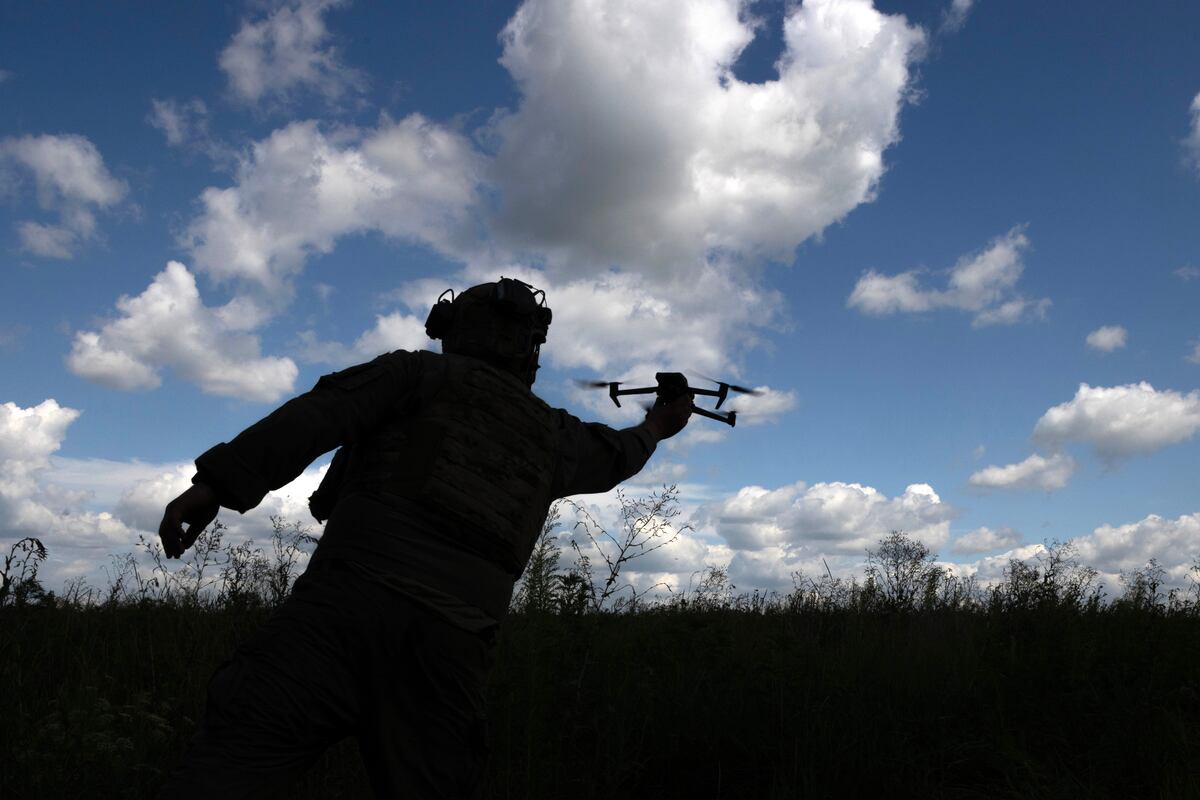
MILAN — Not far from the front lines, under dense vegetation that obstructs satellite signals, a military nano-sized drone is conducting a reconnaissance mission. From a safe distance, the operator utters a voice command that an artificial intelligence-based software turns into drone language, causing the tiny robot to change course: “Sharp turn left and head straight.”
The scenario is hypothetical, but seeing drones in conflict zones embedded with an AI-assistant capability, enabling two-way voice communication between drones and their handlers, could become a reality in the not-so-distant future, according to defense analysts.
“The ultimate goal right now, largely influenced by Ukraine , is to make the interactions between the operator and the drone as efficient as possible,” said Samuel Bendett, research analyst at the U.S.-based Center for Naval Analyses. “This includes how the data is transmitted from the UAV and how it is analyzed by the operator,” he added, using the acronym for unmanned aerial vehicle.
One of the ways defense manufacturers are approaching the problem is by developing ways to simplify how humans steer drones on the battlefield, injecting voice control into the mix to replace the traditional control panels of sticks and levers.
A company who has been experimenting with the technology is U.S.-based Teledyne Flir Defense, which has partnered with AI startup Primordial Labs, of New Haven, Conn., to include voice control to the Black Hornet micro-drone, widely used by militaries globally.
Unveiled at the International SOF Week in Tampa, Florida, in May, the drone was integrated with the Anura software – coined by Primordial Labs as a “tactical AI assistant” – where it was able to receive voice commands from its operator from a computer and fly to different points in the conference hall.
“We first learned about the Anura voice control technology late last year and thought it would be a very interesting modality to bring to our Black Hornet end-users,” Ole Seeland, product director of reconnaissance systems at Teledyne, told Defense News. “U.S. Special Operations Command has supported this effort with both funding and requirements.”
Implementing auditory controls for drones is not necessarily a new science, as Seeland points out, as there is already a considerable amount of research on it from aviation and industrial-robotics applications. What’s new, though, is the increasing interest some militaries in the technology, especially in the United States. Primordial Labs has previously stated that they are on contract with Special Operations Command to fold 100 additional autonomous behaviors into Anura this year.
Traditionally, manufacturers of autonomous systems have relied on visual processes, which Seeland says has led to concerns over greater cognitive burden for operators, reduced situational awareness, and increased time to make decisions.
“This reliance on the visual system is not unexpected as the acoustic environments for many of our customers are not conducive to auditory exchange, but there are use cases for which it is incredibly well-suited,” Seeland said.
These could include alerting a user of changing or critical information while simultaneously providing instructions and suggestions as to what actions to take. Additionally, it can benefit operators wishing to fly their drones hands-free, enabling them to operate multiple missions and helping to reduce human error.
Relying on voice commanding can also be effective for transmitting and receiving a high density of information quickly and intuitively, the Teledyne official added.
The development and integration of voice controls into drones remains at an early stage, in need of additional operational testing.
For Teledyne, fitting the Black Hornet with Anura “is a technology demo, not a finished product … and a good capability demonstrator for future requirements,” Seeland stated. He added that feedback received from the company’s user community indicates they’d like to see the technology more tightly integrated with the rest of the Black Hornet system.
Currently, the scope of spoken orders for the software is rather simple – route reconnaissance, carrying out diverse survey methods in a given zone, or circling a point.
A potential add-on the companies are envisioning is a talk-back capability, where the drone would be able to respond to its operator about what it perceives based on an object-recognition program. At this stage, however, there is no timeframe for when this might happen, said Seeland.
While industry experts seem to agree that the prospect for voice-guided drones to become operational is somewhat near, they argue that it could take some time for them to be acquired by militaries.
“I agree that we’re not decades away, but likely still severely years from adoption by conventional forces,” Matt McCrann, the U.S. subsidiary’s CEO of Australia-based DroneShield, said.
An important element to consider is that the level of interest in this capability will vary, as pointed out by Yoav Poizner, the head of business development at the Israeli firm Elbit Systems. Some less-developed armies are only now beginning to procure modern communication systems, which means voice-controlled drones might not be a priority.
“It might be that this new technology could be right around the corner, but it could also be something customers are not looking for,” Poizner told Defense News in an interview.
Steering drones via voice commands is one of the many machine-intelligence capabilities Elbit is investigating for its Legion X application, a system designed to link several unmanned systems using artificial intelligence.
Bendett, the defense analyst, concurs that although the capability could prove to be convenient, every operator works in a unique way – some may prefer to work as they do now, using visual modalities, while others would be satisfied having a drone communicate back using an actual voice.
Another challenge he highlights is related to the possibility for some users to get emotionally attached to their systems.
“Some are getting attached to their drones as if they were their actual comrades – we are seeing that language used by some Russian bloggers,” he said. “So, if your drone is talking to you as if it is human, and then is lost, that can potentially add a psychological trauma for operators,” Bendett said.
Elisabeth Gosselin-Malo was a Europe correspondent for Defense News. She covers a wide range of topics related to military procurement and international security, and specializes in reporting on the aviation sector. She is based in Milan, Italy.
米兰——在距离前线不远、卫星信号被茂密植被遮蔽的地方,一架军用纳米无人机正在执行侦察任务。操作员在安全距离外发出语音指令,人工智能软件将其转化为无人机语言,从而控制这架微型机器人改变航向:“左急转弯,直飞。”
国防分析人士表示,虽然这只是假设,但在不久的将来,冲突地区部署配备人工智能辅助功能的无人机,实现无人机与其操控人员之间的双向语音通信,可能会成为现实。
“目前的最终目标,很大程度上受到乌克兰局势的影响,是尽可能提高操作员与无人机之间的交互效率,”美国海军分析中心的研究分析师塞缪尔·本德特说。“这包括数据如何从无人机传输以及操作员如何分析这些数据,”他补充道,这里他使用了无人机的缩写。
国防制造商解决这一问题的方法之一是开发简化人类在战场上操控无人机的方法,将语音控制融入其中,以取代传统的操纵杆和控制杆控制面板。
一直在试验这项技术的公司是总部位于美国的 Teledyne Flir Defense,该公司与康涅狄格州纽黑文的人工智能初创公司 Primordial Labs 合作,将语音控制功能添加到全球军方广泛使用的 Black Hornet 微型无人机中。
该无人机于 5 月在佛罗里达州坦帕举行的国际特种作战部队周上亮相,它集成了 Anura 软件(由 Primordial Labs 称为“战术人工智能助手”),能够接收操作员通过计算机发出的语音命令,并飞往会议厅内的不同地点。
“我们去年底首次了解到Anura语音控制技术,并认为将其引入我们的黑黄蜂终端用户会非常有趣,”泰莱达因公司侦察系统产品总监奥勒·西兰德告诉《防务新闻》。“美国特种作战司令部在资金和需求方面都支持了这项工作。”
正如西兰德所指出的,为无人机实现听觉控制并非一项全新的科学,航空和工业机器人领域已经积累了大量相关研究。然而,真正新鲜的是一些军方,尤其是美国军方,对这项技术的兴趣日益浓厚。Primordial Labs此前曾表示,他们已与美国特种作战司令部签订合同,计划今年为Anura无人机新增100种自主行为。
传统上,自主系统的制造商一直依赖视觉过程,但 Seeland 表示,这导致人们担心操作员的认知负担会加重,情境感知能力会下降,决策时间会延长。
“这种对视觉系统的依赖并不出乎意料,因为我们很多客户的声学环境都不利于听觉交流,但在某些情况下,它却非常适用,”西兰德说。
这些功能包括提醒用户注意变更或关键信息,同时提供操作指南和建议。此外,它还能帮助希望实现无人机免手持飞行的操作员,使他们能够执行多个任务,并有助于减少人为错误。
泰莱达因公司的一位官员补充说,依靠语音指令也可以快速、直观地有效地传输和接收高密度信息。
无人机语音控制技术的开发和集成仍处于早期阶段,需要进行更多运行测试。
泰莱公司表示,为“黑黄蜂”无人机配备Anura系统“是一项技术演示,而非最终产品……也是对未来需求的一次很好的能力验证”。西兰德补充道,公司用户群体的反馈表明,他们希望看到这项技术与“黑黄蜂”系统的其他部分更紧密地集成。
目前,该软件的语音指令范围相当简单——路线侦察、在给定区域内执行各种调查方法或绕点飞行。
这些公司设想的一个潜在附加功能是双向通话功能,即无人机能够根据物体识别程序,向操作员反馈其感知到的信息。但西兰德表示,目前尚无该功能何时实现的具体时间表。
虽然业内专家似乎一致认为语音引导无人机投入使用的前景已经比较接近,但他们认为军方可能需要一些时间才能获得这些无人机。
“我同意我们距离普及无人机技术还有几十年的时间,但距离常规部队采用无人机技术可能还有很长的路要走,”总部位于澳大利亚的 DroneShield 公司美国子公司首席执行官 Matt McCrann 表示。
以色列埃尔比特系统公司业务发展主管约阿夫·波伊兹纳指出,需要考虑的一个重要因素是,各方对这项技术的兴趣程度各不相同。一些欠发达国家的军队现在才开始采购现代通信系统,这意味着语音控制无人机可能并非他们的优先事项。
“这项新技术可能即将问世,但也可能是客户并不需要的东西,”波伊兹纳在接受《防务新闻》采访时表示。
通过语音命令操控无人机是埃尔比特公司正在为其 Legion X 应用研究的众多机器智能功能之一,Legion X 是一个旨在利用人工智能连接多个无人系统的系统。
国防分析师本德特也认为,虽然这种能力可能很方便,但每个操作员的工作方式都不同——有些人可能更喜欢像现在这样使用视觉方式工作,而另一些人则会满足于让无人机用真正的语音进行交流。
他强调的另一个挑战是,一些用户可能会对他们的系统产生情感依恋。
“有些人对无人机产生了感情,就像对待自己的战友一样——我们看到一些俄罗斯博主就使用了这种说法,”他说。“所以,如果你的无人机像人一样和你说话,然后又丢失了,这可能会给操作人员造成心理创伤,”本德特说。
伊丽莎白·戈斯林-马洛曾任《防务新闻》欧洲通讯员。她的报道涵盖军事采购和国际安全等广泛领域,尤其擅长航空领域的报道。她常驻意大利米兰。