US Coast Guard cutter tests lethal capabilities at RIMPAC美国海岸警卫队巡逻舰在环太平洋军事演习中测试致命能力
U.S. Coast Guard cutters are punching above their weight in the Pacific, conducting higher-end missions and operating at longer ranges than usual.
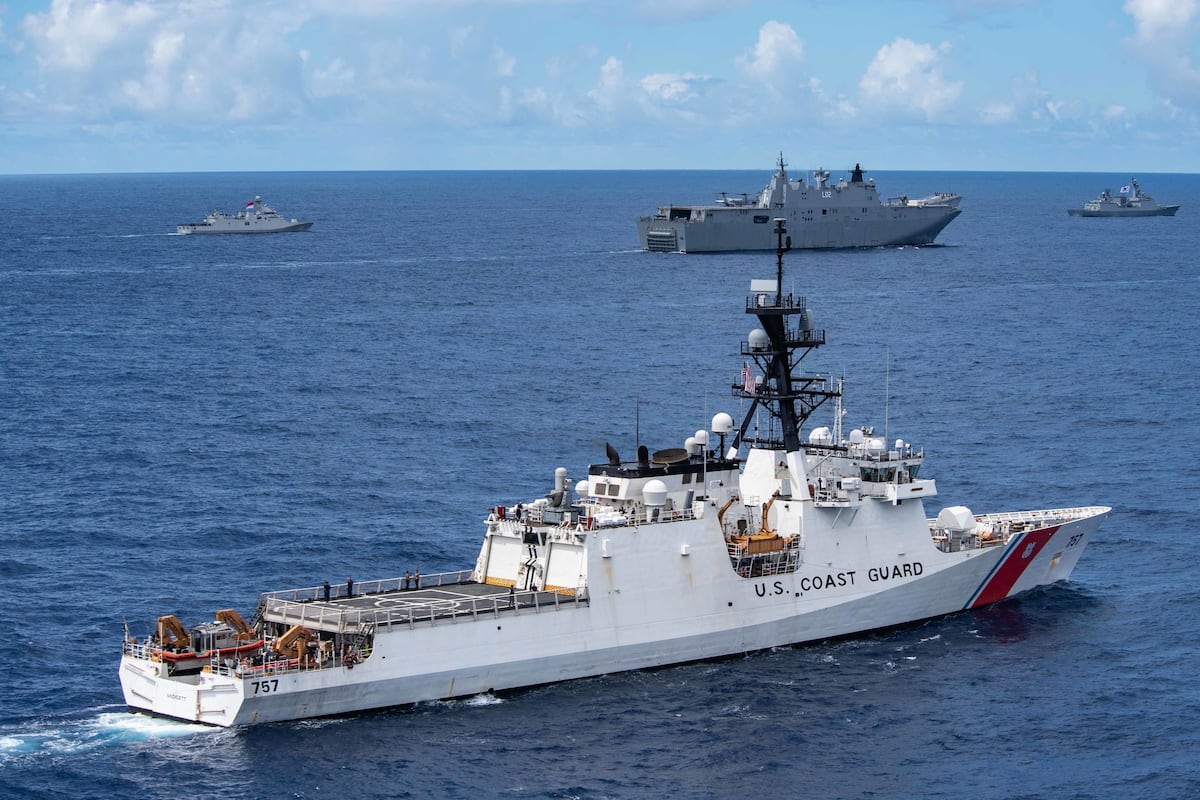
COAST GUARD BASE HONOLULU — For the first time, a U.S. Coast Guard national security cutter oversaw American and foreign navy ships during high-end military drills, including an anti-submarine warfare scenario.
The service’s cutters stationed in Hawaii have used naval exercises and deployments over the last year to show how it can punch above its weight while the U.S. Navy implements its distributed maritime operations vision.
During the recent Rim of the Pacific exercise, which ran from June 29 to Aug. 4 , the Coast Guard cutter Midgett commanded an international task force overseeing maritime interdiction operations, while also providing its deck to a U.S. Navy helicopter in a display of joint service collaboration.
Another RIMPAC participant, the fast response cutter William Hart, last fall deployed to American Samoa for a mission with a 10-day transit time that well exceeded the typical range of that ship class. During last year’s Large Scale Exercise, the vessel embarked with Marines to establish a joint force communications node — showing across the two events how small cutters can play a pivotal role as the eyes and ears of the military in places the Navy visits less frequently.
The Navy envisions a network of joint and coalition assets scattered around the Pacific to contribute to an overall common operating picture of the region. The more of these assets that are lethal, the better, the thinking goes: given a single adversary couldn’t target all the coalition assets that pose a threat, these distributed lethality and distributed maritime operations concepts could provide a deterrent effect.
But the Navy can only keep so many ships sailing around the Pacific at any given time, which means partners and allies are key, as are Coast Guard ships and aircraft, something that was highlighted in the 2020 Tri-Service Maritime Strategy . The document specifically asks the Coast Guard to conduct freedom of navigation operations to challenge excessive maritime claims; conduct law enforcement operations against terrorism, weapons proliferation, transnational crime and piracy; and enforce sanctions through maritime interdiction operations.
Vice Adm. Andrew Tiongson, who commands Coast Guard Pacific Area, told Defense News the service implemented that strategy by deploying Coast Guard liaisons on Navy ships as well as training with and operating the Navy’s equipment to bolster interoperability.
“As we prepare for high-end joint operations in the maritime domain, we will support naval efforts with complementary capabilities throughout the Indo-Pacific with port security units, strategic asset escorts and other unique strengths to augment capacity. The more intertwined our services are prior to conflict, the easier we will adapt when needed,” Tiongson said.
Commanding a task force
Midgett and William Hart, along with other cutters based in Honolulu, are going beyond requirements of the tri-service strategy.
The former’s RIMPAC experience was unusual, achieving several firsts for the Coast Guard and pushing its own boundaries in terms of lethality and joint force interoperability. For example, Midgett commanded a RIMPAC task force — something no Coast Guard cutter has ever done. Its commanding officer, Capt. Willie Carmichael, led Combined Task Force 175 ships, including U.S. Navy destroyers Chafee and Gridley, French Navy frigate Prairial and Peruvian Navy frigate Guise .
This task force oversaw maritime interdiction operations for the combined maritime force at RIMPAC, and it also conducted anti-submarine warfare drills — something a Coast Guard cutter cannot do, but that Midgett was able to oversee through advanced Link 16 network connectivity.
“These national security cutters are built to interface with — from the technology, and the command and control, and the communication links — to fall right in line with the Navy and [Defense Department] counterparts. So these RIMPACs are awesome opportunities to exercise that,” Chief Matt Masaschi, a spokesman for Coast Guard Pacific Area, told reporters during a tour of Midgett.
A U.S. Navy Sailor displays post-flight signals to the Navy MH-60R Seahawk helicopter crew during flight operations aboard Legend-class cutter USCGC Midgett (WMSL 757) during Rim of the Pacific (RIMPAC) 2022 on July 12. (Petty Officer 3rd Class Taylor Bacon/US Coast Guard)
Carmichael said during the tour that he spent nearly four weeks preparing to take command of the task force, which involved hosting Navy subject matter experts on the ship ahead of RIMPAC “to help us integrate more at a higher level for those higher-warfare areas.”
Midgett will soon depart Hawaii for a Western Pacific patrol under the U.S. Navy’s 7th Fleet, highlighting the importance of that service interoperability.
Midgett also carried a Navy MH-60R helicopter for predeployment training, and then for the whole duration of RIMPAC. This was the first time that helicopter type embarked on a Coast Guard ship.
Carmichael said the MH-60 can fit in a national security cutter’s hangar if it folds up its blades and tail. The capability and range of the MH-60 could be of great value to the ship during law enforcement missions. And the Navy could benefit from this experience by conducting MH-60 anti-submarine operations from a cutter’s deck.
This experiment was partly meant to determine how to “sustain that particular airframe, how do you support it for a long-range, two-month or three-month deployment,” Carmichael said.
Midgett also showed off its lethal traits, taking what it learned from the MH-60 and Link 16 system to serve as an adversary in another at-sea scenario of RIMPAC.
The cutter collaborated with other opposing force ships to track and hunt vessels, earning nine “constructive kills,” which involved providing targeting data to allied assets that resulted in immediate simulated strikes.
Midgett also participated in a shooting competition among RIMPAC participants. Though a cutter would typically employ its weapons for self-defense or in a law enforcement context, this shoot-off gave participants a GPS coordinate for a simulated island and asked them to conduct a land-attack mission.
“That’s not typical for us, island targets,” said the ship’s weapons officer, Ensign Matthew Pindell, adding that the ship used its 57mm MK 110 cannon with an 8-mile range to go after the target.
Pindell said the crew recently used its Phalanx close-in weapon system to shoot at a missile target towed by a Learjet, noting that this type of experience is important for the upcoming deployment to 7th Fleet’s area of responsibility.
As Midgett pushes the boundaries of what a Legend-class national security cutter can do, the service has found areas that require improvement, Carmichael said. For example, the ship and its crew lack “the ability to plan and execute long-range planning efforts that are very complex in a maritime environment. So we’re learning some of those lessons from our Navy counterparts as well and their best practices. We actually brought some of their subject matter experts onboard” so the crew could learn and then share those lessons with the other ships in the class.
The Coast Guard’s fast response cutters in Honolulu — roughly a third of the length of national security cutters — have taken on presence missions in Oceania that were once conducted by much larger vessels.
Cmdr. Cynthia Travers, the commanding officer of William Hart, said her ship and crew of 24 — along with the two other fast response cutters based in Honolulu — have had an outsized impact on American presence in Oceania.
Though the ship class is usually called for law enforcement, search and rescue, and environmental protection missions around the Hawaiian Islands, “last fall we operated between Oahu and American Samoa. It’s about a 10-day transit for us, so it’s sort of doing a larger-ship mission with a small Coast Guard cutter,” she said.
That transit was uncomfortable for the crew, she acknowledged, and the cutter had to sail at just 10 knots (12 mph) to conserve fuel and ensure it could make it to American Samoa without refueling at sea, given no assets were available to sail with William Hart or link up midway.
Fast response cutters out of Hawaii and Guam are more likely taken on these longer-range transits.
U.S. Marine Corps Sgt. Anthony Garcia Ballard, a communications specialist with 3d Marines, 3d Marine Division, establishes communications with USCGC William Hart (WPC 1134) during Large Scale Exercise 2021 at U.S. Coast Guard Base Honolulu, Aug. 5, 2021. (Cpl. Juan Carpanzano/US Marine Corps)
During William Hart’s trip to Oceania last fall, it operated alongside ships from the U.S., Australia, New Zealand and France to combat illegal, unreported and unregulated fishing. Though the mission itself wasn’t high end, it put the cutter in a location in which U.S. Navy ships were unlikely to operate, creating an opportunity for the joint force.
And during Large Scale Exercise 2021, William Hart and a team of Marines combined their sensors into a single, common-operating picture of the battlespace. Ships and aircraft the Coast Guard saw with its sensors were shared to the Marine Corps network, using both the Coast Guard’s Rescue 21 system and the Marines’ satellite communications technology, building a clearer picture for maritime domain awareness.
“We’re sort of filling a gap that exists right now. There are some larger cutters that are under construction that we’re hoping will be able to take on this mission in the years to come, but for right now the fast response cutter is the tool that we have here that can respond to that need,” Travers said.
Megan Eckstein is the naval warfare reporter at Defense News. She has covered military news since 2009, with a focus on U.S. Navy and Marine Corps operations, acquisition programs and budgets. She has reported from four geographic fleets and is happiest when she’s filing stories from a ship. Megan is a University of Maryland alumna.
美国海岸警卫队檀香山基地——美国海岸警卫队国家安全巡逻舰首次在高端军事演习中监督美国和外国海军舰艇,其中包括反潜作战场景。
过去一年,驻扎在夏威夷的美国海军巡逻舰通过海军演习和部署,展示了其如何以小博大,而美国海军则在实施其分布式海上作战愿景。
在最近举行的环太平洋军事演习(6 月 29 日至 8 月 4 日)期间,海岸警卫队巡逻舰“米吉特”号指挥了一支国际特遣部队,负责监督海上拦截行动,同时还向美国海军直升机提供了甲板,以展示联合军种合作。
另一艘参加环太平洋军演的快速反应巡逻舰“威廉·哈特”号,去年秋季部署至美属萨摩亚执行任务,航程长达10天,远远超出该级舰艇的典型航程。在去年的大规模演习中,该舰搭载海军陆战队建立了一个联合部队通信节点——这两次行动都表明,小型巡逻舰如何在海军不常到访的地区发挥关键作用,成为军队的耳目。
海军设想在太平洋地区建立一个由联合和盟军资产组成的网络,以构建该地区的整体作战态势图。其思路是,这些资产中具有杀伤力的越多越好:鉴于单个敌方无法攻击所有构成威胁的盟军资产,这种分布式杀伤力和分布式海上作战理念可以起到威慑作用。
但海军在太平洋海域同时航行的舰艇数量有限,这意味着合作伙伴和盟友至关重要,海岸警卫队的舰艇和飞机也同样重要,这一点在2020年三军联合海上战略中得到了强调。该文件特别要求海岸警卫队开展航行自由行动,挑战过度的海上主张;开展打击恐怖主义、武器扩散、跨国犯罪和海盗行为的执法行动;并通过海上拦截行动执行制裁。
负责指挥美国海岸警卫队太平洋地区的安德鲁·蒂昂森中将告诉《防务新闻》,海岸警卫队通过在海军舰艇上部署海岸警卫队联络员以及与海军进行训练和操作海军设备来加强互操作性,从而实施了这一战略。
“在筹备海上高端联合行动之际,我们将利用港口安保部队、战略资产护航以及其他独特优势,以互补能力支持整个印太地区的海军行动,从而增强作战能力。冲突爆发前,各军种之间的协同作用越强,我们在需要时就越容易做出调整,”蒂昂森说道。
指挥特遣队
米吉特和威廉·哈特以及其他驻扎在檀香山的巡逻艇正在超越三军战略的要求。
前者在环太平洋军演中的经历非同寻常,为海岸警卫队创造了多项第一,并在杀伤力和联合部队互操作性方面突破了自身极限。例如,米吉特号指挥了一支环太平洋特遣部队——这是海岸警卫队任何舰艇都未曾做到的。该特遣部队的指挥官威利·卡迈克尔上校率领了由175艘舰艇组成的联合特遣部队,其中包括美国海军驱逐舰“查菲”号和“格里德利”号、法国海军护卫舰“普雷里亚尔”号以及秘鲁海军护卫舰“吉斯”号。
该特遣部队负责监督环太平洋军演中联合海上部队的海上拦截行动,并进行了反潜作战演习——这是海岸警卫队巡逻舰无法完成的,但米吉特号通过先进的Link 16网络连接能够进行监督。
“这些国家安全舰艇的设计旨在与海军和国防部的同类舰艇进行对接——从技术、指挥控制到通信链路——完全一致。因此,这些环太平洋军演是演练这种对接的绝佳机会,”海岸警卫队太平洋地区发言人马特·马萨斯基上校在参观“米吉特”号时告诉记者。
2022年7月12日,在环太平洋军演(RIMPAC)期间,一名美国海军水兵在“传奇”级巡逻舰“米吉特”号(USCGC Midgett,WMSL 757)上进行飞行作业时,向海军MH-60R“海鹰”直升机机组人员展示飞行后信号。(三级士官泰勒·培根/美国海岸警卫队)
卡迈克尔在参观期间表示,他花了近四周时间准备接管特遣部队的指挥权,其中包括在环太平洋军演之前在舰上接待海军相关领域的专家,“以帮助我们更好地整合更高层次的作战领域”。
米吉特号即将离开夏威夷,前往美国海军第七舰队的西太平洋进行巡逻,这凸显了该舰队互操作性的重要性。
“米吉特”号还搭载了一架海军MH-60R直升机用于部署前训练,并在整个环太平洋军演期间服役。这是该型号直升机首次部署在海岸警卫队舰艇上。
卡迈克尔表示,如果MH-60折叠起落架和尾翼,它可以停放在国家安全舰艇的机库中。MH-60的性能和航程对于该舰执行执法任务来说至关重要。海军也可以从MH-60在舰艇甲板上执行反潜作战的经验中获益。
卡迈克尔说,这项实验的部分目的是为了确定如何“维持该特定机身的正常运转,如何支持其进行长达两到三个月的长期部署”。
米吉特还展示了其致命特性,它从 MH-60 和 Link 16 系统中学到了东西,在环太平洋军演的另一个海上场景中扮演了对手的角色。
该巡逻舰与其他敌对部队的舰船合作,追踪和猎杀船只,取得了九次“建设性击杀”,即向盟军提供目标数据,从而立即进行模拟打击。
米吉特还参加了环太平洋军演参演人员之间的射击比赛。虽然巡逻艇通常会将武器用于自卫或执法,但这次射击比赛却给参赛者提供了一个模拟岛屿的GPS坐标,并要求他们执行一次陆地攻击任务。
“这对我们来说并不常见,我们通常不会攻击岛屿目标,”该舰武器官马修·平德尔少尉说道,并补充说,该舰使用了射程为 8 英里的 57 毫米 MK 110 型舰炮来攻击目标。
平德尔表示,机组人员最近使用“密集阵”近程防御武器系统射击了一架由里尔喷气机拖曳的导弹目标,并指出这种经验对于即将部署到第七舰队责任区非常重要。
卡迈克尔表示,随着“米吉特”号不断拓展“传奇”级国家安全舰艇的能力边界,海军也发现了一些需要改进的地方。例如,该舰及其船员缺乏“在海上环境中制定和执行极其复杂的长期计划的能力”。因此,我们也在向海军同行学习他们的最佳实践。我们甚至邀请了一些他们的专家登舰”,以便船员们能够学习,并将这些经验分享给同级的其他舰艇。
驻扎在檀香山的海岸警卫队快速反应巡逻舰(长度约为国家安全巡逻舰的三分之一)已承担起在大洋洲执行的部署任务,而这些任务以前是由更大的船只执行的。
“威廉·哈特”号的指挥官辛西娅·特拉弗斯中校表示,她的舰艇和24名船员,以及驻扎在檀香山的另外两艘快速反应巡逻舰,对美国在大洋洲的存在产生了巨大的影响。
她说:“虽然该级舰艇通常用于夏威夷群岛附近的执法、搜救和环境保护任务,但去年秋天我们曾在瓦胡岛和美属萨摩亚之间执行任务。对我们来说,这段航程大约需要 10 天,所以这相当于用一艘小型海岸警卫队巡逻艇执行大型舰艇的任务。”
她承认,那次航行对船员来说很不舒服,而且由于没有其他船只可以与威廉·哈特号一起航行或在中途会合,为了节省燃料并确保能够到达美属萨摩亚而无需在海上加油,这艘巡逻艇不得不以 10 节(12 英里/小时)的速度航行。
从夏威夷和关岛出发的快速反应巡逻艇更有可能执行这些远程航行任务。
2021年8月5日,在檀香山美国海岸警卫队基地举行的2021年大规模演习期间,美国海军陆战队第3师第3陆战团的通信专家安东尼·加西亚·巴拉德中士与美国海岸警卫队“威廉·哈特”号巡逻舰(WPC 1134)建立通信。(下士胡安·卡潘扎诺/美国海军陆战队)
去年秋天,威廉·哈特号巡逻舰访问大洋洲期间,与来自美国、澳大利亚、新西兰和法国的舰艇协同作战,打击非法、未报告和无管制捕捞活动。虽然此次任务本身并非高端行动,但它使这艘巡逻舰进入了美国海军舰艇不太可能涉足的区域,为联合部队提供了行动机会。
在2021年大规模演习期间,威廉·哈特和一支海军陆战队小队将各自的传感器整合到一个统一的战场态势图上。海岸警卫队利用其传感器观测到的舰船和飞机信息通过海岸警卫队的“救援21”系统和海军陆战队的卫星通信技术共享到海军陆战队网络,从而构建出更清晰的海上态势感知图。
特拉弗斯说:“我们正在填补目前存在的空白。一些更大的切割船正在建造中,我们希望它们能在未来几年承担这项任务,但就目前而言,快速反应切割船是我们能够满足这一需求的工具。”
梅根·埃克斯坦是《防务新闻》的海军作战记者。自2009年以来,她一直从事军事新闻报道,主要关注美国海军和海军陆战队的行动、采购项目和预算。她曾报道过四个不同地理区域的舰队,最喜欢在舰艇上进行新闻报道。梅根毕业于马里兰大学。