Chinese military analysts can’t wait for the US Navy’s battleship era中国军事分析人士迫不及待地想要看到美国海军的战列舰时代。
Opinion: A PLA assessment of the proposed Trump-class battleships probes for weaknesses.
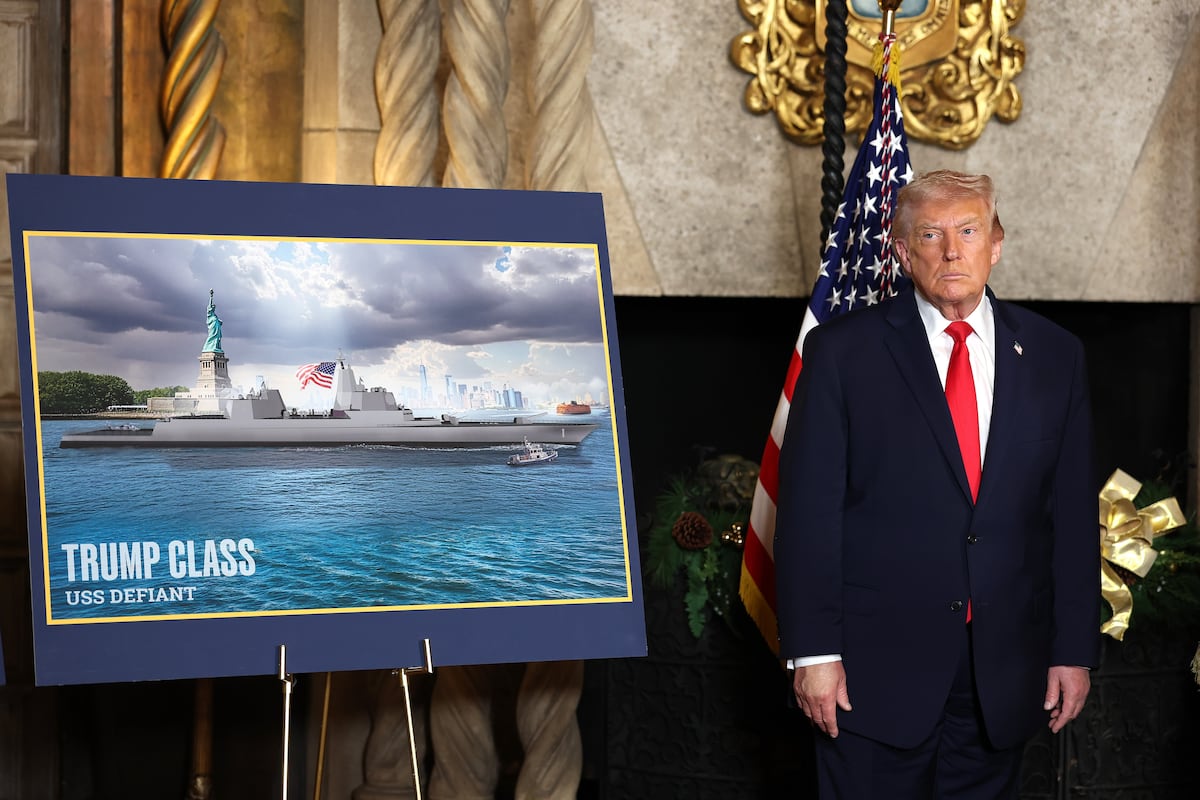
The U.S. Navy has experienced some considerable setbacks in recent months, from a power failure on a destroyer in the South China Sea to morale issues aboard the aircraft carrier USS Lincoln. Still, the service has been buoyed by a nationwide recognition that shipbuilding has too long been neglected and the current administration seems to have a variety of innovative maritime strategy concepts, encompassing a new vision for the fleet.
Among these ideas, none have been more controversial than the proposed Trump-class battleship .
Proponents argue that this new capital ship would bring concentrated fighting power with new high-tech weapons and large magazines that could fight independently and also withstand substantial punishment in battle. With its currently planned nuclear propulsion, moreover these behemoths could patrol for extended periods without the need to refuel.
Critics have taken aim at the project’s enormous expense, as well as the feasibility of the proposed design that is characterized as over-ambitious.
Into this roiling debate, it is instructive to survey a rather different perspective: What do the Chinese make of this project? An Aug. 21 article in China National Defense News [中国国防报] provides some initial insights into how America’s chief global rival is assessing this potentially major change in direction for the U.S. Navy surface fleet.
This article, published in an official paper of the Peoples Liberation Army (PLA) does note that the ship could have the advantages that “large vessels can continue to execute certain combat missions even when communications are jammed, and their hulls offer superior damage resistance compared to small or medium-sized ships.” It notes that smaller, distributed platforms could overly “rely on stable data links.” In addition, it’s worth observing that this rendering does note that the planned U.S. battleship would have nuclear propulsion, and would possibly also carry nuclear-armed missiles.
Nevertheless, the Chinese analysis, mirroring many Western evaluations, is suffused with ample skepticism.
For 15 Trump-class battleships built between 2028 and 2056, the costs would amount to $275 billion, with the lead class carrying the price tag of $23.4 billion. The report says that cost is 55% higher due to the change from conventional to nuclear propulsion and terms this price as “exorbitant.” Illustrating some familiarity with nuclear power issues, the analysis adds that “nuclear waste disposal and vessel dismantling following retirement are not included” in the $275 billion estimate.
“Unfinalized designs and insufficient technological maturity” are also flagged as potential major problem that may cause delays and cost overruns. Potentially carrying rail guns, hypersonic weapons, as well as lasers, this critique seems quite valid. As the PLA assessment states: “This ‘build the platform first, install equipment later’ approach could increase the risks.” The piece cites the examples of the both the Zumwalt-class destroyer and the Littoral Combat Ship (LCS) as relevant examples of recent problematic programs.
Notably, the Chinese article is also particularly attuned to potential shifts in the basic U.S. Navy warfighting doctrinal paradigm.
The article observes: “This design differs from the Distributed Maritime Operations concept that the U.S. Navy has been advancing in recent years. The theory of distributed maritime operations emphasizes the dispersal of detection, command, and strike capabilities across multiple nodes … to mitigate the impact that damage to a few large vessels would have on the entire formation.”
In a closely related point, the PLA article also broaches the question of whether large surface combatants are simply too vulnerable to quiet submarines, hypersonic missiles, and “drone swarms.”
Apparently quite aware of major difficulties in U.S. shipbuilding, the Chinese military assessment adds that leading American shipyards “are currently facing average delays of five years, with the delivery cycle for a single ship extending from approximately five years in the early 2000’s to about eleven years today.”
Noting that the new battleship program could have cascading results for other high priority U.S. Navy programs, the article concludes: “Assembly of nuclear-powered battleships … could further slow the construction of aircraft carriers and submarines.” These Chinese strategists are no doubt aware such a delay would further impact the Asia-Pacific naval balance.
China itself has indicated interest in nuclear-powered surface vessels. Thus, they have thoroughly investigated the newly renovated Russian battle cruiser Admiral Nakihimov.
Yet it is would be foolhardy to invest in such ambitious platforms for the U.S. Navy at a time when the service confronts so many shipbuilding challenges and when the nation also faces an inevitable process of belt-tightening. Perhaps some of America’s allies can experiment with the new battleship concept. But the U.S. Navy will be well advised to go toward its time-tested strengths, especially in undersea warfare, but also in the emergent domain of drones.
Overall, America’s sea service must bring its force structure into alignment with a new strategy appropriate to the multipolar world that involves reducing expensive “presence” missions and embracing more cost-effective hedging.
That will most likely mean a less high-profile role for surface combatants and thus recognizing the reality that the Trump-class battleship will most likely never get built.
Certainly, this Chinese military article implies that at least some Chinese strategists are eager for the U.S. to pursue that extravagant project, knowing that it is folly and would thus weaken Beijing’s chief rival.
Lyle Goldstein is director of the China Initiative at Brown University’s Watson School and concurrently serves as director of the Asia Program at the think-tank Defense Priorities.
近几个月来,美国海军遭遇了一系列重大挫折,从南海一艘驱逐舰的电力故障到“林肯”号航空母舰上的士气低落。尽管如此,全国范围内普遍认识到造船业长期以来被忽视,以及现任政府似乎拥有一系列创新性的海上战略理念(涵盖了舰队发展的新愿景),都提振了海军士气。
在这些想法中,没有比提议建造的“特朗普级”战列舰更具争议性的了。
支持者认为,这种新型主力舰将配备高科技武器和大容量弹药库,拥有强大的集中战斗力,能够独立作战,并在战斗中承受巨大的打击。此外,凭借目前计划的核动力推进系统,这些巨舰无需补充燃料即可长时间巡逻。
批评人士抨击该项目耗资巨大,以及所提出的设计方案过于雄心勃勃,其可行性也受到质疑。
在这场激烈的争论中,不妨从一个截然不同的视角来审视一下:中国人如何看待这个项目?8月21日《中国国防报》的一篇文章初步揭示了美国的主要全球竞争对手是如何评估美国海军水面舰队这一可能具有重大意义的方向转变的。
这篇发表于中国人民解放军官方报纸的文章指出,该舰的优势在于“大型舰艇即使在通信受到干扰的情况下也能继续执行某些作战任务,而且其船体比中小型舰艇具有更强的抗损能力”。文章还指出,小型分散式平台可能过于“依赖稳定的数据链路”。此外,值得注意的是,该渲染图显示,计划中的美国战列舰将采用核动力推进,并且可能还会携带核导弹。
然而,与许多西方评价一样,中国的分析也充满了怀疑态度。
2028年至2056年间建造15艘特朗普级战列舰的总成本将达到2750亿美元,其中首舰造价为234亿美元。报告指出,由于动力系统从传统动力转向核动力,成本增加了55%,并称这一价格“高得离谱”。该分析还表明其对核电问题有一定的了解,并补充说,2750亿美元的估算“不包括核废料处理和舰艇退役后的拆解费用”。
“设计尚未最终定型和技术成熟度不足”也被认为是可能导致延误和成本超支的潜在重大问题。考虑到这些舰艇可能搭载电磁轨道炮、高超音速武器以及激光武器,这一批评似乎颇有道理。正如解放军评估报告所述:“这种‘先造平台,后装设备’的做法可能会增加风险。”报告以朱姆沃尔特级驱逐舰和濒海战斗舰(LCS)为例,指出它们是近期问题重重的项目。
值得注意的是,这篇中文文章也特别关注美国海军基本作战理论范式的潜在转变。
文章指出:“这种设计与美国海军近年来一直在推进的分布式海上作战概念有所不同。分布式海上作战理论强调将探测、指挥和打击能力分散到多个节点……以减轻少数大型舰艇受损对整个编队的影响。”
在密切相关的一点上,解放军的文章还提出了一个问题,即大型水面作战舰艇是否太容易受到静音潜艇、高超音速导弹和“无人机群”的攻击。
中国军方评估报告显然非常清楚美国造船业面临的重大困难,报告还指出,美国主要造船厂“目前面临平均五年的延误,单艘舰艇的交付周期从2000年代初的大约五年延长到如今的大约十一年”。
文章指出,新的战列舰项目可能会对美国海军其他高优先级项目产生连锁反应,并总结道:“核动力战列舰的组装……可能会进一步延缓航空母舰和潜艇的建造。” 这些中国战略家无疑意识到,这样的延误将进一步影响亚太地区的海军力量平衡。
中国自身也对核动力水面舰艇表现出了兴趣。因此,他们对新近翻新的俄罗斯战列巡洋舰“纳基希莫夫海军上将”号进行了深入考察。
然而,在美军面临诸多造船挑战,且国家也不得不缩减开支之际,投资如此雄心勃勃的平台无疑是鲁莽之举。或许美国的某些盟友可以尝试一下这种新型战列舰的概念。但美国海军明智的做法是发挥其久经考验的优势,尤其是在水下作战以及新兴的无人机领域。
总体而言,美国海军必须调整其兵力结构,使其符合多极世界的新战略,包括减少昂贵的“存在”任务,并采取更具成本效益的对冲措施。
这很可能意味着水面作战舰艇的作用将不再那么引人注目,从而也承认了特朗普级战列舰很可能永远不会建造的现实。
当然,这篇中国军事文章暗示,至少有一些中国战略家渴望美国继续推进这项奢侈的计划,尽管他们知道这是愚蠢的,这样做会削弱北京的主要竞争对手。
莱尔·戈德斯坦是布朗大学沃森公共政策学院中国倡议项目的负责人,同时也是智库“国防优先事项”亚洲项目的负责人。