CIA Tracked Down A Nazi, Scoured Museums To Build An Aircraft Siren To Scare The Hell Out Of People中央情报局追踪到一名纳粹分子,搜遍博物馆,打造出一个飞机警报器,用来吓唬民众。
The CIA was on a quest to build a device similar to the siren the Nazis had used on their legendary Ju-87 Stuka dive bombers.
新闻视频
By Joseph Trevithick
Updated Apr 10, 2020 1:57 PM EDT
More than a decade after the end of World War II, the Central Intelligence Agency initiated a project to develop an air-driven siren that it could readily attach to a small aircraft for psychological warfare operations . The inspiration for this device, dubbed the Jericho Horn, was a similar system the Nazis had employed on the legendary Ju-87 Stuka dive bomber. In the end, the CIA tracked down the designer of that siren and scoured museums in the United States for information about the Stuka before building its own prototypes.
An unknown CIA officer appears to have first made a handwritten request for “a siren or screamer type noisemaker for psychological warfare” for use on an aircraft on May 8, 1958, kicking off what was also referred to as the “Screamer Project.” The exact reason why the Agency wanted this device is unclear, but “the device is to be used in conjunction with a current high priority Agency project,” according to another report, requesting to initiate “Task S,” dated Sept. 5, 1958. Other records say that the requirement originated with the CIA’s Far East Division. These and other documents related to the Jericho Horn effort are now declassified, with significant redactions, and available online via the CIA Records Search Tool, or CREST.
The handwritten document says that the CIA wanted the horn to be able to work with a P-51 Mustang propeller-engine fighter. The Agency wanted it to be able to be sufficiently disconcerting with the aircraft flying at speeds between 280 and 300 miles per hour and at an altitude of just 300 feet.
A portion of the May 1958 handwritten CIA request for the “siren or screamer.”, CIA
This proposed combination is not necessarily surprising. In the first few decades after its creation in 1947, the Agency regularly used a wide array of surplus World War II-era aircraft for covert operations around the world. During the CIA-orchestrated overthrow of Guatemalan President Jacobo Árbenz in 1954, a mercenary-piloted P-47 Thunderbolt notably bombed the city of Chiquimula, some 65 miles east of Guatemala City, as part of associated psychological warfare effort to demoralize and confuse regime forces.
The problem was that the CIA appears to have had no idea about how to go about building such a thing. “Dan says it can be done, but if program is to be a fresh start considerable time & money are involved,” the initial handwritten request explained. There is no hint as to who this “Dan” might have been.
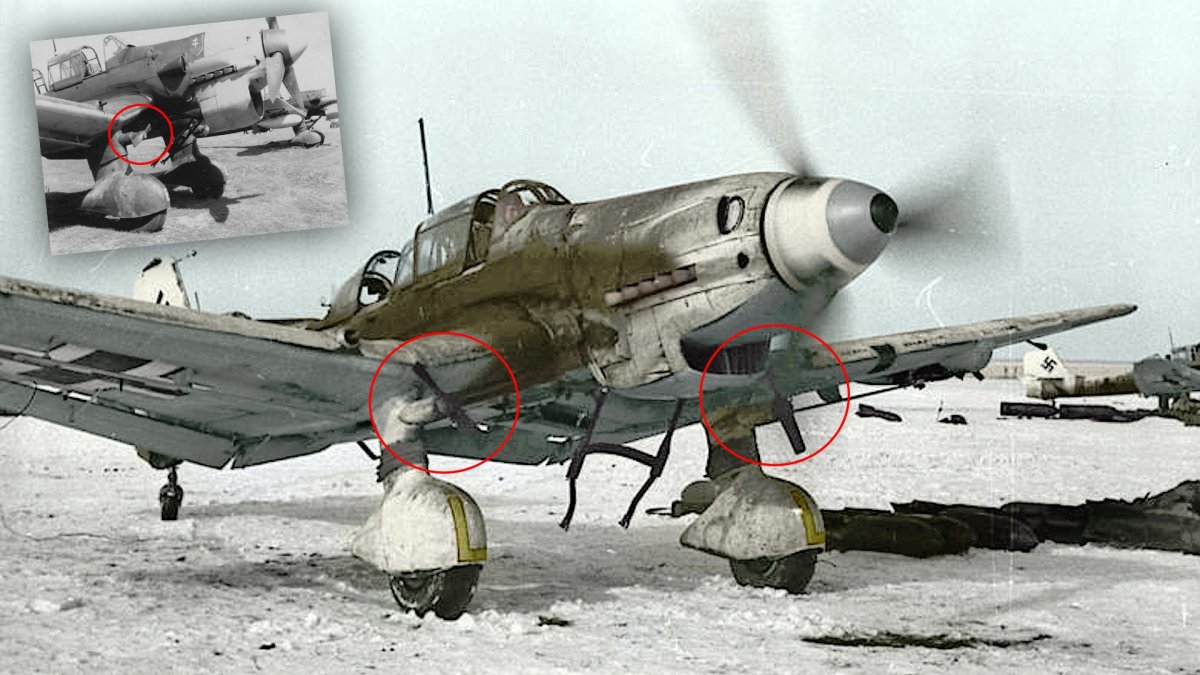
Quite reasonably, the CIA’s first thought was to see if the Air Force had a Ju-87 so personnel could examine the design of the original siren. The Stuka had two mounts, one on each of the fairings covering both of its fixed main landing gear struts, for what the Germans themselves had called Jericho Trompetes , or Jericho Trumpets. Both this and the CIA’s name for their device are references to the Old Testament story , also found in the Hebrew Bible, of the Israelites, under the command of Joshua, blowing rams’ horns to bring down the walls of the city of Jericho.
A contemporary picture of a Jericho Trumpet installed on a Ju-87 Stuka dive bomber., Public Domain
Another Stuka with the Jericho Trumpets installed., Public Domain
The Agency found that the Air Technical Intelligence Center did at one point have a Stuka, but had gotten rid of it and it was unclear where it had gone. “May now be in air museum or Army archives,” the officers writing up the Jericho Horn request noted.
CIA personnel also visited the Smithsonian Institution believing that it might have a complete Jericho Trumpet in its collection, but not on public display. As it turned out, the Smithsonian did not have one of the sirens and Paul Garber, then the Assistant Director of the Institutions Aeronautics Section told them to check with the Museum of Science and Industry in Chicago, Illinois, which, to this day, has a Ju-87 on display. Garber was also the first head of the National Air Museum, the predecessor to today’s National Air and Space Museum.
The handwritten report does not say what happened when CIA officials went to Chicago, but they would have been disappointed again. The aircraft there, which is a Ju-87R-2/Trop variant, is missing its landing gear fairings. The “Trop” in the designation refers to the aircraft’s tropical operations kit, which the German had developed for flying in hot and sandy environments, such as North Africa.
The Ju-87R-2/Trop on display at the Museum of Science and Industry in Chicago., Daderot via Wikimedia
Trying to find Ju-87 with a working example of an original Jericho Trumpet would have been something of a wild goose chase. Junkers delivered more than 5,000 Stukas of all variants delivered to the Luftwaffe between 1936 and 1944, but the Nazis continued to send the increasingly obsolete aircraft into combat right until the very end of World War II. Today, just as it was when the CIA began their Jericho Horn project in 1958, there are just two effectively complete Ju-87s on display anywhere in the world, the one in Chicago and another at the Royal Air Force Museum in the United Kingdom. Various groups have or have had plans to restore other examples and there are a small number of partial aircraft in other museums, as well.
Given the difficulty of finding an original Jericho Trumpet, the CIA eventually went in a completely different direction. Starting in 1946, the U.S. government had initiated a secret program, known as Operation Paperclip , to relocate German scientists, engineers, and other technical specialists to the United States in order for them to work for the U.S. government and to keep them from doing the same for the Soviet Union.
The Agency identified Henning Von Girke, who had designed the original Jericho Trumpet, among the “Paperclips” working at the Air Force’s Wright-Patterson Air Force Base. Von Girke subsequently provided design notes and technical details regarding his siren.
A handwritten note regarding the location of Henning Von Girke from the CIA’s May 1958 request for the Jericho Horn., CIA
Not everyone was thrilled with the Jericho Horn plan. In a meeting on May 12, 1958, another individual the CIA consulted, who’s name is redacted in the handwritten document, pointed out that the Ju-87’s iconic whine while diving actually came from its structural design and that the Germans themselves had only made limited use of the Jericho Trumpets, despite them being a popular point in any discussion about the Stuka. The trumpets added drag and slowed down the already sluggish dive bombers and alerted defenders that they were coming, all of which made the aircraft vulnerable.
This person also pointed out that the Navy had hired the Chrysler Corporation’s Dynamic Laboratory to develop a similar siren during World War II and that they had succeeded in crafting a superior design to German Jericho Trumpet. Unfortunately, testing on a Grumman F6F Hellcat propeller-engine fighter showed that the device made the plane dangerously unstable.
The Navy subsequently abandoned the effort, deciding that further development would not “be of significant value.” The individual also told CIA officials that they were “very doubtful [the] whistle will be of value.”
A handwritten note about the siren that Chrysler developed for the US Navy, including a basic drawing of its design., CIA
The CIA decided to continue with the project and in late 1958 had initiated a contract with an unknown company, the name of which is redacted in the declassified documents, to build four prototype Jericho Horns. The Agency initially estimated the cost of the project would be just $6,572 and that it would take three months to compete.
By the end of October 1958, the contractor working for CIA had built an experimental device with an air-driven whistle and begun putting it through testing in a laboratory enviornment. These tests showed that the device could generate a whistling sound up to 150 decibels loud. Measuring sound is difficult as it dissipates the further a person is from the source and how much an individual hears, to begin with, is highly variable. However, 130 to 140 decibels is typically considered the threshold for pain for most people. The CIA reported the potential to increase the siren’s output to between 170 to 180 decibels “by electronic means.”
Despite the initial projections, work on the siren continued at least into early 1959. The first series of flight tests involving a twin-engine Beechcraft AT-11 light aircraft carrying one of the Jericho Horns. It took place in January 1959.
A US Army Air Forces AT-11., Bill Larkins via Wikimedia
The version employed in these tests had an adjustable “iris” for the whistle that would alter the air flow and change the sound output. Controls in the cockpit allowed the pilot to make these changes in flight. Despite the results of the ground testing, in six passes at 300 feet and at speeds of between 220 and 245 miles per hour, the AT-11-mounted siren only produced a maximum sound output of 108 decibels, about as loud as a chainsaw.
“In the present state this whistle can not be considered as a harassment item. It does however attract attention,” a CIA report on the flight tests said. “Upon hearing the whistle for the first time, and completely unaware that any such device was being tested, a charter pilot, who flew the undersigned to the test site, was of the opinion that either the oil or fuel pump of the test aircraft was failing. He expressed concern for fear the test aircraft might crash due to motor failure. Although this unbiased witness was concerned about the noise, he was not frightened to any degree.”
Details about the January 1959 flight tests, including the discussion of the disappointing amount of noise the siren produced., CIA
Another series of flight tests, utilizing a smaller Cessna Model 180 , took place in March 1958 involving two different modified versions of the siren design with equally disappointing results. “At present the ‘Jericho Horn’ does not satisfy this requirement [for a psychological warfare device], and it is doubtful that continued effort will achieve this end,” a report dated Mar. 31, 1958, declared.
The CIA’s engineering division subsequently asked the Far East Division if there was any possible use to be had from the siren as a means of covertly identifying friendly aircraft flying above. Agency aircraft regularly conducted supply drops and other missions to support proxy forces or agent teams in hostile territory. Signaling to those planes could often be difficult and there was always an inherent risk of compromising personnel on the ground.
A portion of the CIA Engineer Division’s March 1959 message asking about other possible uses for the Jericho Horns., CIA
“If this whistle cannot serve any useful purpose as a psychological identification device, it is our recommendation that this project be dropped,” a Mar. 31, 1958 letter from the CIA’s engineering division said. “Two prototype whistles have been fabricated under this program and any recommendations as to their disposal would be appreciated.”
It’s not clear what ultimately happened to the two prototype Jericho Horns.
Interest in psychological warfare systems, including devices to generate annoying or painfully loud noises, never went away. During the Vietnam War, the U.S. Air Force experimented with an air-droppable device called the “ Screeming Meemie ,” with equally lackluster results. Aircraft and helicopters did carry speaker arrays to broadcast propaganda messages and obnoxious noises during that conflict.
The inside of a US Air Force “Screeming Meemie” psychological warfare system. , USAF via FOIA
The U.S. military famously blasted rock music at the Apostolic Nunciature, the Vatican’s embassy, in Panama City in December 1989, after the country’s autocratic ruler Manuel Noriega fled there following the U.S. invasion of the country. American forces took Noriega into custody after 10 days of negotiations and auditory harassment.
American law enforcement and military personnel employed similar tactics during the 1993 siege of the Branch Davian cult compound in Waco, Texas. This incident ended in a raid and the deaths of 76 individuals inside, including a number of children, and the U.S. government’s handling of the situation remains extremely controversial to this day.
Auditory psychological warfare definitely remains a part of U.S. military operations, with personnel on the ground using speakers or long-range acoustic hailing devices , or LRADs, to broadcast confusing, distressing, or otherwise harassing messages and noises. The War Zone
was first to report that American troops had played an audio recording described simply as “crying,” among others, during the campaign to eject ISIS terrorists from the Iraqi city of Mosul in 2016.
LRADs, in particular, have seen increasingly widespread use on the ground and at sea , and even aerial applications, typically mounted on helicopters , in the past couple of decades . Law enforcement agencies, as well as military forces, around the world have adopted them .
The U.S. Air Force, Navy, and Marine Crops also routinely use combat jets to conduct shows for force , relying in part on the psychological effect of the loud noise of those aircraft flying overhead at relatively low levels and high speeds, to ward off hostile or potentially hostile forces . The Air Force has employed other, larger fast-flying aircraft, including B-1B bombers and SR-71 Blackbird spy planes, in this role in the past, as well.
The sonic booms from the SR-71s, which were capable of flying at speeds more than three times the speed of sound, had a notable psychological effect on the countries the aircraft flew over, including Cuba , North Korea , and Libya. In 1990, in the lead up to the first Gulf War, Ben Rich, the head of Lockheed Martin’s Skunk Works advanced projects division, specifically proposed reactivating a number of Blackbirds for operations over Iraq to both collect intelligence and “to sonic-boom the bastards .” The Air Force had retired these aircraft the previous year and passed on this pitch. It did return a number of these aircraft to service starting in 1995, before retiring the type for good in 1998.
Various branches of the U.S. military are now pursuing new technologies, including propaganda “leaflets” that can play recorded messages and balls of superheated plasma that can “talk,” that could expand the psychological warfare capabilities available to American troops. These developments could also benefit the U.S. Intelligence Community if agencies such as the CIA aren’t already pursuing their own efforts along similar lines.
However, it seems unlikely that the idea of attaching an air-driven siren to an aircraft to create loud and obnoxious noises while it flies at extremely low altitudes will ever make a comeback based on the CIA’s experience, as well as that of the Nazis themselves.
Contact the author: joe@thedrive.com
Comments couldn’t be loaded. Please refresh the page.
作者:约瑟夫·特雷维西克
更新于美国东部时间2020年4月10日下午1:57
二战结束十多年后,中央情报局启动了一个项目,旨在研发一种可快速安装在小型飞机上的气动警报器,用于心理战行动。这种被命名为“耶利哥号角”的装置,其灵感来源于纳粹德国在传奇的Ju-87“斯图卡”俯冲轰炸机上使用的类似系统。最终,中央情报局找到了“斯图卡”警报器的设计者,并在美国各地的博物馆中搜寻有关“斯图卡”的信息,之后才制造出自己的原型机。
1958年5月8日,一位身份不明的中央情报局官员似乎首次手写了一份申请,要求为一架飞机配备“用于心理战的警报器或尖叫器”,由此启动了后来被称为“尖叫器计划”的项目。中央情报局需要这种装置的确切原因尚不清楚,但根据另一份日期为1958年9月5日的报告,该装置“将与一项当前高度优先的中央情报局项目配合使用”,该报告要求启动“S任务”。其他记录显示,这项需求最初来自中央情报局远东分局。这些以及其他与“杰里科号角”行动相关的文档现已解密,但经过大量删减,可通过中央情报局档案检索工具(CREST)在线查阅。
这份手写文件显示,中央情报局希望这种喇叭能够与P-51野马螺旋桨战斗机配合使用。该机构希望这种喇叭在飞机以每小时280至300英里的速度飞行,且飞行高度仅为300英尺时,能够产生足够的干扰效果。
1958年5月中央情报局一份手写请求,要求提供“警报器或尖叫器”,其中一部分内容来自中央情报局。
这种组合方案并不令人意外。在1947年成立后的最初几十年里,中央情报局经常使用大量二战时期剩余的飞机在全球各地执行秘密行动。例如,在1954年中央情报局策划推翻危地马拉总统哈科沃·阿本斯的行动中,一架由雇佣兵驾驶的P-47“雷电”战斗机轰炸了位于危地马拉城以东约65英里的奇基穆拉市,这是旨在打击和迷惑政权部队的心理战行动的一部分。
问题在于,中央情报局似乎完全不知道该如何着手建造这样的设施。最初的手写请求中写道:“丹说这能做到,但如果这个项目要从头开始,就需要投入大量的时间和金钱。”至于这个“丹”究竟是谁,则没有任何线索。
中央情报局首先想到的,理所当然地是看看空军是否拥有Ju-87轰炸机,以便人员能够研究原始警报器的设计。斯图卡轰炸机在两个固定主起落架支柱的整流罩上各有一个安装座,用于安装德国人称之为“耶利哥号角”(Jericho Trompetes)的装置。这个名称以及中央情报局对其装置的命名,都源自《旧约》(希伯来圣经)中以色列人在约书亚的指挥下吹响羊角号,推倒耶利哥城墙的故事。
一张当代照片,展示了一架Ju-87斯图卡俯冲轰炸机上安装的杰里科号角。(公共领域)
另一架安装了耶利哥号角的斯图卡俯冲轰炸机。(公共领域)
该机构发现,空军技术情报中心曾经拥有一架斯图卡俯冲轰炸机,但后来将其处理掉,下落不明。“现在可能在航空博物馆或陆军档案馆里,”撰写杰里科角请求书的官员写道。
中央情报局人员也曾前往史密森尼学会,他们认为该学会的藏品中可能收藏着一架完整的“耶利哥号角”警报器,但并未对外展出。结果发现,史密森尼学会并没有收藏这种警报器。时任该学会航空部助理主任的保罗·加伯建议他们联系位于伊利诺伊州芝加哥的科学与工业博物馆,该博物馆至今仍展出着一架Ju-87。加伯同时也是国家航空博物馆(现国家航空航天博物馆的前身)的首任馆长。
这份手写报告没有说明中央情报局官员前往芝加哥后发生了什么,但他们恐怕又要失望了。那里的那架Ju-87R-2/Trop型飞机,起落架整流罩已经不见了。“Trop”指的是该机的热带作战套件,这是德国人为在北非等炎热多沙的环境中飞行而开发的。
芝加哥科学与工业博物馆展出的 Ju-87R-2/Trop 飞机。(图片来自 Wikimedia,由 Daderot 提供)
想要找到一架配备原装“杰里科号角”发动机且运转正常的Ju-87,简直难如登天。容克斯公司在1936年至1944年间向德国空军交付了超过5000架各种型号的斯图卡俯冲轰炸机,但纳粹德国却一直将这种日益过时的飞机投入战斗,直到二战结束。如今,正如1958年美国中央情报局启动“杰里科号角”计划时一样,全世界仅有两架基本完整的Ju-87在展出,一架在芝加哥,另一架在英国皇家空军博物馆。一些团体曾计划或正在计划修复其他Ju-87,此外,其他一些博物馆也收藏着少量残缺的飞机。
鉴于找到一支真正的耶利哥号角十分困难,中央情报局最终采取了完全不同的策略。从1946年开始,美国政府启动了一项名为“回形针行动”的秘密计划,旨在将德国科学家、工程师和其他技术专家转移到美国,让他们为美国政府效力,并阻止他们为苏联效力。
该机构在空军赖特-帕特森空军基地的“回形针”小组中发现了设计了最初的耶利哥号角的亨宁·冯·吉尔克。冯·吉尔克随后提供了有关他设计的警报器的设计说明和技术细节。
一份关于亨宁·冯·吉尔克下落的手写笔记,出自中央情报局1958年5月要求提供“耶利哥号角”的请求。
并非所有人都对“杰里科号角”计划感到满意。在1958年5月12日的一次会议上,另一位中央情报局咨询过的人士(其姓名在手写文件中被涂黑)指出,Ju-87俯冲时标志性的尖啸声实际上源于其结构设计,而且尽管“杰里科号角”是讨论斯图卡俯冲轰炸机时的一个热门话题,但德国人自己也只是有限地使用了它。这些号角会增加阻力,减慢原本就行动迟缓的俯冲轰炸机的速度,并向防御方发出敌机来袭的警报,所有这些都使飞机变得脆弱。
此人还指出,二战期间,海军曾聘请克莱斯勒公司的动力实验室研发类似的警报器,并且成功设计出比德国“耶利哥号角”更先进的型号。然而,在格鲁曼F6F“地狱猫”螺旋桨战斗机上的测试表明,该装置使飞机极度不稳定,存在安全隐患。
海军随后放弃了这项工作,认为进一步研发“意义不大”。该人士还告诉中央情报局官员,他们“非常怀疑这个举报工具是否有用”。
一份关于克莱斯勒为美国海军开发的警报器的手写笔记,包括其基本设计图。(中央情报局)
中央情报局决定继续推进该项目,并于1958年末与一家不知名的公司(解密文件中隐去了该公司名称)签订合同,建造四个“耶利哥号角”原型机。该机构最初估计该项目的成本仅为6572美元,工期为三个月。
到1958年10月底,为中央情报局工作的承包商制造出一种带有气动哨子的实验装置,并开始在实验室环境中进行测试。测试表明,该装置可以发出高达150分贝的哨声。测量声音很困难,因为声音会随着距离声源的增加而衰减,而且每个人的听力水平差异很大。然而,130到140分贝通常被认为是大多数人的疼痛阈值。中央情报局报告称,可以通过“电子手段”将警报器的输出提高到170到180分贝。
尽管最初有所预测,但警报器的研发工作至少持续到了1959年初。第一轮飞行测试使用了一架搭载杰里科号角警报器的双引擎比奇AT-11轻型飞机。测试于1959年1月进行。
美国陆军航空队的AT-11教练机。图片来自Wikimedia,由Bill Larkins提供
这些测试中使用的版本哨子配有一个可调节的“光圈”,可以改变气流并改变声音输出。驾驶舱内的控制装置允许飞行员在飞行中进行这些调整。尽管地面测试结果良好,但在六次以300英尺高度、220至245英里/小时的速度进行的飞行测试中,AT-11飞机上安装的警报器最大音量仅为108分贝,大约相当于电锯的音量。
“就目前情况而言,这种哨声不能被视为骚扰物品。但它的确会引起注意,”一份关于飞行测试的中央情报局报告指出。“一位包机飞行员在第一次听到哨声时,完全不知道正在测试这种装置。他当时载着我前往测试地点,并认为测试飞机的油泵或燃油泵出了故障。他担心测试飞机可能会因发动机故障而坠毁。尽管这位公正的证人对噪音感到担忧,但他并没有感到任何恐惧。”
1959年1月飞行测试的详情,包括对警报器噪音过大的讨论。(中央情报局)
1958年3月,使用较小的塞斯纳180型飞机进行了另一系列飞行测试,测试了两种不同的改进型警报器设计,结果同样令人失望。一份日期为1958年3月31日的报告宣称:“目前,‘耶利哥号角’尚不满足(心理战设备的)这一要求,而且继续努力能否达到这一目标也令人怀疑。”
随后,中央情报局工程部门询问远东分局,警报器是否可用于秘密识别上方飞行的友军飞机。中情局飞机经常执行空投补给和其他任务,以支援敌对地区的代理部队或特工小组。向这些飞机发出信号通常很困难,而且始终存在暴露地面人员身份的风险。
中央情报局工程部1959年3月的一份电报节选,询问“耶利哥号角”的其他可能用途。
“如果这种哨子不能作为心理识别设备发挥任何实际作用,我们建议终止这个项目,”中央情报局工程部门在1958年3月31日的一封信中写道。“该项目已制造了两个原型哨子,欢迎就如何处置它们提出任何建议。”
目前还不清楚那两支杰里科号角原型机最终的下落。
人们对心理战系统的兴趣从未消退,其中包括制造烦人或刺耳噪音的设备。越战期间,美国空军曾试验一种名为“尖叫米米”(Screaming Meemie)的空投装置,但效果同样不尽如人意。在那场战争中,飞机和直升机确实携带了扬声器阵列,用于播放宣传信息和令人厌恶的噪音。
美国空军“尖叫米米”(Screaming Meemie)心理战系统的内部结构。(图片来自美国空军,依据《信息自由法》)
1989年12月,美国入侵巴拿马后,该国独裁统治者曼努埃尔·诺列加逃往巴拿马城的梵蒂冈大使馆——宗座大使馆。此后,美军在使馆内播放摇滚乐,这一举动广为人知。经过10天的谈判和音乐骚扰,美军最终逮捕了诺列加。
1993年,美国执法部门和军方在围攻位于德克萨斯州韦科市的布兰奇·戴维安邪教营地时,也采用了类似的策略。该事件最终以突袭告终,营地内76人死亡,其中包括多名儿童。时至今日,美国政府对此事的处理方式仍然极具争议。
听觉心理战仍然是美军行动的重要组成部分,地面人员使用扬声器或远程声波广播设备(LRAD)播放令人困惑、不安或其他骚扰性的信息和噪音。《战区》
最先报道说,在 2016 年将 ISIS 恐怖分子从伊拉克城市摩苏尔驱逐出去的战役中,美军播放了一段被描述为“哭泣”的录音。
尤其是远程声呐装置(LRAD),在过去二十年中得到了越来越广泛的应用,无论是在陆地、海上,甚至是空中(通常安装在直升机上)。世界各地的执法机构和军队都已采用了这种装置。
美国空军、海军和海军陆战队也经常使用战斗机进行武力展示,部分原因是依靠这些飞机以相对低空高速飞行时产生的巨大噪音来震慑敌对或潜在敌对势力。空军过去也曾使用过其他更大、飞行速度更快的飞机,包括B-1B轰炸机和SR-71“黑鸟”侦察机,执行过类似的任务。
SR-71侦察机飞行速度超过音速三倍,其产生的音爆对包括古巴、朝鲜和利比亚在内的多个国家造成了显著的心理影响。1990年,在第一次海湾战争爆发前夕,洛克希德·马丁公司臭鼬工厂先进项目部门负责人本·里奇曾提议重新启用部分SR-71黑鸟侦察机,用于在伊拉克上空执行任务,目的是收集情报并“用音爆震慑那些混蛋”。空军在前一年已经退役了这些飞机,因此拒绝了里奇的提议。不过,空军在1995年开始重新启用部分SR-71飞机,最终在1998年彻底退役了该机型。
美国军方各部门目前正在研发新技术,包括能够播放录音信息的宣传“传单”和能够“说话”的超高温等离子球,这些技术有望拓展美军的心理战能力。如果中央情报局等机构尚未开展类似研究,这些技术的发展也可能使美国情报界受益。
然而,根据中央情报局和纳粹的经验来看,将气动警报器安装在飞机上,使其在极低空飞行时发出响亮刺耳的噪音,这种做法似乎不太可能卷土重来。
联系作者:joe@thedrive.com
评论加载失败,请刷新页面。