Sweet spots: 5 new Chinese dessert cafes and what to order甜品推荐:5 家新开的中国甜品店及必点菜品
Explore sweet treats at five new spots such as Yimanfen and Mozmoji which have opened in Orchard Road, Holland Village and Chinatown. Read more at straitstimes.com.
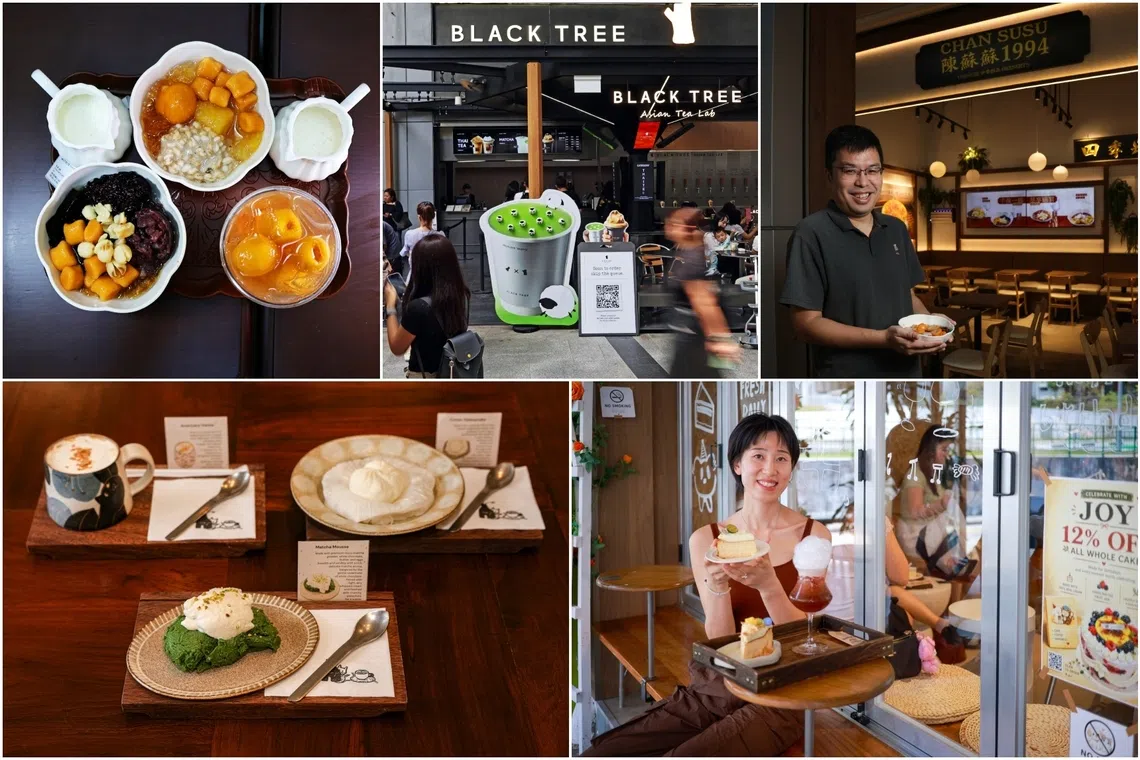
From viral Chinese brands to home-grown dessert brands, here are five places to check out and what to order at each.
ST PHOTO: KELVIN CHNG
Published Sep 12, 2026, 10:45 AM
Updated Sep 12, 2026, 12:52 PM
Chinese dessert cafes are trending in Singapore, with new brands like Yimanfen Dessert and BlackTree opening alongside local ventures such as Chan Susu 1994, Mozmoji and Joy Cake.
These cafes focus on quality ingredients, unique concepts and adapting to local tastes, aiming to establish Chinese desserts as a lasting category in Singapore’s diverse food scene.
Owners plan further expansion and innovation, expecting the trend to last several years while emphasising product quality over fleeting popularity.
SINGAPORE – Viral Chinese brands such as Yimanfen Dessert and BlackTree have landed in Singapore, along with a string of dessert cafes opened here by Chinese entrepreneurs.
Home-grown Chinese dessert brand Chan Susu 1994 opened at Orchard Gateway on Jan 1, followed by ceramics cafe Mozmoji in Chinatown in April and cottagecore-themed Joy Cake in Holland Village in July.
The same month, Hangzhou’s viral Yimanfen Dessert, which grew to more than 90 outlets across China in two years, opened its first overseas outlet at 313@somerset, followed by BlackTree’s first overseas outpost at the same mall on Aug 7.
Zhao Shu Yong, in his 50s, the Singapore business partner for both brands who facilitated their entry here, was drawn to their strong concepts and products, as well as the creativity of their founders.
Zhao, who is a Chinese national, is the owner of 5:59+ Cafe & Bistro, a Western dining concept from Chengdu which opened at 313@somerset in September 2025.
He believes Singapore’s diverse dining market and openness to new Asian flavours make it attractive to Chinese brands looking overseas.
On how long the Chinese dessert trend here will last, he says: “I do not think it will truly fade. Instead, it will gradually become an established category in Singapore’s dining scene.”
But he adds that consumers will become more focused on the quality of the product, rather than simply chasing new brands.
Joy Cake owner Nikita Ma, 30, who has a chain of three cafes in Hebei, China, observes that while China has a huge population, the country’s vast geographical size means consumer spending is dispersed over a much larger area.
In compact Singapore, despite its much smaller population, spending is more concentrated, which she views as an advantage.
Ma expects more Chinese dessert brands to enter Singapore as operators look for opportunities outside China. She reckons the trend here will last another three to five years.
Here are five places to check out and what to order at each.
Yimanfen: Viral desserts from Hangzhou
Yimanfen at 313@somerset. ST PHOTO: KELVIN CHNG
Yimanfen at 313@somerset.
Where: 02-50 & 02-K4 313@somerset, 313 Orchard Road Open: 10am to 9.30pm daily Info: @yimanfen_sg_official on Instagram
Founded in Hangzhou in 2024, viral Chinese dessert brand Yimanfen has expanded to more than 90 outlets across China, including in Beijing, Shanghai, Chengdu, Wuhan and Chongqing.
In Singapore, it appeals to local diners with generously loaded dessert bowls and ingredients with contrasting textures.
Founder Eleven Xu, 33, who has more than 10 years’ experience in the tea beverage industry, started Yimanfen after seeing beverage brands increasingly compete on marketing and price. She saw an opportunity in the modern Chinese desserts market and wanted to focus on quality ingredients and how they are prepared.
The 32-seat outlet has an open kitchen with ingredients on display.
Xu is particular about where they come from. Peach gum is sourced from Suizhou, a city in the Hubei province, while white lotus seeds come from Jianning in Fujian province.
The brand does not use pre-made syrups or artificial additives, and its syrups, sweet soups and tea bases are prepared in-store daily.
Singapore business partner Zhao Shu Yong says the brand has made some adjustments for the local market.
In China, the desserts are generally served at room temperature. In Singapore, the milk used in regular desserts is chilled before serving as customers here prefer colder desserts in the tropical heat. For ice-blended desserts, the milk is frozen before blending.
The signature Manfen Grand Bowl ($8.20) is a textural delight of grass jelly, snow fungus, peach gum, white lotus seeds, red beans, handcrafted sweet potato taro balls and Shaanxi-style black glutinous rice. The ingredients are served at room temperature with chilled fresh milk. Sweetness is minimal.
Manfen Grand Bowl contains peach gum from Suizhou. ST PHOTO: KELVIN CHNG
Manfen Grand Bowl contains peach gum from Suizhou.
Manfen Chewy Shushu Bowl ($7.80) combines sweet potato taro balls, snow fungus, peach gum and tapioca with the signature Jumbo Taro-Filled Sweet Potato Ball. Handcrafted in China and sent here frozen, the oversized ball has a chewy sweet potato exterior filled with soft taro paste.
Manfen Chewy Shushu Bowl features the Jumbo Taro-Filled Sweet Potato Ball. ST PHOTO: KELVIN CHNG
Manfen Chewy Shushu Bowl features the Jumbo Taro-Filled Sweet Potato Ball.
Xu’s experience in tea shows in the thirst-quenching Loquat Iced Tea ($6.90). The loquat – sourced from Tangqi, known as the loquat town of China – comes in a chilled, clean-tasting blend of roasted green tea and jasmine tea.
Loquat Iced Tea is a clean-tasting thirst-quencher. ST PHOTO: KELVIN CHNG
Loquat Iced Tea is a clean-tasting thirst-quencher.
BlackTree Asian Tea Lab: Thai milk tea from China
Where: 01-26 313@somerset, 313 Orchard Road Open: 10am to 10pm daily Info: @blacktree_sg_official on Instagram
For all the attention lavished on BlackTree Asian Tea Lab’s photogenic drinks, including Matcha Wang’s Lily Lamb ($7.90) and Milky Cat Cheese Thai Milk Tea ($6.90), the real highlight is its Singapore-exclusive Ambarella Sorbet (from $6.90).
Ambarella Sorbet at BlackTree Asian Tea Lab. ST PHOTO: KELVIN CHNG
Ambarella Sorbet at BlackTree Asian Tea Lab.
Launched in August, the deliciously tangy-sweet sorbet made with ambarella , also known as buah long long, costs $6.90 a cup, $7.90 for a single-scoop cone and $8.90 for a double-scoop cone.
BlackTree was started in 2025 by Miller Xie, who is in his 30s and has 10 years’ experience in F&B. Its first outlet opened in Shenzhen and the brand now has about 20 stores across China, including in Beijing, Shanghai, Hangzhou, Guangzhou and Chongqing.
Thai tea was chosen because of its strong global recognition and how it is more readily accepted by consumers in South-east Asia, says Xie, who intends to continue developing more tea beverages with distinctive Asian characteristics for the market.
The 30-seat Singapore outlet is the brand’s first Asian Tea Lab, where different teas, ingredients and preparation techniques can be tried out. Xie hopes to use Singapore as a test bed to understand how the brand should continue evolving for international consumers.
BlackTree opened its first overseas outpost in Singapore in August. ST PHOTO: KELVIN CHNG
BlackTree opened its first overseas outpost in Singapore in August.
He says: “Singapore consumers are extremely well exposed to tea and beverage brands, so they tend to be discerning. We find that they pay attention not only to novelty, but also to the actual quality and balance of the drink.”
He notes that refreshing flavours such as ambarella are naturally appealing, given Singapore’s climate.
Matcha Wang’s Lily Lamb is a collaboration with Shanghai speciality matcha brand Matcha Wang and is limited to 200 cups a day, with a separate queue for the drink alone.
Jasmine milk tea is capped with matcha foam, on which staff draw each lamb by hand. It takes about two months of training for employees to master the illustration, which takes just a few dozen seconds to complete. The jasmine tea’s floral notes come through beneath the matcha foam.
Matcha Wang’s Lily Lamb. ST PHOTO: KELVIN CHNG
Matcha Wang’s Lily Lamb.
A three-dimensional cat head hand-shaped from cheese foam sits atop the Milky Cat Cheese Thai Milk Tea. The savoury, salty foam contrasts with the sweet Thai milk tea, while coconut jelly and water chestnut popping boba add texture.
Its sweetness level is fixed and cannot be adjusted, but Xie says the amount of sugar was reduced slightly after customer feedback during the soft opening.
Milky Cat Cheese Thai Milk Tea. ST PHOTO: KELVIN CHNG
Milky Cat Cheese Thai Milk Tea.
Chan Susu 1994: Singapore dessert brand expands to China
Chan Susu 1994 at Orchard Gateway. ST PHOTO: GIN TAY
Chan Susu 1994 at Orchard Gateway.
Where: 01-10 Orchard Gateway, 277 Orchard Road Open: 10.30am to 11.30pm daily Tel: 9238-0368 Info: @chansusu1994sg on Instagram
While established Chinese dessert brands are entering Singapore, home-grown Chan Susu 1994 broke into the Chinese market a month after opening its flagship outlet at Orchard Gateway on Jan 1.
In February, it opened its second outlet in Guangzhou and, at the start of September, its third outlet in Chengdu.
Co-owner Kimi Zhou, 37, plans to open another one or two outlets in Singapore in 2026, and intends to have no more than five here over the next two years. He is also considering expansion into Indonesia and Malaysia.
Kimi Zhou, co-owner of Chan Susu 1994, with Handmade Lava Taro Ball Grand Bowl, Fig Snow Ice and Signature Mango Pomelo Sago. ST PHOTO: GIN TAY
Kimi Zhou, co-owner of Chan Susu 1994, with Handmade Lava Taro Ball Grand Bowl, Fig Snow Ice and Signature Mango Pomelo Sago.
Zhou, who hails from Shanghai, came to Singapore in 2011 to study at the East Asia Institute of Management, where he graduated with a bachelor’s degree in hospitality management from Scotland’s Queen Margaret University in 2014. It was followed by a Master of Arts in International Tourism and Leadership in 2015 from the university.
After graduating, Zhou, whose parents are entrepreneurs in the IT industry, went into F&B. He started a bubble tea business in 2016, which now has 15 outlets, and has also opened Chinese restaurants in Jurong, Tanjong Pagar and Chinatown.
He became a Singapore permanent resident in January 2022.
Chan Susu 1994’s concept is traditional Chinese desserts with a contemporary spin. The 40-seat, 700 sq ft outlet has 56 items, including desserts, snacks and savoury dishes.
Its best-selling Handmade Lava Taro Balls Grand Bowl ($8.90) took a month to develop. Two large lava taro balls, made fresh daily, come with grass jelly, peach gum, small taro balls, red beans and steamed black glutinous rice. Bite into one and the chewy tapioca-starch skin yields to reveal a soft yam filling.
Chan Susu 1994’s signature desserts: (from left) Handmade Lava Taro Ball Grand Bowl, Signature Mango Pomelo Sago and Fig Snow Ice. ST PHOTO: GIN TAY
Chan Susu 1994’s signature desserts: (from left) Handmade Lava Taro Ball Grand Bowl, Signature Mango Pomelo Sago and Fig Snow Ice.
The dessert is minimally sweet, as are the others on the menu. Zhou says some local customers have complained that it is not sweet enough, but the outlet does not provide additional syrup.
Fresh milk is served separately, on account of customers who are lactose-intolerant.
The customer base comprises 95 per cent locals and 5 per cent tourists.
Zhou observes that local diners commonly share desserts, so the cafe offers extra bowls and spoons, which are not provided at his outlets in China. The China outlets do not carry snow ice desserts as consumers there prefer hot desserts.
Fresh fruit features heavily in the Fig Snow Ice With Vanilla Scoop ($15.90), which comes with an avalanche of fragrantly sweet fresh red figs , water chestnut pearl balls and fresh mint.
Fig Snow Ice comes with plenty of fresh figs. ST PHOTO: GIN TAY
Fig Snow Ice comes with plenty of fresh figs.
Zhou is particularly proud of the Signature Mango Pomelo Sago ($7.90), which is prepared with fresh mangoes blended in-house into a thick puree, without any dilution with water. He says working with fresh mangoes can be tricky as the fruit is seasonal.
He welcomes the growing number of Chinese dessert cafes, saying: “Competition makes society improve.”
He reckons the trend could last six months to a year, but says trends are useful mainly for generating publicity. “Once the trend is over, it is still about the quality of the product,” he says.
Mozmoji: Ceramics gallery-cafe
Mozmoji founder Olivia Zhang with a Matcha Mousse, Americano Vienna and Cotton Cheesecake. ST PHOTO: BRIAN TEO
Mozmoji founder Olivia Zhang with a Matcha Mousse, Americano Vienna and Cotton Cheesecake.
Where: 02-01, 252 South Bridge Road Open: 11am to 7pm (Tuesdays to Fridays); 10am to 7pm (Saturdays, Sundays and public holidays); closed on Mondays Tel: 8930-1779 Info: @mozmoji on Instagram
Mozmoji is a lifestyle space which houses a cafe in a Chinese ceramic art gallery in a Chinatown shophouse. While its address is listed as South Bridge Road, the entrance is in Temple Street, where a staircase leads to the cosy second-storey nook with a mezzanine.
An ardent admirer of Chinese ceramics, owner Olivia Zhang, 30, originally wanted to set up a ceramics studio and gallery to showcase Chinese ceramic art in Singapore. But she realised that locals might not be familiar with the artists, no matter how established they are in China or Japan.
Having seen gallery-cafes showcasing ceramics, glassware and woodcraft become popular in China, she felt incorporating a cafe would be a practical way to introduce the craft here.
She says: “I wanted customers to have contact with the ceramic ware by serving the food and drinks on ceramic ware, and have a choice of which plate or cup they want.
“Ceramic ware should be used. They are works of art, but we need to form a connection with them. They are not solely for display.”
Mozmoji founder Olivia Zhang at her cosy ceramics gallery-cafe. ST PHOTO: BRIAN TEO
Mozmoji founder Olivia Zhang at her cosy ceramics gallery-cafe.
Opened on April 12, the 1,300 sq ft, 22-seat Mozmoji has more than 1,000 pieces by over 50 ceramic artists, 80 per cent of them from Jingdezhen, China’s “porcelain capital” in Jiangxi.
The works of 35 artists are on display at any one time, with a short biodata of each artist accompanying his or her creations . Among them is the work of Yao Lan, a ceramic artist who is also an associate professor at Shanghai Art and Design Academy, known for her painted ceramics.
The ceramics are on open wooden shelves and Zhang encourages visitors to touch and handle the pieces. About 60 handmade cups and plates, valued from $25 to $102 each, are set aside for diners to choose for their orders.
More than 20 pieces have been broken since opening, including a $158 plate, but Zhang accepts it as part and parcel of using these pieces of “functional art”.
About 50 customers have asked to buy individual pieces or entire sets. Zhang refuses to sell pieces used for service. When two Singaporean customers wanted pieces they had used, she commissioned the artists to make similar ones instead.
Originally from Wuhan, Zhang moved to Singapore with her family in mid-2022 after her husband, an IT engineer, found a job here. The family became permanent residents in 2024.
A graduate in media studies from Beijing’s Communication University of China in 2018, and a former publishing house editor and scriptwriter, Zhang found it difficult to get similar work here and became a full-time mother.
She took up pottery in late 2024 and spent a month training in Jingdezhen, returning three times in 2025 for stays of one to two months.
By December, she had collected about 80 pieces and wanted a place to display them.
That month, she spent two weeks in Shanghai learning to be a barista. Back in Singapore, she taught herself pastry-making through YouTube, designing the menu and developing the recipes on her own.
The best-selling Cotton Cheesecake ($12.80), inspired by one she ate in Kobe in 2022, took a month to develop. Made with filtered Greek yogurt, New Zealand cream cheese, whipping cream and condensed milk, it takes 1½ days to make and set, with no added sugar.
The best-selling Cotton Cheesecake was inspired by one Olivia Zhang ate in Kobe in 2022. ST PHOTO: BRIAN TEO
The best-selling Cotton Cheesecake was inspired by one Olivia Zhang ate in Kobe in 2022.
The new Matcha Mousse ($12.80), launched on Aug 22, is made with Isuzu matcha powder, white chocolate, butter and pasteurised eggs, and topped with whipped cream, pistachio and sea salt.
Matcha Mousse is a new item launched in August. ST PHOTO: BRIAN TEO
Matcha Mousse is a new item launched in August.
Americano Vienna ($10.80) pairs a full-bodied Americano with freshly whipped cream and housemade crisp cocoa chips containing very little sugar.
Americano Vienna is served in a ceramic cup from a collection by Chinese ceramics artist Yao Lan. ST PHOTO: BRIAN TEO
Americano Vienna is served in a ceramic cup from a collection by Chinese ceramics artist Yao Lan.
Joy Cake: Cottagecore cake cafe
Joy Cake has a cottagecore interior for a relaxing vibe. ST PHOTO: JASON QUAH
Joy Cake has a cottagecore interior for a relaxing vibe.
ST PHOTO: JASON QUAH
Where: 25A Lorong Liput, Holland Village Open: 10am to 10pm daily Tel: 8419-7976 Info: @joy.cake.sg on Instagram
Originally from Harbin, Nikita Ma, 30, runs three cafes in Hebei, China, but chose Singapore for her first overseas venture after a week-long visit here for the first time in January.
Ma, a pastry chef by training and mother to an eight-year-old girl, was attracted by Singapore’s year-round tropical weather, safety and dining scene. She also noticed how much locals enjoy desserts.
Five months later, on July 31, she opened the cottagecore-themed Joy Cake in Holland Village. Currently in Singapore on her own, she has plans for her husband and daughter to join her here later, as she hopes her daughter can study here.
Nikita Ma, owner of Joy Cake. ST PHOTO: JASON QUAH
Nikita Ma, owner of Joy Cake.
She deliberately chose a quiet corner of Holland Village for her 70 sq m cafe, which seats 20 indoors and up to eight outdoors. She designed the French cottagecore-inspired interior herself, giving it a rustic, homely feel with an electric fireplace and flower-accented straw hats displayed on the walls.
Her cafes in Hebei are also in quiet corners, as she wants diners to experience a getaway feeling of relaxation. Active social media usage helps raise the profile of her cafes and bring them footfall in China.
She is adopting a similar approach to market her cafe here. She is also focused on keeping the quality of her cakes and drinks high to build a stable of regulars.
While she has no plans for another Joy Cake outlet in Singapore, she is open to exploring other concepts, such as a pizzeria, as she has learnt pizza-making in the course of her training.
At 16, she enrolled at Beijing New Oriental Baking and Pastry School and graduated with a diploma in pastry and baking in 2012. She went on to work at Paris Baguette and in pastry kitchens in Beijing and Harbin, including that of Shangri-La Hotel in Beijing, and also Italian restaurant Opera Bombana in Beijing, before starting her own business in 2018.
Her cafes in Hebei sell four-inch whole cakes, but within two days of opening here, she learnt that customers in Singapore prefer ordering cake by the slice.
She switched to baking six-inch cakes to sell by the slice, but customers said the slices were too small for the prices charged. Now, she prepares eight-inch cakes which are sold by the slice. Customers can also pre-order whole cakes for celebrations.
Ma also keeps the sweetness of her cakes low. She says low-sugar treats have been the trend in China for the last decade as consumers there are cautious about sugar intake.
Many components of her cakes and drinks are prepared in-house, including about 10 varieties of fruit jam, from strawberry to pineapple. The jams are made weekly without preservatives and with minimal sugar.
The cake display case is the focal point of the cafe. ST PHOTO: JASON QUAH
The cake display case is the focal point of the cafe.
Ma is particularly thrilled by the pineapples available here, which she says are of fresher quality than back home, and is now experimenting with pink guava for new desserts.
The popular Pineapple Coconut Basque Cheesecake ($14 a slice) is topped with coconut cream, baked pineapple and housemade pineapple and vanilla jam.
Pineapple Coconut Basque Cheesecake. ST PHOTO: JASON QUAH
Pineapple Coconut Basque Cheesecake.
The top-selling Yuzu & Jasmine Basque Cheesecake ($15 a slice) combines cream cheese with jasmine green tea and is topped with yuzu cream, housemade grapefruit jam, lime and dried jasmine flowers. The cheesecake has an airy texture, accented with citrus and floral flavours.
Yuzu & Jasmine Basque Cheesecake. ST PHOTO: JASON QUAH
Yuzu & Jasmine Basque Cheesecake.
First Sight ($10) is made with a light-roast Colombia Rose Valley cold brew, housemade strawberry and raspberry jam, jasmine green tea and a light splash of Chambord – a French raspberry liqueur – and topped with diced fresh strawberry.
First Sight, a cold brew concoction at Joy Cake. ST PHOTO: JASON QUAH
First Sight, a cold brew concoction at Joy Cake.
Hedy Khoo is senior correspondent at The Straits Times. She covers food-related news, from reviews to human interest stories.
从爆款中国品牌到本土甜品品牌,以下五个地方值得一去,并推荐每个地方的特色菜。
《海峡时报》摄影:KELVIN CHNG
发布于 2026 年 9 月 12 日上午 10:45
更新于2026年9月12日下午12:52
中式甜品店在新加坡越来越受欢迎,除了像 Yimanfen Dessert 和 BlackTree 这样的新品牌外,还有 Chan Susu 1994、Mozmoji 和 Joy Cake 等本地品牌也纷纷开业。
这些咖啡馆注重优质食材、独特理念和适应当地口味,旨在将中式甜品打造成为新加坡多元化美食界中一个持久的品类。
业主计划进一步扩张和创新,预计这一趋势将持续数年,同时强调产品质量而非短暂的流行度。
新加坡——像一满粉甜品和黑树这样的中国网红品牌已经登陆新加坡,同时还有许多中国企业家在这里开设了甜品店。
本土中国甜品品牌 Chan Susu 1994 于 1 月 1 日在 Orchard Gateway 开业,随后陶瓷咖啡馆 Mozmoji 于 4 月在唐人街开业,田园风主题的 Joy Cake 于 7 月在荷兰村开业。
同月,杭州爆红的宜满芬甜品在短短两年内发展到在中国拥有 90 多家分店,并在 313@somerset 开设了第一家海外分店;随后,黑树甜品也于 8 月 7 日在同一购物中心开设了第一家海外分店。
赵树勇,50多岁,是这两个品牌的新加坡商业伙伴,他促成了这两个品牌进入新加坡市场。他被这两个品牌强大的理念和产品,以及创始人的创造力所吸引。
赵先生是中国籍,他是 5:59+ 咖啡小馆的老板,这是一家来自成都的西式餐饮概念餐厅,于 2025 年 9 月在 313@somerset 开业。
他认为,新加坡多元化的餐饮市场以及对亚洲新口味的开放态度,使其对寻求海外市场的中国品牌具有吸引力。
关于中式甜品在新加坡的流行趋势会持续多久,他表示:“我不认为它会真正消失。相反,它会逐渐成为新加坡餐饮界一个成熟的品类。”
但他补充说,消费者将更加关注产品质量,而不是一味追求新品牌。
Joy Cake 的老板 Nikita Ma 今年 30 岁,在中国河北拥有三家连锁咖啡馆。她观察到,虽然中国人口众多,但该国幅员辽阔,这意味着消费支出分散在更大的区域内。
尽管新加坡人口较少,但国土面积却很紧凑,消费更加集中,她认为这是一个优势。
马女士预计,随着商家寻求在中国以外地区发展,会有更多中国甜品品牌进入新加坡市场。她认为这一趋势还将持续三到五年。
以下是五个值得一去的地方,以及每个地方的推荐菜品。
一满粉:杭州爆款甜点
Yimanfen 位于 313@somerset。ST 摄影:KELVIN CHNG
Yimanfen 在 313@somerset。
地点:313@somerset,乌节路313号,02-50 & 02-K4 营业时间:每日上午10点至晚上9点30分 更多信息请关注Instagram账号@yimanfen_sg_official
2024年成立于杭州的网红中国甜品品牌一满粉,已在中国开设了90多家分店,遍布北京、上海、成都、武汉、重庆等城市。
在新加坡,它以分量十足的甜点碗和口感对比鲜明的食材吸引了当地食客。
创始人徐伊雯(Eleven Xu)今年33岁,拥有超过10年的茶饮行业经验。她创办怡曼芬的初衷是,目睹了饮料品牌在营销和价格方面日益激烈的竞争。她看到了现代中国甜品市场的机遇,并希望专注于优质原料及其制作工艺。
这家拥有 32 个座位的餐厅设有开放式厨房,食材都摆放在外面。
徐先生对这些原料的产地非常讲究。桃胶产自湖北省随州市,而白莲子则产自福建省建宁市。
该品牌不使用预制糖浆或人工添加剂,其糖浆、甜汤和茶底料均每日在店内新鲜制作。
新加坡商业伙伴赵树勇表示,该品牌已针对当地市场做出了一些调整。
在中国,甜点通常常温供应。在新加坡,由于当地顾客在炎热的热带气候下更喜欢冰凉的甜点,因此普通甜点中使用的牛奶会在上桌前冷藏。而冰沙甜点则会先将牛奶冷冻后再进行搅拌。
招牌满芬大碗(8.20美元)口感丰富,包含仙草冻、银耳、桃胶、白莲子、红豆、手工芋圆和陕西黑糯米。所有食材常温盛于碗中,佐以冰镇鲜奶。甜度适中。
满芬大碗内含随州桃胶。海峡时报摄影:KELVIN CHNG
满芬大碗含有随州桃胶。
满芬软糯芋泥碗(7.80美元)融合了芋圆、银耳、桃胶和西米,并搭配招牌巨型芋泥球。这款巨型芋泥球在中国手工制作,冷冻后运抵本地,外皮是软糯的芋泥,内馅是香甜软糯的芋泥。
满芬软糯烧烧碗的特色是巨型芋泥红薯球。海峡时报摄影:KELVIN CHNG
满芬软糯烧烧碗的特色是巨型芋头馅红薯球。
徐先生在茶饮方面的经验在这款清爽解渴的枇杷冰茶(6.90美元)中体现得淋漓尽致。枇杷产自中国枇杷之乡唐岐,与烘焙绿茶和茉莉花茶混合,口感冰爽清冽。
枇杷冰茶口感清爽,是消渴佳品。(海峡时报图片:KELVIN CHNG)
枇杷冰茶口感清爽,是理想的解渴饮品。
黑树亚洲茶实验室:来自中国的泰式奶茶
地点:01-26 313@somerset, 乌节路313号 营业时间:每日上午10点至晚上10点 更多信息:请关注Instagram账号@blacktree_sg_official
尽管 BlackTree Asian Tea Lab 的饮品因其上镜而备受关注,包括 Matcha Wang 的 Lily Lamb(7.90 美元)和 Milky Cat 芝士泰式奶茶(6.90 美元),但真正的亮点是其新加坡独家供应的 Ambarella Sorbet(6.90 美元起)。
黑树亚洲茶实验室的安巴雷拉冰沙。海峡时报摄影:KELVIN CHNG
BlackTree Asian Tea Lab 的 Ambarella 冰糕。
这款于 8 月推出的美味酸甜冰糕,以安巴雷拉果(又名 buah long long)为原料,每杯售价 6.90 美元,单球甜筒售价 7.90 美元,双球甜筒售价 8.90 美元。
黑树餐饮集团由30多岁的谢先生于2025年创立,他拥有10年的餐饮行业经验。该集团首家门店在深圳开业,目前在中国拥有约20家门店,遍布北京、上海、杭州、广州和重庆等城市。
谢先生表示,之所以选择泰式奶茶,是因为它在全球范围内享有很高的知名度,而且更容易被东南亚消费者接受。他还计划继续为市场开发更多具有鲜明亚洲特色的茶饮料。
这家位于新加坡、设有30个座位的门店是该品牌首家亚洲茶饮实验室,顾客可以在这里体验不同的茶叶、配料和冲泡方法。谢先生希望将新加坡作为试验田,了解该品牌应如何继续发展以更好地服务国际消费者。
黑树集团于8月在新加坡开设了其首家海外分公司。(海峡时报图片:KELVIN CHNG)
黑树集团于8月在新加坡开设了其首个海外分支机构。
他表示:“新加坡消费者接触到的茶饮品牌非常多,因此他们往往比较挑剔。我们发现,他们不仅关注新颖性,也关注饮品的实际品质和口感平衡。”
他指出,鉴于新加坡的气候,像安巴雷拉这样清爽的口味自然很有吸引力。
Matcha Wang 的 Lily Lamb 是与上海特色抹茶品牌 Matcha Wang 合作推出的,每天限量 200 杯,需要单独排队购买。
茉莉花奶茶的顶部覆盖着一层抹茶奶泡,奶泡上每一只小羊都是店员手工绘制的。员工需要接受大约两个月的培训才能掌握这项技艺,而绘制过程本身只需几十秒。茉莉花茶的芬芳则隐藏在抹茶奶泡之下。
抹茶王的莉莉·兰姆。ST 摄影:KELVIN CHNG
Matcha Wang 的 Lily Lamb。
泰式奶茶“奶猫”的顶部,摆放着一个用芝士奶盖手工捏成的立体猫头。咸香的奶盖与香甜的泰式奶茶形成鲜明对比,椰果和荸荠爆珠则增添了丰富的口感。
它的甜度是固定的,无法调整,但谢先生表示,在试营业期间,根据顾客的反馈,糖的用量略有减少。
Milky Cat 芝士泰式奶茶。ST 摄影:KELVIN CHNG
牛奶猫芝士泰式奶茶。
1994年,新加坡甜品品牌Chan Susu进军中国市场。
Chan Susu 1994 年在 Orchard Gateway 演出。ST 摄影:GIN TAY
Chan Susu 1994 年在 Orchard Gateway。
地点:Orchard Gateway 01-10,乌节路277号 营业时间:每日上午10:30至晚上11:30 电话:9238-0368 更多信息:Instagram账号 @chansusu1994sg
虽然一些知名的中国甜品品牌正在进军新加坡市场,但本土品牌 Chan Susu 1994 在 1 月 1 日于 Orchard Gateway 开设旗舰店一个月后,就成功打入了中国市场。
今年2月,该公司在广州开设了第二家分店;9月初,在成都开设了第三家分店。
联合创始人之一、37岁的周基米计划于2026年在新加坡再开设一到两家分店,并打算在未来两年内将新加坡的分店数量控制在五家以内。他还在考虑将业务拓展到印度尼西亚和马来西亚。
Chan Susu 1994 的共同所有人周琪美 (Kimi Zhou) 与手工流心芋圆大碗、无花果雪花冰和招牌芒果柚子西米露合影。ST 摄影:金泰 (GIN TAY)
1994 年 Chan Susu 的共同所有人 Kimi Zhou 带来了手工熔岩芋头球大碗、无花果雪冰和招牌芒果柚子西米露。
周先生来自上海,2011年来到新加坡,就读于东亚管理学院,并于2014年获得苏格兰玛格丽特女王大学酒店管理学士学位。随后,他于2015年获得该大学国际旅游与领导力硕士学位。
周先生的父母都是IT行业的企业家,毕业后他投身餐饮业。2016年,他创办了一家奶茶店,如今已拥有15家分店,并在裕廊、丹戎巴葛和牛车水开设了中餐馆。
他于 2022 年 1 月成为新加坡永久居民。
Chan Susu 1994 的理念是将传统中式甜品与现代元素相结合。这家面积 700 平方英尺、设有 40 个座位的门店提供 56 种菜品,包括甜品、小吃和咸味菜肴。
店里最畅销的手工流心芋圆大碗(8.90新元)耗时一个月研发而成。两只每日新鲜制作的大流心芋圆,搭配仙草冻、桃胶、小芋圆、红豆和蒸黑糯米。咬一口,Q弹的木薯淀粉皮瞬间软化,露出香甜软糯的芋泥馅。
Chan Susu 1994 的招牌甜点:(从左至右)手工流心芋圆大碗、招牌芒果柚子西米露和无花果雪花冰。ST 摄影:GIN TAY
Chan Susu 1994 的招牌甜点:(从左至右)手工流沙芋圆大碗、招牌芒果柚子西米露和无花果雪花冰。
这款甜点甜度很低,菜单上的其他甜点也是如此。周女士说,一些本地顾客抱怨说不够甜,但店里不提供额外的糖浆。
考虑到部分顾客乳糖不耐受,鲜牛奶单独供应。
客户群体中,95%为当地人,5%为游客。
周先生注意到,当地食客通常会分享甜点,因此咖啡馆会额外提供碗和勺子,而他在中国的分店则不提供这些。中国的分店不供应刨冰甜点,因为当地消费者更喜欢热甜点。
无花果雪冰配香草冰淇淋球(15.90 美元)以新鲜水果为主要特色,配有大量香甜的鲜红无花果、荸荠珍珠球和新鲜薄荷。
无花果雪冰里加了很多新鲜无花果。ST 摄影:GIN TAY
无花果雪冰里加了大量新鲜无花果。
周先生尤其引以为豪的是招牌芒果柚子西米露(7.90美元),这款西米露选用新鲜芒果,在店内手工打成浓稠的果泥,不加任何水稀释。他表示,由于芒果是季节性水果,所以处理新鲜芒果并非易事。
他欢迎中国甜品店数量的增长,并表示:“竞争使社会进步。”
他认为这股潮流可能会持续六个月到一年,但他表示,潮流的主要作用是制造话题。“潮流过后,最终还是要看产品质量,”他说。
Mozmoji:陶瓷画廊咖啡馆
Mozmoji创始人Olivia Zhang手捧抹茶慕斯、美式维也纳咖啡和棉花芝士蛋糕。ST摄影:BRIAN TEO
Mozmoji 创始人 Olivia Zhang 与抹茶慕斯、美式维也纳咖啡和棉花芝士蛋糕合影。
地点:南桥路252号02-01室 营业时间:上午11点至晚上7点(周二至周五);上午10点至晚上7点(周六、周日及公众假期);周一休息 电话:8930-1779 更多信息:Instagram账号 @mozmoji
Mozmoji是一家生活方式空间,位于唐人街一间店屋内,内设中国陶瓷艺术画廊和咖啡馆。虽然地址登记在桥南路,但入口在庙街,拾级而上即可到达二楼舒适的角落,那里还有一个夹层。
30岁的店主张女士(Olivia Zhang)是中国陶瓷的忠实爱好者,她最初想在新加坡开设一家陶瓷工作室兼画廊,展示中国陶瓷艺术。但她意识到,无论这些艺术家在中国或日本多么有名,当地人可能都不熟悉他们。
她看到在中国,展示陶瓷、玻璃器皿和木制品的画廊咖啡馆越来越受欢迎,觉得开设一家咖啡馆是把这些工艺品引入这里的一种切实可行的方法。
她说:“我希望顾客能通过用陶瓷器皿盛放食物和饮料来接触陶瓷器皿,并让他们选择自己想要的盘子或杯子。
“陶瓷器皿应该被使用。它们是艺术品,但我们需要与它们建立联系。它们不仅仅是用来展示的。”
Mozmoji创始人Olivia Zhang在她温馨的陶瓷画廊咖啡馆。ST摄影:BRIAN TEO
Mozmoji创始人Olivia Zhang在她温馨的陶瓷画廊咖啡馆里。
Mozmoji 于 4 月 12 日开业,面积 1300 平方英尺,设有 22 个座位,展出了 50 多位陶瓷艺术家的 1000 多件作品,其中 80% 来自中国江西省的“瓷都”景德镇。
展览同时展出35位艺术家的作品,每位艺术家的作品旁都附有其个人简介。其中就包括姚岚的作品,她是一位陶瓷艺术家,同时也是上海艺术设计学院的副教授,以其彩绘陶瓷而闻名。
陶瓷器皿摆放在开放式的木架上,张女士鼓励参观者触摸和把玩。大约60件手工制作的杯碟,每件价值25美元至102美元不等,供食客挑选搭配菜肴。
自开业以来,已有 20 多件作品被打碎,其中包括一个价值 158 美元的盘子,但张认为这是使用这些“实用艺术品”过程中不可避免的一部分。
大约有50位顾客询问过购买单件或整套作品。张女士拒绝出售使用过的器皿。当两位新加坡顾客想要购买他们用过的器皿时,她委托艺术家们重新制作了类似的器皿。
张女士原籍武汉,2022年中期,她的丈夫——一名IT工程师——在新加坡找到工作,于是她和家人一起搬到了新加坡。他们一家于2024年成为新加坡永久居民。
张女士于 2018 年毕业于北京中国传媒大学媒体研究专业,曾任出版社编辑和编剧,但她发现在这里很难找到类似的工作,于是成为了一名全职妈妈。
她在 2024 年底开始学习陶艺,并在景德镇接受了一个月的培训,2025 年又三次返回景德镇,每次停留一到两个月。
到 12 月,她已经收集了大约 80 件藏品,想要找个地方把它们展示出来。
当月,她花了两个星期在上海学习咖啡师技能。回到新加坡后,她通过YouTube自学糕点制作,独立设计菜单并研发配方。
这款最畅销的棉花芝士蛋糕(12.80美元)的灵感来源于她2022年在神户吃到的一款蛋糕,研发耗时一个月。它由过滤后的希腊酸奶、新西兰奶油芝士、鲜奶油和炼乳制成,需要一天半的时间才能完成并凝固,而且不添加糖。
这款最畅销的棉花糖芝士蛋糕的灵感来源于Olivia Zhang在2022年于神户品尝的一款蛋糕。ST PHOTO:BRIAN TEO
最畅销的棉花芝士蛋糕的灵感来自 Olivia Zhang 于 2022 年在神户吃到的一款蛋糕。
8 月 22 日推出的新款抹茶慕斯(12.80 美元)采用五十铃抹茶粉、白巧克力、黄油和巴氏杀菌蛋制成,上面放有鲜奶油、开心果和海盐。
抹茶慕斯是八月推出的新品。ST 摄影:BRIAN TEO
抹茶慕斯是八月份推出的新品。
维也纳美式咖啡(10.80 美元)将醇厚的美式咖啡与新鲜打发的奶油和自制的酥脆可可片搭配,其中含糖量极低。
美式维也纳咖啡盛装于中国陶瓷艺术家姚岚收藏的陶瓷杯中。(ST PHOTO:BRIAN TEO)
Americano Vienna咖啡盛装于中国陶瓷艺术家姚岚收藏的陶瓷杯中。
Joy Cake:田园风蛋糕咖啡馆
Joy Cake 的室内设计采用田园风格,营造轻松惬意的氛围。ST 摄影:JASON QUAH
Joy Cake 的室内设计采用田园风格,营造轻松的氛围。
《海峡时报》摄影:JASON QUAH
地点:25A Lorong Liput, Holland Village 营业时间:每日上午10点至晚上10点 电话:8419-7976 更多信息:Instagram @joy.cake.sg
30岁的马妮卡(Nikita Ma)原籍哈尔滨,在中国河北经营着三家咖啡馆。今年1月,她首次到访新加坡,进行了为期一周的访问,之后便选择新加坡作为她的第一个海外创业项目。
马女士是一位受过专业训练的糕点师,也是一位八岁女孩的母亲。新加坡全年宜人的热带气候、安全的环境和丰富的餐饮选择深深吸引了她。她还注意到当地人对甜点的喜爱程度。
五个月后,7月31日,她在荷兰村开设了以田园风为主题的Joy Cake蛋糕店。目前她独自一人在新加坡,计划之后让丈夫和女儿也来这里与她团聚,因为她希望女儿能在这里读书。
Joy Cake的老板Nikita Ma。ST摄影:JASON QUAH
Joy Cake 的老板 Nikita Ma。
她特意选择荷兰村一个僻静的角落开设了这家70平方米的咖啡馆,室内可容纳20人,室外最多可容纳8人。咖啡馆的室内设计灵感源自法式田园风,由她亲自操刀,营造出一种质朴温馨的氛围,墙上挂着点缀着鲜花的草帽,并配有电壁炉。
她在河北的咖啡馆也都选址在僻静的角落,因为她希望顾客能体验到一种远离尘嚣、放松身心的感觉。积极运用社交媒体有助于提升咖啡馆的知名度,并吸引更多顾客光顾。
她在这里也采用了类似的营销策略。她还专注于保持蛋糕和饮品的高品质,以建立稳定的回头客群体。
虽然她目前没有在新加坡开设另一家 Joy Cake 分店的计划,但她对探索其他概念持开放态度,例如披萨店,因为她在培训过程中学习过披萨制作。
16岁时,她考入北京新东方烘焙糕点学校,并于2012年获得糕点烘焙文凭。之后,她先后在巴黎贝甜以及北京和哈尔滨的糕点厨房工作,包括北京香格里拉大酒店的糕点厨房,以及北京的意大利餐厅Opera Bombana,之后于2018年创立了自己的事业。
她在河北的咖啡馆出售四英寸的整块蛋糕,但在这里开业两天后,她就了解到新加坡的顾客更喜欢按片点蛋糕。
她最初改烤六英寸的蛋糕,按片出售,但顾客反映切片太小,不值这个价。现在,她改烤八英寸的蛋糕,仍然按片出售。顾客也可以预订整个蛋糕用于庆祝活动。
马女士也坚持蛋糕甜度较低。她说,过去十年来,低糖甜点在中国一直很流行,因为中国消费者对糖的摄入量比较谨慎。
她制作的蛋糕和饮品中许多原料都是自家制作的,包括大约10种果酱,从草莓到菠萝应有尽有。这些果酱每周新鲜制作,不添加防腐剂,糖分也极少。
蛋糕展示柜是咖啡馆的视觉焦点。(海峡时报摄影:JASON QUAH)
蛋糕展示柜是咖啡馆的视觉焦点。
马女士对这里的菠萝特别满意,她说这里的菠萝比家乡的菠萝更新鲜,现在她正在尝试用粉红色的番石榴制作新的甜点。
广受欢迎的菠萝椰子巴斯克芝士蛋糕(每片 14 美元)上面放有椰子奶油、烤菠萝和自制菠萝香草果酱。
菠萝椰子巴斯克芝士蛋糕。ST 摄影:JASON QUAH
菠萝椰子巴斯克芝士蛋糕。
这款最畅销的柚子茉莉巴斯克芝士蛋糕(每片15美元)将奶油芝士与茉莉绿茶完美融合,顶部点缀着柚子奶油、自制西柚果酱、青柠片和干茉莉花。蛋糕口感轻盈蓬松,带有柑橘和花香的芬芳。
柚子茉莉巴斯克芝士蛋糕。摄影:JASON QUAH
柚子茉莉巴斯克芝士蛋糕。
“第一印象”(10 美元)由浅烘焙的哥伦比亚玫瑰谷冷萃咖啡、自制草莓和覆盆子果酱、茉莉花绿茶和少许香波(一种法国覆盆子利口酒)制成,并撒上新鲜草莓丁。
“第一眼”(First Sight),Joy Cake 的一款冷萃咖啡饮品。ST 摄影:JASON QUAH
“第一眼”,Joy Cake 的一款冷萃咖啡饮品。
Hedy Khoo是《海峡时报》的资深记者。她报道与食品相关的新闻,包括食品评论和人物故事。