Singapore launches ‘Battlestar Galactica’-like warship with drones新加坡推出类似《太空堡垒卡拉狄加》的无人机战舰
One such vessel, with its fleet of unmanned companions, could execute missions that would otherwise require multiple manned warships.
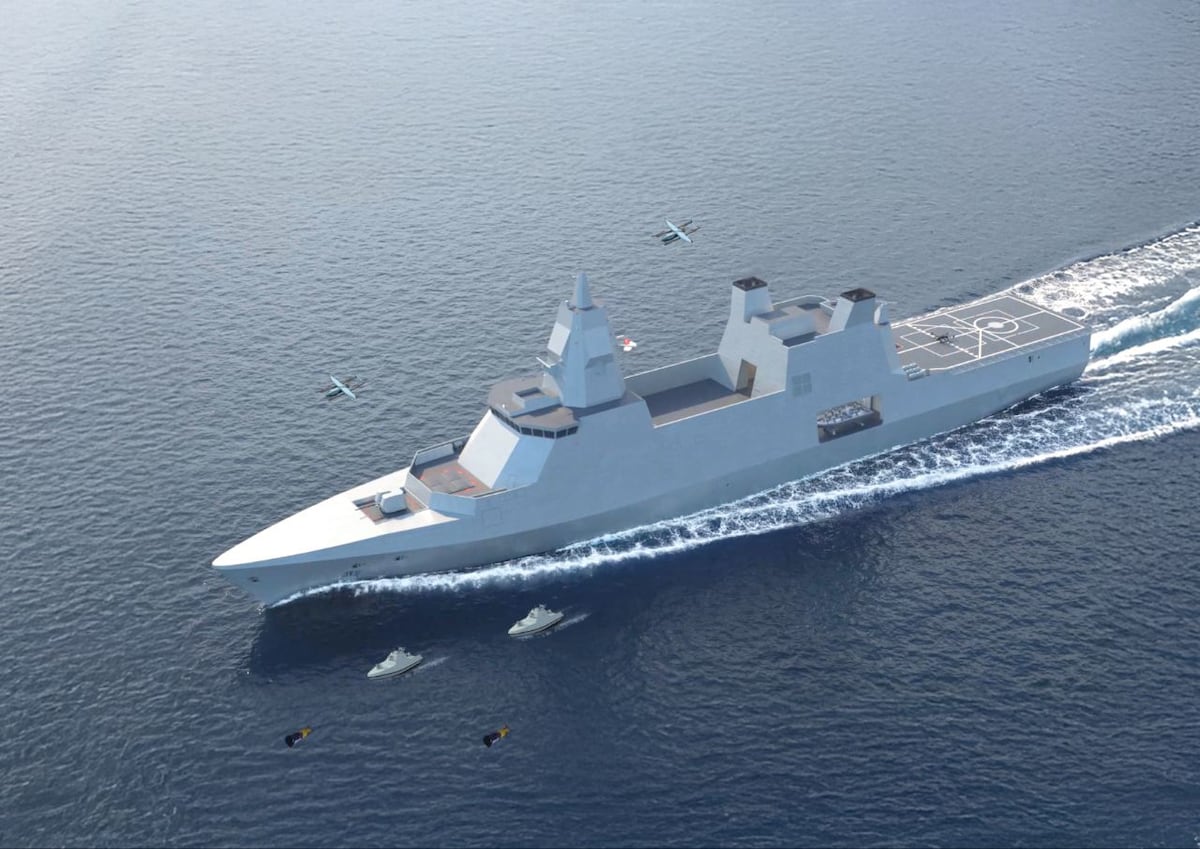
CHRISTCHURCH, New Zealand — When Singapore’s defense minister, Chan Chun Sing, spoke at the launch ceremony of a novel class of warship for his country’s navy this week, he likened the vessel to the fictitious spaceship Battlestar Galactica.
“It isn’t just a ship by itself, but one that’s integrated with artificial intelligence and an evolving brain,” he said of the new 8,000-ton warship, the largest ever surface combatant in Singapore’s navy.
The 492-foot (150m) Victory, the first of six Multi-Role Combat Vessels (MRCV), was launched at ST Engineering’s Benoi shipyard in Singapore on Oct. 21. The warship will now transfer to the shipbuilder’s Gul yard for outfitting, integration and sea trials.
With a contract awarded to ST Engineering in March 2023, the MRCV is a combination of a frigate and “mothership” for unmanned systems that fly through the air, sail on the ocean’s surface or dive beneath the waves.
Chan said the operational concept reminded him of “sci-fi movies, because it isn’t about having a fixed number of drones or unmanned surface vessels. As the mission set evolves, we’ll also evolve the type of weapon system and capabilities that we can have on the ship.”
One MRCV, with its fleet of unmanned companions, could execute missions that would otherwise require multiple manned warships, he claimed.
The six MRCVs, the first of which will be delivered in 2028, will replace six 595-ton Victory-class missile corvettes serving in the Republic of Singapore Navy – the RSN – since the 1990s. the The new slate of ships will take on precisely the same names as the corvettes they succeed.
The MRCVs are designed to have a 7,000-nautical-mile range. A mission bay holds up to eight 20-foot containers, meaning ships can rapidly transition from combat to disaster relief, for example.
At the stern is a load and recovery system that handles smaller boats and unmanned surface vessels. A crane performs the same job on the vessel’s flanks. Drones and a medium-sized helicopter make use of the large flight deck at the stern.
The warship’s armaments include a Leonardo Strales 76mm naval gun, two Rafael Typhoon MK 30-c remote-controlled weapon stations, and missiles. MICA and Aster missiles offer air cover, but Singapore has not revealed what anti-ship missiles will arm the warship. However, it is likely to be Blue Spear missiles from Proteus.
Technology is critical to these ships, cutting down the crew requirement to fewer than 100 sailors. In a pinch, the bridge can be operated by just two crew members.
The new style of warship is designed to keep abreast of contemporary trends. For example, a high-voltage electrical distribution system powers both the integrated full electric propulsion system as well as sensors and weapons.
Chan acknowledged that Singapore’s navy took a long time to get this ship and its requirements approved. “What we need is a ship that can keep evolving with our operational requirements,” he said. “This is the new way that we have to operate and fight in the future.”
Besides ST Engineering, the shipbuilding program includes Sweden-based Saab. The company provided the ship design and is responsible for assembling composite superstructure elements.
Lars Kaddik of Saab Kockums told Defense News that carbon fiber composite is up to 50% lighter than steel, is corrosion-proof, stealthier than a steel equivalent, and it provides insulation for equipment inside the mast. It also reduces top weight on the ship, thus improving hull stability.
Saab has been manufacturing superstructure panels in Singapore. The company now hopes to replicate this kind of international arrangement in other parts of the world. Already, Saab and ST Engineering are jointly promoting Singapore’s 1,200-ton littoral mission vessel to Estonia.
For a nation of just six million citizens, Singapore has a powerful navy. Once current build programs reach fruition, the RSN will boast six Type 218SG submarines, six MRCVs, six frigates, eight littoral mission vessels, four landing ships and a bevy of smaller vessels.
“In the past, the role of the navy was perhaps only to defend our near shores,” Chan said. “Today, our strategic lines of communications extend much farther. That’s why we need new capabilities … to defend and secure our sea lines of communications, to make sure that no one with ill intent can disrupt our day-to-day lives.”
He also referred to the country’s geo-strategic location on the Singapore Strait. More than 100,000 vessels ply annually through this maritime chokepoint in Southeast Asia.
Gordon Arthur is an Asia correspondent for Defense News. After a 20-year stint working in Hong Kong, he now resides in New Zealand. He has attended military exercises and defense exhibitions in about 20 countries around the Asia-Pacific region.
新西兰基督城——本周,新加坡国防部长陈振声在该国海军新型战舰的下水仪式上发表讲话时,将这艘战舰比作虚构的太空飞船“太空堡垒卡拉狄加”。
“它不仅仅是一艘船,而是一艘融合了人工智能和不断进化的大脑的船,”他谈到这艘新型 8000 吨级战舰时说道,这是新加坡海军有史以来最大的水面作战舰艇。
10月21日,首艘多用途作战舰艇(MRCV)——长492英尺(150米)的“胜利”号在新加坡新科工程公司位于贝诺伊的造船厂下水。该舰将移送至造船厂位于古尔的船厂进行舾装、集成和海上试验。
2023 年 3 月,新加坡科技工程公司 (ST Engineering) 获得了 MRCV 的合同。MRCV 是一艘护卫舰和无人系统“母舰”的结合体,这些无人系统可以在空中飞行、在海面上航行或潜入水下。
陈表示,这一作战理念让他想起了“科幻电影,因为它并非关乎拥有固定数量的无人机或无人水面舰艇。随着任务的演变,我们也会不断发展舰上武器系统的类型和能力。”
他声称,一艘多用途遥控飞行器(MRCV)及其无人伴航舰艇可以执行原本需要多艘有人驾驶战舰才能完成的任务。
这六艘多用途导弹护卫舰(MRCV)将于2028年交付,首艘舰艇将取代自上世纪90年代以来一直在新加坡共和国海军(RSN)服役的六艘595吨级胜利级导弹护卫舰。新舰艇将沿用其前身护卫舰的名称。
多用途救援船(MRCV)的设计航程为7000海里。一个任务舱最多可容纳8个20英尺的集装箱,这意味着舰艇可以迅速从作战任务转换到灾害救援任务,例如。
船尾设有装卸系统,用于操作小型船只和无人水面舰艇。船舷两侧的起重机也执行相同的作业。无人机和一架中型直升机则利用船尾的大型飞行甲板进行作业。
该舰的武器装备包括一门莱昂纳多·斯特拉莱斯76毫米舰炮、两座拉斐尔“台风”MK 30-c遥控武器站以及导弹。MICA和“紫菀”导弹可提供空中掩护,但新加坡尚未透露该舰将装备何种反舰导弹。不过,很可能是来自“普罗透斯”导弹防御系统的“蓝矛”导弹。
技术对这些舰船至关重要,它使船员需求减少到不足100人。在紧急情况下,舰桥甚至可以由两名船员操作。
这种新型战舰的设计紧跟时代潮流。例如,高压配电系统为集成式全电力推进系统以及传感器和武器系统供电。
陈先生承认,新加坡海军花了很长时间才批准这艘舰艇及其相关要求。“我们需要的是一艘能够随着作战需求不断升级的舰艇,”他说。“这是我们未来作战和行动的新方式。”
除了新加坡科技工程公司(ST Engineering)之外,该造船项目还包括总部位于瑞典的萨博公司。萨博公司负责船舶设计并组装复合材料上层建筑部件。
萨博·科库姆斯公司的拉尔斯·卡迪克告诉《防务新闻》,碳纤维复合材料比钢轻50%,防腐蚀,比同等钢材更具隐蔽性,还能为桅杆内部设备提供隔热层。此外,它还能减轻舰艇顶部重量,从而提高船体稳定性。
萨博公司一直在新加坡生产上层建筑面板。该公司现在希望将这种国际合作模式复制到世界其他地区。目前,萨博公司和新加坡科技工程公司(ST Engineering)正在联合向爱沙尼亚推介新加坡的1200吨级近海任务舰。
新加坡人口仅有六百万,却拥有一支强大的海军。一旦目前的建造计划完成,新加坡海军将拥有六艘218SG型潜艇、六艘多用途作战舰艇、六艘护卫舰、八艘近海任务舰、四艘登陆舰以及众多小型舰艇。
陈说:“过去,海军的作用或许仅限于保卫近海。如今,我们的战略交通线延伸得更远。因此,我们需要新的能力……来保卫和保障我们的海上交通线,确保任何心怀不轨的人都无法扰乱我们的日常生活。”
他还提到了该国位于新加坡海峡的地理战略位置。每年有超过10万艘船只通过这个东南亚海上咽喉要道。
戈登·阿瑟是《防务新闻》的亚洲特派记者。在香港工作20年后,他现居新西兰。他曾到访亚太地区约20个国家,参加过军事演习和防务展览。