This A-10 Warthog Ground Trainer Still Has A ‘Tickler’ Muzzle Device On Its Cannon (Updated)这架A-10“疣猪”地面教练机的机炮上仍然装有“挠痒痒”式炮口装置(更新)
The device was supposed to help deal with the strain of firing the plane's gun and disperse dangerous fumes, but created its own problems.
新闻视频
By Joseph Trevithick
Updated Dec 1, 2019 7:06 AM EST
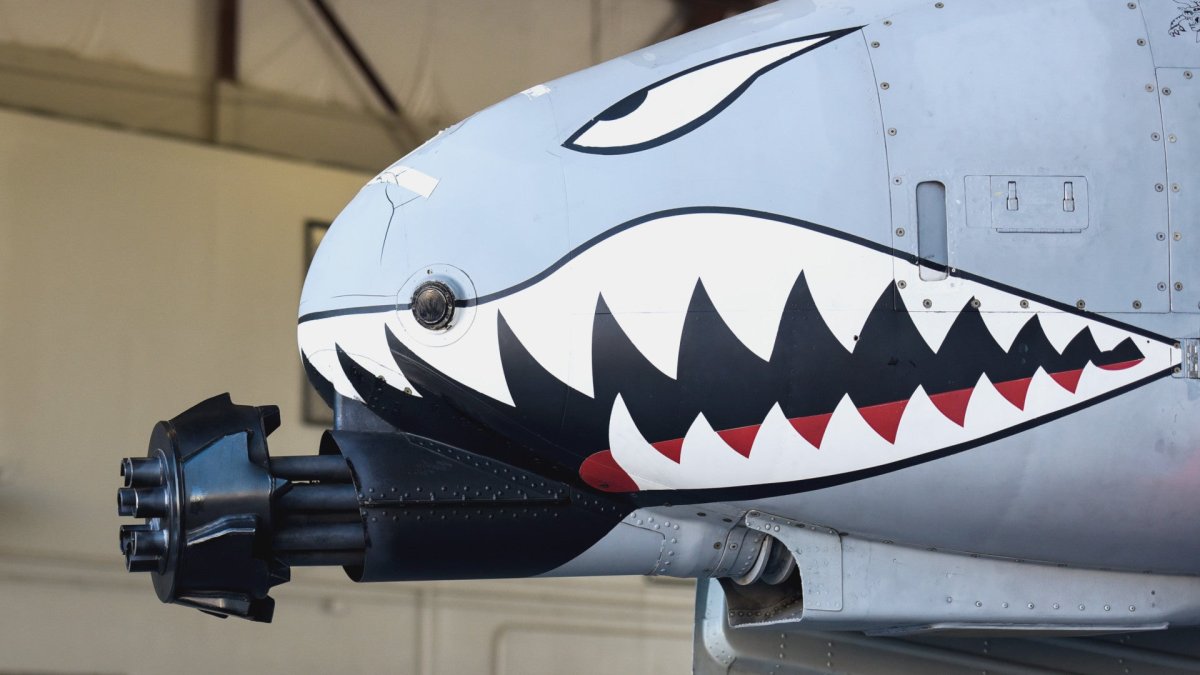
Every year, the U.S. Air Force’s 82nd Training Wing at Sheppard Air Force Base in Texas prepares thousands of airmen to become maintainers and munitions specialists, or to improve their skills, and it uses a number of non-flyable aircraft to help with those training courses. But one of its permanently grounded GA-10A Warthogs is also something of a unique historical article with a rarely seen muzzle device , nicknamed “the Tickler,” on its 30mm GAU-8/A Avenger cannon , which operational units only ever used briefly decades ago.
On Oct. 10, 2018 , the 82nd’s public affairs office posted otherwise unassuming pictures online of trainees from the 362nd Training Squadron using the GA-10 to practice conducting a landing gear function check. The add-on muzzle device it has was originally supposed to help mitigate the shock and blast of firing the massive gun and help deflect and disperse fumes that could choke out the aircraft’s engines, but proved to be problematic in its own right.
We reached out to the Wing for more information about this particular Warthog and they confirmed that it is an instructional trainer airframe. At the time of writing, they had not yet been able to provide the plane’s specific serial number or explain why it still has the muzzle device installed. The unit has received a number of grounded Warthogs over the years, including some of the earliest developmental examples .
“The A-10 is one of the hardest planes to take down [for maintenance],” one of the 362nd’s instructors said, according to a caption for one of the pictures. This is “because of all the back-up/emergency systems it has that the pilot can fall back on when worse comes to worst.”
A trainee assigned to the 362nd Training Squadron sits in the GA-10A with GFU-16/A at Sheppard Air Force Base., USAF
Defense contractor Battelle developed the Tickler, also known more formally as the Gun Gas Diverter or the GFU-16/A, as another safety measure. During development of the Avenger cannon, which occurred in parallel with that of the A-10 itself, it quickly became apparent that without any sort of flash hider or muzzle brake on the end, the gun would blind the pilot during firing. Soot would also build up on the windshield, eventually blocking the pilot’s view in general.
On top of that, the gasses the weapon produced as a by-product of firing could end up getting sucked into either of the Warthog’s two engines. These fumes contained no oxygen, which could starve the jets of air and cause them to stall, and might have unburnt gunpowder in them, which could cause even more serious problems.
The A-10’s manufacturer, Republic, and the Air Force spent considerable effort during the plane’s developmental period and early service life searching for ways to solve these issues, which we at The War Zone
have explored in detail in the past. Battelle’s GFU-16/A was the last of these projects, with work related to the device continuing into the late 1980s.
The muzzle brake has two sets of baffles inside intended to eliminate the flash from firing and help disperse the gun gasses before they exit the device. By all accounts, it was quite successful in performing both of these functions. The Air Force sent the GFU-16/As out to various A-10 units, which dutifully installed them on their aircraft.
A close-up showing the rear of the GFU-16/A with its two sets of baffles., USAF
Unfortunately, the devices also created new and problematic turbulence at the muzzle and magnified the gun’s already severe vibration. This, in turn, led to severe cracking in portions of the forward fuselage, especially inside the gun bay, which became more apparent as time went on.
“Although at this time this cracking is not believed to be a flight safety problem, it is a maintenance burden and could have an impact on the operational readiness of the A-10 force,” one 1986 report explained . At that time, the Air Force had initiated a program to “find a solution to the A-10A gun bay fatigue problem by determining the source of the structural fatigue and applying and verifying airframe modifications to achieve the desired structural design life.”
A rare, but low-quality image of the Battelle Gun Gas Diverter installed on an operational A-10 in the 1980s., CORBIN H. VIA NETWORK54.COM
The source, of course, was the muzzle device. We don’t know the exact results of the flight test program, but what is clear is that the Air Force concluded there was no cost-effective way to fix the problem and quickly ordered units to remove the GFU-16/As permanently.
Today, A-10s feature a more traditional-looking muzzle device. The Air Force largely gave up on trying to fight the adverse effects of firing the gun, as well. Warthog pilots can use a special windshield wiping system to clean off the windscreen and pulling the trigger also constantly trips the engine ignition system. So, even if the gasses do cause the engines to fail, they immediately restart. A change in the gunpowder inside the 30mm ammunition also helped mitigate the problem.
Watch what happens to the bubble compass to the right of the pilot’s heads-up display in the video below to get a sense of just how much force the GAU-8/A exerts on an A-10 during firing.
Still, there are anecdotal reports from as recently as 2007 that some units still had the gun gas diverters sitting around in their parts lockers and, obviously, at least one GA-10A at Sheppard still has its GFU-16/A fitted. Since it is no longer in service, it would serve no training purpose. It doesn’t appear to have any impact on the kind of training that the 362nd uses that airframe for, either, suggesting it was just easier to leave it on.
Regardless, it’s still a cool piece of A-10 history, albeit one that might be better served preserved in a museum at this point.
The much less exotic look of the muzzle on A-10s today., USAF
We have received some additional information from Sheppard Air Force Base regarding this aircraft, which is actually a GA-10C and has the serial number 80-0228. The 82nd Training Wing received its first C model instructional aircraft in 2015.
When 80-228 arrived, crews removed the Gun Gas Diverter from a GA-10A that was heading to the Bone Yard at Davis-Monthan Air Force Base and installed it on the newer aircraft. The 82nd specifically did this in order to ensure the preservation of this piece of history and students working on the aircraft get a brief description of its origins and purpose during training courses.
Contact the author: jtrevithickpr@gmail.com
Comments couldn’t be loaded. Please refresh the page.
作者:约瑟夫·特雷维西克
更新于美国东部时间2019年12月1日上午7:06
每年,位于德克萨斯州谢泼德空军基地的美国空军第82训练联队都会培训数千名空军人员,使他们成为维护人员和弹药专家,或提升现有技能。该联队使用一些无法飞行的飞机来辅助这些训练课程。但其中一架永久停飞的GA-10A“疣猪”攻击机却具有独特的历史意义,其30毫米GAU-8/A“复仇者”机炮上安装了一种罕见的炮口装置,绰号“挠痒痒”(Tickler)。这种机炮仅在几十年前被作战部队短暂使用过。
2018年10月10日,第82空降师公共事务办公室在网上发布了一组看似普通的照片,照片显示第362训练中队的学员正在使用GA-10机炮练习起落架功能检查。该机炮加装的炮口装置原本是为了减轻发射这门巨型火炮时的冲击波和爆炸声,并帮助偏转和驱散可能堵塞飞机发动机的废气,但事实证明,该装置本身也存在问题。
我们联系了该联队,询问有关这架“疣猪”无人机的更多信息,他们确认这是一架教学教练机。截至发稿时,他们尚未能提供该飞机的具体序列号,也无法解释为何机头仍保留着炮口装置。多年来,该部队接收了多架停飞的“疣猪”无人机,其中包括一些最早的研发样机。
据其中一张照片的说明文字显示,第362战斗机联队的一名教官说:“A-10是最难拆卸进行维护的飞机之一。” 这是“因为它配备了所有备用/应急系统,飞行员可以在最糟糕的情况下依靠这些系统。”
一名隶属于美国空军第362训练中队的受训人员坐在谢泼德空军基地的GA-10A教练机内,该教练机配备GFU-16/A中队。
国防承包商巴特尔公司开发了“挠痒痒”(Tickler),也称“枪口气体导流器”或GFU-16/A,作为另一项安全措施。在与A-10攻击机同步开发的“复仇者”机炮中,人们很快发现,如果没有消焰器或枪口制退器之类的装置,机炮在射击时会使飞行员视线受阻。此外,挡风玻璃上还会积聚烟灰,最终完全遮挡飞行员的视线。
此外,武器发射时产生的气体可能会被吸入疣猪战车的两台发动机中。这些气体不含氧气,会导致喷气发动机缺氧而熄火,而且其中可能含有未燃尽的火药,从而引发更严重的问题。
A-10的制造商共和公司和美国空军在飞机的研发阶段和早期服役期间投入了大量精力,寻找解决这些问题的方法,而我们在“战区”栏目中也探讨了这些问题。
过去曾对此进行过详细研究。巴特尔公司的 GFU-16/A 是这些项目中的最后一个,与该设备相关的研究工作一直持续到 20 世纪 80 年代末。
枪口制退器内部有两组挡板,旨在消除射击时的枪口焰,并帮助分散枪膛气体,防止其逸出。据各方评价,它在实现这两项功能方面都相当成功。空军将GFU-16/A型制退器分发给各个A-10攻击机部队,这些部队也都按要求将其安装在飞机上。
一张特写照片,展示了GFU-16/A的尾部,可以看到它的两组挡板。(美国空军)
不幸的是,这些装置还在炮口处产生了新的、棘手的湍流,并加剧了火炮原本就剧烈的振动。这反过来又导致机身前部部分区域,特别是炮舱内部,出现严重的裂纹,随着时间的推移,这些裂纹变得越来越明显。
1986年的一份报告解释说:“虽然目前认为这种裂纹不会造成飞行安全问题,但它会增加维护负担,并可能影响A-10部队的作战准备状态。”当时,空军启动了一项计划,旨在“通过确定结构疲劳的根源,并应用和验证机身改进措施以达到预期的结构设计寿命,从而找到解决A-10A机炮舱疲劳问题的方案。”
一张罕见但质量较低的图片,展示了20世纪80年代安装在一架现役A-10攻击机上的巴特尔(Battelle)机炮气体导流罩。图片来源:CORBIN H. VIA NETWORK54.COM
当然,问题的根源在于枪口装置。我们并不清楚飞行测试项目的确切结果,但可以肯定的是,空军得出结论,没有经济有效的办法来解决这个问题,并迅速命令各部队永久拆除GFU-16/A型枪口装置。
如今,A-10攻击机配备了更传统的炮口装置。空军也基本放弃了对抗炮击带来的不利影响。疣猪攻击机的飞行员可以使用特殊的挡风玻璃刮水系统来清洁挡风玻璃,而且扣动扳机还会持续触发发动机点火系统。因此,即使燃气导致发动机故障,它们也能立即重新启动。30毫米炮弹中火药的改进也有助于缓解这个问题。
观看下方视频中飞行员抬头显示器右侧的气泡罗盘的变化,即可了解 GAU-8/A 在开火时对 A-10 施加了多大的力。
不过,早在2007年就有零星报道称,一些部队的零件库里仍然存放着机炮导气装置,而且显然,谢泼德空军基地至少有一架GA-10A仍然装着GFU-16/A。由于该机已退役,因此无法用于训练。而且,它似乎也没有对第362战斗机联队使用该机进行的训练造成任何影响,这表明保留该装置可能只是为了方便。
不管怎样,这仍然是A-10历史上的一件很酷的藏品,尽管现在把它保存在博物馆里可能更好。
如今A-10攻击机的机头造型远没有以前那么奇特了。(美国空军)
我们从谢泼德空军基地收到了一些关于这架飞机的补充信息,它实际上是一架GA-10C,序列号为80-0228。第82训练联队于2015年接收了第一架C型教学飞机。
第80-228中队抵达后,工作人员从一架即将被送往戴维斯-蒙森空军基地飞机坟场的GA-10A战斗机上拆下了机炮燃气分流器,并将其安装到这架较新的飞机上。第82中队这样做是为了确保这一历史部件得以保存,同时,参与飞机维护的学员在训练课程中也能了解到该部件的来历和用途。
联系作者:jtrevithickpr@gmail.com
评论加载失败,请刷新页面。