AUKUS agreement requires submarine production boost, Franchetti says弗兰凯蒂表示,AUKUS协议需要提高潜艇产量。
She laid out the submarine production rate needed for AUKUS at her Senate hearing, though her confirmation is uncertain.
Correction: A previous version of this story referred to the Chief of Naval Operations as the Chief Naval Officer in one instance.
WASHINGTON ― The AUKUS agreement , under which the U.S. will provide Australia with Virginia-class attack vessels,will require a submarine production increase, the nominee to serve as Chief of Naval Operations told Congress Thursday.
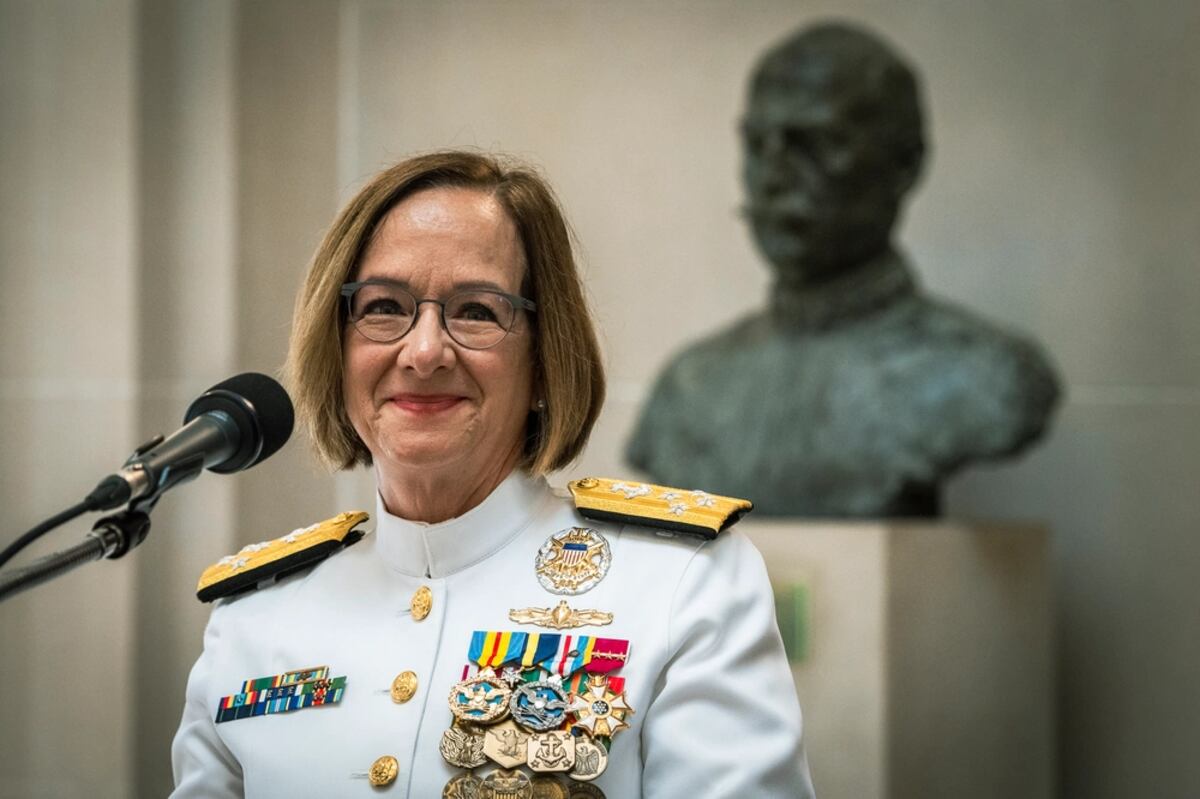
Admiral Lisa Franchetti, who would be the first woman to serve in the position and on the Joint Chiefs of Staff, said at her Senate confirmation hearing that AUKUS will require the production of 2.2 Virginia-class submarines per year. That’s a significant increase above the current production rate of 1.2 vessels per year, but slightly less than what senators had anticipated.
“My understanding is we need to reach 2.2 to meet those requirements, as well as our commitment to continue to produce on Columbia-class submarine,” Franchetti said. “AUKUS is a strategic opportunity for us to knit together the strong partnership we already have with Australia and the U.K. and I think this will again change the adversaries’ decision calculus.”
While the submarine-industrial base is behind this production goal, Franchetti expressed confidence that the Navy “will be able to meet and achieve all of those requirements.”
The Navy expects to achieve production of two Virginia-class submarines per year – its pre-AUKUS goal – by 2028. Under AUKUS, the U.S. plans to sell between three to five Virginia-class submarines to Australia as an interim capability in the early 2030s.
Sen. Roger Wicker of Mississippi, the top Republican on the Armed Services Committee, led half the GOP caucus in a July letter to President Joe Biden arguing that the Navy needs to invest additional funding the submarine-industrial base beyond the $647 million the White House requested for fiscal 2024. The letter projected that the U.S. would need to produce 2.3 to 2.5 Virginia-class submarines per year to “avoid further shrinking our fleet’s operational capacity.”
Wicker blocked two AUKUS authorizations from the Fiscal 2024 defense policy bill , demanding additional money for the submarine-industrial base. One authorization would permit the transfer of two Virginia-class submarines to Australia, while the other would allow the Biden administration to accept the $3 billion Canberra intends to invest in the U.S. submarine-industrial base as part of the AUKUS agreement.
Franchetti laid out a roadmap to bolstering Virginia-class production capacity from 1.2 to 2.2 submarines per year during her confirmation hearing by “continuing to partner with industry to get after their biggest challenges.”
Those steps include workforce development at the yards working on submarines – “making sure that we can go out and help them recruit the people they need” – and data analytics “to understand throughput through the shipyards so we can be more effective with the workforce that we do have.”
She also said the Navy needs to make sure industry has “all the long-lead time materials – the parts, the spare parts – that they need to be able to move through that production line very quickly.”
Franchetti warned that the Navy would not be able to begin construction of the next Virginia-class and Columbia-class submarines under a government shutdown or stopgap funding bill. House Republicans on Wednesday cancelled votes on the defense spending bill amid a litany of additional demands from the right-wing Freedom Caucus, increasing the prospect of a government shutdown at the end of the month.
The Tuberville blockade
Franchetti told senators she has not yet received a briefing on AUKUS submarine-industrial base investments from the Pentagon’s Cost Assessment and Program Evaluation office, citing a lack of “bandwidth” given the fact that she’s currently performing two roles simultaneously. However, she committed to expeditiously putting the briefing on her calendar.
As the vice chief of naval operations, Franchetti currently serves as the acting chief of naval operations. The former chief, Admiral Mike Gilday, left the post in August.
Although the Senate Armed Services Committee did not hold Franchetti’s nomination hearing until this month, her confirmation would nonetheless run up against a blanket hold on the swift confirmation of all general and flag officer promotions instated by Sen. Tommy Tuberville , R-Ala.
The six-month hold, which Tuberville instated over the Pentagon’s abortion leave policy, has already ensnared more than 300 military confirmations, including two other joint chiefs nominees .
During her hearing, Franchetti testified that it would take “years to recover” from Tuberville’s promotion delays, even if the Senate eventually confirms them.
“Just at the three-star level, it would take about three to four months just to move all the people around,” she said.
Tuberville has argued that Senate Majority Leader Chuck Schumer, D-N.Y., should put the joint chiefs nominees on the floor for stand-alone votes .
But it would take until at least the middle of next year to do individual floor votes on the hundreds of other military nominees, even if the Senate neglected its other duties like funding the government and military.
A Congressional Research Services report released this week found it would take the Senate some 700 hours of floor time to confirm the 301 outstanding nominees. The Armed Services Committee expects to receive roughly 300 more military nominees by the end of the year.
Bryant Harris is the Congress reporter for Defense News. He has covered U.S. foreign policy, national security, international affairs and politics in Washington since 2014. He has also written for Foreign Policy, Al-Monitor, Al Jazeera English and IPS News.
更正:此前版本中,曾有一处将海军作战部长误称为海军总军官。
华盛顿——美国海军作战部长提名人周四告诉国会,根据奥库斯协议(美国将向澳大利亚提供弗吉尼亚级攻击型潜艇),美国需要增加潜艇产量。
丽莎·弗兰切蒂海军上将有望成为首位担任此职并进入参谋长联席会议的女性。她在参议院的确认听证会上表示,“奥库斯”计划将需要每年建造2.2艘弗吉尼亚级潜艇。这比目前每年1.2艘的建造速度有了显著提高,但略低于参议员们的预期。
弗兰凯蒂表示:“据我了解,我们需要达到2.2的产能才能满足这些要求,同时也要履行我们继续建造哥伦比亚级潜艇的承诺。AUKUS项目对我们来说是一个战略机遇,可以进一步巩固我们与澳大利亚和英国之间已有的牢固伙伴关系,我认为这将再次改变对手的决策考量。”
尽管潜艇工业基地在实现这一生产目标方面存在不足,但弗兰凯蒂表示有信心海军“能够满足并实现所有这些要求”。
美国海军预计到 2028 年将实现每年生产两艘弗吉尼亚级潜艇的目标——这是其在 AUKUS 计划之前的目标。根据 AUKUS 计划,美国计划在 2030 年代初期向澳大利亚出售三到五艘弗吉尼亚级潜艇,作为过渡能力。
密西西比州参议员罗杰·威克是参议院军事委员会的首席共和党议员,他带领半数共和党议员在7月份致信乔·拜登总统,认为海军需要对潜艇工业基地进行额外投资,超过白宫为2024财年申请的6.47亿美元。信中预测,美国每年需要生产2.3至2.5艘弗吉尼亚级潜艇,才能“避免进一步削弱舰队的作战能力”。
威克阻止了2024财年国防政策法案中两项与奥库斯协议相关的授权,要求为潜艇工业基地追加资金。其中一项授权将允许向澳大利亚转让两艘弗吉尼亚级潜艇,另一项授权则允许拜登政府接受堪培拉方面根据奥库斯协议计划向美国潜艇工业基地投资的30亿美元。
弗兰凯蒂在确认听证会上提出了将弗吉尼亚级潜艇的年产量从 1.2 艘提高到 2.2 艘的路线图,她表示将“继续与业界合作,解决他们面临的最大挑战”。
这些措施包括对潜艇制造厂的劳动力进行发展——“确保我们能够走出去帮助他们招募所需的人员”——以及数据分析“以了解造船厂的吞吐量,从而使我们能够更有效地利用我们现有的劳动力”。
她还表示,海军需要确保工业界拥有“所有需要较长交货周期的材料——零件、备件——以便能够非常快速地完成生产线的工作”。
弗兰凯蒂警告说,如果政府停摆或临时拨款法案未能通过,海军将无法开始建造下一代弗吉尼亚级和哥伦比亚级潜艇。周三,众议院共和党人取消了对国防开支法案的投票,原因是右翼自由党团提出了一系列额外要求,这增加了月底政府停摆的可能性。
图伯维尔封锁
弗兰凯蒂告诉参议员们,她尚未收到五角大楼成本评估和项目评估办公室关于奥库斯潜艇工业基地投资的简报,理由是她目前同时担任两项职务,时间有限。不过,她承诺会尽快将简报安排到日程上。
作为海军作战部副部长,弗兰凯蒂目前担任代理海军作战部长。前任部长迈克·吉尔迪海军上将已于8月离任。
尽管参议院军事委员会直到本月才举行弗兰切蒂的提名听证会,但她的确认仍然会受到阿拉巴马州共和党参议员汤米·图伯维尔提出的全面暂停迅速确认所有将军和高级军官晋升的禁令的阻碍。
图伯维尔对五角大楼堕胎休假政策实施的六个月暂停令,已经影响到 300 多项军事任命确认,其中包括另外两名参谋长联席会议提名人。
在听证会上,弗兰切蒂作证说,即使参议院最终确认了图伯维尔的晋升,也需要“数年时间才能从晋升延迟中恢复过来”。
“仅仅是三星级酒店,光是人员调动就需要三到四个月的时间,”她说。
塔伯维尔认为,参议院多数党领袖查克·舒默(纽约州)应该将参谋长联席会议提名人选提交参议院进行单独投票。
即使参议院忽略了其他职责,例如为政府和军队提供资金,至少也要到明年年中才能对数百名其他军事提名人进行逐一投票表决。
本周发布的一份国会研究服务报告显示,参议院需要约700个小时的议事时间来确认301名待定的提名人选。军事委员会预计到年底还将收到约300名军方提名人选。
布莱恩特·哈里斯是《防务新闻》的国会记者。自2014年以来,他一直在华盛顿报道美国外交政策、国家安全、国际事务和政治。他还曾为《外交政策》、《Al-Monitor》、《半岛电视台英语频道》和IPS新闻撰稿。