Virtual taekwondo heads to Asian Games as Singapore representative prepares for debut虚拟跆拳道即将亮相亚运会,新加坡代表队正准备首次亮相
It may look like a video game, but competing in virtual taekwondo is tougher than it seems, says Singapore's Darren Yap.
It may look like a video game, but competing in virtual taekwondo is tougher than it seems, says Singapore's Darren Yap.
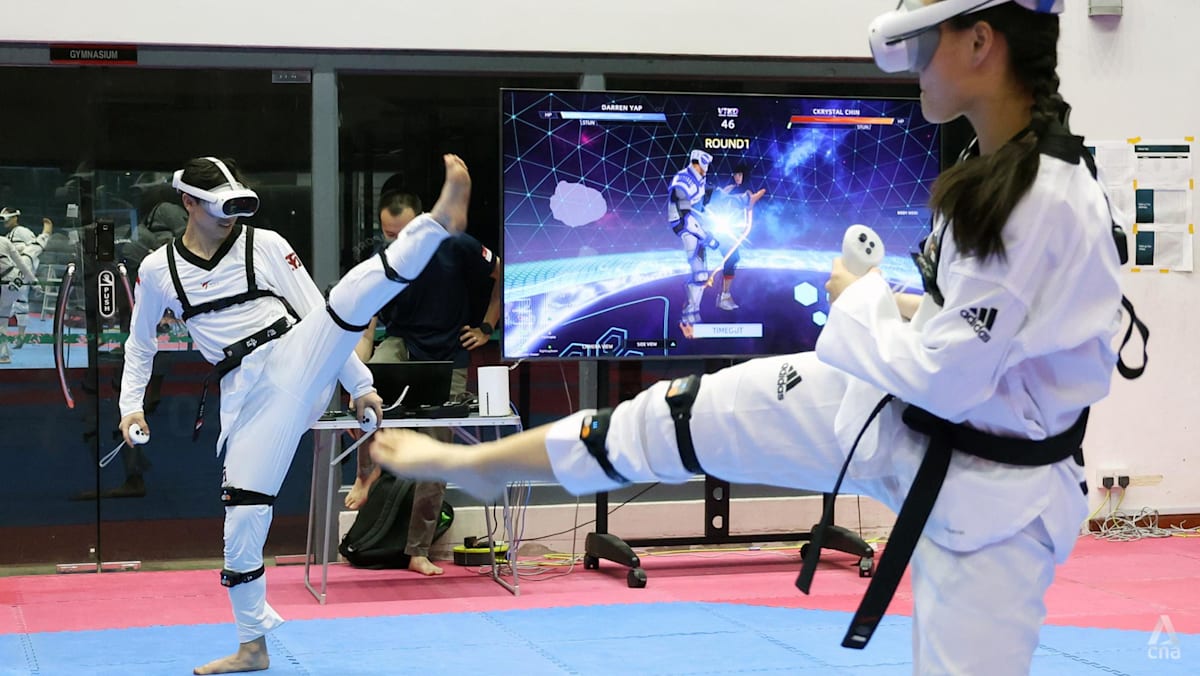
Darren Yap (left), who will be representing Singapore in poomsae and virtual taekwondo at the 20th Asian Games, spars with Ckrystal Chin at the Singapore Taekwondo Federation on Aug 25, 2026. (Photo: CNA/Ooi Boon Keong)
This audio is generated by an AI tool.
SINGAPORE: Put on a virtual reality headset, strap on motion sensors and start kicking at an opponent - without ever physically touching them.
It might sound like a video game, but virtual taekwondo will make its Asian Games debut in October, with Singapore's Darren Yap among the athletes competing for a medal.
The 22-year-old will take part in the mixed-gender event as part of the 2026 Asian Games in Japan, which run from Sep 19 to Oct 4.
Despite its obvious similarities to gaming, virtual taekwondo is not classified as an esport at the Games.
CNA Games Guess Word Crack the word, one row at a time Buzzword Create words using the given letters Mini Sudoku Tiny puzzle, mighty brain teaser Mini Crossword Small grid, big challenge Word Search Spot as many words as you can Show More Show Less And for Yap, who has practised conventional taekwondo since he was four, mastering the virtual version has meant learning a different way of fighting. "You are not fighting against an actual human. You're actually just fighting as an avatar," he told CNA. "But the main difference is also that gauging your distance when you're fighting is a very big change, and also just getting used to the system, getting used to the equipment." HOW VIRTUAL TAEKWONDO WORKS So how does a taekwondo fight take place without either competitor actually hitting the other? Co-developed by World Taekwondo and Singapore-based technology company Refract Technologies, virtual taekwondo combines the physical movements and techniques of taekwondo with virtual reality and motion-tracking technology. Athletes wear virtual reality headsets and motion-tracking devices, or nodes, on their spine, thighs and shins. Their movements are translated onto digital avatars, allowing them to kick and attack their opponent in a virtual arena without making physical contact. Successful strikes deplete their opponent's virtual health bar. Refract Technologies chief operating officer Gerald Lee told CNA that the technology grew out of an idea to use the human body itself as a controller. After encountering limitations with existing motion-capture technology, the company developed its AXIS motion-capture system, which is now used for the sport. At the Asian Games, 16 athletes will compete in a mixed-gender knockout tournament, according to the Olympics website. Matches follow a best-of-three format and are contested in a 4m by 4m space, with each round lasting 60 seconds, according to the Virtual Taekwondo website. Virtual taekwondo was showcased at Singapore's Olympic Esports Week in 2023 and held its inaugural world championships in Singapore the following year. Its progression to the Asian Games has been quicker than even its developer expected. Lee said its inclusion "reflects the credibility the sport has built since 2023". Virtual taekwondo is also expected to feature at the 2027 SEA Games, AP reported in July. In Singapore, it featured at this year's GetActive! Singapore Pesta Sukan, with categories ranging from juniors to participants aged 55 and above, including mixed-gender events. The Singapore Taekwondo Federation also formed a national development squad this year to "sustain the development" of Singapore's virtual taekwondo talent. The squad has 14 athletes.
And for Yap, who has practised conventional taekwondo since he was four, mastering the virtual version has meant learning a different way of fighting.
"You are not fighting against an actual human. You're actually just fighting as an avatar," he told CNA.
"But the main difference is also that gauging your distance when you're fighting is a very big change, and also just getting used to the system, getting used to the equipment."
HOW VIRTUAL TAEKWONDO WORKS
So how does a taekwondo fight take place without either competitor actually hitting the other?
Co-developed by World Taekwondo and Singapore-based technology company Refract Technologies, virtual taekwondo combines the physical movements and techniques of taekwondo with virtual reality and motion-tracking technology.
Athletes wear virtual reality headsets and motion-tracking devices, or nodes, on their spine, thighs and shins.
Their movements are translated onto digital avatars, allowing them to kick and attack their opponent in a virtual arena without making physical contact. Successful strikes deplete their opponent's virtual health bar.
Refract Technologies chief operating officer Gerald Lee told CNA that the technology grew out of an idea to use the human body itself as a controller.
After encountering limitations with existing motion-capture technology, the company developed its AXIS motion-capture system, which is now used for the sport.
At the Asian Games, 16 athletes will compete in a mixed-gender knockout tournament, according to the Olympics website.
Matches follow a best-of-three format and are contested in a 4m by 4m space, with each round lasting 60 seconds, according to the Virtual Taekwondo website.
Virtual taekwondo was showcased at Singapore's Olympic Esports Week in 2023 and held its inaugural world championships in Singapore the following year.
Its progression to the Asian Games has been quicker than even its developer expected.
Lee said its inclusion "reflects the credibility the sport has built since 2023".
Virtual taekwondo is also expected to feature at the 2027 SEA Games, AP reported in July.
In Singapore, it featured at this year's GetActive! Singapore Pesta Sukan, with categories ranging from juniors to participants aged 55 and above, including mixed-gender events.
The Singapore Taekwondo Federation also formed a national development squad this year to "sustain the development" of Singapore's virtual taekwondo talent. The squad has 14 athletes.
Darren Yap, who will represent Singapore in poomsae and virtual taekwondo at the 20th Asian Games, at the Singapore Taekwondo Federation on Aug 25, 2026. (Photo: CNA/Ooi Boon Keong)
FROM POOMSAE TO VIRTUAL TAEKWONDO
For Yap, the Asian Games involve switching between two very different versions of the same martial art.
His main event is traditional poomsae, a non-contact discipline in which athletes perform choreographed sequences of offensive and defensive techniques.
He won a joint bronze in freestyle poomsae at the last SEA Games in Bangkok and previously competed in the Asian Games in Hangzhou.
Virtual taekwondo, however, is new territory. This will be his first competitive foray into virtual taekwondo.
His selection came after he qualified for the Asian Games in poomsae. The Singapore Taekwondo Federation (STF) was subsequently informed by the Asian Taekwondo Union that Yap had also been selected for the virtual taekwondo competition.
Speaking to CNA at the Bedok National Training Centre, Yap said his first reaction was "shock", as he had not known virtual taekwondo would feature at the Games.
"But after that ... I was quite excited about it because it helps me and helps Singapore taekwondo introduce this to a wider audience in Singapore," he said.
Before beginning training in July, his only experience with virtual taekwondo was trying it at the Olympic Esports Week in Singapore in 2023.
Darren Yap (centre), who will be representing Singapore in poomsae and virtual taekwondo at the 20th Asian Games, spars with Ckrystal Chin at the Singapore Taekwondo Federation on Aug 25, 2026. (Photo: CNA/Ooi Boon Keong)
TRAINING FOR VIRTUAL TAEKWONDO
While virtual taekwondo eliminates physical contact between opponents, Yap said competing in it requires considerable adjustment.
He described the sport as an "interesting concept" that looks much easier than it actually is.
"It's actually a very tough event. It's quite tiring, and there's more to it than people outside would think."
One of the biggest adjustments is judging distance in a smaller, virtual competition area. Understanding the technology and equipment is therefore an important part of competing in the sport, he added.
Training sessions last about two hours and include warm-ups, running, cardiovascular exercises, kicking and footwork drills.
Footwork is particularly important because of the smaller competition area, Yap said.
He is also put through scenarios designed to test his decision-making and reactions, as well as sparring sessions that allow him to experiment with "different moves and skills without getting hit".
Techniques do not necessarily transfer directly between virtual and conventional taekwondo either.
"For virtual taekwondo, it's a different technique. It's a different style of kicking that might not work in traditional sparring, and also some kicks in traditional sparring will not work for virtual taekwondo," he said.
During a training session observed by CNA, Yap strapped motion-tracking nodes to his thighs, shins and chest before putting on the virtual reality headset.
With fellow taekwondo athlete Ckrystal Chin helping to set the boundaries of the competition area, the pair then began sparring - their movements translated into the actions of their avatars.
As part of his preparations for the Asian Games, Yap also attended a four-day virtual taekwondo training camp in South Korea.
He said he hoped the camp would help him learn more about "the different techniques and skills that other fighters might use against me" and better prepare him for the competition.
Darren Yap, who will be representing Singapore in poomsae and virtual taekwondo at the 20th Asian Games, at the Singapore Taekwondo Federation on Aug 25, 2026. (Photo: CNA/Ooi Boon Keong)
HOPES FOR ASIAN GAMES
Yap said he is honoured "to wear the Singapore flag" on his sleeve, but feels little pressure given that both he and the event are relatively new to the Asian Games.
"I'm somewhat new to this as well ... and I'm quite excited to participate in this event."
He added that he was trying not to focus on the outcome.
"I just want to do my best, and whatever happens, happens."
"It's a big competition, so my goal is just to have fun, do my best, and get on the podium if I can too," he said.
Singapore Taekwondo Federation's secretary-general Wong Zhen Kang similarly sought to temper expectations.
"The whole scene is really competitive, we're really just there for him to try and as long as he represents Singapore, this is what we're happy for," Wong said.
For Yap, competing at the Asian Games is also an opportunity to introduce more people to virtual taekwondo.
"It's a big opportunity for me to help other players, other taekwondo athletes in Singapore, gain knowledge of this, and maybe outside of taekwondo also," he said.
BEYOND THE ASIAN GAMES
Yap believes Singapore's virtual taekwondo scene is "slowly becoming bigger and bigger", and hopes its Asian Games debut will help broaden the sport's appeal.
He said it could attract people interested in martial arts who are "not a fan of combat or getting hit".
"It's a great way to experience sparring and just the ways of combat or just getting into the Kyorugi (sparring) side of taekwondo," he said.
Refract Technologies' Lee also sees an opportunity to reach people without a taekwondo background.
"We want more people - not just those with a taekwondo background - to understand what VTKD actually is and how approachable it is from the very first session," he said.
Yap acknowledged that some may dismiss virtual taekwondo as simply a "video game", but pointed to the physical skills involved.
"But it (comprises) a lot of taekwondo, traditional taekwondo techniques as well, like kicking, footwork, and all that," he said.
"So I think if you still have your doubts after hearing this, then maybe you should give it a try, and maybe you can find out by yourself."
A single handpicked story that we think you shouldn't miss. Just one a day.
Get our pick of top stories and thought-provoking articles in your inbox
Stay updated with notifications for breaking news and our best stories
Join our channel for the top reads for the day on your preferred chat app
新加坡选手达伦·叶表示,虽然看起来像电子游戏,但参加虚拟跆拳道比赛比看起来要难得多。
2026年8月25日,将代表新加坡参加第20届亚运会品势和虚拟跆拳道比赛的叶达伦(左)在新加坡跆拳道协会与陈晶晶进行对练。(图片:CNA/Ooi Boon Keong)
这段音频由人工智能工具生成。
新加坡:戴上虚拟现实头盔,系上运动传感器,就可以开始踢对手——而无需与对手进行任何身体接触。
听起来像电子游戏,但虚拟跆拳道将于 10 月在亚运会上首次亮相,新加坡选手达伦·叶 (Darren Yap) 等运动员将角逐奖牌。
这位 22 岁的选手将参加 2026 年 9 月 19 日至 10 月 4 日在日本举行的亚运会混合性别比赛。
尽管虚拟跆拳道与电子游戏有明显的相似之处,但它并未被列为奥运会的电子竞技项目。
CNA游戏 猜词游戏 逐行破解单词 流行词游戏 用给定的字母组成单词 迷你数独 小谜题,脑力挑战 迷你填字游戏 小方格,大挑战 单词搜索 尽可能多地找出单词 显示更多 显示更少 对于从四岁起就开始练习传统跆拳道的叶来说,掌握虚拟跆拳道意味着学习一种不同的格斗方式。“你不是在和真人对战,你实际上是在和一个虚拟化身战斗,”他告诉CNA。“但主要的区别在于,在战斗中判断距离是一个非常大的变化,还有就是适应系统,适应设备。” 虚拟跆拳道是如何运作的? 那么,跆拳道比赛是如何在双方都不实际击打对方的情况下进行的呢?由世界跆拳道联盟和新加坡科技公司Refract Technologies联合开发的虚拟跆拳道,将跆拳道的动作和技巧与虚拟现实和动作追踪技术相结合。运动员佩戴虚拟现实头盔,并在脊柱、大腿和小腿上安装动作追踪设备(或称节点)。他们的动作会被转化为数字虚拟形象,使他们能够在虚拟竞技场中踢击和攻击对手,而无需进行实际的身体接触。成功的攻击会减少对手的虚拟生命值。Refract Technologies首席运营官Gerald Lee告诉CNA,这项技术的灵感源于利用人体本身作为控制器的想法。在遇到现有动作捕捉技术的局限性后,该公司开发了AXIS动作捕捉系统,该系统目前已应用于这项运动。据奥运会官网显示,在亚运会上,将有16名运动员参加男女混合淘汰赛。据虚拟跆拳道官网介绍,比赛采用三局两胜制,场地大小为4米×4米,每回合持续60秒。虚拟跆拳道于2023年在新加坡奥林匹克电子竞技周亮相,并于次年在新加坡举办了首届世界锦标赛。其晋级亚运会的速度甚至超过了开发者的预期。李表示,虚拟跆拳道的入选“体现了这项运动自2023年以来所建立的信誉”。据美联社7月报道,虚拟跆拳道预计也将出现在2027年东南亚运动会上。在新加坡,虚拟跆拳道也亮相于今年的“活力新加坡体育节”(GetActive! Singapore Pesta Sukan),比赛组别涵盖青少年组到55岁及以上组,包括男女混合组。新加坡跆拳道协会今年还组建了一支国家发展队,旨在“持续培养”新加坡的虚拟跆拳道人才。该队目前拥有14名运动员。
对于从四岁起就开始练习传统跆拳道的叶来说,掌握虚拟跆拳道意味着学习一种不同的战斗方式。
“你不是在和真人战斗,你实际上只是在以虚拟形象战斗,”他告诉亚洲新闻台。
“但主要区别还在于,战斗时判断距离是一个非常大的变化,而且还需要适应这套系统,适应这些装备。”
虚拟跆拳道如何运作
那么,跆拳道比赛如何在双方都不实际击中对方的情况下进行呢?
虚拟跆拳道由世界跆拳道联盟和新加坡科技公司 Refract Technologies 共同开发,它将跆拳道的身体动作和技巧与虚拟现实和动作追踪技术相结合。
运动员佩戴虚拟现实头盔和运动追踪设备(或节点),这些设备或节点安装在脊柱、大腿和小腿上。
他们的动作会被转化为数字虚拟形象,使他们能够在虚拟竞技场中踢打对手,而无需进行实际的身体接触。成功的攻击会削减对手的虚拟生命值。
Refract Technologies 首席运营官 Gerald Lee 告诉 CNA,这项技术源于利用人体本身作为控制器的想法。
由于现有动作捕捉技术的局限性,该公司开发了 AXIS 动作捕捉系统,该系统现在已应用于这项运动。
据奥运会官网报道,在亚运会上,将有16名运动员参加男女混合淘汰赛。
根据虚拟跆拳道网站的说法,比赛采用三局两胜制,在 4 米乘 4 米的空间内进行,每回合持续 60 秒。
虚拟跆拳道在 2023 年新加坡奥林匹克电子竞技周上亮相,并在次年在新加坡举办了首届世界锦标赛。
它晋级亚运会的速度甚至比开发商预期的还要快。
李表示,这项赛事的入选“反映了这项运动自 2023 年以来所建立的信誉”。
据美联社7月份报道,虚拟跆拳道预计也将出现在2027年东南亚运动会上。
在新加坡,它参加了今年的 GetActive! Singapore Pesta Sukan 活动,参赛组别涵盖青少年组到 55 岁及以上组,包括男女混合组。
新加坡跆拳道协会今年还组建了一支国家发展队,旨在“持续培养”新加坡的跆拳道虚拟人才。该队共有14名运动员。
2026年8月25日,将代表新加坡参加第20届亚运会品势和虚拟跆拳道比赛的Darren Yap在新加坡跆拳道协会接受采访。(图片:CNA/Ooi Boon Keong)
从品势到虚拟跆拳道
对叶来说,亚运会意味着要在同一种武术的两种截然不同的版本之间切换。
他的主要项目是传统品势,这是一项非接触性运动,运动员在其中表演编排好的进攻和防守技术动作。
他在曼谷举行的上一届东南亚运动会上获得自由式品势并列铜牌,此前还参加过杭州亚运会。
然而,虚拟跆拳道对他来说是一个全新的领域。这将是他首次参加虚拟跆拳道比赛。
他在获得亚运会品势比赛参赛资格后入选。随后,亚洲跆拳道联盟通知新加坡跆拳道协会(STF),叶某也入选了线上跆拳道比赛。
叶先生在勿洛国家训练中心接受亚洲新闻台采访时表示,他的第一反应是“震惊”,因为他事先并不知道虚拟跆拳道会成为本届运动会的比赛项目。
“但之后……我感到非常兴奋,因为它帮助我,也帮助新加坡跆拳道将这项运动介绍给新加坡更广泛的受众,”他说。
在 7 月开始训练之前,他唯一的虚拟跆拳道经验是在 2023 年新加坡奥林匹克电子竞技周上尝试过。
2026年8月25日,将代表新加坡参加第20届亚运会品势和虚拟跆拳道比赛的叶达伦(中)在新加坡跆拳道协会与陈晶晶进行对练。(图片:CNA/Ooi Boon Keong)
虚拟跆拳道训练
虽然虚拟跆拳道消除了对手之间的身体接触,但叶先生表示,参加虚拟跆拳道比赛需要做出相当大的调整。
他将这项运动描述为一个“有趣的概念”,看起来比实际操作要容易得多。
“这实际上是一项非常艰苦的赛事。它相当累人,而且远比外界想象的要复杂得多。”
最大的调整之一是在更小的虚拟比赛场地中判断距离。他补充说,因此,了解相关技术和设备是参与这项运动的重要组成部分。
训练课程持续约两小时,包括热身、跑步、有氧运动、踢腿和步法练习。
叶先生说,由于比赛场地较小,步法尤为重要。
他还接受了旨在测试其决策能力和反应能力的各种场景训练,以及让他“在不被击中的情况下尝试不同动作和技能”的实战训练。
技术也不一定能在虚拟跆拳道和传统跆拳道之间直接互换。
“虚拟跆拳道采用的是不同的技术。它的踢法风格与传统实战不同,可能不适用于传统实战,反之亦然,”他说。
在 CNA 观察的一次训练中,叶先生在戴上虚拟现实头盔之前,先将动作追踪节点绑在了他的大腿、小腿和胸部。
在跆拳道运动员 Ckrystal Chin 的帮助下划定比赛区域的边界后,两人开始进行实战练习——他们的动作会转化为他们虚拟角色的动作。
作为备战亚运会的一部分,叶锦鹏还参加了在韩国举行的为期四天的跆拳道线上训练营。
他说,他希望训练营能帮助他更多地了解“其他拳手可能会用来对付我的不同技术和技巧”,从而更好地为比赛做好准备。
2026年8月25日,将代表新加坡参加第20届亚运会品势和虚拟跆拳道比赛的Darren Yap在新加坡跆拳道协会发表讲话。(图片:CNA/Ooi Boon Keong)
对亚运会的期望
叶先生表示,他很荣幸“能将新加坡国旗佩戴在身上”,但考虑到他和这项赛事对亚运会来说都相对较新,他并没有感到太大的压力。
“我在这方面也算是新手……我很兴奋能参加这次活动。”
他还补充说,他尽量不去关注结果。
“我只想尽我所能,至于结果如何,就顺其自然吧。”
“这是一场大型比赛,所以我的目标就是享受比赛,尽我所能,如果可以的话,争取登上领奖台,”他说。
新加坡跆拳道协会秘书长黄振康也试图降低人们的期望。
“整个圈子竞争非常激烈,我们只是支持他去尝试,只要他能代表新加坡,我们就很开心了,”黄说。
对于叶来说,参加亚运会也是一个让更多人了解虚拟跆拳道的机会。
他说:“这对我来说是一个很好的机会,可以帮助其他运动员,新加坡的其他跆拳道运动员,了解这方面的知识,也许还能帮助跆拳道以外的人。”
超越亚运会
叶先生认为新加坡的虚拟跆拳道运动“正在慢慢发展壮大”,并希望其在亚运会上的首次亮相能够帮助扩大这项运动的吸引力。
他说,这可能会吸引那些对武术感兴趣但“不喜欢打斗或挨打”的人。
他说:“这是体验实战和战斗方式,或者只是进入跆拳道竞技(实战)方面的一种好方法。”
Refract Technologies 的 Lee 也看到了接触那些没有跆拳道背景的人群的机会。
他说:“我们希望更多的人——不仅仅是那些有跆拳道背景的人——了解 VTKD 的真正含义,以及它从第一堂课开始就多么容易上手。”
叶先生承认,有些人可能会把虚拟跆拳道仅仅看作是“电子游戏”,但他指出其中也包含着身体技能。
“但它(包含)很多跆拳道技巧,也包括传统的跆拳道技术,比如踢腿、步法等等,”他说。
“所以我觉得,如果你听完这些之后仍然心存疑虑,那么或许你应该亲自尝试一下,也许你会自己找到答案。”
每天一篇,我们精心挑选一篇您不容错过的精彩故事。
订阅我们的邮件,即可获取精选热点新闻和引人深思的文章。
订阅通知,第一时间获取突发新闻和精彩报道。
加入我们的频道,即可在您常用的聊天应用上获取当日热门文章。