Trump says Ukraine lacks leverage. His own officials say otherwise.特朗普称乌克兰缺乏筹码,但他自己的官员却持相反意见。
Rubio called Ukraine’s military the strongest in Europe, while Driscoll told senators the U.S. is playing catch-up with Kyiv’s Delta command network.
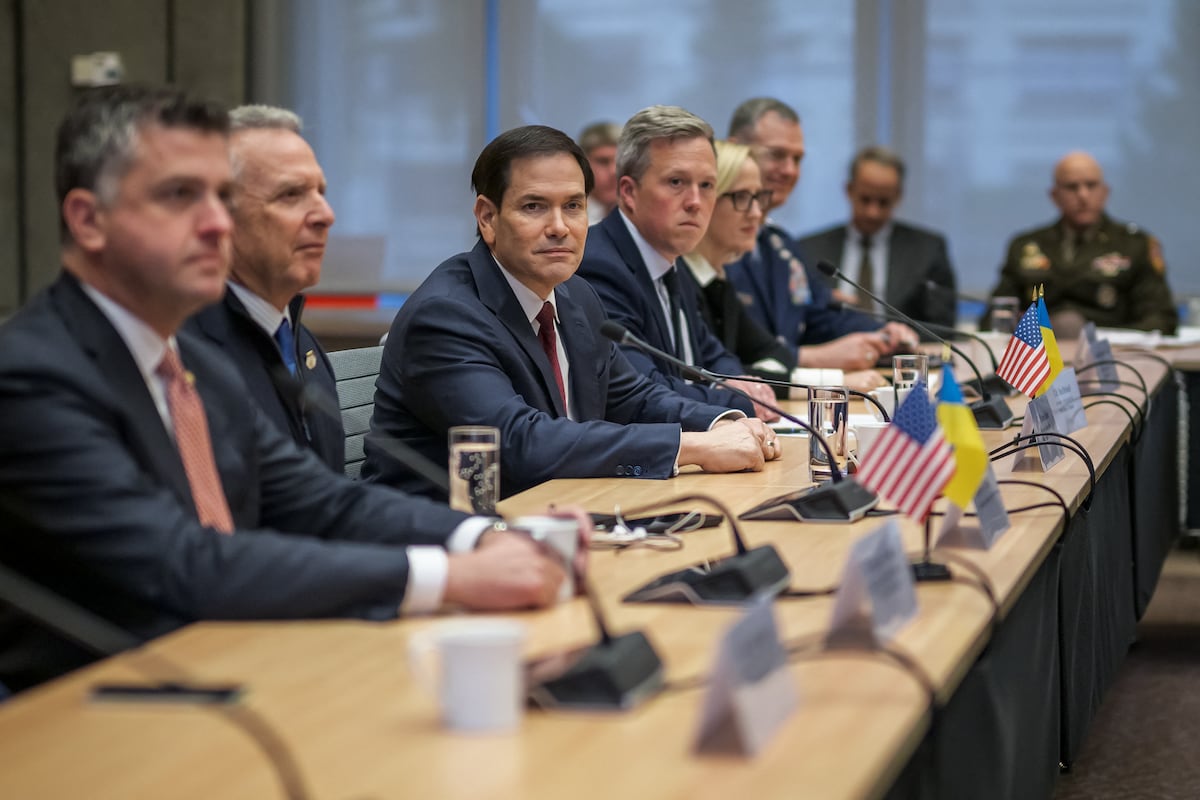
KYIV, Ukraine — Senior White House officials publicly placed Ukraine’s military ahead of allied counterparts in Europe across four venues last week, and in some respects ranked Kyiv ahead of the United States itself, even as U.S. President Donald Trump has continued to dismiss Ukraine’s military strength.
The Ukrainian armed forces are “the strongest, most powerful armed forces in all of Europe,” Secretary of State Marco Rubio said last week, citing a five-to-one Russian-to-Ukrainian casualty rate and four years of battlefield adaptation.
The necessity of fighting the war, Rubio said, has pushed Ukrainians to develop “new tactics, new techniques, new equipment, new technology that is creating a sort of hybrid asymmetrical warfare.”
U.S. Army Secretary Dan Driscoll told the Senate Armed Services Committee the same week that Ukraine has fused drones, sensors and weapons into a single command network running across the front, while U.S. Army systems remain “compartmentalized, isolated and ineffective against modern threats.”
“Ukraine’s Delta common operating system, their modular open system architecture command and control system, is absolutely incredible,” Driscoll testified.
“It fully integrates every single drone, every sensor and every shooting platform into just one single network. Ours does not.”
The shift in tone comes as allied partners press Kyiv for help countering Iranian drones, and as several countries, including the U.S., are seeking to finalize new weapons deals to route Ukrainian drone technology into joint ventures across the West.
It is a sharp turnaround from a second Trump administration that came in saying Kyiv had no cards to play.
Defense Secretary Pete Hegseth has spent the months since Trump assumed office telling European allies the continent’s defense is their problem, not Washington’s, and Trump has continued to frame NATO as a debtor to the U.S. rather than a partner.
In March, Trump continued to downplay Ukrainian dominance in the drone and counter-drone industry.
“We don’t need their help in drone defense,” he told Fox News at the time. “We know more about drones than anybody. We have the best drones in the world, actually.”
The remark came as the Pentagon was quietly moving in the opposite direction: U.S. forces deployed a Ukrainian counter-drone system to intercept Iranian Shahed attacks over an American installation in Saudi Arabia weeks later, and Ukrainian military officials flew in to train American warfighters on the tech.
The same pattern is showing up on the war front.
Ukraine’s offensive operations exceed Russia’s “for the first time,” Commander-in-Chief Gen. Oleksandr Syrskyi said last week, with Russian casualties running 3.5 times higher than Ukrainian losses along the line.
Much of Ukraine’s recent operational edge runs through a single piece of software: the Defense Ministry’s Delta system, the platform Driscoll told senators the U.S. Army cannot match.
Delta is the backbone of Ukraine’s digital kill chain. Developed by the Ministry of Defense, it fuses drone, sensor, radar and communications feeds onto a single digital map shared by verified frontline users.
In 2024, it became the first Ukrainian combat system to pass an information-security audit to NATO standards.
Kyiv has since folded a Mission Control module into the ecosystem that logs every drone sortie — type, launch point, route, mission and outcome — and pushes commander dashboards from battalion to leadership in minutes, logging and analyzing all the information along the way.
Yurii Myronenko, the Defense Ministry’s inspector general and the official who oversaw Delta’s expansion before moving into the audit role in March, said the system was built for the war it is now fighting.
“Delta is one of the best systems because, from the beginning, it was made for this drone war — integrated with EW systems, detectors, artillery, everything,” Myronenko told Military Times.
“And then we have all the data that we are learning from. It’s become a data war.”
The platform now has 270,000 registered users, he said — up from a reported 200,000 in December — and is being refined for ease of use and tighter integration with frontline tools every day.
Pressed on why the Army is only embracing Ukrainian-style integration in the fifth year of the war, Driscoll told the committee the delay is on him.
“Chairman, I would look at myself and only myself that we haven’t moved faster on it,” he said.
Driscoll pointed to a six-week sprint underway at Fort Carson, called Operation Jailbreak, as the answer: rewiring legacy systems to share data, then layering in generative AI for decision-making, something Driscoll said the Ukrainians have been doing “for the entire war.”
Earlier this month, the Army and a coalition of American defense companies, including Anduril, Boeing, Lockheed Martin, Perennial Autonomy and RTX, announced a hackathon sprint called “Right to Integrate,” built around the same modular open-systems architecture that lets Delta absorb new tools as Ukrainian engineers build them.
Several of those companies have already tested their systems on the Ukrainian front, where the war has become the most consequential live proving ground for Western drone and counter-drone tech.
“The war in Ukraine showed the world that speed matters and an open architecture construct is highly effective in high-intensity warfare,” Driscoll said in the Army release.
Rewriting the Army’s command-and-control architecture while the U.S. fights through limited weapons supplies and competing wars is no simple feat. But the alternative, Driscoll said, is worse.
“The biggest risk is not going fast enough,” he told the committee.
乌克兰基辅——上周,白宫高级官员在四个场合公开将乌克兰的军事实力置于欧洲盟国同行之上,并在某些方面将基辅的实力排在美国自身之上,尽管美国总统唐纳德·特朗普一直对乌克兰的军事实力不屑一顾。
美国国务卿马可·卢比奥上周表示,乌克兰武装部队是“全欧洲最强大、最有实力的武装部队”,并列举了俄乌双方五比一的伤亡率以及四年的战场适应经验。
鲁比奥说,战争的必要性促使乌克兰人发展出“新的战术、新的技术、新的装备、新的科技,从而创造了一种混合型非对称战争”。
美国陆军部长丹·德里斯科尔同周告诉参议院军事委员会,乌克兰已将无人机、传感器和武器融合到一个横跨前线的单一指挥网络中,而美国陆军系统仍然“各自独立、孤立,无法有效应对现代威胁”。
德里斯科尔作证说:“乌克兰的 Delta 通用操作系统,其模块化开放系统架构指挥控制系统,绝对令人难以置信。”
“它将每一架无人机、每一个传感器和每一个射击平台完全整合到一个单一的网络中。而我们的系统做不到这一点。”
乌克兰的盟友向基辅施压,要求其帮助对抗伊朗无人机,与此同时,包括美国在内的几个国家正在寻求敲定新的武器交易,以便将乌克兰的无人机技术引入西方的合资企业。这种语气的转变正是在此背景下发生的。
这与特朗普第二任期上台时所说的基辅已无牌可打的说法截然相反。
自特朗普上任以来,国防部长皮特·赫格塞斯几个月来一直告诉欧洲盟友,欧洲大陆的防务是他们的问题,而不是华盛顿的问题;而特朗普也一直将北约视为美国的债务人,而不是合作伙伴。
3月份,特朗普继续淡化乌克兰在无人机和反无人机行业的统治地位。
“我们不需要他们在无人机防御方面提供帮助,”他当时告诉福克斯新闻。“我们比任何人都更了解无人机。事实上,我们拥有世界上最好的无人机。”
就在五角大楼悄悄朝着相反的方向迈进之际,这番言论却出现了:几周后,美军部署了乌克兰反无人机系统,拦截了伊朗“沙赫德”无人机对沙特阿拉伯境内美国设施的袭击;乌克兰军方官员也飞抵美国,为美国作战人员提供该技术的培训。
同样的模式也出现在了战争前线。
乌克兰总司令奥列克桑德·瑟尔斯基将军上周表示,乌克兰的进攻行动“首次”超过了俄罗斯,俄军伤亡人数是乌克兰沿线伤亡人数的3.5倍。
乌克兰近期取得的诸多作战优势都源于一款软件:国防部的 Delta 系统,德里斯科尔告诉参议员,美国陆军无法匹敌的平台。
Delta是乌克兰数字杀伤链的核心。它由国防部开发,将无人机、传感器、雷达和通信数据融合到一个由经过验证的前线用户共享的单一数字地图上。
2024年,它成为第一个通过北约标准信息安全审计的乌克兰作战系统。
基辅方面随后将任务控制模块整合到生态系统中,该模块记录每次无人机出动——类型、起飞点、路线、任务和结果——并在几分钟内将指挥官仪表板从营级推送到领导层,同时记录和分析沿途的所有信息。
国防部监察长尤里·米罗年科(Yurii Myronenko)曾负责监督 Delta 的扩建工作,后于 3 月调任审计部门。他表示,该系统是为现在正在进行的这场战争而建造的。
“Delta 是最好的系统之一,因为它从一开始就是为无人机战争而设计的——它与电子战系统、探测器、火炮等所有装备都集成在一起,”米罗年科告诉《军事时报》。
“然后我们还有所有可以从中学习的数据。这已经演变成一场数据战争。”
他表示,该平台目前拥有 27 万注册用户,高于 12 月份报道的 20 万,并且每天都在进行改进,以提高易用性并与一线工具更紧密地集成。
当被问及为何军队直到战争的第五年才开始接受乌克兰式的一体化时,德里斯科尔告诉委员会,延误是他的责任。
“主席先生,我只能反思我自己,我们在这方面进展不够快,”他说。
德里斯科尔指出,卡森堡正在进行的为期六周的冲刺行动“越狱行动”是解决之道:重新连接传统系统以共享数据,然后添加生成式人工智能进行决策,德里斯科尔说,乌克兰人“在整个战争期间”一直在这样做。
本月初,美国陆军和包括 Anduril、波音、洛克希德·马丁、Perennial Autonomy 和 RTX 在内的美国国防公司联盟宣布了一项名为“整合权”的黑客马拉松冲刺活动,该活动围绕着相同的模块化开放系统架构构建,使 Delta 能够在乌克兰工程师构建新工具的同时吸收这些新工具。
其中几家公司已经在乌克兰前线测试了他们的系统,这场战争已成为西方无人机和反无人机技术最重要的实战试验场。
“乌克兰战争向世界表明,速度很重要,开放式架构在高强度战争中非常有效,”德里斯科尔在陆军发布的新闻稿中说。
在美军武器供应有限、多线作战的情况下,重塑陆军的指挥控制架构绝非易事。但德里斯科尔表示,不这样做更糟糕。
“最大的风险是速度不够快,”他告诉委员会。