France mulls fallback tank for delayed MGCS program in defense update法国考虑为延迟的MGCS项目配备备用坦克,国防动态更新
The delay for the MGCS project is due to Germany deciding to start a program for new Leopard 3 tanks, according to Vautrin.
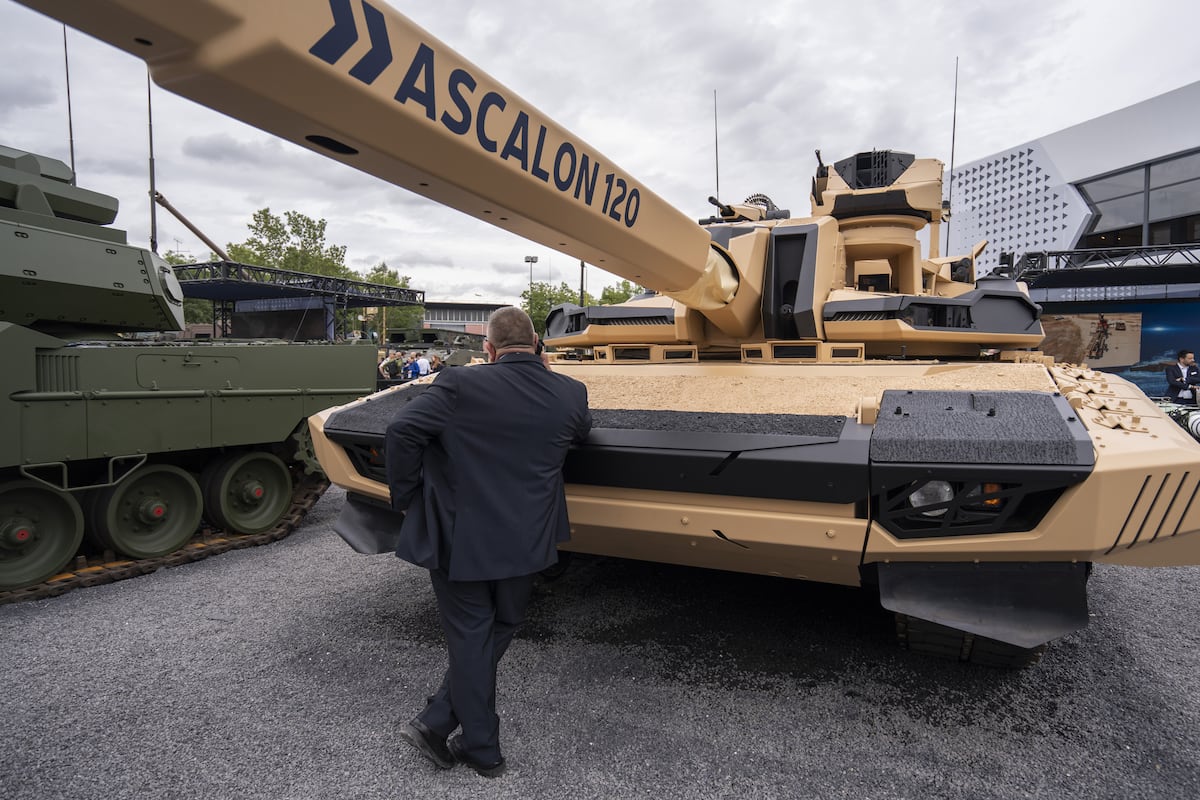
PARIS — France is in talks with manufacturers about an intermediary solution to replace the country’s aging Leclerc main battle tank, as a project with Germany to develop a next-generation tank is delayed, Armed Forces Minister Catherine Vautrin told lawmakers on Wednesday.
The French-German project for the future Main Combat Ground System, which was supposed to produce the Leclerc’s successor, is about a decade behind schedule, Vautrin told lawmakers in a hearing on Wednesday. The minister presented government plans to spend an additional €36 billion ($42 billion) on defense in the 2026-2030 period.
The delay for the MGCS project is due to Germany deciding to start a program for new Leopard 3 tanks, according to Vautrin. That has left France having to bridge the gap between the Leclerc reaching the end of its service life in 2038, and the arrival of the MGCS, which in any case had not been expected before the early 2040s.
“Regarding this intermediate capability, what we want is for it to be the first building block of the MGCS, not the last tank of the old generation,” Vautrin said. The tank would be “the first tank of a new generation of system of systems” with a particular focus on connectivity, according to the minister.
The stopgap tank could be based on a KNDS Germany platform with a KNDS France turret, according to the minister. She said the turret will be French “in any case. Discussions are currently ongoing between France’s Directorate General for Armament and various manufacturers, and are “just getting started,” Vautrin said.
The increased spending is part of an update of France’s military planning law, which had originally budgeted €400 billion for the 2024-2030 period.
With regards to another troubled project, the French-German-Spanish Future Combat Air System, Vautrin said mediation is underway between the two companies developing the next-generation fighter jet at the heart of the program. Work on the fighter jet has ground to a halt amid bickering between Dassault Aviation and Airbus over leadership and work share.
Two “qualified, external individuals” are leading negotiations to address intellectual property, work share and airworthiness certificates, with talks to conclude by the end of April, “which will allow us to see clearly,” the minister said.
Talks with Airbus were to try and reach an agreement that would allow the project to continue, Dassault Aviation Chief Executive Officer Éric Trappier said at an industry conference on April 1, adding that he is “not a man of co-management.”
While FCAS started out as a French-German project, the addition of Spain gave Airbus a bigger share in the pillar working on the next-generation fighter, with Trappier claiming Airbus has been unwilling to accept Dassault Aviation’s originally agreed lead.
Members of parliament noted the Eurodrone project, a long-delayed program led by Airbus to develop a medium-altitude long-endurance drone, is no longer included in the updated budget, with Vautrin responding that “as of now, the project is not progressing satisfactorily.” The government also scrapped plans to buy Safran’s Patroller MALE drone.
France intends to accelerate orders for the SAMP/T NG long-range air-defense system, with the aim of having ten systems in 2030 rather than the originally planned eight, though the goal remains for 12 systems in 2035, according to Vautrin.
The government is sticking to a plan for 225 Rafale fighter jets in 2035, divided between the Air Force and the Navy. Rather than buying additional Rafale jets configured to the F4 standard, the preference is to focus on the purchase of the future F5 standard, which will be able to carry the ASN4G hypersonic nuclear missile under development, according to Vautrin.
The budget includes €3.5 billion to overhaul the combat aviation framework through an approach that combines long-range missiles, escort drones and connectivity, which Vautrin said required to keep the Rafale competitive in export markets. The F5 standard is “truly a mid-life upgrade” that will allow the aircraft to maintain its competitive edge, according to the minister.
The updated military spending plan foresees 30 multiple launch rocket systems in 2030, compared to a previous plan for 16 such long-range strike systems, Vautrin said.
France will test two domestically developed rocket-artillery systems this month, which will allow to decide end-April whether a “sovereign” solution can be considered, or whether the Armed Forces Ministry should look for an off-the-shelf system, according to Vautrin.
Safran together with MBDA as well as Thales in combination with ArianeGroup are each working on their own French-made rocket artillery systems .
The updated budget adds €1 billion to start work on a conventional ballistic long-range strike capability.
The Armed Forces Ministry will order 10,000 combat drones, 43 Proteus anti-drone cannons and four SAMP/T NG air-defense systems this year, as well as €4 billion worth of air-defense systems to counter drones, according to Vautrin. Deliveries in 2026 will include 5,000 combat drones, three anti-drone lasers and two Airbus A400M transport aircraft.
Vautrin noted progress for French arms manufacturers trying to step up production, with the minister saying the firms should “continue the effort.” She said MBDA is increasing production of Mistral 3 short-range air-defense missiles fourfold to reach 800 a year in 2028, while the company aims to increase production of the Scalp cruise missile to 360 in 2027 from 240 in 2025.
Rudy Ruitenberg is a Europe correspondent for Defense News. He started his career at Bloomberg News and has experience reporting on technology, commodity markets and politics.
巴黎——法国武装部队部长凯瑟琳·沃特兰周三告诉议员们,由于与德国合作开发下一代坦克的项目被推迟,法国正在与制造商商讨一种过渡方案,以取代该国老旧的勒克莱尔主战坦克。
瓦特林周三在议员听证会上表示,法德联合研发的未来主战地面系统项目(旨在研发勒克莱尔坦克的继任者)已经比原计划落后了大约十年。这位部长还提交了政府计划,将在2026年至2030年期间额外增加360亿欧元(约合420亿美元)的国防开支。
据沃特兰称,MGCS项目延期的原因是德国决定启动新型豹3坦克项目。这使得法国不得不填补勒克莱尔坦克于2038年退役到MGCS交付之间的空档期,而MGCS的交付原本预计要到2040年代初才能实现。
“关于这项中间能力,我们希望它成为MGCS(多用途装甲防御系统)的首个组成部分,而不是老一代坦克的最终归宿,”沃特林说道。据这位部长称,该坦克将是“新一代系统之系统的第一辆坦克”,尤其注重互联互通。
据这位部长透露,这款过渡型坦克可能以德国KNDS公司的平台为基础,并配备法国KNDS公司的炮塔。她表示,炮塔“无论如何”都将是法国制造的。沃特兰说,法国军备总局目前正在与多家制造商进行磋商,而且“才刚刚起步”。
增加的开支是法国军事计划法更新的一部分,该法最初为 2024-2030 年期间的预算为 4000 亿欧元。
关于另一个陷入困境的项目——法德西未来作战空中系统(FCA),沃特林表示,负责研发该项目核心下一代战斗机的两家公司正在进行调解。由于达索航空和空客之间就领导权和工作分配问题争执不下,战斗机的研发工作已经陷入停滞。
部长表示,两名“合格的外部人士”正在牵头进行谈判,以解决知识产权、工作分享和适航证书等问题,谈判将于4月底结束,“这将使我们能够看得更清楚”。
达索航空首席执行官埃里克·特拉皮耶在4月1日的一次行业会议上表示,与空客的谈判是为了努力达成一项协议,使该项目能够继续进行。他还补充说,他“不是一个喜欢共同管理的人”。
虽然 FCAS 最初是法国和德国的项目,但西班牙的加入使空客在下一代战斗机的研发工作中占据了更大的份额,特拉皮耶声称空客一直不愿意接受达索航空最初商定的领导地位。
议员们注意到,由空客牵头、旨在研发中空长航时无人机的长期延期项目“欧洲无人机”(Eurodrone)已不再列入更新后的预算。对此,沃特林回应称,“目前该项目进展并不令人满意”。此外,政府还取消了购买赛峰集团“巡逻者”(Patroller)中空长航时无人机的计划。
据沃特林称,法国打算加快 SAMP/T NG 远程防空系统的订单,目标是在 2030 年拥有 10 套系统,而不是最初计划的 8 套,尽管到 2035 年的目标仍然是 12 套系统。
政府坚持原计划,到2035年采购225架“阵风”战斗机,空军和海军各占一半。沃特林表示,政府更倾向于采购未来的F5标准型“阵风”战斗机,而不是采购更多F4标准的“阵风”战机,因为F5标准型战机能够携带正在研发中的ASN4G高超音速核导弹。
预算中包含35亿欧元,用于通过结合远程导弹、护航无人机和互联互通的方案来全面改革作战航空体系。沃特林表示,这对于保持“阵风”战斗机在出口市场的竞争力至关重要。这位部长称,F5标准“真正意义上的中期升级”,将使该型战机保持其竞争优势。
沃特林表示,更新后的军费开支计划预计到 2030 年将拥有 30 套多管火箭发射系统,而之前的计划是拥有 16 套此类远程打击系统。
据沃特林称,法国本月将测试两套国产火箭炮系统,这将使法国能够在 4 月底决定是否可以考虑“自主研发”的解决方案,或者武装部队部是否应该寻找现成的系统。
Safran 与 MBDA 合作,以及 Thales 与 ArianeGroup 合作,都在各自研发法国制造的火箭炮系统。
更新后的预算增加了 10 亿欧元,用于启动常规弹道远程打击能力的研发工作。
据沃特林透露,武装部队部今年将订购1万架作战无人机、43门“普罗透斯”反无人机炮和4套SAMP/T NG防空系统,以及价值40亿欧元的用于反无人机的防空系统。2026年交付的装备包括5000架作战无人机、3套反无人机激光武器和2架空客A400M运输机。
沃特兰指出,法国武器制造商在提高产量方面取得了进展,并表示这些公司应该“继续努力”。她表示,MBDA公司正在将“西北风3”短程防空导弹的产量提高四倍,目标是在2028年达到每年800枚;同时,该公司计划将“风暴阴影”巡航导弹的产量从2025年的240枚提高到2027年的360枚。
鲁迪·鲁伊滕贝格是《防务新闻》的欧洲记者。他的职业生涯始于彭博新闻社,拥有报道科技、大宗商品市场和政治方面的经验。