2 free children’s books bring Singapore’s past to life through kaya toast and ice-cream bread两本免费儿童读物通过咖椰吐司和冰淇淋面包,生动展现了新加坡的过去。
Picture books use local food to spark children's curiosity about Singapore's past. Read more at straitstimes.com.
新闻视频
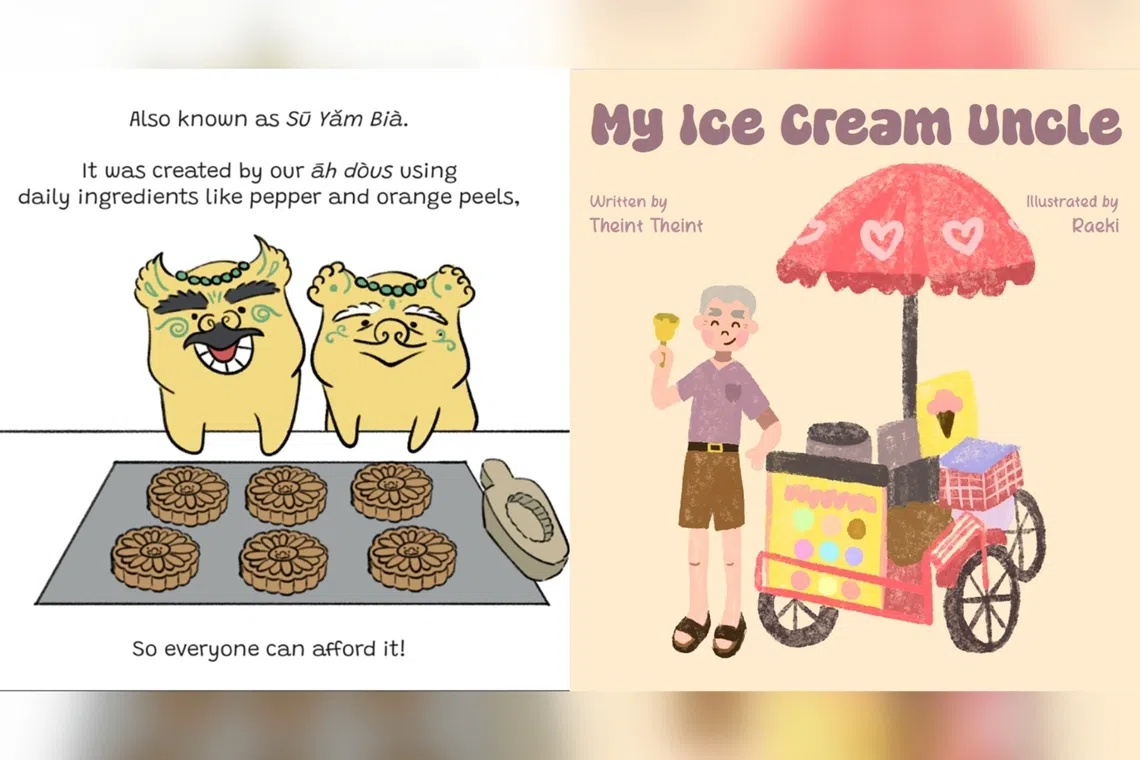
Children’s books Bo’ Hou And The Grand Feast (left) introduces traditional Hainanese food such as mooncake ge bia while My Ice Cream Uncle spotlights roadside ice-cream hawkers.
PHOTOS: THE HAINANESE COOKED, SCOOPS OF MEMORY
Published Sep 13, 2026, 12:36 PM
Updated Sep 13, 2026, 12:36 PM
The Hainanese Cooked team created the picture book Bo’ Hou And The Grand Feast to teach children about Hainanese culture, cuisine and dialect phrases.
The project features a web map highlighting heritage sites and eateries, aiming to make learning about culture a fun family activity.
This book is part of the Temasek Foundation–NUS Heritage Champions programme, which supports student-led projects preserving Singapore’s heritage, including another book on ice cream hawkers.
SINGAPORE – Many children love a good plate of chicken rice or a slice of kaya toast, but few know the story behind them – that these familiar dishes were introduced by Hainanese immigrants who made Singapore their home.
To help kids explore the roots of these beloved dishes, Koh V-Nying, 24, Ng Wee Liang, 27, and Yong Chuen Shin, 25 – collectively known as The Hainanese Cooked – have released Bo’ Hou And The Grand Feast, a picture book celebrating Hainanese culture and cuisine.
Available to read for free online at hainanesecooked.netlify.app , the story follows two animal characters, Bo’ Hou and Mai Tin, inspired by the traditional Hainanese tiger and lion dance.
Through their adventures, young readers are introduced to dialect phrases and lesser-known delicacies such as ge bia, a Hainanese-style mooncake made with orange peel and pepper.
“We hope young readers can learn Hainanese phrases and about delicacies they may not encounter in everyday life,” says Yong, who is of Hainanese heritage. “We want to spark their curiosity to explore more about our culture.”
To help families turn learning into a fun outing, the team has also created a web map. It highlights local eateries serving traditional fare, an 1853 heritage temple and a troupe keeping the art of Hainanese tiger dance alive.
(From left) Ng Wee Liang, Yong Chuen Shin and Koh V-Nying of The Hainanese Cooked hope to share Hainanese culture. PHOTO: NUS LIBRARIES
(From left) Ng Wee Liang, Yong Chuen Shin and Koh V-Nying of The Hainanese Cooked hope to share Hainanese culture.
PHOTO: NUS LIBRARIES
Bo’ Hou And The Grand Feast is one of 10 student-led community heritage projects developed under the inaugural Temasek Foundation-National University of Singapore (NUS) Heritage Champions programme.
Children's book Bo' Hou And The Grand Feast introduces traditional Hainanese food such as mooncake ge bia. PHOTO: THE HAINANESE COOKED
Children's book Bo' Hou And The Grand Feast introduces traditional Hainanese food such as mooncake ge bia.
PHOTO: THE HAINANESE COOKED
Over two years, 125 tertiary students across two cohorts participated in the initiative, supported by NUS Libraries, Temasek Foundation and the National Heritage Board. The top five teams from each cohort received up to $7,000 to bring their projects to life.
Scoops of Memory members Totaan Aljean Choong (far left) and Lai Xin Yu (far right) with roadside ice-cream hawkers. PHOTO: NUS LIBRARIES
Scoops of Memory members Totaan Aljean Choong (far left) and Lai Xin Yu (far right) with roadside ice-cream hawkers.
Another project to emerge from the programme is My Ice Cream Uncle, a children’s picture book spotlighting roadside hawkers selling ice cream wrapped in bread.
Created by Scoops of Memory – comprising Totaan Aljean Choong, 20, Lai Xin Yu, 20, and Theint Theint Zaw Tun, 23 – the project also includes a YouTube documentary exploring the trade, titled Where Are Singapore’s Ice Cream Hawkers Going?.
“Ice-cream hawkers were a familiar part of many Singaporeans’ childhood, but they are slowly disappearing,” says Theint Theint Zaw Tun.
“Each cart represents years of hard work and community connection. We wanted to preserve these stories and make them accessible to a new generation.”
Families can look out for the e-book release on their Instagram page (@scoopsofmemory) by year-end.
Physical copies of the picture books from both teams will also be available at selected public libraries.
Children’s book My Ice Cream Uncle spotlights roadside ice-cream hawkers. PHOTO: SCOOPS OF MEMORY
Children’s book My Ice Cream Uncle spotlights roadside ice-cream hawkers.
PHOTO: SCOOPS OF MEMORY
For NUS university librarian Natalie Pang, these projects highlight how important young voices are in keeping heritage alive.
“Singapore’s heritage is not only found in monuments and historic buildings,” she says. “It also lives in everyday experiences, memories, food, places and the stories of communities.
“When young people take ownership of these stories and find new ways to share them, they help ensure that our heritage remains relevant and meaningful to future generations.”
Elisa Chia is a correspondent at The Straits Times, writing parenting and lifestyle features.
儿童读物《波侯与盛宴》(左)介绍了海南传统美食,如月饼,而《我的冰淇淋叔叔》则重点介绍了路边冰淇淋小贩。
照片:海南人烹饪,记忆的勺子
发布于 2026 年 9 月 13 日下午 12:36
更新于2026年9月13日下午12:36
海南美食团队创作了绘本《波侯与盛宴》,旨在向孩子们介绍海南文化、美食和方言短语。
该项目以网络地图的形式突出展示历史遗迹和餐馆,旨在让学习文化成为一项有趣的家庭活动。
本书是淡马锡基金会-新加坡国立大学遗产保护倡导者计划的一部分,该计划支持学生主导的保护新加坡遗产的项目,其中包括另一本关于冰淇淋小贩的书籍。
新加坡——许多孩子都喜欢吃一盘美味的鸡饭或一片咖椰吐司,但很少有人知道这些熟悉的菜肴背后的故事——这些菜肴是由定居新加坡的海南移民引进的。
为了帮助孩子们探索这些深受喜爱的菜肴的起源,24 岁的 Koh V-Nying、27 岁的 Ng Wee Liang 和 25 岁的 Yong Chuen Shin(他们共同被称为“海南烹饪家”)出版了绘本《波侯与盛宴》,庆祝海南文化和美食。
故事讲述了两个动物角色——波侯和麦天,其灵感来源于海南传统的舞虎舞狮,可以在 hainanesecooked.netlify.app 上免费在线阅读。
通过他们的冒险经历,小读者们会接触到方言短语和一些不太为人所知的美食,例如用橙皮和胡椒制成的海南风味月饼——葛皮月饼。
“我们希望小读者们能学到一些海南语短语,以及一些他们在日常生活中可能接触不到的美食,”拥有海南血统的Yong说道,“我们希望激发他们对海南文化的好奇心,让他们想要更多地了解我们的文化。”
为了帮助家庭将学习变成一次有趣的郊游,团队还创建了一个网络地图。地图上重点介绍了供应传统美食的当地餐馆、一座建于1853年的历史寺庙以及一个传承海南虎舞艺术的表演团体。
(从左至右)“海南料理”的吴伟良、杨传信和许薇莹希望分享海南文化。图片:新加坡国立大学图书馆
(从左至右)海南美食家的吴伟良、杨传信和许薇莹希望分享海南文化。
图片来源:新加坡国立大学图书馆
《波侯与盛宴》是首届淡马锡基金会-新加坡国立大学(NUS)遗产冠军计划下开发的 10 个学生主导的社区遗产项目之一。
儿童绘本《波侯与盛宴》介绍了海南传统美食,例如月饼。图片:海南美食
儿童绘本《波侯与盛宴》介绍了海南传统美食,如月饼。
照片:海南人烹饪
在新加坡国立大学图书馆、淡马锡基金会和国家文物局的支持下,两年内共有两届125名高等院校学生参与了这项计划。每届排名前五的团队获得了高达7000新元的资助,用于实施他们的项目。
Scoops of Memory 成员 Totaan Aljean Choong(左一)和 Lai Xin Yu(右一)与路边冰淇淋小贩合影。照片:新加坡国立大学图书馆
Scoops of Memory 成员 Totaan Aljean Choong(左一)和 Lai Xin Yu(右一)与路边冰淇淋小贩合影。
该计划催生的另一个项目是《我的冰淇淋叔叔》,这是一本儿童图画书,重点介绍了路边小贩用面包包裹冰淇淋的卖道活动。
该项目由 Scoops of Memory 团队创建,该团队由 20 岁的 Totaan Aljean Choong、20 岁的 Lai Xin Yu 和 23 岁的 Theint Theint Zaw Tun 组成。该项目还包括一部探索该行业的 YouTube 纪录片,名为《新加坡冰淇淋小贩要去哪里?》。
“冰淇淋小贩是许多新加坡人童年记忆中熟悉的一部分,但他们正在慢慢消失,”Theint Theint Zaw Tun说道。
“每一辆手推车都代表着多年的辛勤劳动和社区凝聚力。我们希望保存这些故事,并让新一代人也能了解它们。”
家长们可以关注他们的 Instagram 页面 (@scoopsofmemory),该电子书将于年底前发布。
两支球队的图画书实体版也将在指定的公共图书馆提供。
儿童绘本《我的冰淇淋叔叔》聚焦路边冰淇淋小贩。图片:SCOOPS OF MEMORY
儿童读物《我的冰淇淋叔叔》聚焦路边冰淇淋小贩。
照片:记忆之勺
对于新加坡国立大学图书馆员 Natalie Pang 来说,这些项目凸显了年轻人的声音在传承文化遗产方面的重要性。
“新加坡的文化遗产不仅体现在纪念碑和历史建筑中,”她说。“它也存在于日常生活的体验、记忆、食物、场所和社区的故事中。”
“当年轻人掌握这些故事并找到分享它们的新方法时,他们就有助于确保我们的文化遗产对子孙后代仍然具有相关性和意义。”
Elisa Chia是《海峡时报》的记者,撰写育儿和生活方式方面的文章。