Singapore raises defense budget, readies new military acquisitions新加坡增加国防预算,准备采购新的军事装备
The government of Singapore announced a 12.4% defense budget hike on March 3, with major new equipment on order.
CHRISTCHURCH, New Zealand — The government of Singapore announced a 12.4% defense budget hike on March 3, with major new equipment on order.
The island state’s FY2025 defense budget is slated to reach S$23.4 billion, the equivalent of US$17.4 billion. The increase helps fund projects deferred or disrupted by COVID-19, but Defence Minister Ng Eng Hen indicated rises will taper off in the FY2026 budget to ensure defense expenditure stays within 3% of gross domestic product.
That rate represents a cap for Singapore’s defense spending, to which the government has consistently adhered, said Collin Koh, an analyst at the Institute of Defence and Strategic Studies at Singapore’s S. Rajaratnam School of International Studies.
“Singapore has definitely seen the writing on the wall where it comes to the evolving security landscape – increasingly fraught, uncertain and all the more so when international rule of law is coming under strain,” he said.
New weapon investments are slated to come online as result of quickness in buying rather than “threat-based planning,” the analyst added.
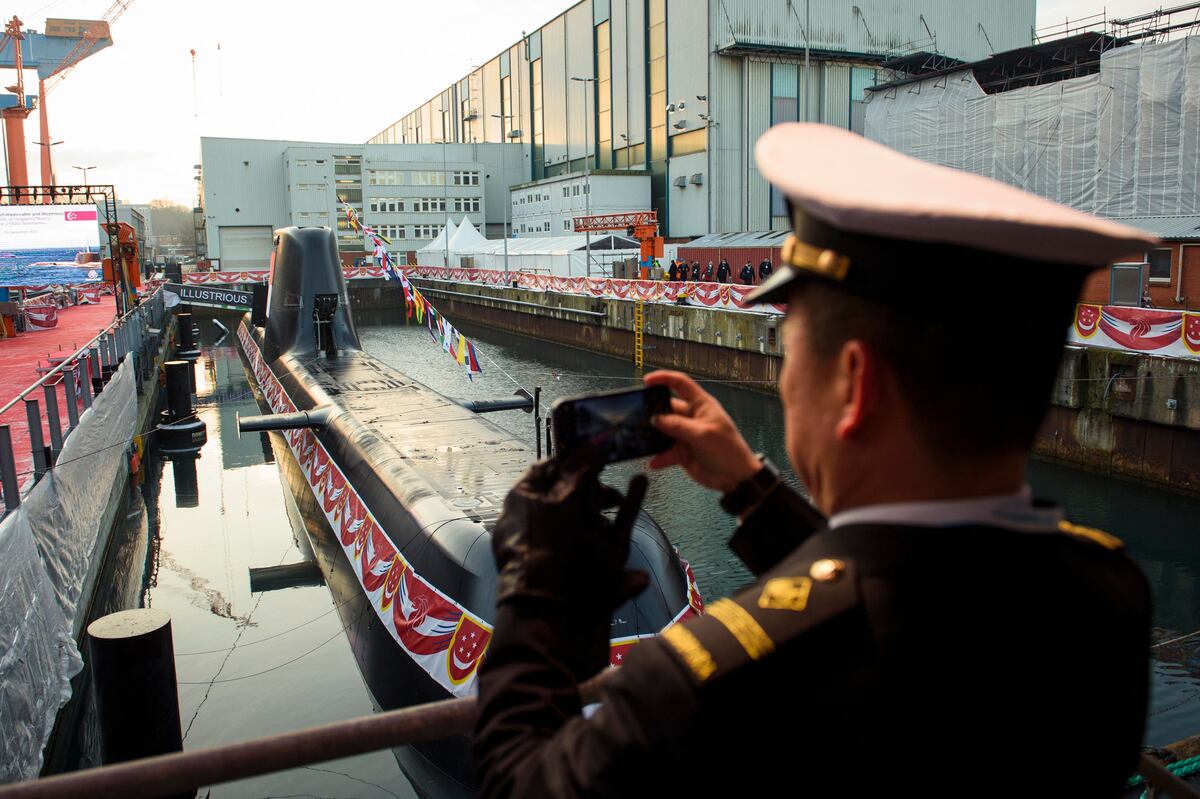
Two more Type 218SG Invincible-class submarines from thyssenkrupp Marine Systems are on the order list, bringing the fleet to six. Two boats were commissioned in September 2024, while the second pair should be operational by 2028.
“Having proven that the Invincible-class submarines can perform to expectations in tropical waters, the Singapore Armed Forces plans to procure two more submarines, to make up a total of six, as the steady state for our submarine fleet,” Ng told lawmakers on the Committee of Supply Debate.
Ng added that defense officials had begun evaluating options for maritime patrol aircraft to replace five Fokker 50 aircraft in service since 1993.
Under consideration are the Airbus C295 or Boeing P-8 Poseidon, which Koh described as “significantly more capable” in scanning the country’s maritime environs for threats.
Ng confirmed a deal for eight F-35A fighters, first announced last year. These come on top of a dozen F-35Bs on order.
The Singapore Army also is in line for new gear under the budget plan. The service will receive a new type of 8x8 infantry fighting vehicle called the Titan. Its main armament is a 30mm cannon in an unmanned turret, plus a counter-drone system. Little is known about the Titan, but it is probably based on ST Engineering’s Terrex s5 vehicle.
Singapore possesses 24 HIMARS rocket launchers, and these will receive a midlife upgrade to permit them to fire “more capable rockets.” according to the Ministry of Defence.
These are likely the Army Tactical Missile System and Precision Strike Missile.
To defend against drones, or unmanned aerial systems, the military has created a Counter-UAS Development and Operations group. It will develop concepts of operations and field an array of sensors, jammers and weapons.
Meanwhile the navy’s first Multi-Role Combat Vessel will launch this year, meant as motherships for various unmanned systems.
Two new commands have been established. One is the Defence Cyber Command to defend military networks and support whole-of-government cyber-defense efforts. The second organization is devoted to pushing digitization of the military and across all branches.
Ng said Singapore must strengthen networks of friends and partners. He highlighted the Five Power Defence Arrangements with Australia, Malaysia, New Zealand and the U.K., as well as high-level exchanges with China and the United Sates.
“We’re not a threat to anyone, and wish all to be friends,” said Ng. “But as the saying goes: Strong fences – and I would add, defenses – make good neighbors.”
Gordon Arthur is an Asia correspondent for Defense News. After a 20-year stint working in Hong Kong, he now resides in New Zealand. He has attended military exercises and defense exhibitions in about 20 countries around the Asia-Pacific region.
新西兰基督城——新加坡政府于3月3日宣布国防预算增加12.4%,并订购了大量新装备。
新加坡2025财年的国防预算预计将达到234亿新元,约合174亿美元。此次增加的预算将用于资助因新冠疫情而推迟或中断的项目。但国防部长黄永宏表示,2026财年的预算增幅将逐步放缓,以确保国防开支占国内生产总值的比例保持在3%以内。
新加坡拉惹勒南国际研究院国防与战略研究所分析师柯林·科赫表示,这一比率代表了新加坡国防开支的上限,政府一直坚持这一上限。
他说:“新加坡显然已经看到了不断变化的安全形势的严峻形势——日益紧张、充满不确定性,尤其是在国际法治受到压力的情况下。”
分析师补充说,新的武器投资之所以能够投入使用,是因为采购速度快,而不是“基于威胁的规划”。
蒂森克虏伯海事系统公司又订购了两艘218SG型“无敌”级潜艇,使该级潜艇总数达到六艘。其中两艘已于2024年9月服役,另外两艘预计将于2028年投入使用。
“新加坡武装部队已经证明无敌级潜艇能够在热带水域达到预期性能,因此计划再采购两艘潜艇,使潜艇总数达到六艘,以维持我们潜艇舰队的稳定规模,”黄永宏在财政预算辩论委员会上告诉议员们。
吴补充说,国防官员已经开始评估海上巡逻机的方案,以取代自 1993 年以来一直在服役的 5 架福克 50 型飞机。
目前正在考虑的机型包括空客 C295 或波音 P-8 海神,Koh 称其在扫描该国海上环境以发现威胁方面“能力要强得多”。
吴先生证实了去年首次宣布的8架F-35A战斗机订单。这笔订单是在此前已订购的12架F-35B战斗机的基础上追加的。
根据预算计划,新加坡陆军也将获得新装备。该军种将接收一种名为“泰坦”(Titan)的新型8x8步兵战车。其主要武器是一门安装在无人炮塔上的30毫米火炮,以及一套反无人机系统。目前关于“泰坦”的信息还很少,但它很可能基于新加坡科技工程公司(ST Engineering)的Terrex S5战车。
新加坡国防部表示,新加坡拥有24套HIMARS火箭发射器,这些发射器将进行中期升级,使其能够发射“性能更强的火箭”。
这些很可能是陆军战术导弹系统和精确打击导弹。
为了防御无人机(或称无人飞行器系统),军方成立了反无人机系统研发与作战小组。该小组将制定作战概念,并部署一系列传感器、干扰器和武器。
与此同时,海军首艘多用途作战舰艇将于今年下水,该舰将作为各种无人系统的母舰。
两个新的指挥机构已经成立。一个是国防网络司令部,负责保护军事网络并支持全政府的网络防御工作。另一个机构致力于推动军队及所有军种的数字化转型。
吴先生表示,新加坡必须加强与朋友和伙伴的网络联系。他重点提及了与澳大利亚、马来西亚、新西兰和英国签署的“五国联防安排”,以及与中国和美国的高层交流。
“我们对任何人都没有威胁,也希望大家都能成为朋友,”吴先生说。“但正如俗语所说:坚固的围墙——我还要补充一点,防御工事——才能造就好邻居。”
戈登·阿瑟是《防务新闻》的亚洲特派记者。在香港工作20年后,他现居新西兰。他曾到访亚太地区约20个国家,参加过军事演习和防务展览。