Germany's likely next government seeks higher defense spending德国下一届政府可能寻求增加国防开支。
Merz cited “the most recent decisions by the American government” as one factor.
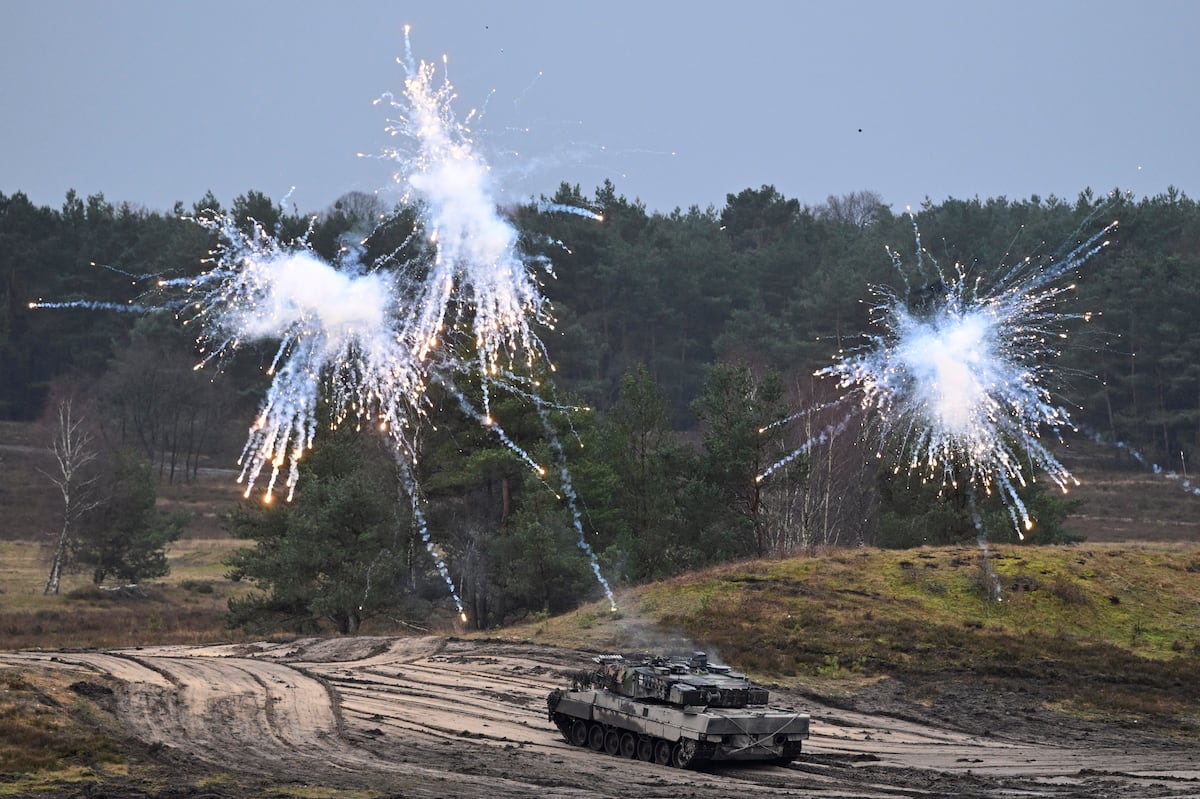
BERLIN (AP) — The prospective partners in Germany’s next government said Tuesday they will seek to loosen the nation’s rules on running up debt to allow for higher defense spending, an issue of growing urgency as doubts increase about the United States’ commitment to European allies.
They also said they will seek to set up a €500 billion ($533 billion) fund to finance spending on Germany’s often-creaking infrastructure over the next 10 years to restore the economy — Europe’s biggest, which has shrunk for the last two years — to “a stable growth course.”
Center-right election winner Friedrich Merz, who is trying to form a coalition government with the center-left Social Democrats of outgoing Chancellor Olaf Scholz, said the two sides will propose exempting the spending of more than 1% of gross domestic product on defense from rules that limit the government’s ability to borrow money.
He said they will bring the proposals for that and the infrastructure package, which will be financed by loans, to Germany’s outgoing parliament next week. Recent weeks have brought new urgency to efforts to further strengthen the country’s long-neglected military.
“In view of the increasing threat situation, it is clear to us that Europe — and with Europe, the Federal Republic of Germany — must now very quickly make very big efforts, very quickly, to strengthen the defense capability of our country and the European continent,” Merz told reporters.
“We are counting on the United States of America standing by our mutual alliance commitments in the future as well,” he said in a reference to NATO. “But we also know that the funding for the defense of our country and alliance must now be expanded significantly.”
Merz cited “the most recent decisions by the American government” as one factor. He didn’t offer specifics, but appeared to be referring to Washington’s dramatically shifting stance on Ukraine.
“‘Whatever it takes’ must also go for our defense now, in view of the threats to our freedom and to peace on our continent,” Merz said.
Merz has long been committed to the trans-Atlantic military and political alliance. After his Union bloc won Germany’s election last month, he said an “absolute priority” would be to strengthen Europe “so that we can really achieve independence from the U.S. step by step.” He said Trump administration comments suggest “the fate of Europe is largely indifferent to the Americans.”
Shortly after Russia launched its full-scale invasion of Ukraine in 2022, Scholz pledged to increase Germany’s defense spending to the current NATO target of 2% of gross domestic product and announced the creation of a 100 billion euro special fund to modernize the military.
Germany met that target thanks to the fund, but it will be used up in 2027.
“We are just as unsettled, and just as concerned, as large parts of our population,” Bavarian governor Markus Söder, a leading conservative ally of Merz, said of the changing U.S. stance.
Germany’s ‘debt brake’
Germany’s “debt brake” allows new borrowing worth only 0.35% of annual gross domestic product, though it can be suspended for emergencies that are out of the state’s control. It was suspended for three years after the COVID-19 pandemic started in 2020.
Both legislative proposals will require a two-thirds majority in parliament as the “debt brake” is anchored in Germany’s constitution.
That could be complicated in the newly elected German parliament, where the far-right Alternative for Germany and the hard-left Left Party have a little over one-third of seats between them. Alternative for Germany portrays itself as a staunch defender of the “debt brake.” The Left Party opposes it but is skeptical about military spending.
But until the new parliament convenes, expected in late March, the old one remains in place. The prospective coalition partners will still need support from at least one of the environmentalist Greens and the pro-business Free Democrats to get their plans approved. The latter swiftly criticized plans to run up more debt.
The Social Democrats’ co-leader, Lars Klingbeil, said his party and Merz’s conservatives also agreed in the longer term “to rework the ‘debt brake’ by the end of 2025 to enable more investment.”
Merz said the parties believe the planned infrastructure package will “also trigger private investment on a large scale.” He said quick improvements to Germany’s competitiveness also will be needed.
The two sides have to reach agreement on many other issues before they can be sure of forming a coalition, but there’s no other politically plausible combination of parties that could form a new government.
柏林(美联社)——德国下一届政府的潜在合作伙伴周二表示,他们将寻求放宽该国关于增加债务的规定,以允许提高国防开支。随着人们对美国对欧洲盟友的承诺越来越怀疑,这个问题变得越来越紧迫。
他们还表示,他们将寻求设立一个 5000 亿欧元(5330 亿美元)的基金,用于在未来 10 年内为德国经常老化的基础设施提供资金,以使德国经济(欧洲最大的经济,在过去两年中一直萎缩)恢复到“稳定的增长轨道”。
中右翼选举获胜者弗里德里希·默茨正试图与即将卸任的总理奥拉夫·朔尔茨领导的中左翼社会民主党组建联合政府。他表示,双方将提议豁免超过国内生产总值 1% 的国防开支不受限制政府借贷能力的规则约束。
他表示,他们将在下周向即将卸任的德国议会提交相关提案以及基础设施建设一揽子计划(该计划将通过贷款融资)。近几周来,加强德国长期被忽视的军事力量的努力变得更加紧迫。
“鉴于威胁形势日益严峻,我们清楚地认识到,欧洲——以及与欧洲一起的德意志联邦共和国——现在必须迅速做出巨大努力,迅速加强我国和欧洲大陆的防御能力,”梅尔茨告诉记者。
“我们指望美国未来继续履行我们共同的联盟承诺,”他指的是北约。“但我们也知道,现在必须大幅增加我们国家和联盟的国防经费。”
默兹将“美国政府最近的决定”列为其中一个因素。他没有提供具体细节,但似乎指的是华盛顿在乌克兰问题上立场的急剧转变。
“鉴于我们大陆的自由与和平正受到威胁,‘不惜一切代价’的原则现在也必须适用于我们的国防,”梅尔茨说。
默茨长期以来一直致力于维护跨大西洋军事和政治联盟。上个月,他的联盟党赢得德国大选后,他表示,加强欧洲将是“绝对优先事项”,“这样我们才能真正逐步摆脱对美国的依赖”。他还说,特朗普政府的言论表明“欧洲的命运在很大程度上与美国人无关”。
2022年俄罗斯全面入侵乌克兰后不久,朔尔茨承诺将德国的国防开支提高到北约目前设定的占国内生产总值2%的目标,并宣布设立1000亿欧元的专项基金,用于军队现代化。
多亏了这笔资金,德国才实现了这一目标,但该资金将于 2027 年用完。
“我们和我们大部分民众一样感到不安和担忧,”巴伐利亚州州长马库斯·索德尔(Markus Söder)说道,他是默茨的主要保守派盟友,他谈到美国立场的转变时表示。
德国的“债务刹车”
德国的“债务刹车”机制允许新增借款额不超过年度国内生产总值的0.35%,但对于国家无法控制的紧急情况,该机制可以暂停实施。在2020年新冠疫情爆发后,该机制暂停了三年。
这两项立法提案都需要议会三分之二的多数票才能通过,因为“债务刹车”机制已写入德国宪法。
在刚刚选出的德国议会中,情况可能会变得复杂,因为极右翼的德国另类选择党和极左翼的左翼党加起来只占三分之一多一点的席位。德国另类选择党标榜自己是“债务刹车”机制的坚定捍卫者。左翼党反对这一机制,但对军费开支持怀疑态度。
但在预计于三月下旬召开的新一届议会之前,旧议会将继续运作。潜在的联合执政伙伴仍需至少获得环保主义的绿党和亲商的自由民主党中至少一方的支持,才能使其方案获得批准。后者迅速对增加债务的计划提出了批评。
社会民主党联合领导人拉尔斯·克林贝伊表示,他的政党和默茨的保守派也同意从长远来看“在2025年底前重新调整‘债务刹车’机制,以促进更多投资”。
默茨表示,各方相信计划中的基础设施建设方案“也将大规模刺激私人投资”。他还表示,德国的竞争力也需要迅速提升。
双方在组建联合政府之前,还需要在许多其他问题上达成一致,但除此之外,没有其他政治上可行的政党组合可以组建新政府。