Pringles cans on drones: Ukraine’s weapons ingenuity takes all forms无人机搭载品客薯片罐:乌克兰的武器创造力体现在方方面面
Ukrainian drone operators continue to use quick thinking and ingenuity to stifle Russian advances.
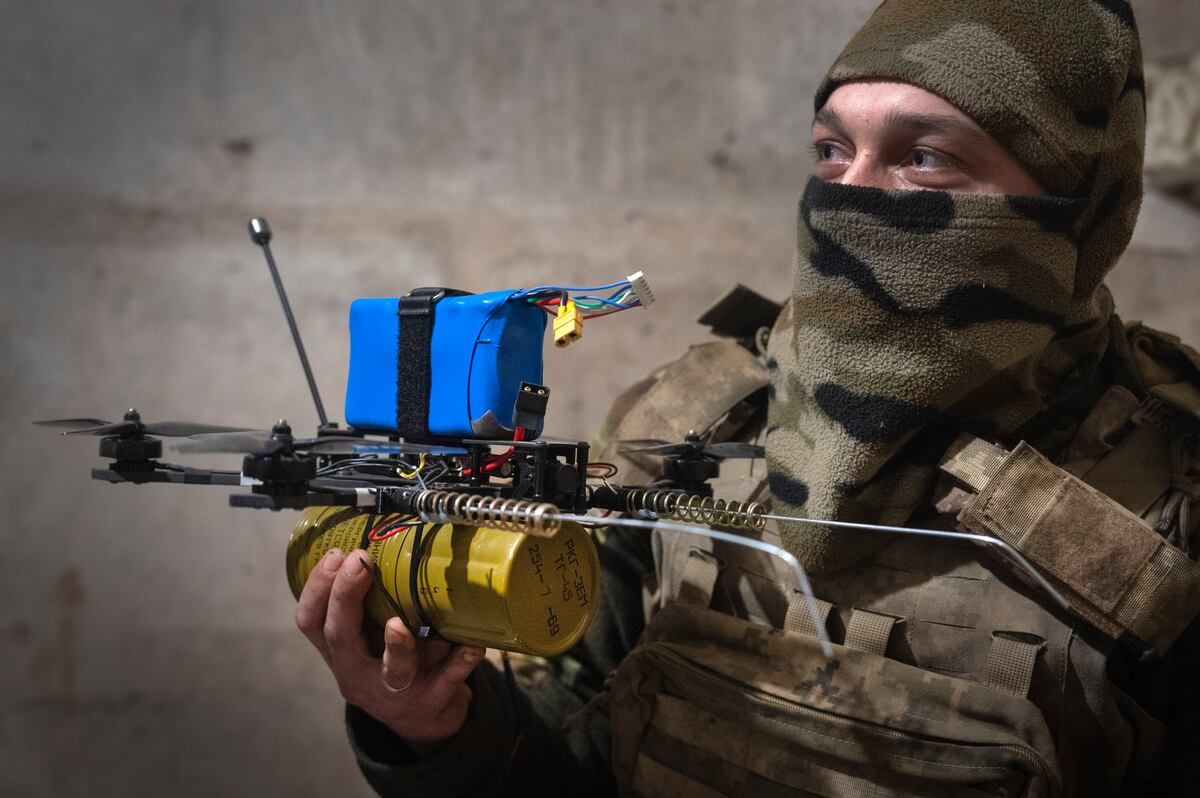
LYMAN, DONETSK REGION- “I don’t need your f***ing American shells,” Vadim Adamov muttered as he packed the Pringles can full of sulphate and plastic explosive.
It was early 2024, and he had been fighting outside Avdiivka, a small town near the occupied city of Donetsk that had been a major Russian target since the start of the war.
The town had been a nearly impenetrable fortress, and the Russians expended an extraordinary collection of men and armor trying to capture it.
Adamov usually packed explosives into ready-made metal containers, but the unit had run out. So, after finishing snacking on chips from the tubed Pringles can, he got to work re-filling it. And it worked.
With the help of neighboring drone spotting units, Adamov flew the drone into the sky and dropped the Pringles can onto a Russian armored vehicle.
The hit disabled the vehicle, which was then finished off by additional impacts.
The drone Adamov used was a DJI Mavic, which retails for a few thousand dollars. The explosives, meanwhile, cost less than a hundred. Pringles in Ukraine go for about $1.50.
Together, the combination proved capable of destroying armored vehicles that cost hundreds of thousands to manufacture.
Ukrainian troops prepare drones ahead of an operation. (Tom Mutch)
Although Avdiivka would fall just over a month later, Adamov had learned a valuable lesson.
Ukraine could not always rely on its allies, but it could use quick thinking and ingenuity to stifle Russian advances.
When Ukraine smuggled hundreds of drones in container trucks into Russia to destroy strategic bombers and spy planes — a June 1 assault known as Operation Spiderweb — they were carrying out a similar sort of DIY assault, albeit on a scale that shocked the world.
Near the front line in the Ukrainian city of Lyman, drone unit pilots flipped through videos of Russian weapons and armor positions being destroyed.
Another pilot sitting nearby trained on an FPV, or first-person view, drone, strapping the now distinctive goggles onto his face, controller in hand, while maneuvering the drone through various obstacles.
Here, the entire process has been gamified. Rankings are offered, online medals awarded and financial and equipment bonuses doled out for confirmed kills of Russian equipment.
“The best thing to do if you hear one is to play dead,” one drone pilot said, pointing out that many of the platforms navigate through motion sensing.
However, he added with a shrug, if the drone gets that close you are probably dead already.
In his poem Arithmetic on the Frontier , Rudyard Kipling uses the example of a well-educated, highly trained British imperial civil servant killed in India with a hastily assembled threadbare rifle.
“Two thousand pounds of education,” Kipling wrote, “falls to a ten-rupee jezail.”
Warfare in the 21st century still has much in common with the 19th. When the Ukraine-Russia war began in 2022, drones had already become a fixture of modern warfare.
While variants that were used in more recent operations like the Global War on Terror were behemoths, hobbyists who employed smaller drones for amateur photography soon realized they could be used in scouting missions.
A Ukrainian soldier operates an FPV drone near the front lines. (Tom Mutch)
The platforms showcased their capability early in the war, when they guided Ukrainian artillery onto an enormous Russian armored column in the Kyiv suburb of Brovary.
From there, it didn’t take long for Ukrainians like Vadim Adamov to realize that drones could carry small explosives to be dropped from overhead or flown into an enemy like a Kamikaze.
When U.S. aid temporarily dried up at the end of 2023, necessity became the mother of invention. A subsequent shortage of artillery shells turned Ukrainian attention to the less expensive drone as their centerpiece of defense.
Ukraine produced 2.2 million drones last year. They expect to make as many as 5 million this year. These drones are not just FPVs used for targeting or reconnaissance, but platforms designed for use on land and sea.
A February 2025 conference in central Kyiv, hosted by an organization called BraveOne, showcased the country’s latest in unmanned development.
There, Sasha Rubina, a Kharkiv-born tech designer for Ukrainian Unmanned Technologies, showed off a UGV, or unmanned ground vehicle, that could be driven remotely and carry food or ammunition to soldiers fighting on the front line.
“The idea is that the person controlling it is in a safe place,” Rubina said. “The less soldiers used on the battlefield itself, the more lives we save and protect our medical personnel.”
An engineer installs components in Kyiv region, Ukraine, on Wednesday, February 7, 2024. (AP Photo/Evgeniy Maloletka)
Such innovations continue to be critical as Ukraine pushes to offset battlefield weaknesses elsewhere.
Since the failure of the counteroffensive of summer 2023, the nation’s military has suffered serious manpower shortfalls, especially among its infantry ranks.
The psychological toll of blood, mud and anguish has washed away much of what was once the hope for an inevitable, hard-fought victory. And any cautious optimism that suggested U.S. President Donald Trump would come down hard on Russia has been dashed against the rocks.
With progress at the negotiating table negligible, Ukraine and Russia continue to be locked in a seemingly endless arms race to both produce and upgrade drones and other battlefield technologies.
It is a tech chess game of sorts, each move eliciting a counter.
In one instance, Ukrainian soldiers began carrying jammers capable of cutting live-feed connections between the Russian pilot and drone, a move that would disable the platform mid-flight.
Russians responded by equipping drones with spools of fiber-optic cable less than a millimeter wide, allowing them to withstand jamming efforts.
Now, Ukrainian trenches, buildings and even roads are often covered with physical netting.
Traveling through Ukraine today reveals basements, back garages and commercial printing factories that have been turned into drone-production facilities.
While the cost of premade DJI Mavic drones continues to drop, amateur, yet increasingly innovative technicians, many of them just teenagers, are finding it cheaper to import the individual parts — rotor blades, batteries and cameras — to build themselves.
In many ways, the national drone-production effort appears as the modern-day opposite of the Manhattan Project. Instead of a super weapon, Ukraine is endeavoring to produce millions of tiny explosives to degrade Russian forces one strike at a time.
Whoever masters mass production and deployment of these drones will likely gain the advantage in the war.
“Strike hard who cares — shoot straight who can," Kipling wrote.
“The odds are on the cheaper man.”
Tom Mutch is a Ukraine-based journalist from New Zealand. He is the author of The Dogs of Mariupol , available now.
顿涅茨克州莱曼——“我不需要你那该死的美国炮弹,”瓦迪姆·阿达莫夫一边嘟囔着,一边把品客薯片罐装满硫酸盐和塑性炸药。
那是 2024 年初,他一直在阿夫迪伊夫卡城外作战。阿夫迪伊夫卡是顿涅茨克市附近的一个小镇,自战争开始以来一直是俄罗斯的主要目标。
该镇曾是一座几乎坚不可摧的堡垒,俄国人投入了大量兵力和盔甲试图攻占它。
阿达莫夫通常把炸药装进现成的金属容器里,但部队里的容器用完了。于是,他吃完罐装品客薯片后,就开始重新装炸药。结果成功了。
在邻近无人机侦察部队的帮助下,阿达莫夫驾驶无人机升空,并将品客薯片罐投放到一辆俄罗斯装甲车上。
撞击使车辆失去动力,随后又受到多次撞击而彻底损毁。
阿达莫夫使用的无人机是大疆 Mavic,零售价高达数千美元。而炸药的成本却不到一百美元。在乌克兰,一包品客薯片的售价约为 1.5 美元。
事实证明,这种组合能够摧毁造价数十万美元的装甲车辆。
乌克兰军队在行动前准备无人机。(汤姆·穆奇摄)
尽管阿夫迪伊夫卡在一个多月后就陷落了,但阿达莫夫从中吸取了宝贵的教训。
乌克兰不能总是依靠盟友,但它可以运用敏捷的思维和创造力来遏制俄罗斯的扩张。
6 月 1 日,乌克兰发动了代号为“蜘蛛网行动”的袭击,用集装箱卡车向俄罗斯走私了数百架无人机,摧毁了战略轰炸机和侦察机。他们当时进行的也是类似的 DIY 式袭击,尽管规模之大震惊了世界。
在乌克兰莱曼市的前线附近,无人机部队的飞行员们正在浏览俄罗斯武器和装甲阵地被摧毁的视频。
附近坐着另一位飞行员,他正对着一架 FPV(第一人称视角)无人机进行训练,戴上如今颇具特色的护目镜,手持控制器,操控无人机穿过各种障碍物。
在这里,整个过程都被游戏化了。系统会提供排名,颁发在线奖牌,并根据击落俄军装备的数量发放金钱和装备奖励。
“如果你听到无人机的声音,最好的办法就是装死,”一位无人机飞行员说道,并指出许多无人机平台都是通过运动感应进行导航的。
不过,他耸耸肩补充道,如果无人机飞得那么近,你可能已经没命了。
鲁德亚德·吉卜林在他的诗作《边境上的算术》中举了一个受过良好教育、训练有素的英国帝国公务员在印度被一支匆忙组装的破旧步枪杀死的例子。
吉卜林写道:“两千英镑的教育,却只值十卢比。”
21世纪的战争与19世纪的战争仍有很多共同之处。2022年乌克兰-俄罗斯战争爆发时,无人机已经成为现代战争的组成部分。
虽然在最近的行动(例如全球反恐战争)中使用的无人机体型庞大,但使用小型无人机进行业余摄影的爱好者很快意识到,它们也可以用于侦察任务。
一名乌克兰士兵在前线附近操作FPV无人机。(汤姆·穆奇摄)
这些平台在战争初期就展现了它们的能力,当时它们引导乌克兰炮兵向基辅郊区布罗瓦里的一支庞大的俄罗斯装甲纵队开火。
从那时起,像瓦迪姆·阿达莫夫这样的乌克兰人很快就意识到,无人机可以携带小型爆炸物从空中投放,或者像神风特攻队一样飞向敌人。
2023年底,美国援助一度中断,需求催生了创新。随之而来的炮弹短缺迫使乌克兰将目光转向价格更低廉的无人机,并将其作为防御的核心。
乌克兰去年生产了220万架无人机,预计今年产量将达到500万架。这些无人机不仅包括用于目标定位或侦察的第一视角无人机,还包括可在陆地和海上使用的平台。
2025 年 2 月,一个名为 BraveOne 的组织在基辅市中心举办了一场会议,展示了该国在无人技术发展方面的最新成果。
在那里,出生于哈尔科夫的乌克兰无人技术公司技术设计师萨沙·鲁比娜展示了一款无人地面车辆(UGV),该车辆可以远程驾驶,并将食物或弹药运送到前线作战的士兵手中。
鲁比娜说:“这样做的目的是确保操控人员身处安全之地。战场上投入的士兵越少,我们就能拯救更多生命,并保护我们的医务人员。”
2024年2月7日,星期三,一名工程师在乌克兰基辅地区安装零部件。(美联社照片/叶夫根尼·马洛列特卡)
此类创新对于乌克兰弥补其他战场上的弱点至关重要。
自 2023 年夏季反攻失败以来,该国军队遭受了严重的人力短缺,尤其是在步兵部队。
鲜血、泥泞和痛苦带来的心理创伤,早已冲刷掉了人们曾经对一场来之不易的胜利的希望。任何认为美国总统唐纳德·特朗普会对俄罗斯采取强硬措施的谨慎乐观情绪,也都已彻底破灭。
由于谈判桌上的进展微乎其微,乌克兰和俄罗斯继续陷入一场看似无休止的军备竞赛,双方都在生产和升级无人机及其他战场技术。
它有点像一场科技象棋游戏,每一步都会引发反击。
在一次事件中,乌克兰士兵开始携带干扰器,能够切断俄罗斯飞行员和无人机之间的实时信号连接,这一举动会使无人机在飞行途中失去行动能力。
俄罗斯的回应是为无人机配备宽度不到一毫米的光纤电缆卷轴,使它们能够抵御干扰。
现在,乌克兰的战壕、建筑物甚至道路经常都被物理网覆盖。
如今在乌克兰旅行,你会发现许多地下室、后车库和商业印刷厂都被改造成了无人机生产设施。
虽然 DJI Mavic 无人机的成品价格持续下降,但业余爱好者,但越来越有创新精神的技术人员(其中许多只是青少年)发现,进口单个零件(旋翼叶片、电池和摄像头)自己组装更便宜。
从很多方面来看,乌克兰的无人机生产计划似乎是现代版的曼哈顿计划。乌克兰的目标不是超级武器,而是生产数百万枚微型炸弹,旨在通过一次次打击削弱俄罗斯军队。
谁掌握了这些无人机的批量生产和部署技术,谁就可能在战争中获得优势。
“谁在乎就狠狠打击,谁能做到就精准射击,”吉卜林写道。
“赔率更高的是价格更低的那个人。”
汤姆·穆奇是一位居住在乌克兰的新西兰记者。他是《马里乌波尔的狗》一书的作者,该书现已出版。