Pentagon leaders hail successful Iran strikes but wary of retaliation五角大楼领导人称赞伊朗空袭成功,但对可能遭受的报复保持警惕。
The operation against Iran involved 125 American aircraft, 75 precision weapons and a bevy of other U.S. military assets.
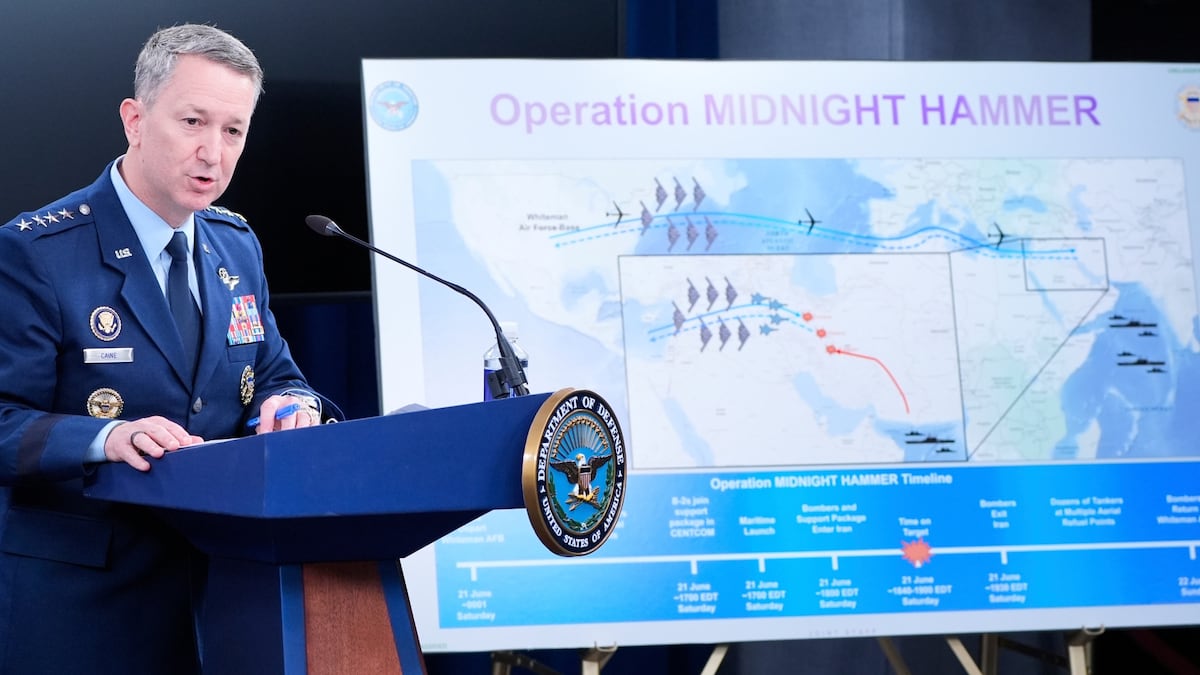
Defense Secretary Pete Hegseth on Sunday insisted that U.S. officials are not seeking regime change in Iran following American military airstrikes against nuclear facilities there.
But he warned that any response for those actions “will be met with force far greater than what was witnessed” this weekend.
“All of our precision munitions struck where we wanted them to strike and had the desired effect,” Hegseth told reporters during an early morning press conference hours after the military assault.
“We believe we achieved destruction of capabilities there. … It would be a very bad idea for Iran or its proxies to attempt to attack American forces [in response].”
The airstrikes — dubbed Operation Midnight Hammer — began early morning Saturday, with American B-2 stealth bombers launched from the U.S. homeland for a highly classified mission.
Once in air, part of the group flew west toward a destination reported to be Guam, while seven others diverted east.
Shortly after the aircraft joined escort fighters over the airspace of Iran — their actual destination — American submarines launched Tomahawk cruise missiles at the Iranian sites. Within hours, the bombers had dropped 14 massive ordnance penetrators, 30,000-pound bunker busting bombs that had never before been used in combat, and the missiles had reached their targets.
Airmen look at a GBU-57, the Massive Ordnance Penetrator bomb, at Whiteman Air Base, Missouri, in 2023. (U.S. Air Force via AP)
In total, the operation targeted at three of Iran’s main nuclear sites involved 125 American aircraft, 75 precision weapons and a bevy of other military assets still in motion.
With it, the United States has taken the enormous bet that setting back Iran’s nuclear program is worth the risk of another widespread conflict in the Middle East, especially if the retaliation from Iran’s military causes major damage.
Central Command has been preparing for a potential attack from Iran after the unprecedented direct strike, which could more deeply involve the U.S. in a war that began little more than a week ago.
“Our forces remain on high alert and are fully postured to respond to any Iranian retaliation or proxy attacks, which would be an incredibly poor choice,” said Chairman of the Joint Chiefs of Staff Gen. Dan Caine, who spoke alongside Hegseth.
The Pentagon’s battle damage assessments are still early, but initial returns are that “all three sites sustained extremely severe damage and destruction,” Caine said of the nuclear infrastructure targeted.
Leading up to Saturday, Trump had vacillated on whether to join the war in Iran. Israel’s own airstrikes had successfully targeted Iranian leadership, but they didn’t carry the needed firepower for more lasting damage.
The United States military had the only weapons thought capable of destroying Iran’s best defended nuclear sites, in particular the Fordo complex dug into a mountain and reinforced with heavy concrete.
Petnagon officials released this graphic timeline on June 22, 2025, regarding the military operation against Iranian nuclear sites hours earlier. (Defense Department)
But by late last week, after days of deliberation, the White House had said the president may take up to two weeks to decide whether to directly join the airstrikes.
Those questions ended with Saturday’s operation.
“There’s no military in the world that could have done what we did tonight, not even close,” Trump said in late-night remarks Saturday from the White House.
By involving its own military in that fight, though, the U.S. opens itself up to a new level of risk.
America has 40,000 forces in the region, up from its usual number of 30,000 while responding to the ongoing crisis, according to the Pentagon. Many of its major bases, including Central Command’s regional headquarters, are located on the Persian Gulf, within range of Iran’s massive store of ballistic and cruise missiles.
Caine on Sunday declined to give specifics on what force protection measures were being put in place to enhance security for U.S. personnel in the region or across the globe.
“We’re being proactive and not reactive, and being very thoughtful about ensuring that we do all that we can to protect our forces out there,” he said.
More than any other foreign policy issue thus far, the question of whether to directly attack Iran has split Trump’s coalition.
More traditional defense hawks in Congress — such as Chairman of the Senate Armed Services Committee Roger Wicker, R-Miss., — supported the strikes and have called for a robust defense of Israel.
But many members of the Republican Party’s newer MAGA wing were vocally critical, warning that U.S. involvement risked another protracted war in the Middle East without clear goals.
On Sunday, Hegseth said the operation’s intent was to set back Iran’s nuclear program and purposefully avoided certain targets.
“The scope of this was intentionally limited,” Hegseth said, while denying that the mission was “open ended.”
Trump’s own director of national intelligence testified earlier this year that Iran’s nuclear program isn’t yet being weaponized, though Trump later dismissed the assessment.
“I decided a long time ago that I would not let this happen,” Trump said of Iran acquiring a nuclear weapon.
The strikes Saturday follow a rapid military buildup in the Middle East , with America rushing warships, fighter jets and other support equipment to the region ahead of the attack. The surge continues a pattern that’s repeated itself in the year and a half since Israel’s war began in Gaza, following a raid by the terrorist group Hamas.
The Pentagon rushed military equipment into the theater to contain a wider regional war, twice defending Israel from what were then unprecedented airstrikes from Iran in April and October last year.
With the attack Saturday, the U.S. has now decided to take part in such a war, accepting the risk of entanglement when Iran likely strikes back.
Still, Hegseth argued that the nature of the operation, with U.S. bombers flying from the homeland and hitting Iranian sites undetected, would itself send a signal of how the U.S. would respond to further attacks.
“We believe that will have a clear psychological impact on how they view the future,” he said of Tehran’s government.
Noah Robertson is the Pentagon reporter at Defense News. He previously covered national security for the Christian Science Monitor. He holds a bachelor’s degree in English and government from the College of William & Mary in his hometown of Williamsburg, Virginia.
Leo covers Congress, Veterans Affairs and the White House for Military Times. He has covered Washington, D.C. since 2004, focusing on military personnel and veterans policies. His work has earned numerous honors, including a 2009 Polk award, a 2010 National Headliner Award, the IAVA Leadership in Journalism award and the VFW News Media award.
美国国防部长皮特·赫格塞斯周日坚称,在美国对伊朗核设施进行军事空袭后,美国官员并未寻求在伊朗实现政权更迭。
但他警告说,对这些行为的任何回应“都将遭到比本周末所见的更大的反击”。
“我们所有的精确制导武器都击中了我们想要击中的地方,并达到了预期的效果,”赫格塞斯在军事行动数小时后的清晨新闻发布会上告诉记者。
“我们相信我们已经摧毁了那里的能力。……伊朗或其代理人试图以此为由攻击美军将是一个非常糟糕的主意。”
这次空袭行动——被称为“午夜铁锤行动”——于周六清晨开始,美国B-2隐形轰炸机从美国本土起飞,执行一项高度机密的任务。
飞机升空后,一部分向西飞往据称是关岛的目的地,而另外七架飞机则转向向东飞行。
飞机与护航战斗机会合飞越伊朗领空——他们的真正目的地——不久后,美国潜艇向伊朗目标发射了战斧巡航导弹。几个小时内,轰炸机投下了14枚巨型穿甲弹,这种重达3万磅的钻地炸弹此前从未在实战中使用过,导弹也成功击中目标。
2023年,在密苏里州怀特曼空军基地,空军人员正在查看一枚GBU-57巨型穿透炸弹。(美国空军供图,美联社发布)
此次针对伊朗三个主要核设施的行动共出动了 125 架美国飞机、75 件精确制导武器以及大量其他军事资产,目前仍在调动中。
通过这一举措,美国孤注一掷,认为阻止伊朗核计划的代价是中东地区可能再次爆发大规模冲突,尤其是如果伊朗军方的报复造成重大损失。
在史无前例的直接袭击之后,中央司令部一直在为伊朗可能发动的袭击做准备,这可能会使美国更深地卷入这场仅仅一周多前才开始的战争。
“我们的部队仍保持高度戒备,并已做好充分准备应对伊朗的任何报复或代理人袭击,这将是一个极其糟糕的选择,”参谋长联席会议主席丹·凯恩将军在与赫格塞斯一同发表讲话时说道。
五角大楼的战损评估还处于早期阶段,但初步结果显示,“所有三个目标核基础设施都遭受了极其严重的破坏和损毁”,凯恩说道。
在周六之前,特朗普一直在是否加入伊朗战争的问题上犹豫不决。以色列的空袭虽然成功打击了伊朗领导层,但火力不足以造成更持久的破坏。
美国军方拥有唯一被认为能够摧毁伊朗防御最严密的核设施的武器,特别是位于山体内部并用厚重混凝土加固的福尔多核设施。
美国国防部官员于2025年6月22日发布了这张图表时间线,内容涉及数小时前针对伊朗核设施的军事行动。(美国国防部)
但到了上周晚些时候,经过数天的商议,白宫表示,总统可能需要长达两周的时间来决定是否直接参与空袭。
随着周六的手术,这些问题就此结束。
特朗普周六晚在白宫发表讲话时说:“世界上没有任何一支军队能够做到我们今晚所做的事,甚至连接近的都没有。”
然而,美国通过让自己的军队参与这场战争,使自己面临更高层次的风险。
据五角大楼称,为应对当前危机,美国在该地区部署了4万兵力,高于通常的3万人。其许多主要基地,包括中央司令部地区总部,都位于波斯湾沿岸,处于伊朗庞大的弹道导弹和巡航导弹库的射程之内。
凯恩周日拒绝透露为加强该地区或全球美军人员的安全而采取的具体部队保护措施。
他说:“我们采取的是积极主动而非被动应对的方式,并且非常认真地考虑如何尽一切努力保护我们在前线的部队。”
迄今为止,在所有外交政策问题中,是否直接攻击伊朗的问题最令特朗普的联盟分裂。
国会中较为传统的国防鹰派人士——例如参议院军事委员会主席、密西西比州共和党参议员罗杰·威克——支持此次空袭,并呼吁大力保卫以色列。
但共和党新成立的“让美国再次伟大”(MAGA)派系的许多成员公开批评,警告说美国的介入可能会在中东引发另一场旷日持久且目标不明的战争。
周日,赫格塞斯表示,此次行动的目的是挫败伊朗的核计划,并特意避开了某些目标。
“这项任务的范围是有意限制的,”赫格塞斯说,同时否认该任务是“没有结束期限的”。
特朗普的国家情报总监今年早些时候作证称,伊朗的核计划尚未被用于武器化,但特朗普后来驳斥了这一评估。
“我很久以前就决定,我绝不会允许这种事情发生,”特朗普在谈到伊朗获得核武器时说道。
周六的空袭发生在中东地区军事力量迅速集结之后,美国在袭击前夕向该地区紧急调派了军舰、战斗机和其他支援装备。自以色列在加沙发动战争以来,这种军事集结的模式在过去一年半的时间里不断重复出现。这场战争的起因是哈马斯恐怖组织发动了袭击。
五角大楼紧急向战区运送军事装备,以遏制更大规模的地区战争,并于去年 4 月和 10 月两次保卫以色列免受伊朗前所未有的空袭。
随着周六的袭击,美国现在决定参与这场战争,并接受了伊朗可能进行反击而卷入其中的风险。
不过,赫格塞斯认为,此次行动的性质,即美国轰炸机从本土起飞,在不被发现的情况下袭击伊朗目标,本身就会发出一个信号,表明美国将如何应对进一步的袭击。
“我们相信,这将对他们如何看待未来产生明显的心理影响,”他谈到德黑兰政府时说道。
诺亚·罗伯逊是《防务新闻》的五角大楼记者。他此前曾为《基督教科学箴言报》报道国家安全新闻。他拥有弗吉尼亚州威廉斯堡威廉与玛丽学院的英语和政治学学士学位。
利奥为《军事时报》报道国会、退伍军人事务部和白宫的新闻。自2004年以来,他一直报道华盛顿特区的新闻,重点关注军人和退伍军人政策。他的作品荣获多项荣誉,包括2009年波尔克奖、2010年国家头条新闻奖、国际退伍军人协会新闻领导力奖和美国退伍军人协会新闻媒体奖。