NATO allies agree to boost defense spending to 5% at The Hague summit在海牙峰会上,北约盟国同意将国防开支提高至5%。
In a press conference before heading back to Washington, Trump struck a conciliatory tone as he sought to harvest praise for the spending boost.
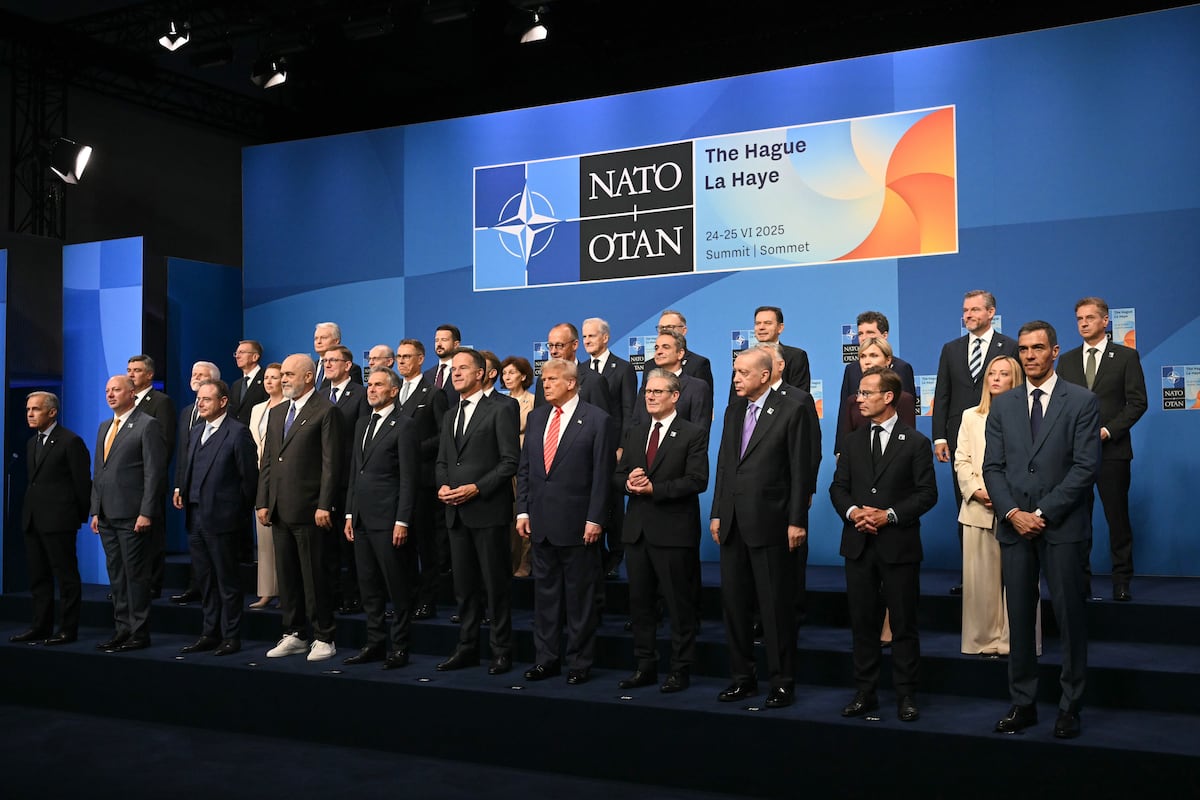
PARIS — NATO allies agreed to boost defense spending to 5% of GDP, NATO Secretary-General Mark Rutte said after a vote of the 32 member countries on Wednesday at a summit in The Hague.
As part of the agreement, allies committed to investing at least 3.5% of GDP on “core defense requirements,” up from the current target of 2%, Rutte said at a press conference following two days of meetings. The NATO secretary-general credited United States President Donald Trump for the result, saying the spending increase wouldn’t have happened without him.
Trump has repeatedly criticized European NATO members and Canada for not spending enough on defense, suggesting the U.S. might not honor the alliance’s mutual-defense commitments for allies that don’t step up. As recently as two years ago, most NATO countries had failed to meet a 2% spending target agreed at a summit in Wales in 2014.
“All allies are united in the understanding that we need to step up to stay safe,” Rutte said. “European allies and Canada will do more of the heavy lifting, equalizing their spending and taking greater responsibility for our shared security.”
Rutte said Trump has been clear that the United States is commited to NATO and “affirmed it again today in no uncertain terms,” while at the same time making clear that the country expects Europe and Canada to contribute more. He said NATO’s Article 5 mutual-defense clause “is absolutely clear,” but the alliance doesn’t provide details on what will trigger it to avoid helping adversaries.
In a press conference before heading back to Washington, Trump struck a conciliatory tone as he sought to harvest praise for the spending boost.
“I came here thinking it’s something I’m supposed to be doing,” he said. The summit proceedings had changed his mind, as he absorbed individual messages of patriotism from alliance member representatives, Trump said.
“It’s not a rip-off,” he told reporters, reversing his long-held grievance, at least for the moment, that Europeans were taking advantage of the United States. “We’ll help them protect their country.”
The U.S. has been asking for allies to lift defense spending since the 1950s, and the agreement reached in The Hague will make the alliance more stable, according to Rutte. He said there is a need to bolster NATO in the face of a threatening Russia, as well as an “impressive military buildup” by China.
Rutte said Russia is a short-term and long-term menace to the alliance, with intelligence suggesting the country could be ready to attack NATO in the next three to seven years. “The Russia threat is there, and we need to make sure to be able to defend ourselves.”
With Trump having demanded NATO allies spend 5% of GDP on defense, the agreement in The Hague is a bit of a workaround, with 3.5% for core defense tasks and an additional 1.5% on measures that support defense and security, for example investment in infrastructure and cyber defense.
“These decisions will have a profound impact on our ability to do what NATO was founded to do, deter and defend,” Rutte said.
U.S. spending on core defense is around the required level already, and its spending on infrastructure, cyber and hybrid threats and developing the defense-industrial base puts the country “more or less” at 5%, according to Rutte. The NATO leader said Trump “was totally right” that Europe and Canada were not providing to the alliance what they should.
Trump said in a press conference with Rutte before the vote that the agreement to increase spending was “a great victory for everybody, I think, and we will be equalized very shortly, and that’s the way it has to be. And it’s going to be a lot of money too, a lot of defense.”
Rutte said more spending will fund air defenses, ammunition, drones, tanks and troops. He said NATO needs to expand defense industrial capacity on both sides of the Atlantic, which could potentially create millions of new jobs across the alliance.
“We need quality and quantity,” the secretary-general said. “We need to innovate and we need to act fast.”
Some countries including Spain and Belgium have questioned the 3.5% target, and Rutte said Spain estimates it can reach its NATO capability targets while spending 2.1% of GDP on defense. The secretary-general said allies will report on how they will reach the capability targets, and NATO will “anyway have a review of all of this” in 2029.
Spain has consistently been at or near the bottom of military spending in NATO, last year ranking last with an estimated 1.3% of GDP spent on defense.
In his post-summit press conference, Trump blasted Spain for seeking an exception to the 5% spending goal. He suggested trying to recoup the notional funding difference by skewing U.S. trade with Madrid in Washington’s favor.
NATO allies have pledged more than €35 billion euros ($41 billion) for Ukraine so far this year to help the country fend of Russia’s invasion, according to Rutte, who said he expects total aid in 2025 to surpass last year’s pledged support of more than €50 billion.
Sebastian Sprenger in Cologne, Germany, contributed to this report.
Rudy Ruitenberg is a Europe correspondent for Defense News. He started his career at Bloomberg News and has experience reporting on technology, commodity markets and politics.
巴黎——北约秘书长马克·吕特在周三于海牙举行的峰会上,32个成员国投票表决后表示,北约盟国同意将国防开支提高到国内生产总值的5%。
鲁特在为期两天的会谈结束后举行的新闻发布会上表示,作为协议的一部分,盟国承诺将至少3.5%的GDP用于“核心国防需求”,高于目前的2%的目标。北约秘书长将这一成果归功于美国总统唐纳德·特朗普,称如果没有他的努力,国防开支的增加就不会发生。
特朗普多次批评欧洲北约成员国和加拿大国防开支不足,暗示美国可能不会履行对不增加国防开支的盟友的共同防御承诺。就在两年前,大多数北约国家仍未能达到2014年威尔士峰会上商定的2%的国防开支目标。
“所有盟国都一致认为,我们需要加强合作以确保安全,”吕特说。“欧洲盟国和加拿大将承担更多责任,平衡各自的开支,并为我们共同的安全承担更大的责任。”
吕特表示,特朗普已明确表示美国致力于北约,并且“今天再次毫不含糊地重申了这一点”,同时他也明确表示,美国希望欧洲和加拿大做出更多贡献。他指出,北约第五条的共同防御条款“非常明确”,但北约并未详细说明在何种情况下会触发该条款以避免援助敌对势力。
在返回华盛顿前的新闻发布会上,特朗普采取了和解的语气,试图为增加支出争取赞扬。
“我来这里的时候以为这是我应该做的,”他说。特朗普表示,峰会的进程改变了他的想法,因为他从联盟成员国代表那里听到了许多爱国主义的信息。
“这不是敲诈勒索,”他告诉记者,至少暂时推翻了他长期以来对欧洲人占美国便宜的不满。“我们会帮助他们保卫自己的国家。”
据吕特称,自上世纪50年代以来,美国一直要求盟国增加国防开支,而海牙达成的协议将使北约更加稳定。他表示,面对俄罗斯的威胁以及中国“令人瞩目的军事扩张”,北约有必要加强自身实力。
吕特表示,俄罗斯对北约构成短期和长期威胁,情报显示,俄罗斯可能在未来三到七年内准备对北约发动攻击。“俄罗斯的威胁确实存在,我们需要确保有能力自卫。”
特朗普要求北约盟国将国内生产总值的 5% 用于国防,而海牙协议则是一种变通方案,其中 3.5% 用于核心国防任务,另外 1.5% 用于支持国防和安全的措施,例如对基础设施和网络防御的投资。
“这些决定将对我们履行北约成立宗旨——威慑和防御——的能力产生深远影响,”吕特说。
据吕特称,美国在核心国防上的支出已基本达到所需水平,而其在基础设施、网络和混合威胁应对以及国防工业基础发展方面的支出,使该国的国防开支“大致”占到所需水平的5%。这位北约领导人表示,特朗普“完全正确”,即欧洲和加拿大没有为北约提供应有的资源。
特朗普在投票前与吕特共同出席的新闻发布会上表示,增加开支的协议“我认为对所有人来说都是一场巨大的胜利,我们很快就会实现收支平衡,事情也必须如此。而且这笔钱也会很多,国防开支也会很大。”
吕特表示,增加的开支将用于防空系统、弹药、无人机、坦克和部队建设。他还表示,北约需要在大西洋两岸扩大国防工业产能,这有望在整个联盟范围内创造数百万个新的就业岗位。
秘书长说:“我们需要质量和数量。我们需要创新,也需要迅速行动。”
包括西班牙和比利时在内的一些国家对3.5%的目标提出质疑。鲁特表示,西班牙估计其国防开支占GDP的2.1%即可达到北约的能力目标。秘书长表示,盟国将汇报如何实现这些能力目标,北约“无论如何都将在2029年对所有情况进行审查”。
西班牙在北约成员国中军费开支一直处于垫底或接近垫底的位置,去年国防开支估计仅占国内生产总值的 1.3%,排名垫底。
在峰会后的新闻发布会上,特朗普猛烈抨击西班牙试图豁免5%的支出目标。他暗示,可以通过操纵美马贸易,使之有利于华盛顿,来弥补名义上的资金缺口。
据鲁特称,北约盟国今年迄今已承诺向乌克兰提供超过 350 亿欧元(410 亿美元)的援助,以帮助该国抵御俄罗斯的入侵。鲁特表示,他预计 2025 年的援助总额将超过去年承诺的 500 亿欧元。
德国科隆的塞巴斯蒂安·斯普伦格对本报道亦有贡献。
鲁迪·鲁伊滕贝格是《防务新闻》的欧洲记者。他的职业生涯始于彭博新闻社,拥有报道科技、大宗商品市场和政治方面的经验。