Airbus is bullish on ‘dronized’ warship helos that can defy rough seas空客公司看好能够无惧恶劣海况的“无人机化”军舰直升机。
The first of the company's VSR700 units will equip four of France’s eight multi-mission frigates.
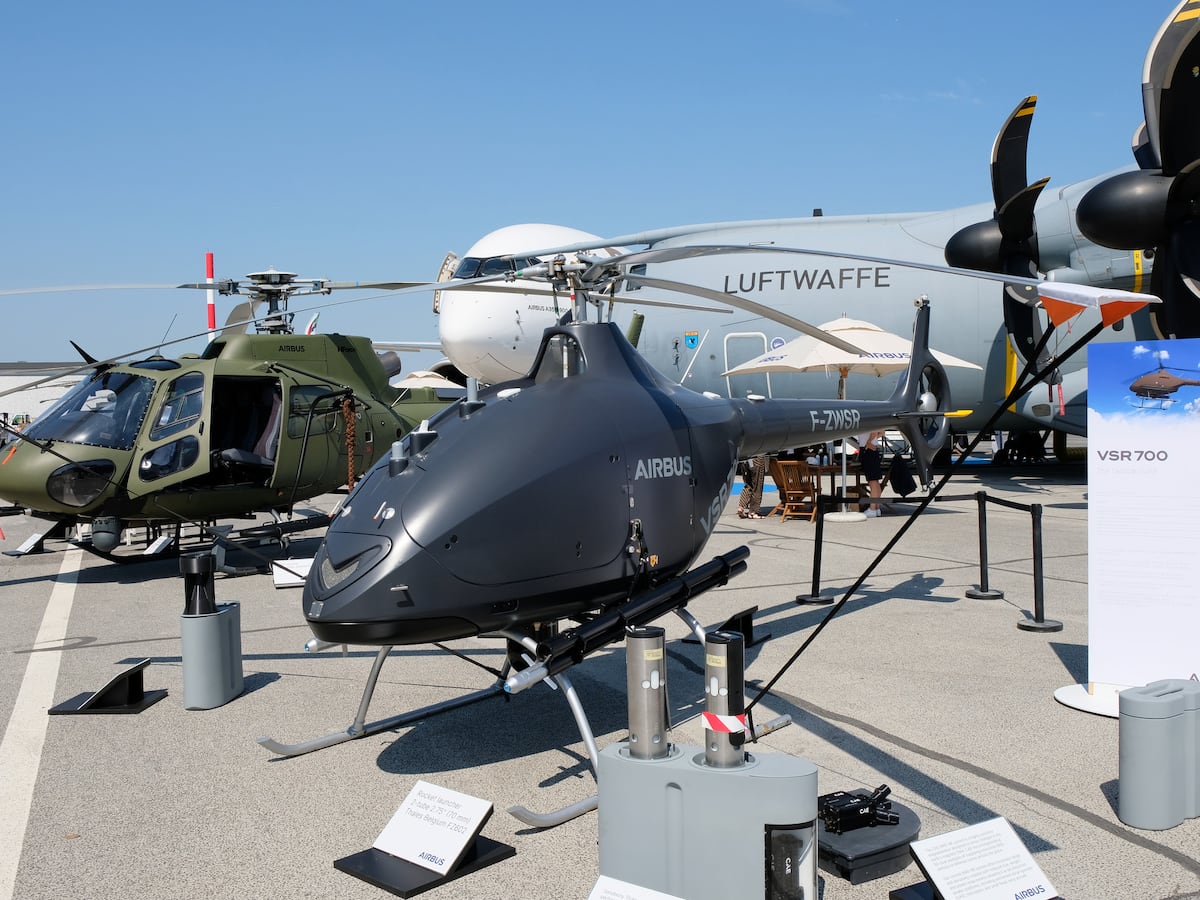
PARIS — Airbus Helicopters sees a large market for its unmanned VSR700 rotorcraft in intelligence gathering as well as for tasks that are “dull, dirty and dangerous,” the head of unmanned aerial systems at the world’s biggest helicopter maker told Defense News at the Paris Air Show.
The company also sees “strong demand” for its HTeaming system that lets helicopter crews control unmanned aerial systems in flight, Victor Gerin-Roze, head of UAS at Airbus Helicopters, said at show here last week. The system is modular and can be retrofitted to existing aircraft.
In a first step, France signed a framework contract on June 17 to equip the French Navy’s frigates with six VSR700 drone helicopters, while inviting other nations to join the program. Meanwhile, Singapore signed an agreement last week to test crewed-uncrewed teaming between the Airbus H225M helicopter and the company’s Flexrotor UAS using HTeaming.
Airbus sees the market for the VSR700 as “quite large, especially considering the different types of missions that we can envisage,” Gerin Roze said. “It’s already sea-tested, it’s operational, but we need to finalize the development.”
The executive said the naval version of the VSR700 is the only unmanned aircraft of its size able to land automatically on deck. The helicopter drone can land autonomously on a moving deck in sea state 5, corresponding to rough seas with waves up to 4 meters, using beacons on the deck and without relying on satellite navigation.
France counts on buying ten of the drones for the navy by the end of 2030 as part ot its defense budget plan, and a total of 15 by 2035. The version for the French Navy is equipped with radar, an electro-optical system and an AIS vessel-tracking receiver.
The first VSR700 units will equip four of France’s eight multi-mission frigates and two out of five of its future Defense and Intervention Frigates, the country’s Directorate General for Armament said.
The VSR700 is an uncrewed version of the Cabri G2 by France’s Helicopteres Guimbal, a two-seat helicopter with carbon fiber fuselage and an advertised base price of €418,000 (US$479,000). Airbus replaced the seats with a bigger fuel tank, mission equipment and avionics, with the unmanned helicopter having a maximum takeoff weight of 760 kilograms.
“What is very interesting is that we start from an existing base, certified and already mission proven in different conditions, and we have dronized it,” Gerin-Roze said.
In addition to the maritime-surveillance version, Airbus presented an armed-scout version of the unmanned helicopter at the air show, with other possible configurations including an anti-submarine and surface vessel role or as a cargo drone.
The same technology used on the VSR700 can be used to turn other platforms into drones, with the autonomy brick “a kind of turnkey solution,” according to Gerin-Roze. He said the H145 is the next step, with Airbus already developing an autonomous, uncrewed version of the U.S. Marine Corps variant of the helicopter, the UH-17 Lakota.
Airbus at the Paris show also presented Flexrotor, a 25-kilogram drone that takes off vertically before tilting to winged flight, and tested earlier this month by the French Navy on one of its high-seas patrol vessels, which lacks a flight deck. The UAS was developed by U.S.-based Aerovel, acquired by Airbus in 2024.
Gerin-Roze said the drone when packed is small enough to be carried at the back of a H145 helicopter or a pickup truck. “Taking off from a ship is not an issue, we did some demonstration on decks, you would not even think that something can land on it.”
Teaming missions could include a Flexrotor flying several kilometers ahead of a troop-transporting H225M to scan a landing area, according to the executive.
Airbus Helicopters has been working on crewed-uncrewed teaming for several years, flying its H135, H145 and H130 models with different drones, including the VSR700 and the Flexrotor.
Airbus showcased its HTeaming system for crewed-uncrewed teaming at the Paris Air Show, with a commercial offering planned for 2026. The system can be retrofitted to any helicopter using a modem and four antennas, with the crew controlling the drone using a ruggedized tablet, according to Gerin-Roze.
“We know the workload it represents to pilot a helicopter, so when we developed the tablet, we had in mind to ensure that the additional workload is limited,” Gerin-Roze said. The executive said teaming between helicopters and drones “is really where we have our competitive advantage – we’ve been making cockpits since a long time.”
Airbus is the first to propose anything like HTeaming, according to Gerin-Roze, who said early adopters will probably be defense and security, before the technology spreads to civilian uses.
The company is working on artificial intelligence to allow a helicopter to team up with multiple drones as a next step, and has started working on swarming technology, Gerin-Roze said.
Rudy Ruitenberg is a Europe correspondent for Defense News. He started his career at Bloomberg News and has experience reporting on technology, commodity markets and politics.
巴黎——全球最大的直升机制造商空中客车直升机公司的无人机系统负责人告诉《防务新闻》,该公司认为其无人驾驶的VSR700旋翼机在情报收集以及“枯燥、肮脏和危险”的任务方面有着巨大的市场。
空中客车直升机公司无人机系统负责人维克托·格林-罗泽上周在此举行的展会上表示,该公司也看到了对其HTeaming系统的“强劲需求”。该系统可以让直升机机组人员在飞行中控制无人机系统。该系统采用模块化设计,可以改装到现有飞机上。
6月17日,法国率先签署了一份框架合同,为法国海军的护卫舰配备六架VSR700无人直升机,并邀请其他国家加入该项目。与此同时,新加坡上周签署了一项协议,将利用HTeaming技术测试空客H225M直升机与该公司Flexrotor无人机系统之间的有人-无人协同作战能力。
空客认为VSR700的市场“相当大,尤其是考虑到我们可以设想的各种任务类型,”格林·罗泽表示。“它已经过海上测试,可以投入使用,但我们需要完成最后的研发工作。”
该高管表示,VSR700的舰载版本是同等尺寸下唯一能够自动在甲板上降落的无人机。这款直升机无人机能够在5级海况(相当于浪高达4米的恶劣海况)下,利用甲板上的信标,无需依赖卫星导航,即可自主降落在移动的甲板上。
法国计划在2030年底前为其海军采购10架无人机,作为其国防预算计划的一部分,并计划到2035年总共采购15架。法国海军使用的版本配备了雷达、光电系统和AIS船舶跟踪接收器。
法国军备总局表示,首批 VSR700 系统将装备法国八艘多用途护卫舰中的四艘,以及未来五艘防御和干预护卫舰中的两艘。
VSR700是法国吉姆巴尔直升机公司(Helicopteres Guimbal)生产的Cabri G2的无人驾驶版本。Cabri G2是一款双座直升机,采用碳纤维机身,官方公布的基本售价为41.8万欧元(约合47.9万美元)。空客公司用更大的油箱、任务设备和航空电子设备取代了座椅,这款无人直升机的最大起飞重量为760公斤。
“非常有趣的是,我们从一个现有的基地出发,这个基地已经过认证,并在不同的条件下证明了其任务价值,然后我们将其无人机化了,”Gerin-Roze说道。
除了海上监视版本外,空客还在航展上展示了这款无人直升机的武装侦察版本,其他可能的配置包括反潜和水面舰艇作战或作为货运无人机。
据格林-罗泽称,VSR700 上使用的相同技术也可用于将其他平台改造为无人机,其自主控制模块“就像一套交钥匙解决方案”。他表示,H145 是下一步计划,空客公司已经在开发美国海军陆战队 UH-17“拉科塔”直升机的自主无人版本。
在巴黎航展上,空客还展示了Flexrotor无人机,这是一款重25公斤的无人机,它能垂直起飞,然后倾斜机身转为翼式飞行。本月初,法国海军在其一艘没有飞行甲板的远洋巡逻舰上对Flexrotor进行了测试。这款无人机系统由美国Aerovel公司研发,该公司于2024年被空客收购。
格林-罗泽表示,无人机打包后体积小巧,足以装载在H145直升机或皮卡车的后部。“从船上起飞不成问题,我们在甲板上做过一些演示,你甚至想不到会有东西能降落在上面。”
据这位高管称,协同作战任务可能包括一架 Flexrotor 直升机在运送部队的 H225M 直升机前方几公里处飞行,以扫描着陆区域。
空客直升机公司多年来一直在研究有人和无人协同飞行技术,其 H135、H145 和 H130 型号直升机与不同的无人机(包括 VSR700 和 Flexrotor)一起飞行。
空客在巴黎航展上展示了其用于有人-无人协同作业的HTeaming系统,并计划于2026年推出商业版本。据Gerin-Roze称,该系统可以通过调制解调器和四个天线改装到任何直升机上,机组人员可以使用加固型平板电脑控制无人机。
“我们深知驾驶直升机的工作量,因此在研发平板电脑时,我们始终牢记要尽可能减少额外的工作量,”格林-罗泽说道。这位高管表示,直升机和无人机的协同作战“正是我们真正的竞争优势所在——我们制造驾驶舱已经很久了。”
据 Gerin-Roze 称,空客是第一个提出类似 HTeaming 的技术的公司,早期采用者可能会是国防和安全部门,之后这项技术才会扩展到民用领域。
Gerin-Roze表示,该公司正在研究人工智能,以便让直升机与多架无人机协同作战,作为下一步计划,并且已经开始研究集群技术。
鲁迪·鲁伊滕贝格是《防务新闻》的欧洲记者。他的职业生涯始于彭博新闻社,拥有报道科技、大宗商品市场和政治方面的经验。