Germany plans to double its defense spending within five years德国计划在五年内将其国防开支翻一番。
Berlin's defense spending is allowed to increase faster because lawmakers voted to loosen borrowing limits.
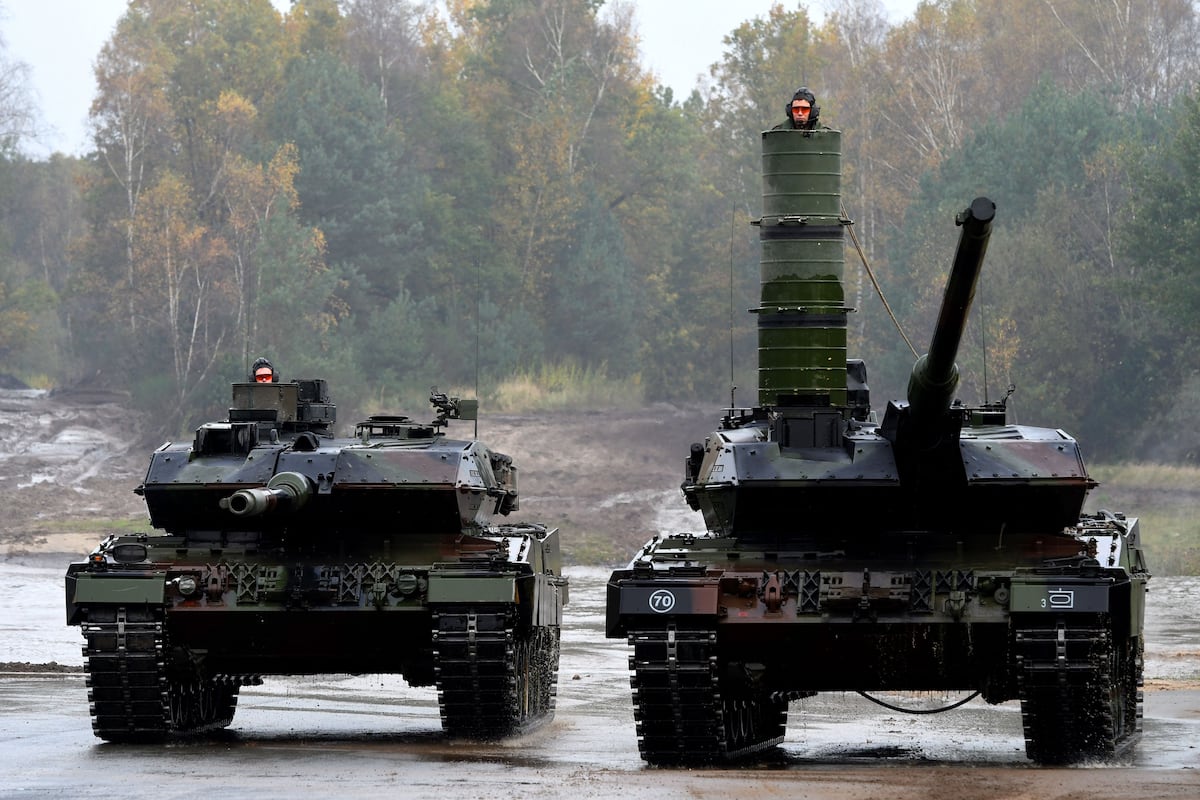
THE HAGUE, Netherlands — Germany will more than double its military spending by the turn of the decade under a new defense spending proposal approved by the government this week.
In total, Germany plans to spend €649 billion ($761 billion) on the military over the coming five years. It marks a continuation of a historic shift that began with Russia’s invasion of Ukraine and led to Berlin loosening the purse strings and overhauling its approach to military might.
The budget plan would see Germany hit NATO’s newly increased spending target of 3.5% of gross domestic product by 2029 by ramping up defense expenditures every year. For this year, Berlin allocated €86 billion ($101 billion) to its military, equivalent to 2.4% of GDP (that number is €95 billion, $111 billion, when including aid to Ukraine). In 2029, this is expected to be €162 billion ($190 billion, including aid to Ukraine).
The spending plan includes a provision of €9 billion ($10.6 billion) for Ukraine annually, as Germany continues to cement its role as a leading supporter of Kyiv in light of U.S. disinterest and potential disengagement, as well as the continued Russian onslaught along the frontline and from the air.
The spending spree will be financed by a wave of borrowing totaling €400 billion ($469 billion) over the next five years. This, in turn, has been enabled by a constitutional reform that loosened Germany’s notoriously stringent debt rules to allow for loans to be taken for military spending and some infrastructure projects. Germany’s “debt brake” provision normally limits borrowing to 0.35% of GDP.
Net government borrowing will jump to €81.8 billion in 2025, up from €33.3 billion last year.
A part of the funding will also come out of what’s left of the “special fund” of €100 billion ($117 billion) created by the previous administration of Chancellor Scholz in the immediate aftermath of Russia’s invasion of Ukraine. It will be depleted by 2027.
Some members of Chancellor Friedrich Merz’s own coalition have questioned the rapid spending uptick, with a group of left-leaning Social Democrats calling percentage-based military spending targets “irrational” in a recently published manifesto on keeping the peace in Europe.
On the flip side, the Green party has accused the government of budget “tricks,” arguing the plan breaks promises about dedicating special funds to additional investments rather than replacing existing spending.
Merz has set out the goal of making the Bundeswehr “the strongest conventional army in Europe.” The chancellor defended the increases this week, telling the Bundestag, Germany’s parliament, that higher military investment serves “not to do the United States a favor — but because Russia actively threatens the freedom of the entire Euro-Atlantic area.”
Linus Höller is Defense News' Europe correspondent and OSINT investigator. He reports on the arms deals, sanctions, and geopolitics shaping Europe and the world. He holds master’s degrees in WMD nonproliferation, terrorism studies, and international relations, and works in four languages: English, German, Russian, and Spanish.
荷兰海牙——根据本周政府批准的一项新的国防开支提案,德国将在本十年末将其军费开支增加一倍以上。
德国计划在未来五年内总共投入6490亿欧元(7610亿美元)用于军事建设。这标志着始于俄罗斯入侵乌克兰的历史性转变的延续,这一转变促使柏林放宽军费开支,并彻底改革其军事实力战略。
根据预算计划,德国将通过逐年增加国防开支,在2029年达到北约新近提高的国防开支目标,即国防开支占国内生产总值(GDP)的3.5%。今年,柏林已拨款860亿欧元(约合1010亿美元)用于军事,相当于GDP的2.4%(若计入对乌克兰的援助,则为950亿欧元,约合1110亿美元)。预计到2029年,这一数字将达到1620亿欧元(约合1900亿美元,含对乌克兰的援助)。
该支出计划包括每年向乌克兰提供 90 亿欧元(106 亿美元)的资金,因为鉴于美国对乌克兰缺乏兴趣和可能撤出,以及俄罗斯在前线和空中持续发动猛烈攻击,德国继续巩固其作为基辅主要支持者的地位。
未来五年,德国将通过总额达4000亿欧元(4690亿美元)的借贷来为这波支出狂潮提供资金。而这一切的实现,则得益于一项宪法改革,该改革放宽了德国出了名的严格债务规则,允许德国为军事开支和部分基础设施项目借贷。德国的“债务刹车”条款通常将借贷规模限制在GDP的0.35%以内。
到 2025 年,政府净借款将跃升至 818 亿欧元,高于去年的 333 亿欧元。
部分资金还将来自前总理朔尔茨政府在俄罗斯入侵乌克兰后立即设立的1000亿欧元(1170亿美元)“特别基金”的剩余部分。该基金将于2027年耗尽。
总理弗里德里希·默茨所在执政联盟的一些成员对军费开支的快速增长提出了质疑,一群左倾的社会民主党人在最近发表的一份关于维护欧洲和平的宣言中称,以百分比为基础的军费开支目标是“不合理的”。
另一方面,绿党指责政府在预算上玩弄“花招”,认为该计划违背了将专项资金用于额外投资而不是取代现有支出的承诺。
默茨的目标是使德国联邦国防军成为“欧洲最强大的常规军队”。本周,这位总理为增加军费开支辩护,他在德国联邦议院(德国议会)表示,增加军费投入“并非为了帮美国的忙,而是因为俄罗斯正在积极威胁整个欧洲-大西洋地区的自由”。
林努斯·霍勒是《防务新闻》的欧洲记者和开源情报调查员。他报道影响欧洲乃至全球的军火交易、制裁和地缘政治。他拥有大规模杀伤性武器不扩散、恐怖主义研究和国际关系三个硕士学位,并精通英语、德语、俄语和西班牙语四种语言。