How businesses can prepare for cross-border disputes before they happen企业如何才能在跨境纠纷发生前做好准备
One way is to discuss beforehand how to manage disputes when they arise. Read more at straitstimes.com.
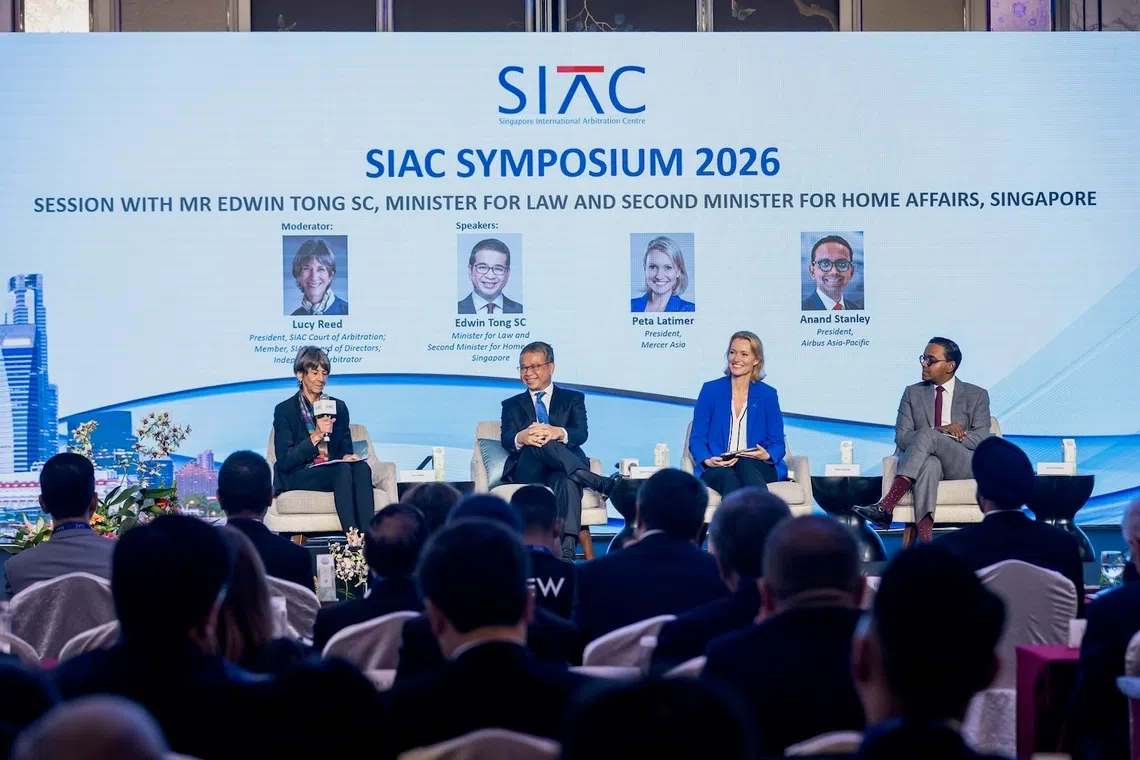
Legal and business experts at Singapore Convention Week 2026 explored how companies can better protect their deals and long-term business relationships
Speaking at a fireside chat at the SIAC Symposium which kicks off Convention Week 2026, Law Minister Edwin Tong (second from left) noted the increasing complexity of cross-border business contracts.
PHOTO: MINISTRY OF LAW
Rachel Chia, Brand Newsroom
Published Sep 14, 2026, 04:00 AM
Updated Sep 14, 2026, 04:00 AM
Up to 10 million – that is the number of components that a single aircraft is made of.
It is also the number of points across a global supply chain where things could potentially go wrong.
“We have multiple tiers of suppliers all over the world,” said Anand Stanley, president of Airbus Asia-Pacific, citing supply chain risk as a key challenge that cross-border businesses now face.
He was speaking at a fireside chat at the Singapore International Arbitration Centre (SIAC) Symposium 2026, alongside Law Minister Edwin Tong and Peta Latimer, president of business consulting firm Mercer Asia.
Held at Shangri-La Singapore on Aug 24, the SIAC Symposium kicks off the week-long Singapore Convention Week 2026. (See box below)
Explaining that some of Airbus’ deals can run into the billions of dollars, Stanley said the sheer scale of it means not every risk can be accounted for through paperwork alone. “The contracts and the documents don’t necessarily get bigger (or more comprehensive) to manage the risk.”
Beyond paperwork, what holds a deal like that together is something less tangible – trust, said Stanley.
“Some of these deals just get done looking eye to eye on a handshake and a word,” he explained.
Echoing the thought, Tong noted that business contracts are getting larger and involving multiple parties across different jurisdictions. Suppliers and partners are linked by relationships “cultivated over long periods of time, (even) decades”, he added.
“Disputes, when they occur, ought not (to) derail the entire relationship,” said Tong, pointing to mediation as an option that businesses can take to resolve disputes while preserving the relationship between parties.
Singapore Convention Week 2026
Organised by the Ministry of Law, Singapore Convention Week (SC Week) 2026 was held from Aug 24 to 28 under the theme “Timeless principles, timely solutions: Nurturing trust in a changing world”.
The event debuted in 2019, when the Singapore Convention on Mediation (SCM) opened for signature in Singapore. SCM is an international treaty that provides a uniform framework that makes it easier for mediated settlement agreements to be enforced across borders.
As of September 2026, SCM has 60 signatories and 24 contracting parties.
SC Week has since grown; this year, the event gathered legal, business, and policy experts from nearly 100 jurisdictions to discuss evolving trends and solutions in dispute resolution amid an uncertain global environment.
Ajay Dua, vice-president and assistant general counsel at global tech firm IBM, was one of them.
SC Week “provides a fantastic platform to connect with professionals from other countries”, said Dua, who is responsible for IBM’s legal matters across Asia-Pacific. “(The sessions also) helped build a deeper understanding of perspectives of other stakeholders.”
At the United Nations Commission on International Trade Law (UNCITRAL) Academy Conference on Aug 25, Law Minister Edwin Tong announced two initiatives that Singapore is making in international dispute resolution:
A bid to host the proposed Multilateral Investment Tribunal (MIT) which would hear disputes between foreign investors and states; and
A new Centre for Arbitration and International Dispute Resolution (CAIDR) by the Ministry of Law and National University of Singapore to drive thought leadership and innovation in international dispute resolution.
The UNCITRAL Academy Conference is SC Week’s headline event.
Mediation is an option that businesses can take to resolve disputes while preserving the relationship between parties, says Law Minister Edwin Tong.
Thinking beyond the contract
As businesses expand across borders, the challenge is not just adapting to change, said Peta Latimer, president of Mercer Asia.
“Businesses can handle differences in terms of how we operate across borders, (and) leaders typically enjoy change because it allows (them) to look for new avenues of growth,” she explained.
At Mercer Asia, Latimer is responsible for the performance of the firm across 11 markets in Asia, including China and Singapore.
Speaking at the fireside chat at the SIAC Symposium, she said the hardest aspect for businesses to manage is actually “unpredictability”.
At a separate SC Week event organised by Singapore International Mediation Centre (SIMC) on Aug 26, Tong advised businesses to stay prepared for unpredictable circumstances, including disputes that may arise.
One way is to discuss – before contracts are signed – “how and when mediation can be used”, he said. “Do not wait until the dispute occurs to decide how the dispute could be managed.”
To do so, Tong added, it is important to broaden the conversation beyond disputes practitioners. SC Week, for example, has made “a concerted effort to bring along more corporate and commercial lawyers, business leaders, people involved who are outside of the law, who negotiate transactions”.
Corporate lawyer Tan Teng Sen, who attended SC Week 2026, concurred. “When advising on cross-border transactions, it is important to think not only about getting the deal done, but also about how the transaction will perform if a dispute arises.”
Tan is a director of Corporate Mergers and Acquisitions practice at Drew and Napier. He added: “An understanding of developments in dispute resolution helps me think more strategically about the overall architecture of a transaction.”
Cross-border commerce is not slowing down, said Tong, and neither are the disputes that come with it. “This makes trusted ways of managing those disputes even more important.”
After all, he stressed, “dispute resolution (is only) a means to an end because businesses are here to do business – not to get involved in resolving disputes – and investors want (to) see the outcome of their investments.”
In partnership with the Ministry of Law
Legal services sector
在2026年新加坡会议周上,法律和商业专家探讨了企业如何更好地保护其交易和长期业务关系。
在新加坡国际仲裁中心研讨会(SIAC Symposium)的炉边谈话中,律政部长唐振辉(左二)指出,跨境商业合同的复杂性日益增加。该研讨会拉开了 2026 年会议周的序幕。
图片来源:律政部
Rachel Chia,品牌新闻编辑室
发布于 2026 年 9 月 14 日 上午 4:00
更新于2026年9月14日凌晨4:00
多达 1000 万个——这是构成一架飞机的部件数量。
它也代表全球供应链中可能出现问题的环节数量。
“我们在世界各地有多层供应商,”空客亚太区总裁阿南德·斯坦利表示,他认为供应链风险是跨境企业目前面临的一个关键挑战。
他与律政部长唐振辉和商业咨询公司美世亚洲总裁佩塔·拉蒂默一起,在新加坡国际仲裁中心 (SIAC) 2026 年研讨会的炉边谈话中发表了讲话。
新加坡国际会议研讨会(SIAC)于8月24日在新加坡香格里拉大酒店举行,拉开了为期一周的2026年新加坡会议周的序幕。(见下方方框)
斯坦利解释说,空客的一些交易金额高达数十亿美元,如此庞大的规模意味着仅靠文书工作无法涵盖所有风险。“合同和文件不一定会因为风险管理而变得更大(或更全面)。”
斯坦利说,除了文书工作之外,维系这类交易的是一种不太容易量化的东西——信任。
他解释说:“有些交易只需握手言和就能完成。”
童先生也表达了类似的观点,他指出,商业合同的规模越来越大,涉及多个司法管辖区的多方参与。他还补充说,供应商和合作伙伴之间的关系是“经过长期,甚至数十年积累”的。
“发生纠纷时,不应该破坏整个关系,”童先生说,他指出调解是企业解决纠纷、同时维护双方关系的一种选择。
2026年新加坡会展周
由新加坡律政部主办的2026年新加坡会议周(SC Week)于8月24日至28日举行,主题为“永恒的原则,及时的解决方案:在不断变化的世界中培育信任”。
该活动于2019年首次举办,当时《新加坡调解公约》(SCM)在新加坡开放签署。SCM是一项国际条约,它提供了一个统一的框架,使调解达成的和解协议更容易在跨境执行。
截至 2026 年 9 月,SCM 拥有 60 个签署方和 24 个缔约方。
SC Week 此后不断发展壮大;今年,该活动汇聚了来自近 100 个司法管辖区的法律、商业和政策专家,共同探讨在不确定的全球环境下,争端解决领域不断变化的趋势和解决方案。
IBM 副总裁兼助理总法律顾问 Ajay Dua 就是其中之一。
“SC Week 提供了一个绝佳的平台,让我们能够与来自其他国家的专业人士交流,”负责 IBM 亚太区法律事务的 Dua 表示,“(这些会议)也帮助我们更深入地了解其他利益相关者的观点。”
8月25日,在联合国国际贸易法委员会(UNCITRAL)学院会议上,新加坡律政部长唐振辉宣布了新加坡在国际争端解决方面采取的两项举措:
申办拟议中的多边投资法庭(MIT),该法庭将审理外国投资者与国家之间的争端;
由新加坡律政部和新加坡国立大学联合成立的仲裁与国际争端解决中心(CAIDR)旨在推动国际争端解决领域的思想领导和创新。
联合国国际贸易法委员会学院会议是安理会周的重头戏。
律政部长唐振辉表示,调解是企业在解决纠纷的同时维护双方关系的一种选择。
跳出合同的局限去思考
Mercer Asia总裁Peta Latimer表示,随着企业向海外扩张,挑战不仅仅是适应变化。
她解释说:“企业能够应对跨境运营方式的差异,领导者通常也乐于接受变化,因为这让他们能够寻找新的增长途径。”
在美世亚洲,拉蒂默负责公司在亚洲 11 个市场(包括中国和新加坡)的业绩。
她在 SIAC 研讨会的炉边谈话中表示,企业最难管理的方面实际上是“不可预测性”。
在 8 月 26 日由新加坡国际调解中心 (SIMC) 组织的另一场 SC 周活动上,Tong 建议企业做好应对不可预测情况的准备,包括可能出现的纠纷。
他表示,一种方法是在签订合同之前讨论“如何以及何时可以使用调解”。“不要等到纠纷发生后才决定如何处理纠纷。”
童补充道,为此,必须将讨论范围扩大到争议解决从业人员之外。例如,《SC Week》就“做出了一系列努力,旨在吸引更多公司和商业律师、商界领袖以及法律界以外的交易谈判人员参与其中”。
出席2026年新加坡证券交易委员会周的公司律师陈腾森对此表示赞同。“在就跨境交易提供咨询时,不仅要考虑如何完成交易,还要考虑如果发生纠纷,交易将如何运作。”
谭先生是德鲁·纳皮尔律师事务所企业并购业务部的董事。他补充道:“了解争议解决领域的最新进展有助于我更具战略性地思考交易的整体架构。”
童先生表示,跨境贸易并未放缓,随之而来的纠纷也同样如此。“这使得建立可信赖的纠纷解决机制变得更加重要。”
他强调,毕竟,“纠纷解决只是达到目的的一种手段,因为企业存在的目的是为了做生意,而不是为了参与解决纠纷,而投资者希望看到他们投资的结果。”
与法律部合作
法律服务行业