Corals in East Asia holding out as world’s coral reefs shrink due to more frequent marine heatwaves由于海洋热浪日益频繁,全球珊瑚礁不断萎缩,而东亚的珊瑚却顽强地生存了下来。
Hard coral cover remained stable in East Asian seas despite global hard coral cover decline. Read more at straitstimes.com.
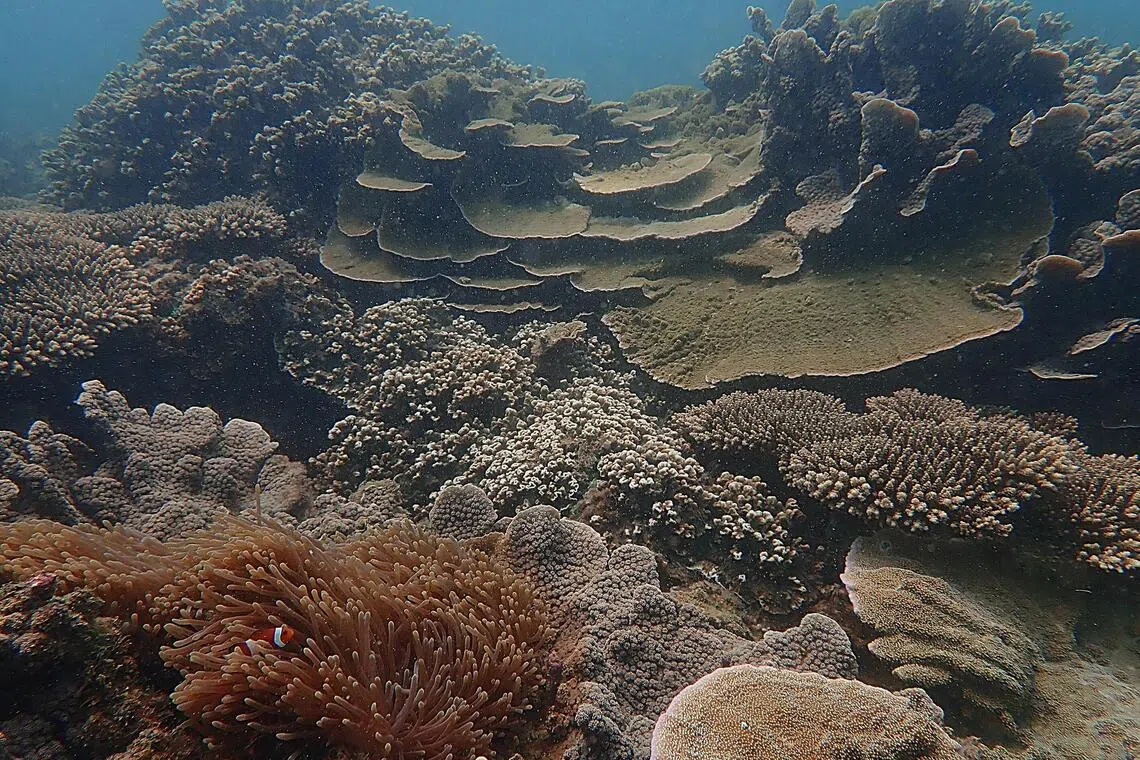
Corals in Pulau Satumu, Singapore in 2019. Corals support about one-quarter of marine life, including thousands of fish species.
Published Sep 14, 2026, 05:00 AM
Updated Sep 14, 2026, 05:00 AM
Coral reefs in East Asian seas, including Singapore, have remained stable over four decades despite global declines caused by frequent marine heatwaves and bleaching events.
These corals may possess heat-tolerant traits and microorganisms, helping them survive warmer temperatures.
Climate change and other threats like pollution, overfishing, and coastal development still endanger reefs, while regional stability masks local variations which require detailed monitoring.
SINGAPORE — Coral reefs around the world are in decline, with many reef areas shrinking as increasingly frequent marine heatwaves leave them less time to recover in between.
But a new report has found that reefs in the East Asian seas, which includes Singapore, Malaysia, Indonesia and other parts of South-east Asia, are bucking the global trend, with coral cover holding steady over the past four decades.
The Aug 31 report by the Global Coral Reef Monitoring Network, an international network of scientists, managers and organisations, also showed that there has not been any documented increase in macroalgae, or seaweed, in this region.
This is another encouraging sign of reef health in East Asia, as macroalgae is known to hinder reef recovery by competing with corals for space to grow.
The East Asian seas is home to the Coral Triangle, one of the world’s richest marine biodiversity hot spots located around Indonesia, Malaysia, Papua New Guinea, Philippines, Solomon Islands and Timor-Leste. About 30 per cent of the world’s coral reef area is found here.
Experts here told The Straits Times that the findings show that reefs in the region could have certain traits that make them more tolerant of hotter temperatures.
For instance, they may have heat- tolerant genetic traits, or could have microorganisms living in them that confers the coral with greater heat resilience.
Corals in Pulau Hantu, Singapore in 2021. Corals which thrive even in harsh environments, such as those that live in the murky waters around Singapore, often have a higher degree of tolerance against marine heatwaves. PHOTO: HUANG DANWEI
Corals in Pulau Hantu, Singapore in 2021. Corals which thrive even in harsh environments, such as those that live in the murky waters around Singapore, often have a higher degree of tolerance against marine heatwaves.
Marine biologist Huang Danwei, deputy head of NUS’ Lee Kong Chian Natural History Museum, said corals which thrive even in harsh environments, such as those that live in the murky waters around Singapore, often have a higher degree of tolerance against marine heatwaves.
Such corals could produce offspring that are naturally resilient to warmer sea surface temperatures. When these coral babies disperse and settle in neighbouring reefs, it could confer them greater resilience against heat waves, he added.
Huang, as well as Karenne Tun, group director of National Parks Board’s (NParks) National Biodiversity Centre, are among the Singapore-based authors who contributed to the global report.
Called Status of Coral Reefs of the World: 2025, the 296-page report was based on more than 40 years of data from 36,886 sites across 124 countries and territories. The last time a similar report was published was in 2021.
Corals support about one-quarter of marine life, including thousands of fish species. About a billion people depend on coral reefs, directly or indirectly, from the ecosystem services they provide.
But the report noted that coral reefs are experiencing bleaching events so frequently that they no longer have time to recover before the next one strikes.
Bleaching happens when corals – which get their vibrant colours from microscopic algae that live in their tissues – expel the algae when they are stressed by rising sea temperatures, turning them ashen white.
The algae supply the corals with nutrients, so when bleaching occurs, the corals become vulnerable to disease. The corals may eventually die if the bleaching event is prolonged, as they are deprived of a key source of nutrition.
Global coral bleaching events occurred in 1998, 2010, 2016 and 2024, with Singapore also experiencing mass bleaching during those years.
All four global bleaching events followed El Nino events – a climate phenomenon that warms sea surface temperatures and lifts global temperatures.
Scientists have warned that another coral bleaching event may be on the cards this year, as the world is in the grips of a severe El Nino event that could extend to 2027.
Corals in Bohol, Phlippines in 2015. Global coral bleaching events occurred in 1998, 2010, 2016 and 2024, with Singapore also experiencing mass bleaching during those years. PHOTO: HUANG DANWEI
Corals in Bohol, Phlippines in 2015. Global coral bleaching events occurred in 1998, 2010, 2016 and 2024, with Singapore also experiencing mass bleaching during those years.
The report showed that the average global hard coral cover dropped from 30.2 per cent in 1980 to 27.3 per cent in 2024 .
Hard coral cover refers to the proportion of the coastal habitat that is covered by hard coral .
In comparison, coral reef cover in East Asian seas remained stable between 1980 and 2009, with an average hard coral cover of about 30 per cent. This dipped to 27 per cent after the 2010 bleaching event, but recovered to close to 1980 levels between 2010 and 2020.
The report’s lead author Manuel Gonzalez Rivero said that the gap between bleaching events once stretched for decades, but now averages just five or six years. For instance, prior to the 1998 global bleaching event, the first widespread mass bleaching occurred during the 1982-83 El Nino, according to the National Oceanic and Atmospheric Administration.
And while the report showed that reefs in this region have shown a “remarkable stability” in hard coral cover over the past four decades, Huang said that climate-driven ocean warming remains the greatest threat to coral reefs even in East Asia.
Moreover, reefs in the region face other stressors that could impact their health. “The other main threats to East Asian reefs include nutrient pollution that causes macroalgae to overgrow corals, marine plastics, overfishing, increased sedimentation and water turbidity, coastal development and land reclamation,” he said.
NParks’ Tun said that the apparent stability of East Asian reefs could also be because any decline in one part of the region is balanced out by an increase in coral cover somewhere else.
For example, declines in Southern Java and Sunda and parts of the Northern Coral Triangle were offset by gains in the Central Coral Triangle and Kuroshio, according to the report. This suggests that apparent regional stability may mask important local variability and vulnerability, it said, noting that resolving such patterns will require consistent, data collection at the local level.
Data collection at the local level could also help scientists keep an eye on other aspects of reef health beyond coral cover.
For instance, Tun noted that while coral cover may remain stable, the types of species found in an area could change. Such shifts in coral communities can affect how reefs function and the ecosystem services they provide, she added.
Chin Hui Shan is a journalist covering the environment beat at The Straits Times.
2019 年新加坡沙都木岛的珊瑚。珊瑚为大约四分之一的海洋生物提供栖息地,其中包括数千种鱼类。
发布于 2026 年 9 月 14 日上午 5:00
更新于2026年9月14日凌晨5:00
尽管频繁的海洋热浪和白化事件导致全球珊瑚礁衰退,但包括新加坡在内的东亚海域的珊瑚礁在过去四十年中一直保持稳定。
这些珊瑚可能具有耐热特性和微生物,帮助它们在较高的温度下生存。
气候变化以及污染、过度捕捞和沿海开发等其他威胁仍然危及珊瑚礁,而区域稳定性掩盖了需要详细监测的局部变化。
新加坡——世界各地的珊瑚礁正在衰退,许多珊瑚礁区域正在缩小,因为越来越频繁的海洋热浪使它们恢复的时间越来越少。
但一份新的报告发现,包括新加坡、马来西亚、印度尼西亚和东南亚其他地区在内的东亚海域的珊瑚礁正在逆转全球趋势,珊瑚覆盖率在过去四十年中保持稳定。
8 月 31 日,由科学家、管理者和组织组成的国际网络——全球珊瑚礁监测网络发布的报告也显示,该地区的大型藻类或海藻数量没有记录在案的增长。
这是东亚珊瑚礁健康状况的又一个令人鼓舞的迹象,因为众所周知,大型藻类会与珊瑚争夺生长空间,从而阻碍珊瑚礁的恢复。
东亚海域是珊瑚三角区的所在地,这是世界上海洋生物多样性最丰富的热点地区之一,位于印度尼西亚、马来西亚、巴布亚新几内亚、菲律宾、所罗门群岛和东帝汶附近。世界上约30%的珊瑚礁面积都位于这里。
当地专家告诉《海峡时报》,研究结果表明,该地区的珊瑚礁可能具有某些特性,使它们更能耐受较高的温度。
例如,它们可能具有耐热的遗传特征,或者体内可能生活着赋予珊瑚更强耐热性的微生物。
2021年新加坡鬼岛的珊瑚。即使在恶劣的环境中也能茁壮生长的珊瑚,例如生活在新加坡附近浑浊水域的珊瑚,通常对海洋热浪具有更高的耐受性。照片:黄丹伟
2021 年新加坡鬼岛的珊瑚。即使在恶劣的环境中也能茁壮成长的珊瑚,例如生活在新加坡周围浑浊水域中的珊瑚,通常对海洋热浪具有更高的耐受性。
新加坡国立大学李光前自然历史博物馆副馆长、海洋生物学家黄丹伟表示,即使在恶劣的环境中也能茁壮成长的珊瑚,例如生活在新加坡周围浑浊水域中的珊瑚,通常对海洋热浪具有更高的耐受性。
他补充说,这类珊瑚能够繁育出天然适应较高海面温度的后代。当这些珊瑚幼苗扩散并定居在邻近的珊瑚礁时,就能增强它们抵御热浪的能力。
黄以及国家公园局(NParks)国家生物多样性中心的小组主任 Karenne Tun 等新加坡作者也参与了这份全球报告的撰写。
这份名为《世界珊瑚礁状况:2025》的报告长达296页,基于来自124个国家和地区的36886个地点超过40年的数据。上一次发布类似报告是在2021年。
珊瑚为大约四分之一的海洋生物提供栖息地,其中包括数千种鱼类。约有十亿人直接或间接地依赖珊瑚礁提供的生态系统服务。
但报告指出,珊瑚礁白化事件发生得如此频繁,以至于它们在下一次白化事件发生之前已经没有时间恢复了。
当珊瑚因海水温度升高而受到胁迫时,它们会排出体内的微小藻类,从而导致珊瑚白化。珊瑚的鲜艳颜色来源于生活在其组织中的微小藻类。
藻类为珊瑚提供营养,因此当珊瑚发生白化时,它们就容易感染疾病。如果白化事件持续时间过长,珊瑚最终可能会死亡,因为它们失去了重要的营养来源。
全球珊瑚白化事件分别发生在 1998 年、2010 年、2016 年和 2024 年,新加坡在这些年份也经历了大规模珊瑚白化。
所有四次全球珊瑚白化事件都发生在厄尔尼诺现象之后——厄尔尼诺现象是一种气候现象,它会使海面温度升高,并导致全球气温上升。
科学家警告说,今年可能会再次发生珊瑚白化事件,因为全球正遭受严重的厄尔尼诺现象的影响,而这种现象可能会持续到 2027 年。
2015年菲律宾保和岛的珊瑚。全球珊瑚白化事件分别发生在1998年、2010年、2016年和2024年,新加坡在这些年份也经历了大规模珊瑚白化。照片:黄丹伟
2015 年菲律宾保和岛的珊瑚。全球珊瑚白化事件分别发生在 1998 年、2010 年、2016 年和 2024 年,新加坡在这些年份也经历了大规模的珊瑚白化。
报告显示,全球硬珊瑚平均覆盖率从 1980 年的 30.2% 下降到 2024 年的 27.3%。
硬珊瑚覆盖率是指沿海栖息地被硬珊瑚覆盖的比例。
相比之下,1980年至2009年间,东亚海域的珊瑚礁覆盖率保持稳定,平均硬珊瑚覆盖率约为30%。2010年珊瑚白化事件后,这一比例下降至27%,但在2010年至2020年间恢复到接近1980年的水平。
该报告的主要作者曼努埃尔·冈萨雷斯·里韦罗表示,珊瑚白化事件之间的间隔曾经长达数十年,但现在平均只有五六年。例如,据美国国家海洋和大气管理局称,在1998年全球珊瑚白化事件之前,第一次大规模珊瑚白化发生在1982-83年的厄尔尼诺现象期间。
虽然报告显示,过去四十年来,该地区的珊瑚礁硬珊瑚覆盖率表现出了“显著的稳定性”,但黄表示,即使在东亚,气候驱动的海洋变暖仍然是珊瑚礁面临的最大威胁。
此外,该地区的珊瑚礁还面临着其他可能影响其健康的压力因素。他表示:“东亚珊瑚礁面临的其他主要威胁包括营养污染导致大型藻类过度生长并覆盖珊瑚、海洋塑料污染、过度捕捞、沉积物增多和水体浑浊、沿海开发和填海造地。”
国家公园局的敦表示,东亚珊瑚礁表面上的稳定性也可能是因为该地区一部分珊瑚礁的衰退会被其他地方珊瑚覆盖率的增加所抵消。
例如,报告指出,爪哇岛南部、巽他半岛以及北部珊瑚三角区部分地区的减少被中部珊瑚三角区和黑潮地区的增加所抵消。这表明,表面上的区域稳定性可能掩盖了重要的局部差异和脆弱性。报告还指出,要解决此类问题,需要在地方层面持续收集数据。
在地方层面收集数据还可以帮助科学家关注珊瑚覆盖率以外的其他珊瑚礁健康状况。
例如,Tun指出,虽然珊瑚覆盖率可能保持稳定,但某一区域内的珊瑚物种类型可能会发生变化。她补充说,珊瑚群落的这种变化会影响珊瑚礁的功能及其提供的生态系统服务。
Chin Hui Shan是《海峡时报》负责环境报道的记者。