NUS researchers use magnetic pulses to turn cancer-promoting immune cells into cancer fighters新加坡国立大学研究人员利用磁脉冲将促进癌症的免疫细胞转化为抗癌细胞。
Researchers use low-intensity magnetic pulses to reprogramme immune cells and target breast cancer, showing promise in preclinical models without chemotherapy. Read more at straitstimes.com.
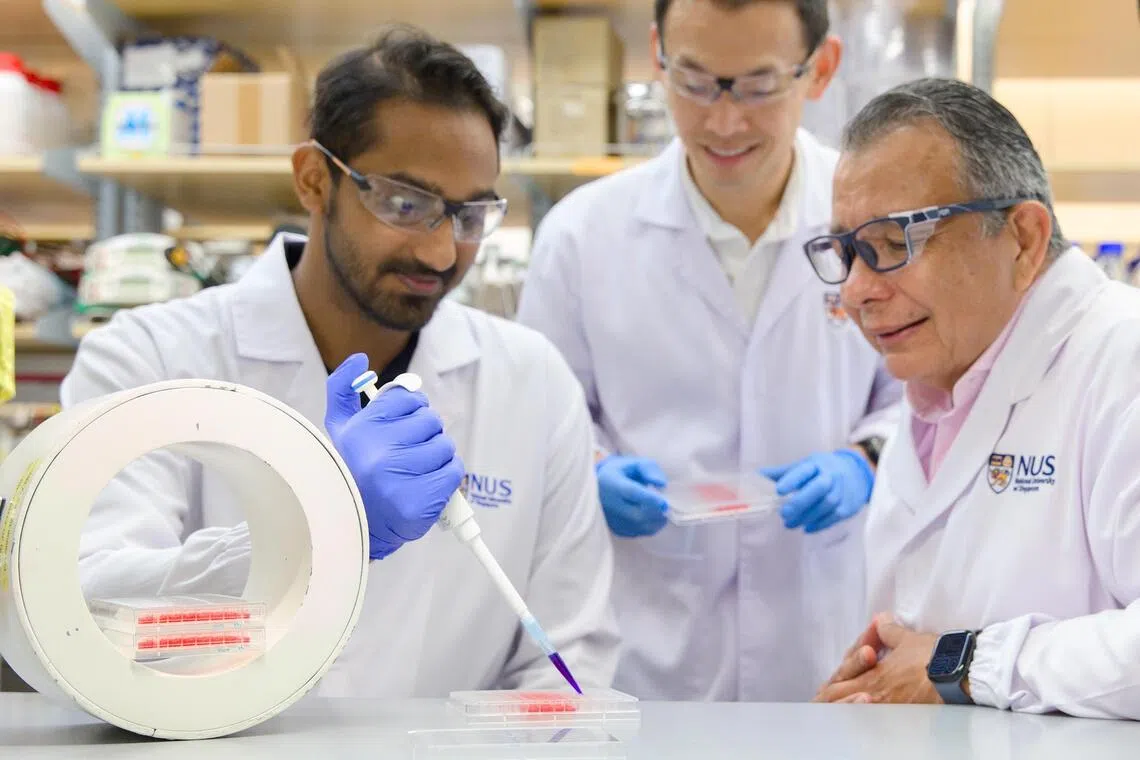
(From left) National University of Singapore researchers Viresh Krishnan Sukumar, Alex Tai and Alfredo Franco-Obregon have successfully used this approach for targeted breast cancer therapy without the use of chemotherapy.
PHOTO: NATIONAL UNIVERSITY OF SINGAPORE
Published Sep 14, 2026, 05:00 AM
Updated Sep 14, 2026, 05:00 AM
Researchers at the National University of Singapore use low-intensity magnetic pulses (PEMFs) to reprogramme immune cells and attack breast cancer without chemotherapy.
PEMFs eradicated tumours in 75% of preclinical models by inducing calcium overload and metabolic stress in cancer cells while sparing healthy tissue.
Phase I safety trials are complete; Phase II will test effectiveness in patients, aiming to reduce chemotherapy dosage and side effects while improving outcomes.
SINGAPORE – Researchers from the National University of Singapore (NUS) have found that using intermittent, low-intensity magnetic pulses could transform a corrupted class of immune cells that typically promote cancer growth into cells that attack and destroy cancer cells.
These scientists have successfully used this approach for targeted breast cancer therapy without the use of chemotherapy.
The pulsed electromagnetic fields (PEMFs) completely eradicated tumours in 75 per cent of tested pre-clinical models after just four 30-minute sessions.
PEMFs are gentle, low-energy magnetic waves that pass safely through the body without generating heat or damaging tissue.
Alfredo Franco-Obregon, who led the research, said that rather than shocking the body, the pulses “act like a biological tuning fork”.
“When they pass through cells, they interact with specialised microscopic gates on the cell surface called TRPC1 channels , which act as biological antennae for weak magnetic fields. Opening these gates triggers a small, controlled wave of calcium into the cell that activates the mitochondria, the cell’s energy furnace,” he said.
“In healthy tissues, this acts like a brisk workout. The energy stimulates cellular repair, boosts energy production and primes the tissue to heal. In cancer cells, the excess stimulation overloads an already unstable system, making PEMFs precision tools that can either warm up or overheat cells, depending on their resting temperatures,” Franco-Obregon added.
This recent discovery, published in Smart Medicine, an international, open-access, peer-reviewed academic journal, on June 4 , was built on the team’s previous work, which showed that brief PEMF exposure enhances the uptake of doxorubicin (DOX), a chemotherapy drug, by breast cancer cells.
Global breast cancer cases are projected to rise by a third, from 2.3 million in 2023 to more than 3.5 million by 2050, while annual deaths may nearly double from 764,000 to nearly 1.4 million.
In Singapore, breast cancer is the most common cancer among women, accounting for around 30 per cent of all female cancer diagnoses.
According to the Singapore Cancer Registry Annual Report of 2023 , one in 12 women will develop breast cancer in their lifetime.
Yet, breast cancer treatment faces challenges such as drug resistance, treatment-related toxicities and tumour heterogeneity, which means that cancer cells are not all identical but instead show distinct genetic, molecular and physical differences.
Franco-Obregon, a research associate professor from the Department of Surgery at the NUS Yong Loo Lin School of Medicine, told The Straits Times that his team’s research focused on the calcium channel protein that “breast cancers overexpress to fuel rapid proliferation and quick spreading”.
The protein forms a tunnel in the cell membrane, allowing calcium ions to flow through – an important process for many cellular functions.
“This excess makes cancer cells uniquely vulnerable to calcium overload and mitochondrial overheating,” he added.
With targeted PEMFs, the scientists exploited this vulnerability in a two-pronged precision approach.
First, they induced acute calcium and metabolic stress, affecting the energy systems within cancer cells, without harming healthy tissue. This enhanced the uptake of standard chemotherapeutic drugs, which in turn reduced the required chemotherapy dosages and lessened debilitating side effects.
Second, the magnetic pulses reprogrammed the immune cells that promote cancer growth to consume breast cancer cells instead, restoring the immune system’s ability to detect and attack cancer.
“In our published findings, PEMF exposure halved the effective dosage required for drugs like doxorubicin to suppress cancer cells. Rather than projecting an unrealistic leap to 100 per cent eradication, our clinical objective is to maximise efficacy while slashing toxicity.
“We aim to preserve the patient’s quality of life and immune health without compromising therapeutic impact,” Franco-Obregon explained.
He added that the use of magnetic pulses to directly destroy cancer cells by burning, freezing or rupturing them, as well as to change the behaviour of immune cells, has so far been shown only in pre-clinical laboratory models.
But translating these findings into patient care “is already well under way”.
“As we have already completed our initial Phase I safety trial in breast cancer patients, we have crossed the first major clinical hurdle.
“The next step is our Phase II clinical trial, which will evaluate how effectively PEMF shrinks tumours and enhances chemotherapy in a larger group of patients over the next two to three years,” he said.
Franco-Obregon said that if the results confirm what the team had already observed in the laboratory, larger multi-centre trials would follow to support formal regulatory approval from agencies like the Singapore Health Sciences Authority and the US Food and Drug Administration.
“In practical terms, broad adoption as standard hospital care typically takes several years of rigorous validation. However, eligible breast cancer patients may have opportunities to receive the therapy much sooner by participating directly in our upcoming clinical trials,” he said.
Franco-Obregon cautioned that while PEMF represents an exciting, non-invasive frontier in precision oncology, it remains an investigational therapy that should complement, not replace, proven medical care.
“Yet, to accelerate this timeline, our team is actively seeking forward-looking clinical trial sites, oncology collaborators and funding partners to co-develop and scale this non-invasive therapy towards widespread patient access,” he said.
Judith Tan is health correspondent at The Straits Times.
(从左至右)新加坡国立大学的研究人员 Viresh Krishnan Sukumar、Alex Tai 和 Alfredo Franco-Obregon 已成功运用这种方法进行靶向乳腺癌治疗,而无需使用化疗。
图片来源:新加坡国立大学
发布于 2026 年 9 月 14 日上午 5:00
更新于2026年9月14日凌晨5:00
新加坡国立大学的研究人员利用低强度磁脉冲(PEMF)重新编程免疫细胞,无需化疗即可攻击乳腺癌。
PEMF 通过诱导癌细胞中的钙超载和代谢应激,在 75% 的临床前模型中根除了肿瘤,同时保护了健康组织。
第一阶段安全性试验已完成;第二阶段将测试其对患者的有效性,旨在减少化疗剂量和副作用,同时改善治疗效果。
新加坡——新加坡国立大学 (NUS) 的研究人员发现,使用间歇性的低强度磁脉冲可以将通常促进癌症生长的受损免疫细胞转化为攻击和摧毁癌细胞的细胞。
这些科学家已成功运用这种方法进行靶向乳腺癌治疗,而无需使用化疗。
脉冲电磁场 (PEMF) 在仅经过四次 30 分钟的治疗后,就完全消除了 75% 的受试临床前模型中的肿瘤。
PEMF(脉冲电磁场)是一种温和的、低能量的磁波,可以安全地穿过人体,不会产生热量或损伤组织。
领导这项研究的阿尔弗雷多·弗朗哥-奥布雷贡表示,这些脉冲不会对身体造成冲击,而是“像生物音叉一样发挥作用”。
他说:“当它们穿过细胞时,会与细胞表面一种叫做TRPC1通道的特殊微观闸门相互作用,这种通道就像生物天线一样,能够感知微弱的磁场。打开这些闸门会引发一股微弱的、可控的钙离子波进入细胞,从而激活线粒体——细胞的能量工厂。”
“在健康组织中,这就像一次快速锻炼。能量刺激细胞修复,促进能量产生,并使组织做好愈合的准备。但在癌细胞中,过度刺激会使本已不稳定的系统超负荷运转,因此,脉冲电磁场疗法是一种精准的工具,它可以根据细胞的静息温度,使细胞升温或过热,”弗朗哥-奥布雷贡补充道。
这项最新发现于 6 月 4 日发表在国际开放获取同行评审学术期刊《Smart Medicine》上,该发现建立在该团队之前的研究基础上,之前的研究表明,短暂的脉冲电磁场暴露可以增强乳腺癌细胞对化疗药物阿霉素 (DOX) 的吸收。
全球乳腺癌病例预计将增加三分之一,从 2023 年的 230 万例增至 2050 年的 350 多万例,而每年的死亡人数可能会几乎翻一番,从 76.4 万人增至近 140 万人。
在新加坡,乳腺癌是女性最常见的癌症,约占所有女性癌症诊断的 30%。
根据新加坡癌症登记处2023年年度报告,每12名女性中就有1名会在一生中患上乳腺癌。
然而,乳腺癌治疗面临着耐药性、治疗相关毒性和肿瘤异质性等挑战,这意味着癌细胞并非完全相同,而是表现出明显的遗传、分子和物理差异。
新加坡国立大学杨潞琳医学院外科系的研究副教授弗朗哥-奥布雷贡告诉《海峡时报》,他的团队的研究重点是钙通道蛋白,这种蛋白“在乳腺癌中过度表达,以促进快速增殖和扩散”。
这种蛋白质在细胞膜上形成一个通道,允许钙离子通过——这是许多细胞功能的重要过程。
“这种过量钙离子使癌细胞特别容易受到钙过载和线粒体过热的影响,”他补充道。
利用有针对性的脉冲电磁场,科学家们采用双管齐下的精准方法,利用了这一弱点。
首先,它们诱导癌细胞产生急性钙离子和代谢应激,影响癌细胞内的能量系统,而不会损伤健康组织。这增强了癌细胞对标准化疗药物的吸收,进而降低了所需的化疗剂量,并减轻了严重的副作用。
其次,磁脉冲重新编程了促进癌症生长的免疫细胞,使其转而吞噬乳腺癌细胞,从而恢复了免疫系统检测和攻击癌症的能力。
“在我们已发表的研究结果中,PEMF 暴露使阿霉素等药物抑制癌细胞所需的有效剂量减半。我们的临床目标不是追求 100% 根除癌细胞这一不切实际的目标,而是在最大限度提高疗效的同时,最大限度地降低毒性。”
“我们的目标是在不影响治疗效果的前提下,保持患者的生活质量和免疫健康,”弗朗哥-奥布雷贡解释说。
他还补充说,利用磁脉冲直接通过燃烧、冷冻或破坏癌细胞来摧毁癌细胞,以及改变免疫细胞的行为,目前仅在临床前实验室模型中得到证实。
但将这些研究成果转化为患者护理“已经进展顺利”。
“由于我们已经完成了针对乳腺癌患者的初步 I 期安全性试验,我们已经跨越了第一个主要的临床障碍。
他说:“下一步是我们的 II 期临床试验,该试验将在未来两到三年内评估 PEMF 在更大范围的患者群体中缩小肿瘤和增强化疗效果的有效性。”
Franco-Obregon表示,如果结果证实了该团队在实验室中观察到的情况,接下来将进行更大规模的多中心试验,以支持获得新加坡卫生科学局和美国食品药品监督管理局等机构的正式监管批准。
“实际上,要将这种疗法广泛应用于医院标准治疗,通常需要数年严格的验证。然而,符合条件的乳腺癌患者可以通过直接参与我们即将开展的临床试验,更快地接受治疗。”他说道。
Franco-Obregon 警告说,虽然 PEMF 代表了精准肿瘤学中令人兴奋的非侵入性前沿,但它仍然是一种研究性疗法,应该作为补充,而不是取代已证实有效的医疗护理。
“然而,为了加快这一进程,我们的团队正在积极寻找具有前瞻性的临床试验地点、肿瘤学合作者和资金合作伙伴,以共同开发和扩大这种非侵入性疗法的规模,使其惠及广大患者,”他说。
Judith Tan是《海峡时报》的健康记者。