UK industry team demos new counter-missile protection for armored vehicles英国工业团队演示装甲车辆新型反导弹防护系统
A Leonardo-led, U.K.-based industry team has demonstrated an active vehicle protection system that includes soft and hard kill options for the British military.
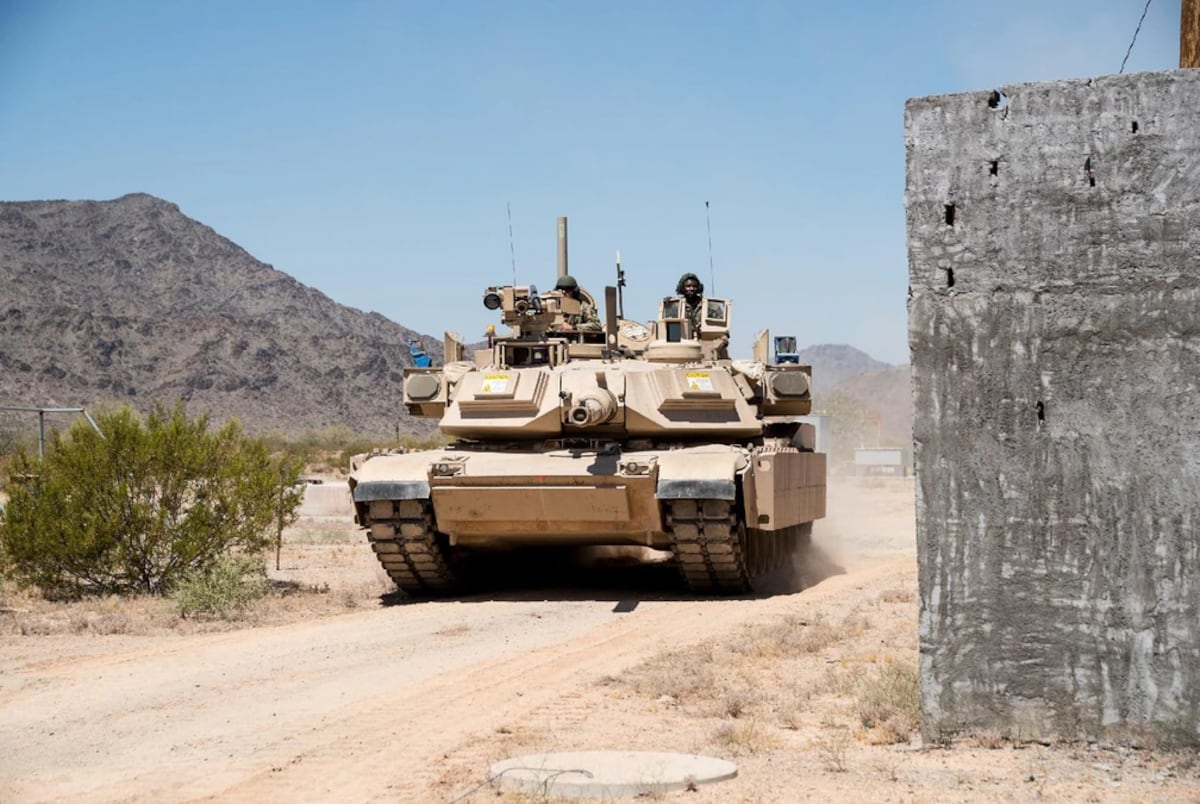
WASHINGTON — A U.K.-based industry team led by Italian defense company Leonardo has successfully demonstrated a new system to protect tanks and armored vehicles from incoming missiles , according to a Sept. 15 statement issued by Leonardo at the DSEI defense exhibition in London.
Integrating active protection systems onto vehicle fleets is a challenge shared by countries worldwide, including the United States, which has its own efforts to develop a modular system capable of protecting combat vehicles from rocket-propelled grenades and anti-tank guided weapons .
The team — which includes Abstract Solutions, CGI, Frazer-Nash, Lockheed Martin UK, Rheinmetall BAE Systems Land, Roke and Ultra Electronics — demonstrated the new high-tech protection solution — called the Modular Integrated Protection System, or MIPS — at the Ministry of Defence Shoeburyness range in Essex in July. The test was part of Project Icarus, a U.K. Defence Science and Technology Laboratory technology demonstrator program.
The project was launched due to the rise and “rapidly evolving threat” of modern RPGs and anti-tank guided weapons, the statement noted.
During the demonstration, threat representative weapons were shot at close range at the MIPS, which consists of a combination of commercial off-the-shelf and surrogate sensors and countermeasures.
“This trial provided a comprehensive test of the ability of the MIPS sense, control and reaction sequence to respond appropriately to threats within extremely short timeframes,” the statement read.
MIPS has an open-system architecture that allows for modular integration of affordable and best-of-breed sensors and countermeasures, according to Leonardo. Some of these sensors offer “soft” protection that can detect a threat early and attempt to disrupt, decoy or spoof the threat. Other sensors are designed to physically intercept and defeat the incoming missile.
“The MIPS solution is specifically designed to enable the vehicle’s protection system to be rapidly tailored, evolved and certified to protect crewmembers as new threats emerge on the battlefield,” the statement added.
A road map for the solution’s entire life cycle is under development to help the British Defence Ministry as it plans a way to mature the capability and bring it into the force, according to Leonardo.
Now that the initial demonstration is complete, the program has been extended and the scope widened through contract amendments in order to examine MIPS’ potential to deliver counter-drone and counter-intelligence, surveillance, target acquisition and reconnaissance solutions, the statement said.
The U.S. Army is also working toward a Modular Active Protection System, or MAPS, capability. It most recently awarded Lockheed Martin , earlier this year, a contract to integrate and formally test an open-architecture processor designed to control the system.
Lockheed will develop the MAPS base kit hardware and software; perform platform integration; and run on-vehicle, live-fire demonstrations over a 36-month period.
The U.S. Army is working with other industry partners to bring in sensors and countermeasures that are compliant with the MAPS architecture.
The Army, Lockheed and other industry partners have been working to prepare sensors and countermeasures controlled by the MAPS base kit for laboratory-based and live-fire demonstrations, including soft-kill systems like Northrop Grumman’s MEOS, BAE Systems’ Raven and Ariel Photonics’ CLOUD, as well as hard-kill systems including Artis Corporation’s Iron Curtain and Elbit System’s Iron Fist.
The Army has spent years developing a vehicle protection system, and has had several attempts — one successful, others not — to field interim active protection systems onto current combat vehicles.
The service has only fielded an active protection system — Rafael’s Trophy — on its M1 Abrams tank, which has been under evaluation with a unit in Europe . Leonardo DRS integrated Trophy onto the Abrams tank as part of that program.
Jen Judson is an award-winning journalist covering land warfare for Defense News. She has also worked for Politico and Inside Defense. She holds a Master of Science degree in journalism from Boston University and a Bachelor of Arts degree from Kenyon College.
华盛顿——据莱昂纳多公司9月15日在伦敦举行的DSEI防务展上发表的声明称,由意大利国防公司莱昂纳多领导的英国工业团队已成功演示了一种保护坦克和装甲车免受来袭导弹攻击的新系统。
将主动防护系统集成到车辆车队中是世界各国共同面临的挑战,包括美国在内,美国也在努力开发一种模块化系统,该系统能够保护作战车辆免受火箭推进榴弹和反坦克导弹的攻击。
该团队由Abstract Solutions、CGI、Frazer-Nash、洛克希德·马丁英国公司、莱茵金属BAE系统陆地公司、Roke和Ultra Electronics等公司组成,于7月在埃塞克斯郡国防部绍伯里尼斯靶场演示了名为“模块化集成防护系统”(MIPS)的新型高科技防护解决方案。此次测试是英国国防科技实验室技术验证项目“伊卡洛斯计划”的一部分。
声明指出,该项目的启动是由于现代火箭筒和反坦克制导武器的兴起和“快速演变的威胁”。
在演示过程中,威胁代表武器在近距离向 MIPS 进行了射击。MIPS 由商用现成传感器和替代传感器以及对抗措施组合而成。
声明中写道:“本次试验全面测试了 MIPS 感知、控制和反应序列在极短时间内对威胁做出适当反应的能力。”
据莱昂纳多公司称,MIPS采用开放式系统架构,可模块化集成经济实惠且性能卓越的传感器和对抗措施。其中一些传感器提供“软性”防护,能够及早发现威胁并尝试干扰、诱骗或欺骗威胁。另一些传感器则旨在物理拦截并摧毁来袭导弹。
声明还补充道:“MIPS解决方案经过专门设计,能够快速调整、改进和认证车辆的防护系统,以便在战场上出现新的威胁时保护乘员。”
据莱昂纳多公司称,目前正在制定该解决方案整个生命周期的路线图,以帮助英国国防部规划如何完善该能力并将其引入部队。
声明称,既然初步演示已经完成,该计划已通过合同修订进行了扩展和范围扩大,以便检验 MIPS 在提供反无人机和反情报、监视、目标获取和侦察解决方案方面的潜力。
美国陆军也在致力于研发模块化主动防护系统(MAPS)。今年早些时候,美国陆军授予洛克希德·马丁公司一份合同,委托其集成并正式测试一款用于控制该系统的开放式架构处理器。
洛克希德公司将开发 MAPS 基础套件的硬件和软件;进行平台集成;并在 36 个月内进行车载实弹演示。
美国陆军正与其他行业伙伴合作,引进符合 MAPS 架构的传感器和对抗措施。
陆军、洛克希德公司和其他行业合作伙伴一直在努力准备由 MAPS 基础套件控制的传感器和对抗措施,以进行实验室和实弹演示,其中包括诺斯罗普·格鲁曼公司的 MEOS、BAE 系统公司的 Raven 和 Ariel Photonics 公司的 CLOUD 等软杀伤系统,以及 Artis 公司的 Iron Curtain 和 Elbit 系统公司的 Iron Fist 等硬杀伤系统。
陆军多年来一直在研发车辆防护系统,并曾多次尝试(一次成功,其他几次则失败)将临时主动防护系统部署到现役作战车辆上。
该军种目前仅在其M1艾布拉姆斯坦克上部署了一套主动防护系统——拉斐尔公司的“战利品”(Trophy),该系统一直在欧洲的一个部队进行评估。莱昂纳多DRS公司作为该项目的一部分,负责将“战利品”系统集成到艾布拉姆斯坦克上。
珍·贾德森是一位屡获殊荣的记者,为《防务新闻》报道陆地战争。她也曾为《政治报》和《内幕防务》工作。她拥有波士顿大学新闻学硕士学位和凯尼恩学院文学学士学位。