Japan could become partner nation on UK-led future fighter effort, says program director项目主管表示,日本可能成为英国主导的未来战斗机项目的合作伙伴。
The United Kingdom, Sweden, and Italy are jointly developing cutting-edge technologies to feed into the Future Combat Air System effort.
LONDON — Japan could be the next partner nation for the trinational, British-led next-generation fighter program , an official hinted at the DSEI arms trade show in London.
The United Kingdom, Sweden, and Italy are jointly developing cutting-edge technologies to feed into the Future Combat Air System effort. The FCAS is to eventually lead to a core fighter aircraft and a raft of new capabilities alongside it by 2035.
Since 2020, Japan has partnered on elements of the program, but military and industry officials at the biennial DSEI conference in London hinted that the relationship could develop further within the next few years.
The program — also referred to as Tempest, and separate from the Franco-German-Spanish effort also known as FCAS — is working with Japan on the technological initiative, said the U.K. program director, Air Commodore Johnny Moreton.
“We’ve been in negotiation, conversations and some pilot projects — nothing necessarily too complex at the moment,” he said while moderating a Wednesday panel on the program’s advantages through international alliances at the conference.
In July, the Japanese government announced that the two countries had pledged to jointly develop new engine technologies that could inform both the London-led FCAS program, and Tokyo’s F-X effort to build a new sixth-generation fighter jet.
“We’re doing a joint engine viability study with Japan at the moment, and that’s quite exciting,” Moreton said. “They have an F-X program that has a very similar time frame to us, 2035; the threat is very similar to the one that we are anticipating, and in terms of an industrial nation, clearly they sit at the top table, as do we.”
The United Kingdom and Japan might extend the partnership beyond engine technologies, into electronic warfare and radar capabilities, he noted. However, those are “very much at a minor stage at this point,” he added.
Last year, the U.K., Sweden and Italy signed a memorandum of understanding to collaborate on the FCAS project, involving their national industry partners BAE Systems, Saab and Leonardo, respectively.
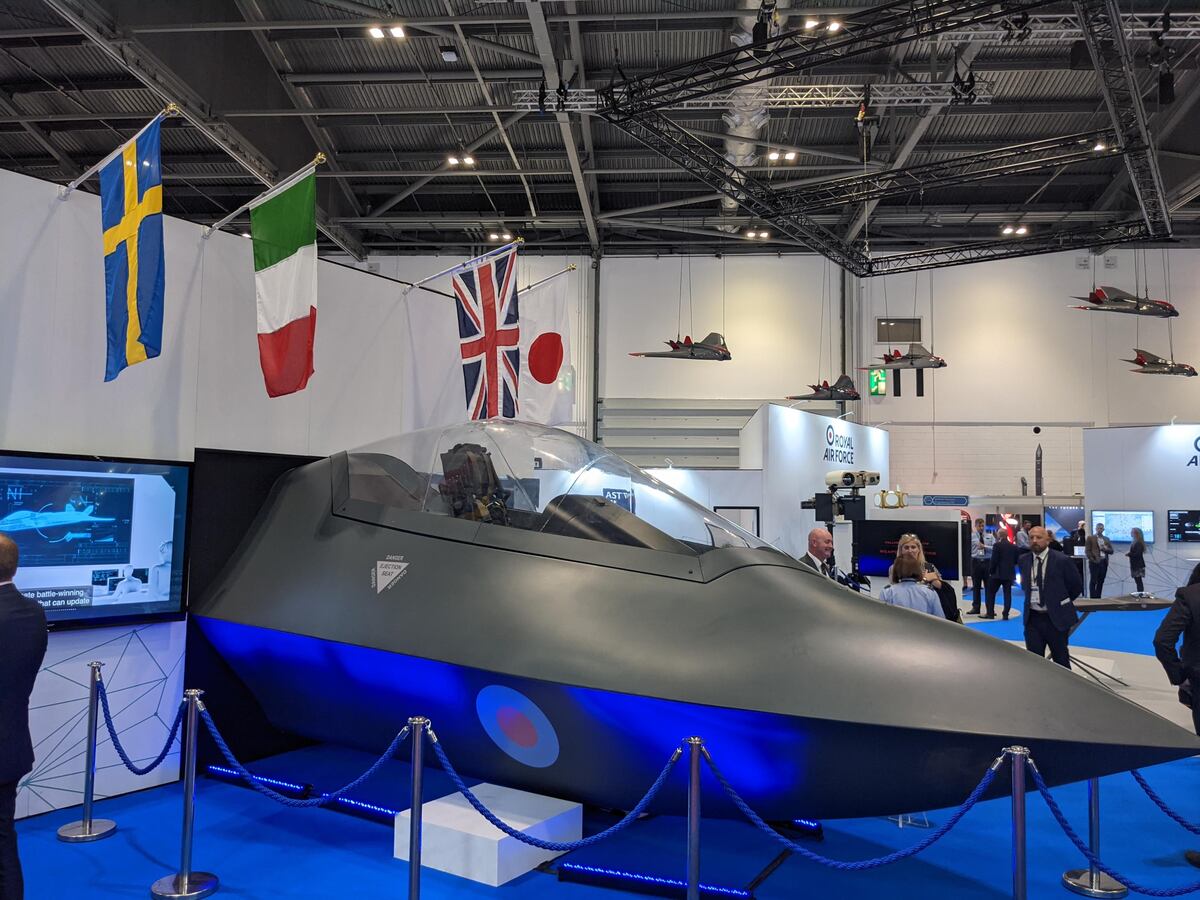
While Moreton emphasized that the British military’s work with Japan was an “exploratory partnership” during the panel, the static display of a possible FCAS cockpit just feet away from the podium on the DSEI exhibition floor had four national flags hanging distinctly above it.
The close, if still unofficial, partnership between the United Kingdom and Japan on FCAS-related technologies demonstrates that “where we see opportunity across the world, we are prepared to embrace” it, Moreton said.
While the FCAS allies and their industry teams are working together to develop the next-generation technologies, the concept of “freedom of modification” — where each country has the ability to make its own changes to the future aircraft and systems — also remains paramount.
“We want to be able to upgrade, advance [and] develop our capabilities ourselves, and as sovereign countries inside the partnership, each partner has that goal,” Moreton said.
Japan’s participation is a clear example of that dynamic, said Guglielmo Maviglia, senior vice president for Leonardo’s Tempest program.
“Trying to tightly bound all of this [effort] into a single partnership, I think, is a mistake anyway,” he said on the panel. “So leaving the flexibility for other partners to join is really important, and Japan provides us with our first test of that.”
On July 29, the British Defence MInistry announced a £250 million (U.S. $346 million) contract to launch the FCAS concept and assessment phase with its “Team Tempest” partners. The nation plans to spend about £2 billion on the program over the next four years, the government said. The contract was awarded to a U.K. industry team led by BAE Systems, which includes Rolls-Royce and the British arms of Leonardo and MBDA.
The FCAS team will continue this phase over the next several years, with plans to define and begin the design of FCAS, mature system technologies, invest in a skilled workforce, and secure the digital and physical infrastructure needed by 2024.
“The purpose of this phase is to look at the concepts [and] make an assessment of the program,” Moreton said. “And then, in late ‘24, go to our governments — Italy, Sweden, U.K. in this case, and potentially Japan — and say: ‘This is the program. This is what we can deliver. This is the timeline and the capability.’ And we’ll move forward from there.”
Vivienne Machi is a reporter based in Stuttgart, Germany, contributing to Defense News' European coverage. She previously reported for National Defense Magazine, Defense Daily, Via Satellite, Foreign Policy and the Dayton Daily News. She was named the Defence Media Awards' best young defense journalist in 2020.
伦敦——一位官员在伦敦举行的DSEI防务展上暗示,日本可能成为由英国主导的三国下一代战斗机项目的下一个合作伙伴国家。
英国、瑞典和意大利正在联合开发尖端技术,以支持未来作战空中系统(FCAS)项目。FCAS最终目标是在2035年前研发出一款核心战斗机以及一系列与之配套的新型作战能力。
自 2020 年以来,日本已在该计划的部分内容上与美国展开合作,但在伦敦举行的两年一度的 DSEI 防务展上,军方和工业界官员暗示,这种关系在未来几年内可能会进一步发展。
英国项目主管、空军准将约翰尼·莫顿表示,该项目(也称为“暴风雨”计划,与法德西联合开发的FCAS项目不同)正在与日本合作开展这项技术计划。
“我们一直在进行谈判、对话和一些试点项目——目前没有什么特别复杂的事情,”他在周三主持一个关于该计划通过国际联盟获得优势的小组讨论时说道。
7 月,日本政府宣布,两国承诺共同开发新的发动机技术,这些技术既可以为伦敦主导的 FCAS 项目提供信息,也可以为东京的 FX 项目(旨在建造新的第六代战斗机)提供信息。
莫顿说:“我们目前正在与日本进行联合发动机可行性研究,这非常令人振奋。他们的FX项目与我们的时间框架非常相似,都是在2035年;他们面临的威胁也与我们预期的非常相似;而且就工业化国家而言,他们显然和我们一样,都处于领先地位。”
他指出,英国和日本的合作可能会从发动机技术扩展到电子战和雷达能力领域。但他补充说,这些领域“目前还处于非常初级的阶段”。
去年,英国、瑞典和意大利签署了一份谅解备忘录,就 FCAS 项目展开合作,其国家工业合作伙伴分别为 BAE Systems、Saab 和 Leonardo。
虽然莫顿在小组讨论中强调英国军方与日本的合作是一种“探索性伙伴关系”,但在DSEI展览会上,距离讲台仅几英尺远的FCAS驾驶舱静态展示品上方却醒目地悬挂着四面国旗。
莫顿表示,英国和日本在FCAS相关技术领域密切(尽管仍是非正式的)的合作关系表明,“无论我们在世界各地看到什么机会,我们都准备好去抓住它”。
尽管未来空中作战系统 (FCAS) 的盟友及其行业团队正在共同努力开发下一代技术,但“修改自由”的概念——即每个国家都有能力对未来的飞机和系统进行自己的修改——仍然至关重要。
莫顿说:“我们希望能够自主升级、提升和发展我们的能力,作为伙伴关系中的主权国家,每个伙伴都有这个目标。”
莱昂纳多公司 Tempest 项目高级副总裁 Guglielmo Maviglia 表示,日本的参与就是这种动态的一个明显例子。
他在小组讨论中表示:“我认为,试图将所有这些努力紧紧捆绑到一个单一的合作伙伴关系中,无论如何都是一个错误。因此,为其他合作伙伴的加入留出灵活性至关重要,而日本为我们提供了这方面的第一个考验。”
7月29日,英国国防部宣布与“暴风雨团队”(Team Tempest)合作伙伴签署一份价值2.5亿英镑(约合3.46亿美元)的合同,启动未来空中作战系统(FCAS)的概念和评估阶段。英国政府表示,计划在未来四年内为该项目投入约20亿英镑。该合同授予了由英国航空航天系统公司(BAE Systems)牵头的英国工业团队,团队成员包括罗尔斯·罗伊斯公司以及莱昂纳多公司和MBDA公司的英国分公司。
未来航空安全系统 (FCAS) 团队将在未来几年继续推进这一阶段的工作,计划到 2024 年确定并开始设计 FCAS,完善系统技术,投资培养熟练的劳动力,并确保所需的数字和物理基础设施。
莫顿说:“这一阶段的目的是审视概念,并对项目进行评估。然后,在2024年底,我们会与各国政府——在本例中是意大利、瑞典和英国,可能还有日本——沟通,告诉他们:‘这就是项目。这就是我们能够交付的成果。这就是时间表和能力。’然后我们再根据这些进展推进项目。”
薇薇安·马奇是驻德国斯图加特的一名记者,主要负责《防务新闻》的欧洲报道。她此前曾为《国家防务杂志》、《防务日报》、《卫星通讯》、《外交政策》和《代顿每日新闻》撰稿。2020年,她荣获防务媒体奖最佳青年防务记者称号。