Tails Of War: Animals Have Made The Rigors Of Combat More Bearable Wherever Troops Have Served战争故事:无论军队在哪里服役,动物都让战斗的艰辛更容易忍受。
This Veterans Day, we invite you to remember the four-legged friends who made troops' service a little brighter.
新闻视频
Updated Nov 11, 2021 5:29 PM EST
As long as humans have gone to war, history records that animals have gone with them. The Pharoah Ramses II kept a lion as a pet , which joined him in battle against the Hittites. Hannibal’s army of Carthaginians famously crossed the Alps with elephants to attack Rome along a thoroughly unexpected axis. Horses have pulled wagons, carried ammunition, and served not merely as steeds, but as beloved comrades in mounted cavalry . But not all the animals that have accompanied warfighters have served a military purpose — at least not entirely. Dogs, for example, have served not only as protectors as long as they have existed , but also as pets and mascots.
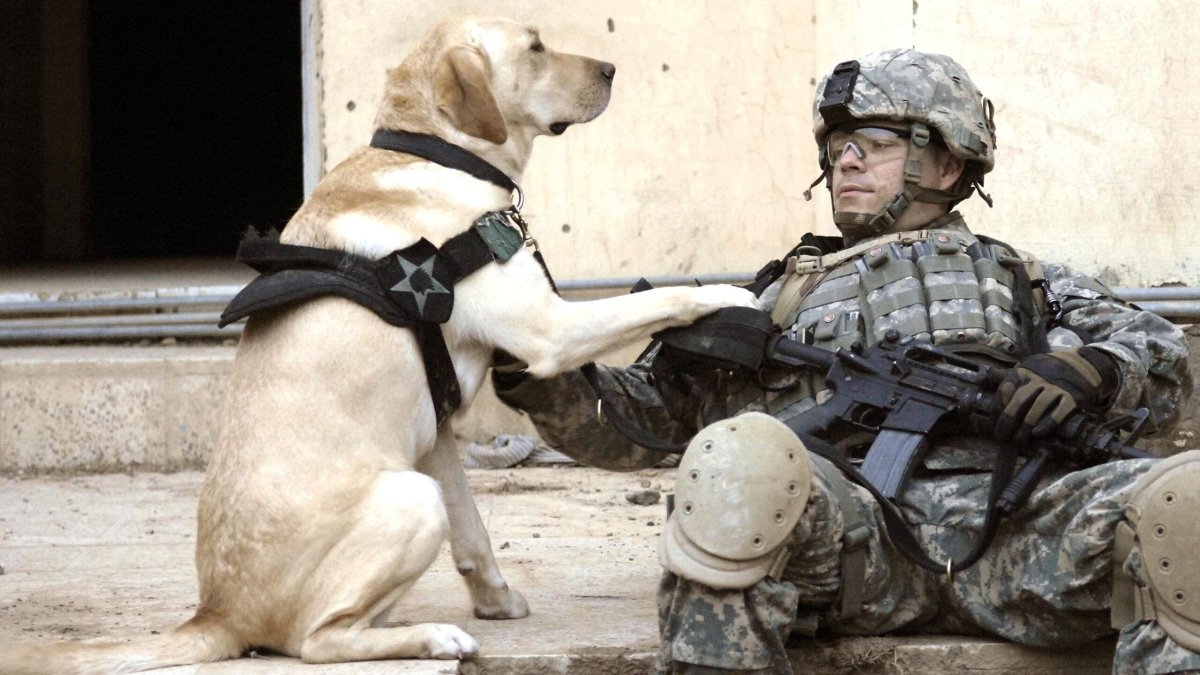
On this Veterans Day, many vets will remember their brothers and sisters in arms and sing the old songs and tell the old tales, and many of those tales will also involve, well, tails — the stories of those animal friends who deployed with them or joined unexpectedly, by happenstance — the four-legged animals sent to war or displaced by war and adopted by the men and women in uniform who found them.
Then Commandant of the Marine Corps Gen. Robert B. Neller poses with Chesty the Bulldog, the Marine Corps Mascot, at the 2018 Marine Corps Birthday Gala in New York. , U.S. Marine Corps / Sgt. Olivia G. Ortiz, USMC
A 1996 article in the National Archives newsletter, Prologue , tells the story of quite a few who spent their time with U.S. troops in World War II.
Consider Butch, shown here on Iwo Jima in February 1945, watching over a sleeping Private First Class (Pfc) Rez P. Hester of the 7th War Dog Platoon, 25th Regiment.
Butch was an official part of Pfc. Hester’s unit. The kitten in the next image, on the other hand, was found by the Marine in the photo, Corporal Edward Burckhardt, at the foot of Iwo Jima’s Mount Suribachi, also in February 1945. Given the brutality of the months-long fight to take that island — casualty estimates say as many as 27,000 American troops were killed or wounded in the battle — it’s likely there were few smiles anywhere on the island. But this kitten provided at least one Marine a brief respite from the war.
Naval History and Heritage Command
Sometimes dogs were more than pets — they were comrades-in-arms. Consider Nemo, a German shepherd who served in the U.S. Air Force in Vietnam. On Dec. 5, 1966, Nemo and his handler, Airman 1st Class Robert A. Throneburg, were patrolling Tan Son Nhut Airbase near Saigon, in South Vietnam. Nemo discovered two Viet Cong infiltrators, and a gunfight between the VC and Air Force personnel ensued. Throneburg was wounded in the shoulder and throat, and Nemo received a bullet graze to the snout as well as a shot that cost him an eye.
According to dogtime.com :
After Throneburg fell unconscious, Nemo crawled on top of the [airman’s] body to protect him from harm. The dog didn’t let anyone touch his fallen handler; it took a veterinarian to remove Nemo (Nemo and Throneburg later recovered from their wounds). Nemo was later given a permanent retirement kennel.
Nemo shown with an escort, Airman 2nd Class Melvin Bryant, after his return to the United States., U.S. Air Force
Cats have never had any official status in the military (despite military satire website Duffel Blog’s best efforts ).
But not only strays have accompanied the troops into war zones. Navy ships, in particular, seem to have adopted cats, perhaps because they were especially useful in controlling shipboard rodent populations. This (admittedly a little silly) video tells the story of how cats first went down to the sea.
In the U.S. Navy, goats have been popular as well. In the days of sailing ships, goats could be a good source of fresh milk, particularly for the officers’ coffee, at least if Patrick O’Brian is to be believed. In this photo, the crew of the USS Maine (BB-10 — not the one that blew up in Havana, but the one named and built for her in 1899) entertain the ship’s goat sometime between 1902 and 1905.
Taking mascots to a combat zone or adopting stray animals found on deployment is not just a historical habit. Consider, for example, this kitten, stashed in a U.S. soldier’s pocket during an exercise in the Philippines in 2012.
Wikimedia / Camelia Montoy
More recently, one U.S. service member has actually enlisted the assistance of the nonprofit Guardians of Rescue to retrieve and provide veterinary for care “Sergeant Whiskers,” who approached the service member, known only as Sgt. Kelsey, and eventually led the human to her two kittens. Sergeant Whiskers was malnourished and injured, and Sgt. Kelsey and her comrades swiftly adopted the felines.
And then there’s the famous story of Conan , the working dog who helped take down infamous ISIS leader Abu Bakr al-Baghdadi and earned a ceremony at the White House to celebrate the victory. Working dogs and their handlers grow so close, often the handler will adopt his furry partner when one or the other is ready to leave active service.
Those who have experienced the sacrifice, deprivations, and triumphs of military service say they form bonds with each other that are difficult to explain and even harder to replicate in civilian life. For many, the bonds with the animals they encountered during their service are similarly strong. No doubt, there are countless stories from across the battlefields and deployments of U.S. service members throughout history. We hope you’ll share your story in the comments below.
We wish you a safe and pleasant Veterans Day and the best memories of your time in service to the nation and each other.
Contact the author: Brian@TheDrive.com
Comments couldn’t be loaded. Please refresh the page.
更新于美国东部时间2021年11月11日下午5:29。
自人类发动战争以来,历史记载动物一直伴随左右。法老拉美西斯二世饲养了一头狮子作为宠物,这头狮子曾与他一同对抗赫梯人。汉尼拔率领的迦太基军队曾率领战象翻越阿尔卑斯山,从一条出人意料的轴线进攻罗马,这在历史上广为流传。马匹拉车、运弹药,不仅是战马,更是骑兵部队中备受爱戴的战友。但并非所有伴随战士的动物都用于军事用途——至少并非完全如此。例如,狗自古以来就扮演着守护者的角色,同时也是人们的宠物和吉祥物。
在今年的退伍军人节,许多退伍军人将缅怀他们的战友,唱起老歌,讲述老故事,而这些故事中也常常包含着动物的故事——那些与他们一同部署或因偶然巧合而意外加入的动物朋友的故事——这些四条腿的动物被送往战场或因战争流离失所,然后被找到它们的军人收养。
时任美国海军陆战队司令罗伯特·B·内勒将军在2018年纽约海军陆战队生日庆典上与海军陆战队吉祥物——斗牛犬切斯蒂合影。(美国海军陆战队/美国海军陆战队中士奥利维亚·G·奥尔蒂斯摄)
1996 年,《国家档案馆通讯》的一篇报道讲述了许多在二战期间与美军一起度过时光的人的故事。
想想看,图中这只名叫 Butch 的狗,在 1945 年 2 月的硫磺岛上,正守护着第 25 团第 7 战犬排的一等兵 Rez P. Hester 睡觉。
布奇是列兵赫斯特所在部队的正式成员。而下一张照片中的小猫,则是照片中的海军陆战队员,下士爱德华·伯克哈特,于1945年2月在硫磺岛折钵山脚下发现的。考虑到这场持续数月的夺岛战役的残酷性——据估计,多达27000名美军士兵在战斗中阵亡或受伤——岛上恐怕鲜少有人露出笑容。但这只小猫至少给一位海军陆战队员带来了一丝战争的慰藉。
海军历史与遗产司令部
有时,狗不仅仅是宠物——它们是并肩作战的战友。以尼莫为例,这只德国牧羊犬曾在美国空军服役,驻扎在越南。1966年12月5日,尼莫和它的训导员,一等兵罗伯特·A·索恩伯格,正在南越西贡附近的谭山一空军基地巡逻。尼莫发现了两名越共渗透者,随后越共与空军人员发生枪战。索恩伯格肩部和喉咙中弹受伤,尼莫的鼻子被子弹擦伤,另一颗子弹导致它失去了一只眼睛。
据 dogtime.com 报道:
索恩伯格昏迷后,尼莫爬到他身上保护他免受伤害。这条狗不让任何人碰它倒下的训导员;最后还是兽医把尼莫从他身上移开(尼莫和索恩伯格后来都康复了)。之后,尼莫被安置在一个永久的养老犬舍里。
尼莫返回美国后,由二等兵梅尔文·布莱恩特护送。(美国空军)
猫在军队中从未获得过任何官方地位(尽管军事讽刺网站 Duffel Blog 竭尽全力)。
但并非只有流浪猫会随军进入战区。尤其是海军舰艇,似乎特别喜欢养猫,或许是因为它们在控制船上啮齿动物数量方面特别有效。这段(不得不承认有点滑稽的)视频讲述了猫咪最初是如何下海的故事。
在美国海军中,山羊也一直很受欢迎。在帆船时代,山羊是新鲜牛奶的良好来源,尤其适合军官们冲泡咖啡,至少帕特里克·奥布莱恩是这么说的。在这张照片中,缅因号战列舰(BB-10——不是在哈瓦那爆炸的那艘,而是1899年以她的名字命名并建造的那艘)的船员们在1902年至1905年间的某个时候与舰上的山羊玩耍。
将吉祥物带到战区或收养部署期间发现的流浪动物并非只是历史遗留的做法。例如,这只小猫就曾被藏在2012年菲律宾的一次演习中一名美国士兵的口袋里。
维基媒体 / Camelia Montoy
最近,一位美国军人求助于非营利组织“救援守护者”(Guardians of Rescue),救助并照顾了一只名叫“胡须中士”(Sergeant Whiskers)的小猫。这只小猫主动接近了这位名叫凯尔西中士(Sgt. Kelsey)的军人,并最终引导她找到了自己的两只小猫。胡须中士当时营养不良且受伤,凯尔西中士和她的战友们迅速收养了这两只小猫。
还有著名的科南的故事。这只工作犬帮助击毙了臭名昭著的ISIS头目阿布·贝克尔·巴格达迪,并因此在白宫举行了庆祝仪式。工作犬和它们的训导员之间往往建立了深厚的感情,当其中一方准备退役时,训导员常常会收养自己的毛茸茸的伙伴。
那些经历过军旅生涯中的牺牲、艰辛和胜利的人说,他们彼此之间建立的纽带难以言喻,更难以在平民生活中复制。对许多人来说,他们在服役期间与动物建立的联系也同样牢固。毫无疑问,美国军人在历史上无数的战场和部署中都留下了无数这样的故事。我们希望您能在下方评论区分享您的故事。
祝您度过一个安全愉快的退伍军人节,并珍藏您为国家和彼此服务期间的美好回忆。
联系作者:Brian@TheDrive.com
评论加载失败,请刷新页面。