Her Majesty’s Death Ray: How The AIM-9L Sidewinder Vanquished The Argentine Air Force女王陛下的死亡射线:AIM-9L“响尾蛇”导弹如何击败阿根廷空军
The author of a new book on the conflict reveals how the American-made AIM-9L missile provided a lethal edge in the 1982 Falklands air war.
Updated Nov 27, 2020 6:13 PM EST
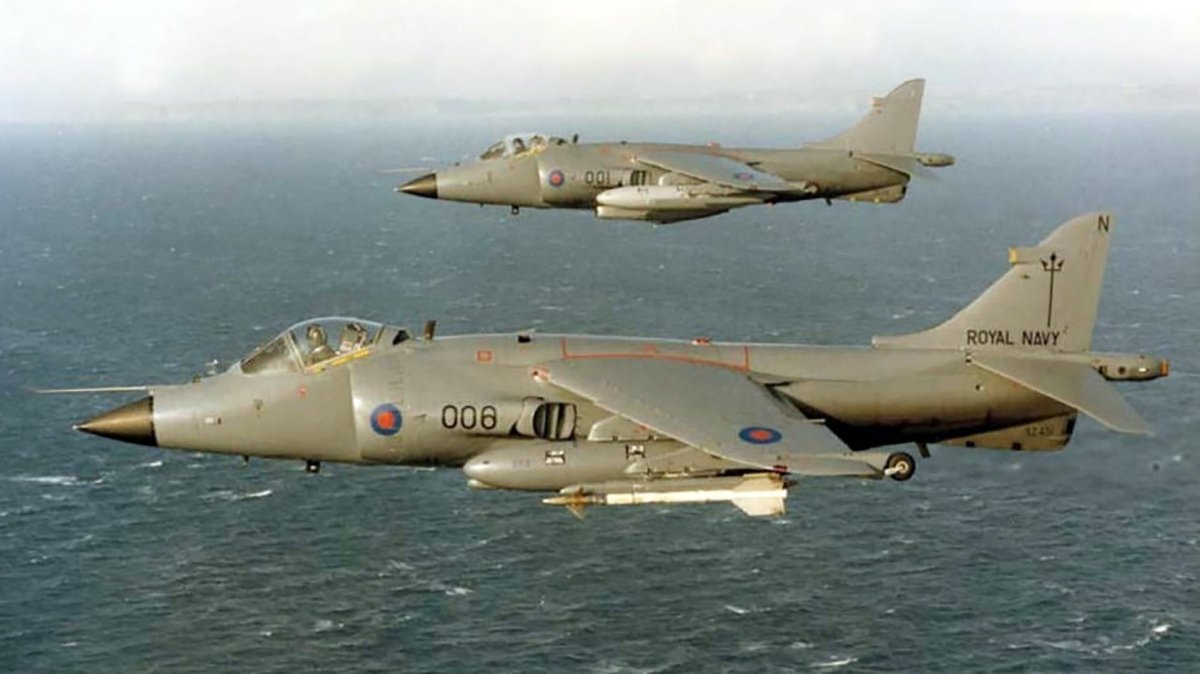
The Flight Deck Officer whipped down a green flag and crouched to the side of the take-off run that stretched ahead toward the “ski-jump” ramp over the aircraft carrier HMS Hermes ’ bow. Inside the cockpit of the Sea Harrier , armed with two AIM-9L Sidewinder missiles, Lieutenant Simon Hargreaves slammed the throttle lever to the stops with his left hand. Engine gauges flicked around their dials in harness with the big Rolls-Royce Pegasus turbofan winding up behind him. A second later, 10 tons of thrust began to overwhelm the brakes, scrubbing stationary rubber across the rough metal flight deck.
Hargreaves then released the brakes and the jet leaped forward, accelerating fiercely to 90 knots in just three seconds before pressing its pilot further down into his seat as it nosed up the ramp and over the bow. As soon as the cockpit cleared the deck, he pulled the nozzle lever back to the short take-off stop then left the controls alone, allowing the fighter to arc through a ballistic trajectory as it accelerated to wing-borne flight.
He could hardly believe his luck. The youngest and least experienced member of 800 Naval Air Squadron, part of the U.K. Royal Navy’s Fleet Air Arm, he’d only been out of training for a couple of months on April 2, 1982. On that date, Argentina had invaded the Falkland Islands, a small British territory nearly eight thousand miles from home.
When he took off from Hermes , it was just weeks since he’d landed on the ship for the very first time. Now the ship was leading the British Task Force sent to end the occupation and he’d been scrambled to intercept an unidentified radar contact approaching from the southwest at 20,000 feet.
Hargreaves’ interception of an Argentine Air Force Boeing 707 tracking the Royal Navy’s progress marked the first aerial encounter between the two belligerents. While not a single shot was fired, it would prove to be one of the most significant events of the whole air war.
Fifteen minutes before he launched, the young fighter pilot was preparing to fly a training sortie. Following the order to head-off the enemy shadower, the squadron’s armorers had removed the training rounds from beneath the wings of Hargreaves’ Sea Harrier and replaced them with a pair of live AIM-9L Sidewinder heat-seeking missiles.
When photographs taken during the 707’s reconnaissance mission revealed that British jets were armed with the latest version of the Sidewinder, the “Nine Lima,” it caused consternation inside Argentine crew rooms.
Simon Hargreaves’ Sea Harrier off the wing of the Argentine 707. The realization that the British fighters were armed with AIM-9Ls caused concern within the Argentine Air Force, VIA AUTHOR
At the 1981 Junior Olympics, a 15-year-old boxer from Catskill, New York knocked out his opponent after just eight seconds in the first round to win the heavyweight gold medal. The following year, in the final of the same competition, his opponent’s corner threw in the towel in round one to spare their fighter from further punishment. That young boxer’s name was Mike Tyson. He would go on to become the undisputed heavyweight champion of the world, cutting down all-comers with clinical speed, power, and accuracy. So fearsome became his reputation that most of his opponents expected to lose before the first punch was thrown.
The AIM-9L Sidewinder had a similar effect. If the British had Nine Limas, their Argentine counterparts believed they were at a disadvantage before they had even left the ground. And with good reason. The missile had been described by one of the engineers that had developed it as “a death ray.”
Simon Hargreaves after returning to Hermes following the interception of the Argentine 707., VIA AUTHOR
More than three decades before the Falklands conflict, in 1951, U.S. naval aviator Wally Schirra hadn’t welcomed his new posting to the Naval Ordnance Test Station at China Lake, California. After clocking up 90 combat missions as a fighter pilot in Korea, he wanted to go to the U.S. Navy’s test pilot school at Patuxent River, Maryland, not a safe space for “Ph.D. types” in the middle of the Mojave Desert.
Wally Schirra, during his time as an astronaut., VIA AUTHOR
After all, he had the Right Stuff. A future NASA astronaut , the young naval aviator had flying in the blood. His father was a World War I pilot turned barnstormer, and, or so legend had it, his mother continued to perform her wing-walking act while pregnant with Wally. But when Schirra was shown around the lab at China Lake, his disappointment soon turned to fascination. A smoker, Schirra noticed that a device mounted inside a small glass dome attached to the front of an adapted 5-inch air-to-ground rocket, was following him, or rather his cigarette, around the room.
“This,” his boss told him, “is your new toy.”
The new heat-seeking missile would be christened the Sidewinder, named after the local horned rattlesnake that hunted in the desert at night by detecting the infrared radiation given off by its prey, and it was going to change the nature of aerial warfare forever.
The new missile’s development flew in the face of the then state-of-the-art in air-to-air missile design. While large American aerospace companies like Hughes and Raytheon poured Air Force and Navy money into ever more complex, sophisticated, and apparently fallible radar-guided systems, the small team at China Lake tacked the other way.
An AIM-9 about to hit a QF-86 drone at China Lake. , VIA AUTHOR
An XAAM-N-7 Sidewinder mounted under the right wing of a Douglas AD-4 Skyraider , VIA AUTHOR
A Sidewinder 1 beneath the wing of an F3D Skyknight at China Lake in 1951., VIA AUTHOR
“It’s easy,” argued the team’s leader, Dr. William B. McLean, “to build something complicated; it’s hard to build it so it’s simple.” The key to success thought McLean in 1946: put the fire control in the missile instead of the aircraft .
A year after the end of World War II, he set his mind on building what amounted to an autonomous robot that, once fired by the pilot, would guide itself to the target with no further outside input or direction. McLean first sketched the “heat-homing” seeker head that would make that possible on an envelope in 1947. Developed as an R&D project, without official support, the project advanced under McLean’s exacting leadership and, by 1953, China Lake test pilots were able to amuse themselves by swooping in behind trucks, trains, and Greyhound buses to see if they could get their missiles to lock on.
But it was footage of an old B-17 Flying Fortress spiraling into the ground after taking a direct hit from one of the missiles in early 1954 that finally helped persuade officials in Washington to take an interest. By March 1955, the Sidewinder, which eventually received the designation AIM-9, was in full-scale production. It would make its combat debut three years later.
Am AIM-9B destroys an F6F-5K Hellcat at China Lake in 1957., VIA AUTHOR
In the summer of 1958, as tension mounted over the Chinese Communist bombardment of Taiwanese islands in the Taiwan Strait, American and Chinese warships stared each other down. High above them, Taiwanese F-86 Sabre jet fighters tried and failed to get within gun range of the Communist Chinese MiG-17 Fresco jets flying overhead with impunity.
Capable of flying faster and higher than the Taiwanese jets, the Soviet-built MiGs were untouchable. On September 22, the Taiwanese pilots rejoined the battle with a new trick up their sleeves. By the end of the day they’d destroyed at least 10 of the high-flying Chinese MiGs and had shown that, armed with the right weapon, a fighter didn’t necessarily need to outperform its opponent.
Such was the confidence in the new generation of air-to-air missiles, such as the Sidewinder that, after breaking every sort of speed and altitude world record under the sun, the U.S. Navy’s hot new interceptor, the McDonnell Douglas F-4 Phantom II , entered service in the early 1960s without a gun. Yet in combat in Vietnam, the Sidewinder failed to live up to expectations. By the end of the war in Southeast Asia, just one in five Sidewinders had hit its target.
As it turned out, the early Sidewinder was extremely short-ranged and it needed a clear, unbroken view of the target’s jet exhaust, so it had to be fired from behind the enemy. That required a degree of cooperation from a target that was likely to be more inclined to try hard maneuvering, flying into clouds, or pointing toward the sun. All of this worked in confounding the missile. It didn’t like wet weather, either and, at low altitude over water, it found it hard to acquire the target at all.
Even the later AIM-9G version of the Sidewinder, which was piled high in British armories and magazines in early 1982, looked like a weapon that was going to be asked to perform well out of its comfort zone at low level in the grim late-fall conditions faced by the British Task Force in the South Atlantic.
All-aspect AAM in the Falklands
The Nine Lima was another matter altogether, though. Its design had been shaped by the experience in Vietnam to address every one of its predecessors’ shortcomings. A brand-new seeker head gave it an all-aspect capability making it the first Sidewinder that could be fired at a target from any direction, even head-on. New double-delta canards endowed it with the ability to generate 35 g loads as it twisted and turned towards its prey. No aircraft, let alone its pilot, could match it.
An AIM-9L takes out a QF-33 drone at China Lake in 1975., VIA AUTHOR
“When China Lake invented the Nine Lima,” a USAF colonel told one of the engineers at Raytheon, the missile’s manufacturer, “I knew it was time to get out of the fighter pilot business.”
Unfortunately, when, on April 5, 1982, the British fleet set sail for the Falklands, they had just 19 examples of the new missile. Inside the Ministry of Defence in London, there were urgent efforts being made to rectify the situation. A quantity of AIM-9Ls had been raided from NATO stocks at RAF Leuchars, a Royal Air Force base in Scotland. More importantly, 100 more had been requested from the United States.
The plan was to have these additional missiles air-freighted directly to Ascension Island in the mid-Atlantic to await the arrival of the Royal Navy’s two carriers, HMS Hermes and HMS Invincible . It all rested on an assumption that the Sea Harrier could carry and fire the Nine Lima. It wasn’t expected to be an issue, but with just 20 Sea Harriers providing air cover for a British operation mounted only 300 miles from the Argentinian mainland, there was no room for any doubt.
Five days after the invasion of the Falklands, Lieutenant Commander Tim Gedge, who only two months earlier had relinquished command of 800 Naval Air Squadron, was asked to form a new Sea Harrier squadron to reinforce the small force of jump jets that had already deployed. He was given just three weeks to do it and his unit had a Dirty Dozen feel to it.
He pulled mothballed Sea Harriers out of storage, from test squadrons, and off the British Aerospace production line. Anywhere he could find them. Radars were appropriated from jets earmarked for the Indian Navy, while his pilots were recalled from foreign exchange postings in Arizona, California, and Australia. Two were borrowed from a Royal Air Force Harrier squadron in Germany. The only thing they were missing, joked one aviator, “is someone sprung from jail.”
RAF Harrier GR3 ground-attack jets were fitted with Sidewinders in 1982 to give them the capability to bolster the small force of Sea Harrier fighters., VIA AUTHOR
While Gedge’s priority was to make sure his pilots were given bare-bones training in flying and fighting the Sea Harrier — and some would get fewer than 10 hours in the cockpit of the jet — he was also charged with helping develop and test new weapons, software, and tactics. In his last weeks as squadron boss of 800 Naval Air Squadron, Gedge knew that the Sea Harrier’s clearance trials for the Nine Lima had been scheduled for later in the year. He now brought them forward to the end of the week.
He booked time on the weapons ranges at RAF Valley on Anglesey in Wales, rustled up a chase plane from the Aeroplane and Armament Experimental Establishment at Boscombe Down, Wiltshire, to observe the test firings, and directed a pair of experienced pilots to plan the various flight profiles they’d use during the trials. But when, a couple of days later, Gedge flew up to Valley himself, he was told there was a problem.
The reprofiled canard fins at the front of the Nine Lima meant it no longer fit on the missile launch rails beneath the Sea Harrier’s wings. That would normally need an expensive manufacturer’s redesign and recertification to sort out. He asked the Chief Petty Officer responsible for arming the aircraft if there was anything that could be done.
“Well, we could just file down rails we’ve already got to make them fit…”
Gedge told him to do it, amused at the ease with which the normal sequence of things had been sidestepped. “Must be one of the cheapest modifications ever,” he thought.
The trials were complete a day later. Six shots. Six direct hits. 100%. The Nine Lima was ready to go to war.
A fortnight later, so too was Gedge’s reformed 809 Naval Air Squadron.
A Sea Harrier test-firing a Sidewinder., VIA AUTHOR
In the six-week war that followed, the Royal Navy’s Sea Harriers — outnumbered nearly 10-to-one by the Argentine fast jet force — won a decisive victory. In shooting down 23 enemy aircraft, they had not suffered a single loss in air combat by return. Twenty-one of the British kills fell to the AIM-9L Sidewinder, which finished the war with an 87% success rate.
The Royal Navy’s opponent, the Argentine Air Force, included jets that were considerably faster than the Sea Harriers, such as the Mach-2-capable delta-wing Mirage III and Dagger jet fighters, plus agile A-4 Skyhawks . By any measure, this was a very credible adversary, much like the MiG-17s that had tangled with Sabres over the Taiwan Strait almost a quarter-century earlier.
One of two AIM-9L Sidewinders fired by 800 Naval Air Squadron commanding officer Andy Auld at a pair of Argentine Daggers on May 24, 1982. The Nine Limas destroyed them both., VIA AUTHOR
The Nine Lima didn’t have it all its own way, though. There had been a handful of occasions when the missile had refused to leave the rails. It was thought that the constant rain and mist might have borne some responsibility for the failures. And so, in order to remedy the situation, the Sidewinders’ infrared seekers were removed after each mission and dried out in the carrier’s bread ovens before being reattached as required. It seemed to do the trick.
No matter what, the Nine Lima had proved to be a war-winner. This was a fact reinforced later in the year when it went into action with the Israeli Air Force over Lebanon’s Bekaa Valley against the Syrian Air Force with similar results.
Way back in 1934, the British Air Ministry, worried about falling behind German technological advances, set up a Committee for the Scientific Survey of Air Defence. Of particular concern to the committee was the prospect of some kind of electromagnetic beam being used to either disable aircraft or incapacitate their crews. Unable to figure out how to do it on their own, they offered a £1,000 prize to anyone who could build a device that could incinerate a sheep from a distance of 100 yards. With the prize still unclaimed a year later, the Air Ministry asked the country’s Radar Research Station for advice on the “practicability of proposals of the type colloquially called ‘death ray’.” The death ray turned out to be a not very practical proposition at all.
Fifty years later, though, a weapon so devastatingly lethal that it had earned that label from one of its creators helped Britain win an unlikely war on the far side of the world against a skilled and courageous opponent.
Rowland White’s new book, Harrier 809 , which tells the dramatic story of how a small, outnumbered band of fighter pilots won a victory in the air eight thousand miles from home, is published by Silvertail Books on October 15, 2020. Make sure to order your copy by clicking here.
Contact the editor: tyler@thedrive.com
Comments couldn’t be loaded. Please refresh the page.
更新于美国东部时间2020年11月27日下午6:13。
飞行甲板军官挥下绿旗,蹲在起飞滑跑道旁,这条滑跑道一直延伸到“赫尔墨斯”号航空母舰舰艏上方的滑跃甲板。在装备了两枚AIM-9L“响尾蛇”导弹的“海鹞”战斗机的驾驶舱内,西蒙·哈格里夫斯中尉左手猛地将油门杆推到极限。发动机仪表盘上的指针飞速转动,巨大的劳斯莱斯“飞马”涡扇发动机在他身后轰鸣起来。一秒钟后,10吨的推力开始压垮刹车,静止的轮胎在粗糙的金属甲板上摩擦出刺耳的摩擦声。
哈格里夫斯随即松开刹车,喷气式飞机猛然向前跃出,仅三秒便加速至90节,随后机头掠过舷梯,越过船首,飞行员被压得更加紧贴座椅。座舱刚一离开甲板,他就将喷嘴操纵杆拉回短距起飞位置,然后不再操作操纵杆,任由战斗机沿着弹道轨迹飞行,最终加速至翼载飞行。
他简直不敢相信自己的好运。作为英国皇家海军舰队航空兵第800海军航空中队中最年轻、经验最少的成员,1982年4月2日,他结束训练才几个月。就在那一天,阿根廷入侵了福克兰群岛,这片距离英国本土近八千英里的小型英国领土。
当他从“赫尔墨斯”号上起飞时,距离他第一次登上这艘船仅仅几周时间。现在,“赫尔墨斯”号正率领英国特遣舰队前往结束占领,而他被紧急派去拦截一个从西南方向2万英尺高空接近的不明雷达目标。
哈格里夫斯拦截了一架跟踪英国皇家海军动向的阿根廷空军波音707飞机,这标志着交战双方的首次空中遭遇。虽然双方没有交火,但这却是整个空战中最重要的事件之一。
起飞前十五分钟,这位年轻的战斗机飞行员正在准备执行一次训练飞行任务。接到拦截敌方跟踪机的命令后,中队的军械员将哈格里夫斯驾驶的“海鹞”战斗机机翼下的训练弹卸下,换上了两枚实弹AIM-9L“响尾蛇”红外制导导弹。
当707号飞机执行侦察任务时拍摄的照片显示,英国喷气式飞机装备了最新版本的响尾蛇导弹“九利马”,这在阿根廷机组人员休息室里引起了恐慌。
西蒙·哈格里夫斯的“海鹞”战斗机从阿根廷707客机的机翼旁飞过。英国战斗机装备AIM-9L导弹这一事实引起了阿根廷空军的担忧。(作者注)
1981年青少年奥运会上,一位来自纽约州卡茨基尔的15岁拳击手在第一回合仅用8秒就击倒对手,夺得重量级金牌。次年,在同一项赛事的决赛中,他的对手教练组在第一回合就扔出白毛巾认输,以避免他的拳手遭受更多伤害。这位年轻的拳击手名叫迈克·泰森。他后来成为无可争议的世界重量级拳王,以精准的速度、强大的力量和精准的打击击败所有挑战者。他的威名如此可怕,以至于大多数对手在第一拳出手前就预感到自己必败无疑。
AIM-9L“响尾蛇”导弹也产生了类似的效果。如果英国人拥有“九利马”导弹,他们的阿根廷同行甚至在导弹升空之前就认为自己处于劣势。这并非没有道理。参与研发该导弹的工程师之一曾将其描述为“死亡射线”。
西蒙·哈格里夫斯在拦截阿根廷707客机后返回赫尔墨斯公司。(图片来自作者)
早在福克兰群岛战争爆发三十多年前的1951年,美国海军飞行员沃利·施拉就不乐意被调往加利福尼亚州中国湖海军军械试验站。在朝鲜战争中作为战斗机飞行员执行了90次战斗任务后,他原本想去位于马里兰州帕图克森特河的美国海军试飞员学校,而不是莫哈韦沙漠中心那个“博士们”的避风港。
沃利·施拉,在他担任宇航员期间。(图片来自作者)
毕竟,他具备成为宇航员的潜质。这位年轻的海军飞行员,未来的NASA宇航员,天生就对飞行充满热情。他的父亲曾是一战飞行员,后来成为特技飞行表演者;据说,他的母亲在怀着沃利的时候,仍然坚持进行翼上行走表演。但当施拉参观中国湖实验室时,他的失望很快被浓厚的兴趣所取代。施拉是个烟民,他注意到一个装置安装在一个改装过的5英寸空对地火箭前端的小玻璃罩内,这个装置似乎在跟着他,或者更确切地说,是跟着他的香烟在房间里移动。
“这是你的新玩具,”他的老板告诉他。
这种新型热寻导弹将被命名为“响尾蛇”,得名于当地一种在沙漠中夜间通过探测猎物发出的红外辐射来捕猎的角状响尾蛇。它将永远改变空中战争的性质。
这种新型导弹的研发方向与当时最先进的空空导弹设计背道而驰。当休斯和雷神等美国大型航空航天公司将空军和海军的资金投入到日益复杂、精密且看似漏洞百出的雷达制导系统中时,中国湖空军基地的这支小团队却另辟蹊径。
一枚AIM-9导弹即将击中中国湖上空的QF-86无人机。(图片来自作者)
一枚XAAM-N-7“响尾蛇”导弹挂载在道格拉斯AD-4“空中袭击者”攻击机的右翼下方,图片来自作者。
1951年,一枚响尾蛇1型导弹挂载在一架F3D空中骑士战斗机的机翼下方,地点位于中国湖机场。(图片来自作者)
“制造复杂的东西很容易,”团队负责人威廉·B·麦克莱恩博士辩称,“但要制造出简单的东西却很难。”麦克莱恩在1946年认为,成功的关键在于:把火控系统放在导弹上,而不是飞机上。
二战结束后一年,他便立志要制造一种类似自主机器人的武器,这种武器一旦由飞行员发射,就能在无需任何外部输入或指令的情况下自行飞向目标。1947年,麦克莱恩在一张信封上首次勾勒出了实现这一目标所需的“热寻”导引头草图。该项目最初是一个研发项目,没有官方支持,但在麦克莱恩的严格领导下取得了进展。到1953年,中国湖的试飞员们已经开始兴致勃勃地驾驶导弹,悄悄接近卡车、火车和灰狗巴士,测试导弹能否锁定目标。
但真正促使华盛顿官员开始关注的,是1954年初一架老旧的B-17“飞行堡垒”轰炸机被导弹直接击中后螺旋坠落的画面。到1955年3月,最终被命名为AIM-9的“响尾蛇”导弹已投入全面生产。三年后,它将首次投入实战。
1957年,一枚AIM-9B导弹在上海中国湖击落一架F6F-5K“地狱猫”战斗机。(图片来自作者)
1958年夏天,随着中国共产党炮击台湾海峡岛屿的紧张局势加剧,美国和中国的军舰对峙不休。在它们上方的高空,台湾的F-86佩刀式喷气战斗机试图接近中国共产党的米格-17壁画式喷气战斗机,但未能成功,后者正肆无忌惮地在空中盘旋。
苏联制造的米格战机飞行速度和高度都远超台湾战机,几乎无人能敌。9月22日,台湾飞行员带着新的战术重返战场。当天结束时,他们至少击落了10架高空飞行的中国米格战机,证明只要武器装备得当,战斗机并不一定需要在性能上超越对手。
人们对新一代空空导弹(例如“响尾蛇”导弹)信心十足,以至于美国海军的新型拦截机——麦克唐纳·道格拉斯F-4“鬼怪II”战斗机——在打破了各种速度和高度世界纪录后,于20世纪60年代初服役时竟然没有配备机炮。然而,在越南战争中,“响尾蛇”导弹的表现却令人失望。到东南亚战争结束时,只有五分之一的“响尾蛇”导弹击中了目标。
事实证明,早期的响尾蛇导弹射程极短,而且需要清晰无遮挡地瞄准目标喷气发动机尾焰,因此必须从敌机后方发射。这就需要目标飞机配合,而目标飞机往往会进行剧烈机动、飞入云层或迎着太阳飞行。所有这些因素都给导弹造成了干扰。此外,响尾蛇导弹也不适应潮湿天气,在低空飞越水面时,它几乎无法锁定目标。
即使是后来的 AIM-9G 型响尾蛇导弹,在 1982 年初就堆积在英国的军械库和杂志上,看起来也像是要在英国特遣部队在南大西洋面临的严峻的深秋条件下,在低空进行超出其舒适范围的作战。
福克兰群岛全方位防空导弹系统
然而,九利马导弹则完全不同。它的设计汲取了越南战争的经验,旨在弥补其前代导弹的所有不足。全新的导引头赋予了它全方位射击能力,使其成为第一款可以从任何方向(甚至正面)发射的响尾蛇导弹。新型双三角翼使其能够在转向攻击目标时产生35g的过载。没有任何飞机,更不用说飞行员,能够与之匹敌。
1975年,一枚AIM-9L导弹在中国湖击落一架QF-33无人机。(图片来自作者)
“当中国湖导弹公司发明九利马导弹时,”一位美国空军上校告诉导弹制造商雷神公司的一位工程师,“我知道是时候退出战斗机飞行员的行列了。”
不幸的是,1982年4月5日,当英国舰队启程前往福克兰群岛时,他们只有19枚新型导弹。伦敦国防部内部正紧急采取措施扭转局面。一批AIM-9L导弹从北约位于苏格兰皇家空军基地卢查斯(RAF Leuchars)的库存中被征用。更重要的是,他们还向美国请求增购100枚。
计划是将这些额外的导弹空运到大西洋中部的阿森松岛,等待英国皇家海军的两艘航母“赫尔墨斯”号和“无敌”号的到来。这一切都基于一个假设:海鹞战斗机能够携带并发射“九利马”导弹。虽然预计这不会是个问题,但考虑到只有20架海鹞战斗机为距离阿根廷大陆仅300英里的英国行动提供空中掩护,任何疑虑都不容有失。
福克兰群岛战争爆发五天后,仅仅两个月前才卸任第800海军航空中队指挥官的蒂姆·格奇中校,奉命组建一支新的“海鹞”战斗机中队,以加强此前已部署的小型垂直起降战斗机部队。他只有三周时间完成这项任务,而他组建的这支部队给人的感觉就像是电影《十二金刚》里的情节。
他把封存的“海鹞”战斗机从仓库、测试中队和英国宇航公司的生产线上全部调了出来。凡是能找到的,他都找。雷达是从原本要交付给印度海军的喷气式飞机上拆下来的,飞行员则是从亚利桑那州、加利福尼亚州和澳大利亚的海外交流岗位上召回来的。还有两架是从驻德国的英国皇家空军“海鹞”战斗机中队借来的。一位飞行员开玩笑说,他们唯一缺的就是“一个刚从监狱里出来的飞行员”。
1982年,英国皇家空军的“鹞”式GR3对地攻击机加装了“响尾蛇”导弹,以增强其对抗能力,从而增强当时规模较小的“海鹞”战斗机部队的作战能力。(作者注)
盖奇的首要任务是确保他的飞行员接受海鹞战斗机飞行和作战的基本训练——有些飞行员的飞行时间甚至不足10小时——同时,他还负责协助研发和测试新的武器、软件和战术。在他担任800海军航空中队中队长的最后几周,盖奇知道海鹞战斗机在九利马机场的飞行测试原定于年底进行。现在,他把测试提前到了本周末。
他预定了位于威尔士安格尔西岛的皇家空军谷地靶场的射击时间,从威尔特郡博斯科姆唐的飞机与武器实验机构调来一架伴飞飞机,以便观察试射,并指示两名经验丰富的飞行员规划试验期间将使用的各种飞行路线。但几天后,当盖奇亲自飞往谷地时,却被告知出了问题。
由于“九利马”导弹前部的鸭翼形状经过重新设计,它不再适合安装在“海鹞”战斗机机翼下方的导弹发射架上。这通常需要制造商花费大量资金进行重新设计和重新认证才能解决。他询问负责飞机武器装备的首席士官长,是否有任何办法可以解决这个问题。
“嗯,我们可以把现有的铁轨锉短一些,让它们能装上去……”
盖奇让他照做,对事情如此轻易地绕过正常流程感到好笑。“这肯定是有史以来最便宜的改造之一,”他心想。
测试在一天后完成。六发炮弹,全部命中,命中率100%。九利马号已做好参战准备。
两周后,盖奇重组的 809 海军航空中队也成立了。
一架海鹞式战斗机正在试射响尾蛇导弹。(图片来自作者)
在随后的六周空战中,英国皇家海军的海鹞战斗机——尽管数量上几乎只有阿根廷喷气式战斗机的十倍——仍然取得了决定性的胜利。他们击落了23架敌机,而自身在空战中却未遭受任何损失。其中21架敌机是由AIM-9L“响尾蛇”导弹击落的,该导弹在战争结束时的命中率高达87%。
英国皇家海军的对手阿根廷空军拥有比海鹞战斗机速度快得多的喷气式战机,例如能够达到2马赫速度的三角翼幻影III和匕首战斗机,以及敏捷的A-4天鹰攻击机。无论从哪个角度来看,这都是一个非常强大的对手,就像近25年前在台湾海峡与佩刀战斗机交战的米格-17战斗机一样。
1982年5月24日,海军航空兵第800中队指挥官安迪·奥尔德向两架阿根廷“匕首”战斗机发射了两枚AIM-9L“响尾蛇”导弹中的一枚。这支“九利马”中队将其全部击落。(图片来自作者)
然而,“九利马”号航母也并非一帆风顺。导弹曾有几次无法脱离发射轨道。人们认为,持续不断的雨雾可能是造成这些故障的原因之一。因此,为了解决这个问题,每次任务结束后,响尾蛇导弹的红外导引头都会被拆下,在航母的烤炉中烘干,然后再根据需要重新安装。这种方法似乎奏效了。
无论如何,“九利马”战斗机已被证明是赢得战争的关键。同年晚些时候,它与以色列空军在黎巴嫩贝卡谷地对叙利亚空军作战,取得了类似的战果,再次印证了这一点。
早在1934年,英国空军部就担心在技术上落后于德国,于是成立了防空科学调查委员会。该委员会尤其关注某种电磁波束可能被用来瘫痪飞机或使机组人员丧失行动能力。由于无法自行研制出这种装置,他们悬赏1000英镑,奖励任何能够制造出一种可以在100码(约91米)外烧死一只羊的装置的人。一年过去了,奖金仍然无人认领,空军部便向国家雷达研究站咨询“俗称‘死亡射线’的装置可行性”。结果证明,“死亡射线”根本不切实际。
然而,五十年后,一种威力巨大的武器——其设计者之一甚至因此称其为“毁灭性武器”——帮助英国在世界的另一端赢得了一场看似不可能的战争,击败了一位技术精湛、英勇无畏的对手。
罗兰·怀特的新书《鹞式809》讲述了一小队寡不敌众的战斗机飞行员如何在距离家乡八千英里的空战中取得胜利的惊心动魄的故事,该书将于2020年10月15日由银尾出版社出版。点击此处即可订购。
联系编辑:tyler@thedrive.com
评论加载失败,请刷新页面。