Rare bowmouth guitarfish recorded in Singapore waters after 30-year absence新加坡水域时隔30年再次发现罕见的弓口吉他鱼。
A rare bowmouth guitarfish has been officially recorded in Singapore waters after nearly 30 years, highlighting local marine biodiversity and conservation efforts. Read more at straitstimes.com.
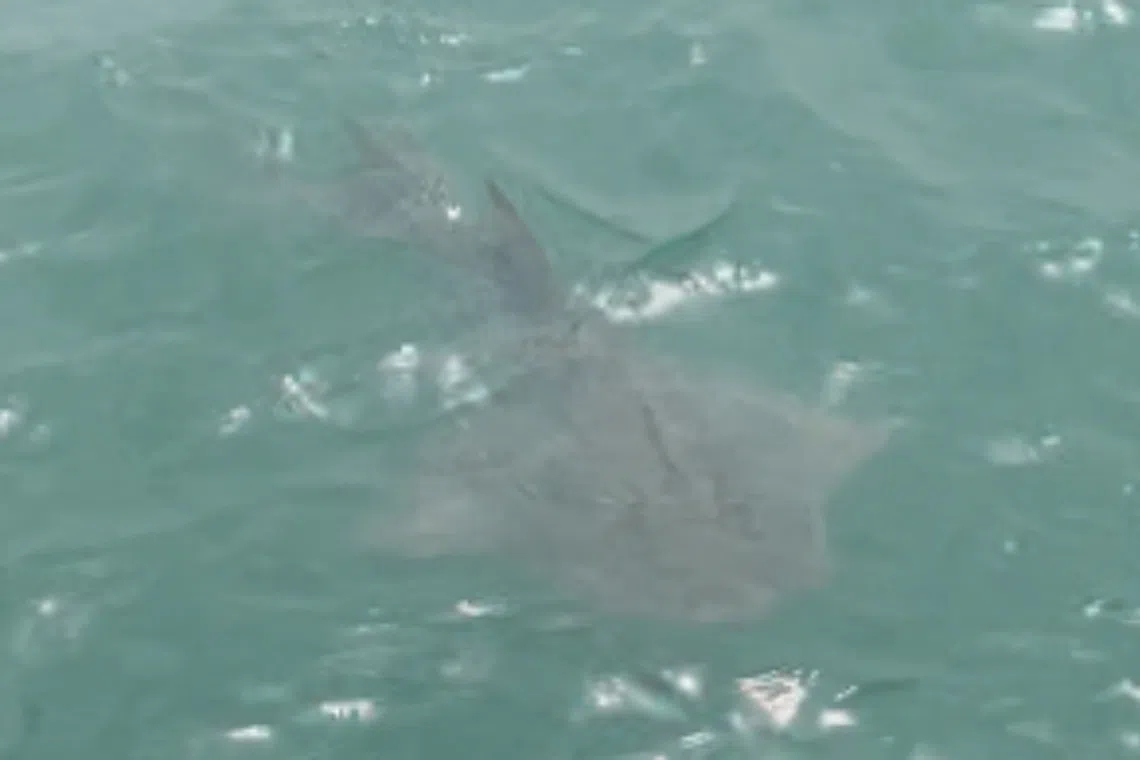
A critically endangered bowmouth guitarfish that surfaced off Bedok Jetty on Oct 29, 2022, was the first formal record of a sighting in Singapore in nearly 30 years.
Published Sep 14, 2026, 12:00 PM
Updated Sep 14, 2026, 12:00 PM
A critically endangered bowmouth guitarfish was recorded in Singapore's waters for the first time in nearly 30 years.
The species is genetically unique and faces threats like overfishing and habitat loss. Of the world’s jawed animals with backbones, it ranks as the most genetically unique lineage facing an extreme risk of extinction.
The record is part of a research project to understand the distribution of sharks and rays in the territorial waters of Singapore, as well as the impact of recreational fishing on these threatened animals.
SINGAPORE – The bowmouth guitarfish – a pet cause for billionaire Jeff Bezos and Hollywood actor Leonardo DiCaprio because it is critically endangered across the world – has been officially detected in Singapore waters after an absence of nearly 30 years.
Lee Kong Chian Natural History Museum, the only museum of its kind in Singapore, recently published a report of the sighting.
“We were ecstatic,” Maryam Kolakkodan, a research assistant at the National University of Singapore’s department of biological sciences who co-authored the Aug 31 report, told The Straits Times.
She recounted how the footage obtained from the social media user who posted the video captured the creature’s faint silhouette.
On Oct 29, 2022, anglers at Bedok Jetty had seen and filmed one of these creatures, estimated to be between 1.5m and 2m in length.
After cruising in the water for three to five minutes, the solitary fish swam away. This observation was documented by Kolakkodan along with her co-authors, marine biologist Zeehan Jaafar and Lin Jiayuan, co-founder of the Ichthyological Society of Singapore.
This is the first formal record of the bowmouth guitarfish since now-defunct Chinese-language newspaper Lianhe Wanbao reported in 1995 that a 1.83m-long specimen weighing about 40kg was caught in a shrimp net in the sea off Marine Parade .
The bowmouth guitarfish has been officially detected in Singapore waters after an absence of nearly 30 years. PHOTO: LISA OSHIAFI
The bowmouth guitarfish has been officially detected in Singapore waters after an absence of nearly 30 years.
The species is often dubbed the shark ray as it has a sleek, shark-like body, prominent dorsal fins and ray-like pectoral fins.
Among the world’s jawed animals with backbones, it ranks as the most genetically unique lineage facing an extreme risk of extinction. This is driven by wildlife trafficking, overfishing, habitat degradation and other threats.
A 2024 paper said the extinction of the bowmouth guitarfish could result in the loss of 88 million years of evolutionary history, as it is the only surviving species of the genus Rhina, a lineage of rays.
Internationally, the bowmouth guitarfish has received increasing conservation attention and is currently the focus of global protection and rewilding efforts by initiatives such as Shark Ray 360 and the Phoenix Species Project . The latter is backed by Jeff Bezos and Leonardo DiCaprio.
In June, the Singapore Oceanarium partnered the Taiwanese authorities to release a bowmouth guitarfish into its ancestral waters off Taiwan, making the oceanarium the first facility to breed, raise and release the animal.
The Aug 31 record shows that Singapore’s busy waters remain a corridor for critically endangered species such as the bowmouth guitarfish, Kolakkodan said.
The first captive-bred bowmouth guitarfish released into the waters off Taiwan. PHOTO: SINGAPORE OCEANARIUM
The first captive-bred bowmouth guitarfish released into the waters off Taiwan.
PHOTO: SINGAPORE OCEANARIUM
According to satellite-tagging efforts by the rewilding collective ReShark, bowmouth guitarfishes are known to travel more than 100km from their original locations, she added.
“Other studies have documented occurrences of this species in the open ocean, away from coastal waters,” Kolakkodan said. “These findings reiterate the interconnectivity of the seas and the importance of international collaboration. Protection across the distribution range will likely be a more effective conservation strategy than fragmented protection in singular areas alone for a transboundary species such as the bowmouth guitarfish.”
The Bedok Jetty record is part of a broader research project funded by Mandai Nature. It aims to understand the distribution of sharks and rays within the territorial waters of Singapore, as well as the impact of recreational fishing on these threatened animals.
Kolakkodan, who is analysing the project’s data, said: “Observations of angler catches over the years tell us that Singapore’s nearshore waters house a rich diversity of threatened marine taxa (a group of animals), including sharks and rays.”
Since 2022, the bowmouth guitarfish has apparently been spotted again in Singapore waters.
Bowmouth guitarfish at the Singapore Oceanarium on April 21. ST PHOTO: LIM YAOHUI
Bowmouth guitarfish at the Singapore Oceanarium on April 21.
ST PHOTO: LIM YAOHUI
Zeehan Jafaar, a senior lecturer at the NUS department of biological sciences, said that the team was alerted in August to a May 24 sighting of the marine animal.
That day, the fish was hooked by anglers fishing from a vessel and later released. The more recent sighting has not yet been officially recorded.
“Important sightings such as this are often shared by members of the public and are valuable in furthering our understanding of local biodiversity,” said Jaafar.
The team is seeking avid anglers for focus group interviews to share their experiences and thoughts on how to sustainably fish sharks and rays here.
Lin, who has been fishing for nearly two decades, said it was satisfying to formalise recent records of the species, citing other social media footage that the fish had been around over the past decade.
The Nanyang Technological University bioengineering student said: “Its presence in our waters warrants future research on this species, whether it is resident or whether it’s passing by and stopped for food, to better aid in conservation for both this species and marine fauna of Singapore.”
Members of the public who come across large marine animals in Singapore, such as dolphins, dugongs, turtles, sharks and rays, can report their sightings at public submission database MegMaLS at this website .
2022 年 10 月 29 日,一条极度濒危的弓口吉他鱼在勿洛码头附近出现,这是近 30 年来新加坡首次正式记录到这种鱼的踪迹。
发布于2026年9月14日下午12:00
更新于2026年9月14日中午12:00
近30年来,新加坡水域首次发现极度濒危的弓口吉他鱼。
该物种基因独特,面临过度捕捞和栖息地丧失等威胁。在世界有颌脊椎动物中,它是基因最独特、灭绝风险最高的物种之一。
该记录是新加坡一项研究项目的一部分,旨在了解新加坡领海内鲨鱼和鳐鱼的分布情况,以及休闲捕鱼对这些濒危动物的影响。
新加坡——弓口吉他鱼(一种在世界范围内极度濒危的鱼类,因此成为亿万富翁杰夫·贝佐斯和好莱坞演员莱昂纳多·迪卡普里奥的重点保护对象)在消失近30年后,已在新加坡水域被正式发现。
新加坡唯一的李光前自然历史博物馆最近发表了一篇关于此次目击事件的报告。
“我们欣喜若狂,”新加坡国立大学生物科学系的研究助理玛丽亚姆·科拉科丹(Maryam Kolakkodan)告诉《海峡时报》,她是 8 月 31 日报告的合著者。
她讲述了从发布视频的社交媒体用户那里获得的录像是如何捕捉到该生物模糊的轮廓的。
2022 年 10 月 29 日,勿洛码头的垂钓者看到并拍摄到其中一只生物,估计其长度在 1.5 米到 2 米之间。
在水中游弋了三到五分钟后,这条孤零零的鱼游走了。科拉科丹与她的合作者——海洋生物学家齐汉·贾法尔和新加坡鱼类学会联合创始人林嘉元——记录了这一观察结果。
这是自 1995 年已停刊的中文报纸《联合晚报》报道在马林百列附近海域的虾网中捕获一条长 1.83 米、重约 40 公斤的弓口吉他鱼以来,首次有正式记录。
阔别近30年后,弓口吉他鱼在新加坡水域被正式发现。照片:LISA OSHIAFI
阔别近30年后,弓口吉他鱼在新加坡水域被正式发现。
这种鱼常被称为鲨鱼鳐,因为它拥有光滑的、类似鲨鱼的身体、突出的背鳍和类似鳐鱼的胸鳍。
在世界有颌脊椎动物中,它是基因最独特的物种之一,面临着极高的灭绝风险。造成这种风险的原因包括野生动物走私、过度捕捞、栖息地退化以及其他威胁。
2024 年的一篇论文指出,弓口吉他鱼的灭绝可能导致 8800 万年的进化史的丧失,因为它是鳐鱼属(Rhina)中唯一幸存的物种。
在国际上,弓口吉他鱼的保护工作日益受到关注,目前已成为全球保护和野化工作的重点,相关项目包括“鲨鱼鳐鱼360”(Shark Ray 360)和“凤凰物种项目”(Phoenix Species Project)。后者由杰夫·贝佐斯和莱昂纳多·迪卡普里奥支持。
6 月,新加坡海洋馆与台湾当局合作,将一条弓口吉他鱼放生到台湾附近的原生水域,使该海洋馆成为第一个繁殖、饲养和放生这种动物的机构。
科拉科丹表示,8 月 31 日的记录显示,新加坡繁忙的水域仍然是弓口吉他鱼等极度濒危物种的迁徙通道。
首批人工繁殖的弓口吉他鱼被放流至台湾附近海域。图片:新加坡海洋馆
首批人工繁殖的弓口吉他鱼被放生到台湾附近海域。
图片来源:新加坡海洋馆
她补充说,根据野生化组织 ReShark 的卫星标记工作,弓口吉他鱼已知会从其原始栖息地游动超过 100 公里。
科拉科丹说:“其他研究也记录了这种鱼类在远离沿海水域的开阔海域的出现。这些发现再次强调了海洋的相互联系以及国际合作的重要性。对于像弓口吉他鱼这样的跨界物种来说,在整个分布范围内进行保护,可能比仅在单一区域进行零散的保护更为有效。”
勿洛码头的记录是万代自然基金会资助的一项更广泛研究项目的一部分。该项目旨在了解新加坡领海内鲨鱼和鳐鱼的分布情况,以及休闲捕鱼对这些濒危动物的影响。
负责分析该项目数据的科拉科丹表示:“多年来对垂钓者渔获的观察表明,新加坡近岸水域栖息着种类繁多的受威胁海洋生物(一群动物),包括鲨鱼和鳐鱼。”
自 2022 年以来,弓口吉他鱼似乎再次在新加坡水域被发现。
4月21日,新加坡海洋馆的弓口吉他鱼。(海峡时报摄影:林耀辉)
4月21日,新加坡海洋馆的弓口吉他鱼。
ST 照片:林耀辉
新加坡国立大学生物科学系高级讲师 Zeehan Jafaar 表示,该团队在 8 月份接到通知,称 5 月 24 日有人目击了这种海洋动物。
当天,这条鱼被乘船垂钓的钓鱼者钓到,之后被放生。最近一次发现这条鱼的记录尚未正式公布。
“像这样的重要目击事件通常会被公众分享,对于增进我们对当地生物多样性的了解非常有价值,”贾法尔说。
该团队正在寻找热衷垂钓的垂钓者进行焦点小组访谈,以分享他们关于如何在这里可持续地捕捞鲨鱼和鳐鱼的经验和想法。
林先生有近二十年的捕鱼经验,他说很高兴能正式记录到该物种的最新踪迹,并引用了其他社交媒体上的视频,证明这种鱼在过去十年中一直存在。
南洋理工大学生物工程系学生表示:“这种生物出现在我们的水域中,值得我们对该物种进行进一步研究,无论它是本地物种还是过境觅食的物种,以便更好地保护该物种和新加坡的海洋动物群。”
在新加坡遇到大型海洋动物(如海豚、儒艮、海龟、鲨鱼和鳐鱼)的公众,可以通过此网站的公共提交数据库 MegMaLS 报告他们的目击情况。