How Iranian, Russian arms makers shared a Belgrade trade fair hall伊朗和俄罗斯武器制造商如何共享贝尔格莱德贸易展厅
Iranian officials were furious that their large but remote booth got so little attention, as Russia's Rosoboronexport stall had no gear to show at all.
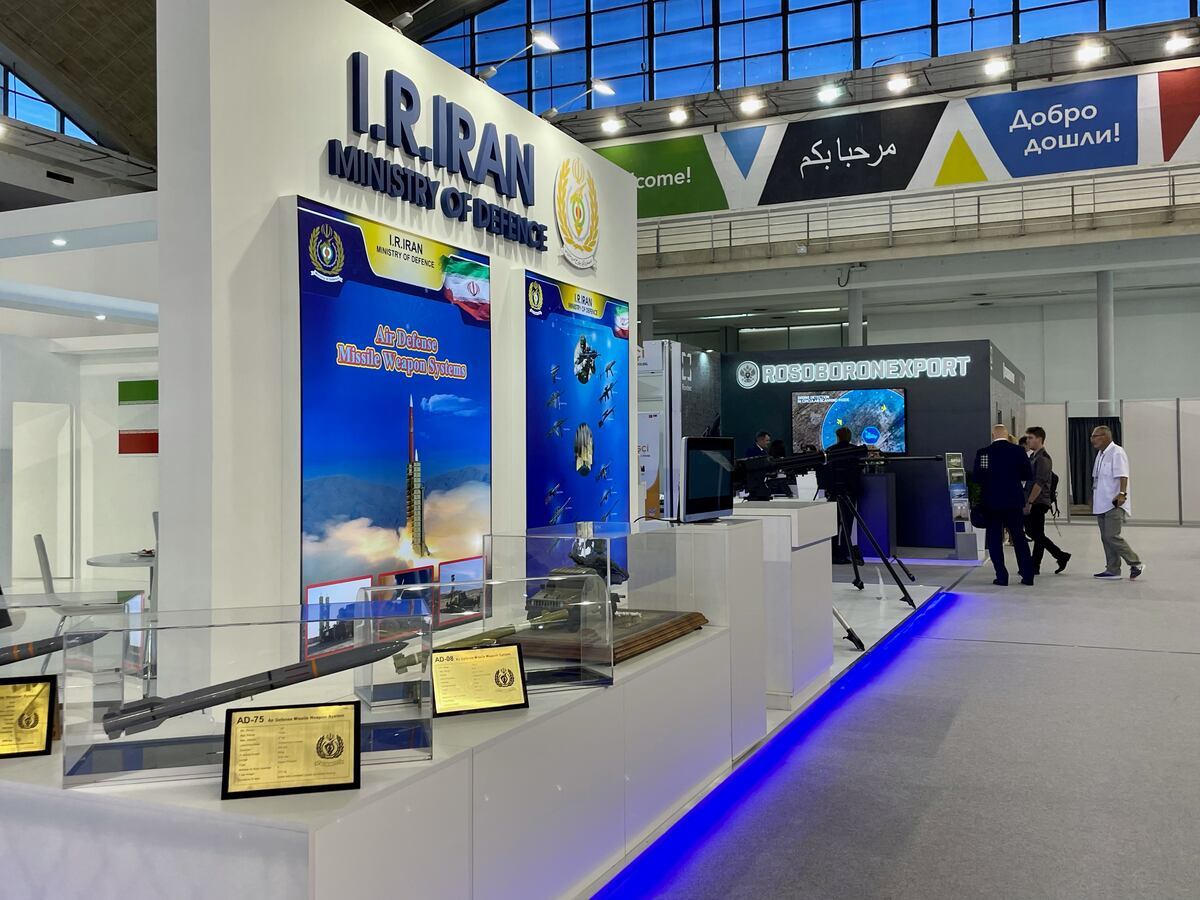
BELGRADE, Serbia — Iranian defense officials were livid at some of the organizers of the “Partner 23″ arms fair here about the placement of their colossal stand: Tucked away in a separate pavilion, shared primarily with Russia’s weapons export agency, who would come look at Tehran’s offerings of drones and missiles?
That was the gripe Iranian delegation members strongly voiced at a Serbian government-sponsored defense exhibition that brought together some of the West’s most prominent foes in Europe’s backyard.
The event, which ran Sept. 25-28, also featured large European contractors like Airbus, plus a smattering of other defense entities ranging from countries like Italy to Azerbaijan, making for an unusual grouping of political adversaries under the banner of selling weapons.
Placed center stage on Iran’s setup were anti-ship cruise missiles, air defense systems and small-scale prototypes of the M6, Karrar and Shahin drones. Models included the AD-75 air defense missile with a maximum range of 75 kilometers; the CM-35 anti-ship cruise missile with a 130 kg warhead; and Shahin vertical take-off and landing unmanned aerial system fitted with multi-rotor propellers by China-based company T-Motor.
The towering setup of 16 weapon systems dwarfed the neighboring stand of Rosoboronexport, whose sparse display suggested the delegation had come empty-handed. Some of the only visible items shown by the Russian group were a video of the Barrier-2, an electronic-scanning radar to detect drones, and a large picture of the Pantsir missile system.
This is at odds with what Rosoboronexport had said it would be showcasing in a statement released two days prior to the fair.
“Given the high interest of the world market in the unmanned aerial vehicles, the Orion-E and Orlan-30 reconnaissance drones will be on display at the company’s booth; it will also present the Su-35, MiG-35 fighters, Yak-130 combat trainer, and more to air force representatives,” Rosoboronexport stated on its website.
A Russian representative here blamed the meager showing on logistical problems in transporting the equipment to Belgrade.
Iran has helped supply Russia with ammunition and drones to support the invasion of Ukraine, as Moscow’s stocks are reportedly dwindling. Earlier this summer, the European Union imposed a new set of sanctions against Tehran that prohibits bloc companies from exporting drone parts to the repressive regime.
A Defense News reporter was told by fair organizers here that the layout of the event was arbitrary, and that the Russian and Iranian exhibitors were placed in a separate hall only because that space was newly added to the display space of an increasingly popular event.
The Iranians were still highly miffed, complaining that the isolation resulted in next to no visitors coming to see their systems.
In an outburst of anger on the second day of the event, Iranian delegates declared that their defense ministry perhaps wouldn’t have booked the space had they known about the layout. Contributing to their protest was the fact that for a scheduled meeting with an undisclosed Serbian company, the host-nation executives had not shown up.
According to the Iranians, Tehran’s shopping list included navigation systems for guided artillery. Commanders typically use those munitions for targeting military vehicles or high-value assets like command posts or reinforced structures.
Elisabeth Gosselin-Malo was a Europe correspondent for Defense News. She covers a wide range of topics related to military procurement and international security, and specializes in reporting on the aviation sector. She is based in Milan, Italy.
塞尔维亚贝尔格莱德——伊朗国防官员对“合作伙伴 23”武器展的一些组织者安排其庞大展位的位置感到非常愤怒:展位被安置在一个单独的展馆内,主要与俄罗斯武器出口机构共用,谁会来参观德黑兰提供的无人机和导弹呢?
在塞尔维亚政府赞助的国防展览会上,伊朗代表团成员强烈表达了这种不满。此次展览会汇聚了西方一些最主要的敌人,地点就在欧洲的后院。
此次活动于 9 月 25 日至 28 日举行,除了空客等大型欧洲承包商外,还有来自意大利、阿塞拜疆等国的其他一些国防实体参与其中,这使得政治对手们以出售武器为名聚集在一起显得不同寻常。
伊朗展台的重点是反舰巡航导弹、防空系统以及M6、卡拉尔和沙欣无人机的小型原型机。展出的型号包括最大射程75公里的AD-75防空导弹;配备130公斤弹头的CM-35反舰巡航导弹;以及由中国T-Motor公司制造的、配备多旋翼螺旋桨的沙欣垂直起降无人机系统。
16套武器系统组成的庞大阵列令邻近的俄罗斯国防出口公司展台相形见绌,后者寥寥无几的展品表明代表团此行空手而来。俄罗斯代表团展出的少数展品包括一段关于“屏障-2”电子扫描雷达(用于探测无人机)的视频,以及一张“铠甲”防空导弹系统的大幅图片。
这与俄罗斯国防出口公司在展会前两天发布的声明中所说的将要展示的内容相矛盾。
“鉴于世界市场对无人机的高度关注,公司将在展位上展出猎户座-E和猎户座-30侦察无人机;同时还将向空军代表展示苏-35、米格-35战斗机、雅克-130战斗教练机等产品,”俄罗斯国防出口公司在其网站上表示。
一位俄罗斯代表将此次惨淡的展览效果归咎于将设备运往贝尔格莱德的后勤问题。
据报道,由于莫斯科的弹药库存正在减少,伊朗已向俄罗斯提供弹药和无人机,以支持其入侵乌克兰。今年夏天早些时候,欧盟对德黑兰实施了一系列新的制裁,禁止欧盟成员国公司向这个专制政权出口无人机零部件。
《防务新闻》记者从展会组织者那里得知,展会的布局是随意安排的,俄罗斯和伊朗的参展商被安排在一个单独的展厅,仅仅是因为这个空间是这个越来越受欢迎的展会的展示空间中新增加的。
伊朗人仍然非常不满,抱怨说这种孤立状态导致几乎没有人来参观他们的系统。
在活动的第二天,伊朗代表们怒不可遏,他们声称,如果伊朗国防部事先知道场地布局,或许就不会预订这个场地。此外,原定与一家未公开名称的塞尔维亚公司举行的会议,东道国高管也未出席,这更加剧了他们的不满。
据伊朗方面称,德黑兰的采购清单中包括用于制导火炮的导航系统。指挥官通常使用这类弹药来打击军用车辆或指挥所、加固建筑等高价值目标。
伊丽莎白·戈斯林-马洛曾任《防务新闻》欧洲通讯员。她的报道涵盖军事采购和国际安全等广泛领域,尤其擅长航空领域的报道。她常驻意大利米兰。