Australian F-35 crews end their Asian exercise spree in Indonesia澳大利亚F-35战机机组人员在印度尼西亚结束了他们的亚洲系列演习。
Australian airmen also made stops in the Philippines and Japan to train with allied air forces in the region.
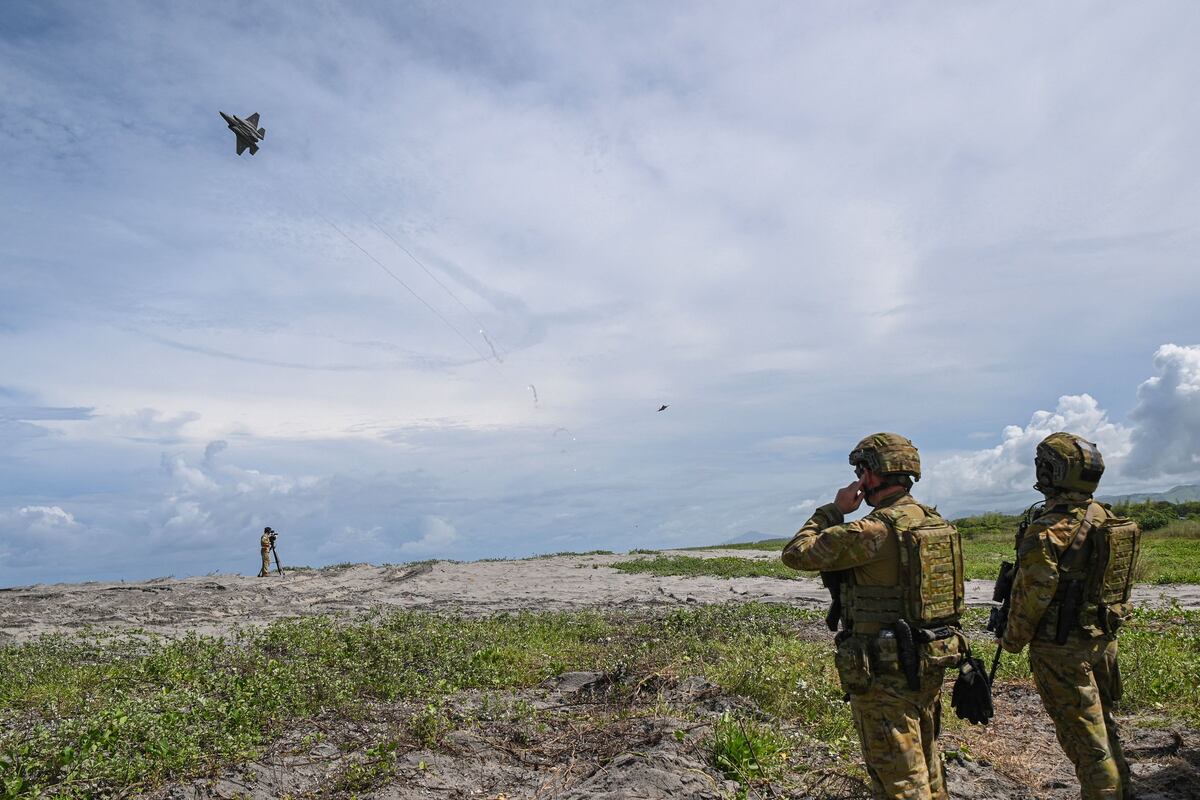
MELBOURNE, Australia — Australian F-35 fifth-generation stealth fighters are taking part in an exercise in Indonesia, on the last leg of a deployment that has seen the jets visit the Philippines , Japan and Indonesia for the first time.
The six Lockheed-Martin F-35A Lightning II Joint Strike Fighters from 75 Squadron of the Royal Australian Air Force, or RAAF, are currently taking part in Exercise Elang Ausindo with Indonesian Air Force Lockheed-Martin F-16 fighter jets at Manado on Indonesia’s North Sulawesi Island from Sept. 18 to Sept. 28.
The exercise will see Australian and Indonesian personnel and aircraft conduct air combat missions including offensive and defensive counter air missions; basic fighter maneuvers and air combat maneuvers and air-to-air refueling with an RAAF KC-30A multi-role tanker transport.
Squadron Leader Paul Anderton, an instructor-pilot with 75 Sqn, told Defense News that the exercise took a building-block approach to training, starting with one-versus-one air combat engagements before moving on to two-versus-one or two-versus-two training.
The engagements will then become more complex, with larger formations such as four-versus-four training dogfights.
However, Anderton said that the exercise was not just Australian jets going head-to-head with their Indonesian counterparts, but its aim also includes interoperability training with the Indonesian F-16s, flying in mixed formations and air-to-air refueling.
“There’s a heavy focus on the bilateral side of the aviator level engagement and that is us integrating with the Indonesian F-16s and providing joint training to each other,” he said.
The Australian F-35s had come to Indonesia from Komatsu, Japan, where they participated in Exercise Bushido Guardian with the Japan Air Self-Defense Force, or JASDF, Sept. 4-15.
According to Wing Commander Tony Parker, the commanding officer of 75 Sqn, Bushido Guardian was conducted roughly along the same lines as Elang Ausindo with the Indonesians. However, he noted that there were several key differences, with a key one being that the JASDF was also an F-35As operator.
The drill in Japan involved both services using the F-35-specific Multifunction Advanced Data Link, or MADL, to share information. “This was a first for us, for both nations, and was a was a really successful activity,” said Parker. “We were able to operate on data links across both platforms to achieve mutual effects within their operating airspace.”
The JASDF also participated at Bushido Guardian with its Mitsubishi F-2 multirole fighters and F-16 interceptors, and the larger number of aircraft enabled the participants to organize the missions into larger aircraft packages, deepening interoperability between the RAAF and the JASDF.
Komatsu is also the home of the JASDF’s Tactical Fighter Training Group, which flies F-15s in the dedicated role of adversary aircraft. These played the role of enemy forces Air during Bushido Guardian, with other JASDF or RAAF participants taking turns fighting alongside them as adversary aircraft.
“It was pretty common practice to have Australian F-35s on both Blue and Red Air,” Parker said referring to friendly and enemy formations. “It was the same for Japanese F-35s and their F-15s. The aggressors were playing their aggressor role, and being particularly well trained to being aggressors, they often did fill that function,” Parker added.
Parker also spoke about the reliability of his jets throughout the deployment, noting that there was only one instance of a jet not being able to fulfill a mission due to maintenance problems.
“The deployment was very successful from a maintenance perspective and very reliable as a platform. We will be walking away having operated this highly technical platform on the road in Asia with limited support for five weeks, and that has given us a great sense of confidence in our ability to do that.”
Mike Yeo is the Asia correspondent for Defense News.
澳大利亚墨尔本——澳大利亚的F-35第五代隐形战斗机正在印度尼西亚参加演习,这是此次部署的最后阶段,这些战机此前已首次访问了菲律宾、日本和印度尼西亚。
澳大利亚皇家空军第 75 中队的 6 架洛克希德·马丁 F-35A 闪电 II 联合攻击战斗机目前正在印度尼西亚北苏拉威西岛的万鸦老与印度尼西亚空军的洛克希德·马丁 F-16 战斗机一起参加“Elang Ausindo”联合演习,演习时间为 9 月 18 日至 9 月 28 日。
此次演习将包括澳大利亚和印度尼西亚的人员和飞机执行空中作战任务,包括进攻和防御性反空袭任务;基本战斗机机动和空中作战机动,以及与澳大利亚皇家空军 KC-30A 多用途加油运输机进行空中加油。
第 75 中队的教官兼飞行员保罗·安德顿中队长告诉《防务新闻》,此次演习采取了循序渐进的训练方法,先进行一对一的空战,然后再进行二对一或二对二的训练。
随后,交战将变得更加复杂,出现更大规模的编队,例如四对四的训练空战。
然而,安德顿表示,此次演习不仅仅是澳大利亚战机与印尼战机正面交锋,其目的还包括与印尼F-16战机进行互操作性训练,进行混合编队飞行和空中加油。
他说:“我们非常重视飞行员层面的双边合作,也就是与印尼的F-16战机进行整合,并互相提供联合训练。”
澳大利亚的 F-35 战机从日本小松来到印度尼西亚,它们于 9 月 4 日至 15 日与日本航空自卫队 (JASDF) 一起参加了“武士道守护者”演习。
据第75中队指挥官托尼·帕克中校称,“武士道守护者”演习的实施方式与印尼的“Elang Ausindo”演习大致相同。但他指出,两者之间存在一些关键差异,其中一个重要区别是日本航空自卫队也是F-35A战斗机的用户。
在日本的演习中,美军和空军都使用了F-35专用的多功能先进数据链(MADL)进行信息共享。“这对我们两国来说都是第一次,而且非常成功,”帕克说。“我们能够跨平台使用数据链,在各自的作战空域内实现相互配合。”
日本航空自卫队也携三菱F-2多用途战斗机和F-16截击机参加了武士道卫士演习,更多的飞机使参与者能够将任务组织成更大的飞机编队,加深了澳大利亚皇家空军和日本航空自卫队之间的互操作性。
小松也是日本航空自卫队战术战斗机训练大队的驻地,该大队专门驾驶F-15战斗机扮演假想敌飞机的角色。在“武士道守护者”演习中,这些F-15战斗机扮演了敌方空军的角色,其他日本航空自卫队或澳大利亚皇家空军的参演人员则轮流作为假想敌飞机与它们并肩作战。
帕克说:“澳大利亚的F-35战机同时出现在蓝方和红方阵地上是很常见的做法。”他指的是友军和敌军的编队。“日本的F-35和F-15战机也是如此。假想敌扮演的是假想敌的角色,而且由于他们接受过专门的假想敌训练,所以往往能够很好地完成这项任务。”帕克补充道。
帕克还谈到了他的战机在整个部署期间的可靠性,并指出只有一架战机因维护问题而无法完成任务。
“从维护角度来看,此次部署非常成功,平台本身也非常可靠。我们将在亚洲地区,在有限的支持下,成功运营这个技术含量极高的平台长达五周,这让我们对自身的能力充满信心。”
Mike Yeo 是《防务新闻》的亚洲通讯员。