What’s preventing Taiwan from preparing for potential war?是什么阻止了台湾为可能发生的战争做好准备?
Taiwan’s military is not yet “optimally manned, trained, equipped and motivated to defend against an attack” by China on the self-ruled island, and efforts at defense reform face obstacles from institutional opposition from senior officers and a lack of time.
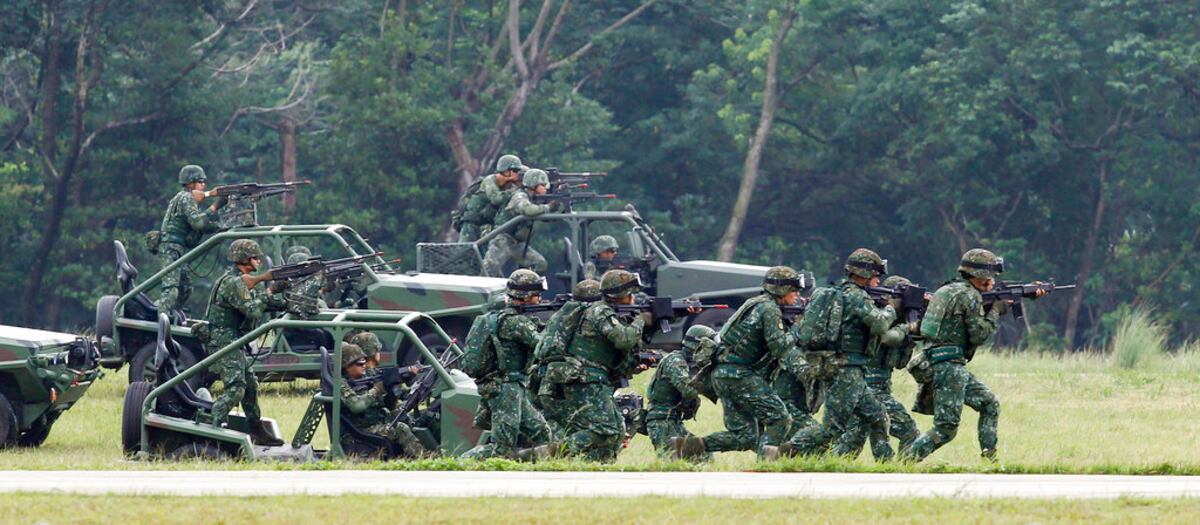
MELBOURNE, Australia — Taiwan’s military is not yet “optimally manned, trained, equipped and motivated to defend against an attack” by China on the self-ruled island, and efforts at defense reform face obstacles from institutional opposition from senior officers and a lack of time.
This is according to Michael Hunzeker, assistant professor at George Mason University’s School of Policy and Government, who testified to the congressional U.S.-China Economic and Security Review Commission. The hearing was held last month to discuss ways to deter Chinese aggression against Taiwan, which China considers a rogue province and has vowed to take back by force if necessary.
Hunzeker added that Taiwan’s military needs to focus on countering the threat of a full-scale invasion by the Chinese People’s Liberation Army vis-a-vis “sub-invasion” scenarios that would see large-scale missile strikes, blockades or the seizure of Taiwanese islands located in the Taiwan Strait separating the two countries.
He argued that the defensive capabilities and preparations that will help Taiwan defend against a full-scale invasion will also be useful against “lesser” threats rather than serving as a distraction against them.
However, he noted, Taiwan’s military is experiencing several shortfalls in active and reserve personnel numbers, equipment, doctrine, and training. For example, the 153,000 personnel in Taiwan’s Army, Air Force, Navy and Marine Corps represent roughly 80 percent of its authorized end strength, with this percentage falling to 60 percent in its front-line units as the military seeks to transition away from conscription and into an all-volunteer force.
And while its equipment numbers look imposing, supply and maintenance issues as well as the age of some of Taiwan’s platforms mean availability rates are low, potentially affecting training in peacetime and effectiveness in conflict. Even worse for the armed forces is the obsolescence some of those platforms, an issue exacerbated by Taiwan having to regularly scramble aircraft and maritime vessels to investigate Chinese military activity around the island.
Meanwhile, Taiwan’s military doctrine for countering a Chinese invasion calls for a symmetric response, therefore shaping its force posture and acquisition of expensive and high-end platforms, which is “high on prestige but of limited utility in an actual conflict,” Hunzeker warned. This is particularly the case, he added, as the People’s Liberation Army has a qualitative and quantitative edge over Taiwan’s military.
In addition, Taiwan’s conscripts and reserves leave much to be desired, with the former spending too little of their 16-week service on combat training, he said.
Nevertheless, Hunzeker noted, the Taiwanese government under President Tsai Ing-wen has introduced a series of reforms for the military. Known as the Overall Defense Concept, or ODC, it seeks to address many of the aforementioned shortfalls and adjust the military’s posture to a multilayered, asymmetric force .
But while the ODC is “more appropriate to Taiwan’s threat environment,” its implementation is facing opposition from military officers and officials in the Defense Ministry, some of which are veterans, according to the expert. He suggested this is driven by “interpersonal animosity, principled disagreement or bureaucratic inertia.”
Hunzeker also questioned whether the ODC will take hold at all, with the current administration seemingly “unwilling or unable” to compel the ministry to implement it, partly due the ODC proposing politically sensitive moves, such as a return of full conscription.
Even if the ODC is implemented, he fears time is against Taiwan’s side, with weapons acquisition and development plans years away from delivery. He said even more time is needed to change doctrine, training, logistics and sustainment systems, and the military’s culture.
Mike Yeo is the Asia correspondent for Defense News.
澳大利亚墨尔本——台湾的军队尚未达到“最佳人员配备、训练、装备和士气来抵御中国对这个自治岛屿的攻击”,国防改革的努力也面临着来自高级军官的体制性反对和时间不足的阻碍。
这是乔治·梅森大学政策与政府学院助理教授迈克尔·亨泽克(Michael Hunzeker)的说法。他曾向美国国会美中经济与安全审查委员会作证。该听证会于上月举行,旨在探讨如何遏制中国对台湾的侵略行为。中国视台湾为叛离省份,并誓言必要时将以武力收复台湾。
亨泽克补充说,台湾军方需要集中精力应对中国人民解放军全面入侵的威胁,而不是应对“次级入侵”情景,后者可能导致大规模导弹袭击、封锁或占领位于分隔两国之间的台湾海峡的台湾岛屿。
他认为,有助于台湾抵御全面入侵的防御能力和准备工作,对于应对“较小”的威胁也同样有用,而不是分散台湾对较小威胁的注意力。
然而,他指出,台湾军队在现役和预备役人员数量、装备、作战理论和训练方面都存在诸多不足。例如,台湾陆军、空军、海军和海军陆战队共有15.3万名人员,约占其核定编制的80%,而随着军队寻求从义务兵役制过渡到全志愿兵役制,一线部队的核定编制比例已降至60%。
尽管台湾的装备数量看起来相当可观,但由于供应和维护问题,以及部分装备平台的老旧,其可用率较低,这可能会影响和平时期的训练和冲突中的作战效能。更糟糕的是,部分装备平台已经过时,而台湾不得不经常紧急出动飞机和舰艇调查岛屿周边的中国军事活动,这进一步加剧了这一问题。
与此同时,台湾应对中国入侵的军事理论要求采取对等回应,因此其兵力部署和昂贵高端装备的采购“虽然声望很高,但在实际冲突中作用有限”,亨泽克警告说。他补充道,尤其值得注意的是,解放军在质量和数量上都优于台湾军队。
此外,他还表示,台湾的义务兵和预备役人员还有很多不足之处,前者在16周的服役期内用于战斗训练的时间太少。
然而,亨泽克指出,蔡英文总统领导的台湾政府已经推出了一系列军事改革。这些改革被称为“整体防卫理念”(ODC),旨在解决上述诸多不足,并将台湾军队的态势调整为多层次、非对称作战力量。
但这位专家表示,虽然《军民防务准则》“更适合台湾的威胁环境”,但其实施却遭到军方官员和国防部内部人士的反对,其中一些人还是退伍军人。他认为,这种反对是“人际敌意、原则性分歧或官僚主义惰性”造成的。
洪泽克尔还质疑《公民义务发展法案》(ODC)是否能够真正实施,因为现任政府似乎“不愿或不能”强迫该部执行该法案,部分原因是《公民义务发展法案》提出了一些政治敏感的举措,例如恢复全面征兵制。
即便《作战发展准则》得以实施,他担心时间对台湾不利,因为武器采购和研发计划距离交付还有数年之久。他还表示,改变作战理论、训练、后勤保障体系以及军队文化,都需要更多时间。
Mike Yeo 是《防务新闻》的亚洲通讯员。