The US has several options to counter Iranian mines. These are some key assets.美国有多种应对伊朗地雷的方案。以下是一些关键措施。
The U.S. Navy decommissioned its only four minesweepers in the Middle East last year, but still maintains other counter-mine capabilities it can deploy.
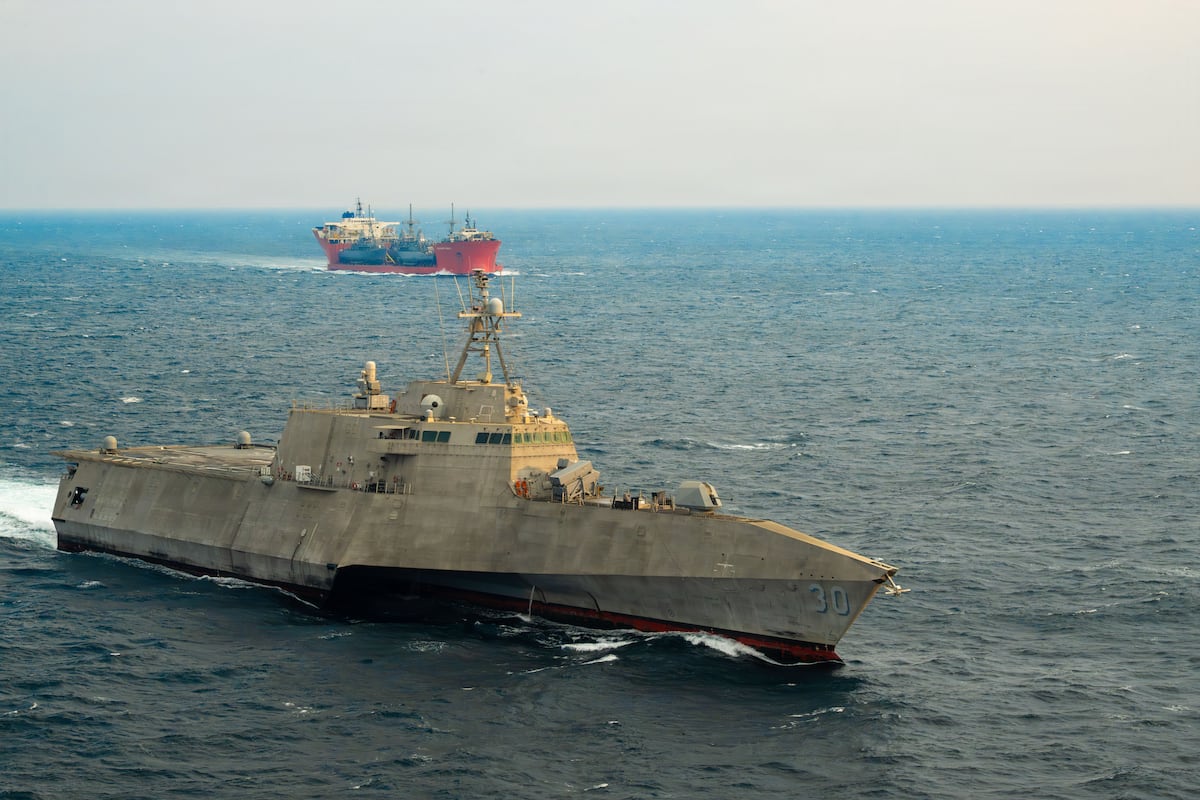
The U.S. military possesses several capabilities that it could wield to combat naval mine warfare in the Strait of Hormuz.
Iran’s Islamic Revolutionary Guard Corps Navy views the maritime weapon as a key pillar of its military strategy, according to a 2017 Office of Naval Intelligence report, and reportedly began laying mines in the sea passage last week.
Defense Secretary Pete Hegseth said in a Pentagon briefing Friday, however, that there was “no clear evidence” of mines in the strait.
Adm. Brad Cooper, head of U.S. Central Command, said Monday that U.S. forces destroyed storage bunkers for naval mines during a U.S. strike on military targets on Iran’s oil export hub, Kharg Island, on Friday. U.S. forces also destroyed 16 Iranian minelayers last week, according to CENTCOM.
Iran is estimated to possess roughly 6,000 mines, according to a congressional report published Wednesday. The stockpile may include limpet mines, which are typically attached to a ship manually by a diver; moored mines, which float below the water’s surface and are tethered to the seabed; bottom mines that rest on the seabed; and drifting mines, which float above the water’s surface and detonate upon contact.
Here’s a look at the U.S. Navy’s arsenal of minesweepers, littoral combat ships equipped with counter-mine capabilities and helicopters outfitted with anti-mine technology.
Avenger-class minesweepers
The Navy currently has four Avenger-class mine countermeasures ships stationed in Sasebo, Japan, that it could forward deploy to the Middle East in support of Operation Epic Fury if necessary.
The service commissioned 14 Avenger-class minesweepers beginning in the 1980s, but has since retired nearly all of them.
The service had four deployable minesweepers stationed in Bahrain up until 2025, but they were decommissioned and replaced with littoral combat ships equipped with minesweeping and mine-hunting capabilities. Each of the minesweepers decommissioned had served for over 30 years.
These vessels, which utilize sonar and tethered remote operating vehicles to identify mines beneath the water’s surface, were used during the Gulf War to destroy over 1,000 mines off of Kuwait.
They sweep and destroy mines by detonating them with an acoustic device that emits a noise meant to trigger sound-sensitive mines or with an electromagnetic tool that emits an electromagnetic field to trick magnetically induced mines into exploding.
They also drag cables and cutters behind them to intercept and sever the tethers attached to moored mines. Once the tether is cut, the mine floats to the top and is destroyed.
Minesweepers are constructed of wood and fiberglass in order to produce a nonmagnetic signature and low acoustic footprint that will not trigger mines to explode, allowing the vessels to operate inside and near a mine-threat zone.
Minesweepers also host two .50-caliber machine guns and two Mk 19 grenade launchers.
An unmanned surface vehicle is craned aboard the USS Canberra as a part of the first embarkation of the MCM mission package, April 23, 2024. (MC1 Vance Hand/U.S. Navy)
Independence-class littoral combat ships
The Navy has sought to modernize its minesweeping capabilities by rotating out its aging minesweepers in Bahrain for Independence-class littoral combat ships uniquely fitted with a mine countermeasures mission package .
The USS Canberra was the first LCS with the MCM mission package to arrive in the Middle East on May 22, 2025. The USS Santa Barbara and USS Tulsa, two other littoral combat ships with the MCM mission package, joined it shortly thereafter.
All three are homeported in Bahrain.
As of Monday, the USS Canberra was operating in the Indian Ocean, parts of which fall under the U.S. 5th Fleet area of responsibility, the U.S. 5th Fleet told Military Times in an emailed statement.
The USS Santa Barbara and USS Tulsa were conducting brief logistical stops in Malaysia, according to the U.S. 5th Fleet.
“U.S. forces routinely make port calls in Malaysia as part of our operations,” the statement read.
The MCM mission package is used exclusively by Independence-class littoral combat ships.
Littoral combat ships are made of aluminum and do not possess the same unique ship architecture as the nondetectable minesweepers, and as a result, they can only operate outside a mine-threat zone.
The LCS employs unmanned surface and underwater vehicles to travel into an area where mines have been laid to discover and destroy the mines.
These unmanned vessels utilize the AN/AQS-20 mine-hunting sonar system, which is towed and uses sensors to pinpoint the location of bottom mines and moored mines.
There is also the unmanned influence sweep system , which provides common unmanned surface vehicles aboard the LCS with the ability to sweep or detonate mines through a magnetic sweep cable that emits a magnetic field or a towed acoustic device that emits sound.
The unmanned vehicle moves along a predetermined route but sends camera footage and radar readings back to a remote operator who can steer the vehicle away from obstacles underwater.
The littoral combat ships with the MCM mission package have yet to be deployed in combat.
The ships have a noticeably upgraded weapons package, compared to the Avenger-class mine countermeasures ships, including a 57mm MK-110 gun system, SeaRAM self-defense system and .50-caliber machine guns.
The Independence-class littoral combat ship’s MCM mission package includes the aerial capabilities of the Sikorsky MH-60S Seahawk helicopter, which can deploy from the LCS to assist with mine hunting and minesweeping.
These helicopters are equipped with the AN/AES-1 Airborne Laser Mine Detection System, which detects floating and near-surface moored mines, as well as the AN/ASQ-235 Airborne Mine-Neutralization System, which sends an expendable unmanned underwater vehicle to intercept and destroy a mine.
Prior to the MCM mission package, Sikorsky’s MH-53E Sea Dragon helicopter served as the Navy’s main counter-mine aircraft, which was deployed during the Gulf War to help destroy mines and clear shipping lanes in the Persian Gulf.
The MH-53E uses side-scan AQS-14A mine-hunting sonar to identify mines and can tow the Mark 105 Hydrofoil Magnetic Minesweeping Sled and the Mk-103 mechanical minesweeping system to destroy mines.
The helicopter is currently out of production, with 28 aircraft in operation, according to the Naval Air Systems Command website.
The Navy is in the process of “evaluating its requirement” for future airborne mine countermeasures missions after 2025, the website states.
Riley Ceder is a Navy reporter at Military Times, where he covers issues directly affecting service members and their families, as well as breaking news.
美国军方拥有多种能力,可以用来打击霍尔木兹海峡的水雷战。
根据美国海军情报局 2017 年的一份报告,伊朗伊斯兰革命卫队海军将海上武器视为其军事战略的关键支柱,并据报道已于上周开始在该海道布雷。
然而,国防部长皮特·赫格塞斯在周五五角大楼的简报会上表示,没有“明确证据”表明海峡中存在水雷。
美国中央司令部司令布拉德·库珀海军上将周一表示,美军上周五对伊朗石油出口枢纽哈尔格岛的军事目标发动空袭,摧毁了该岛的海军水雷储存库。据中央司令部称,美军上周还摧毁了16艘伊朗布雷舰。
根据周三公布的一份国会报告,伊朗估计拥有约6000枚水雷。这些水雷可能包括:通常由潜水员手动安装在船上的吸附式水雷;漂浮在水面以下并用绳索系泊在海底的水雷;沉底水雷;以及漂浮在水面以上、接触水面后引爆的漂流水雷。
下面让我们来看看美国海军的扫雷舰、配备反水雷能力的濒海战斗舰以及配备反水雷技术的直升机。
复仇者级扫雷器
目前,日本海军在日本佐世保驻扎了四艘复仇者级扫雷舰,如有必要,可以将其前沿部署到中东,以支援“史诗狂怒行动”。
该海军从 20 世纪 80 年代开始建造了 14 艘复仇者级扫雷舰,但此后几乎全部退役。
该海军在巴林驻扎了四艘可部署的扫雷舰,直至2025年。这些扫雷舰已退役,并被配备扫雷和猎雷能力的濒海战斗舰所取代。每艘退役的扫雷舰服役时间均超过30年。
这些船只利用声呐和系绳遥控潜水器来识别水下水雷,在海湾战争期间曾用于摧毁科威特附近海域的 1000 多枚水雷。
他们通过声波装置引爆地雷来清除和摧毁地雷,这种装置会发出一种旨在触发声敏地雷的噪音;或者通过电磁工具发射电磁场来诱使磁感应地雷爆炸。
他们还会拖着缆绳和切割器,拦截并切断系泊水雷的系缆。系缆切断后,水雷就会浮到水面并被摧毁。
扫雷艇采用木材和玻璃纤维建造,以产生非磁性特征和低声学特征,从而不会引爆水雷,使船舶能够在水雷威胁区内和附近作业。
扫雷艇还配备两挺 .50 口径机枪和两具 Mk 19 榴弹发射器。
2024年4月23日,一艘无人水面艇被吊装到“堪培拉”号两栖攻击舰上,这是水雷对抗任务包首次装载的一部分。(MC1 Vance Hand/美国海军)
独立级濒海战斗舰
海军一直致力于通过轮换巴林老旧的扫雷舰,换装配备有水雷对抗任务包的独立级濒海战斗舰,来实现扫雷能力的现代化。
2025 年 5 月 22 日,堪培拉号濒海战斗舰成为第一艘搭载水雷对抗任务包抵达中东的濒海战斗舰。随后不久,圣巴巴拉号和塔尔萨号这两艘搭载水雷对抗任务包的濒海战斗舰也加入了它的行列。
这三架飞机的母港都在巴林。
截至周一,美国海军“堪培拉”号军舰正在印度洋执行任务,而印度洋的部分海域属于美国第五舰队的责任区。美国第五舰队在一份电子邮件声明中告诉《军事时报》。
据美国第五舰队称,圣巴巴拉号和塔尔萨号军舰在马来西亚进行了短暂的后勤补给停靠。
声明中写道:“作为我们军事行动的一部分,美军会定期访问马来西亚的港口。”
MCM任务包仅供独立级濒海战斗舰使用。
近海战斗舰由铝制成,并不具备与隐形扫雷舰相同的独特舰船结构,因此,它们只能在水雷威胁区之外作业。
LCS 使用无人水面和水下航行器进入布设水雷的区域,以发现和摧毁水雷。
这些无人船艇利用 AN/AQS-20 扫雷声呐系统,该系统采用拖曳式设计,利用传感器精确定位水雷和系泊水雷的位置。
还有无人影响扫雷系统,该系统使濒海战斗舰上常见的无人水面舰艇能够通过发射磁场的磁力扫雷电缆或发射声音的拖曳式声学装置来扫雷或引爆水雷。
无人驾驶潜水器沿着预定路线移动,但会将摄像头拍摄的画面和雷达读数发送回远程操作员,远程操作员可以引导潜水器避开水下障碍物。
配备水雷对抗任务包的濒海战斗舰尚未投入实战。
与复仇者级扫雷舰相比,这些舰艇的武器装备明显升级,包括57毫米MK-110炮系统、SeaRAM自卫系统和.50口径机枪。
独立级濒海战斗舰的扫雷任务包包括西科斯基 MH-60S 海鹰直升机的空中作战能力,该直升机可从濒海战斗舰上部署,协助进行猎雷和扫雷作业。
这些直升机配备了 AN/AES-1 机载激光水雷探测系统,可以探测漂浮水雷和近水面系泊水雷;以及 AN/ASQ-235 机载水雷中和系统,该系统会派遣一次性无人水下航行器拦截并摧毁水雷。
在 MCM 任务包出现之前,西科斯基的 MH-53E 海龙直升机是海军的主要反水雷飞机,在海湾战争期间被部署用于帮助摧毁波斯湾的水雷和清理航道。
MH-53E 使用侧扫 AQS-14A 扫雷声呐来识别水雷,并可拖曳 Mark 105 水翼磁性扫雷滑橇和 Mk-103 机械扫雷系统来摧毁水雷。
据美国海军航空系统司令部网站显示,该型直升机目前已停产,目前有 28 架飞机在役。
该网站称,海军正在“评估其在 2025 年后未来空中扫雷任务的需求”。
Riley Ceder 是《军事时报》的海军记者,他负责报道直接影响军人及其家属的问题以及突发新闻。