Lockheed boosts bet on Skunk Works’ Vectis stealth drone洛克希德·马丁公司加大对臭鼬工厂Vectis隐形无人机的投资
Lockheed now plans to build five Vectis prototypes, with the first on track to fly in 2027.
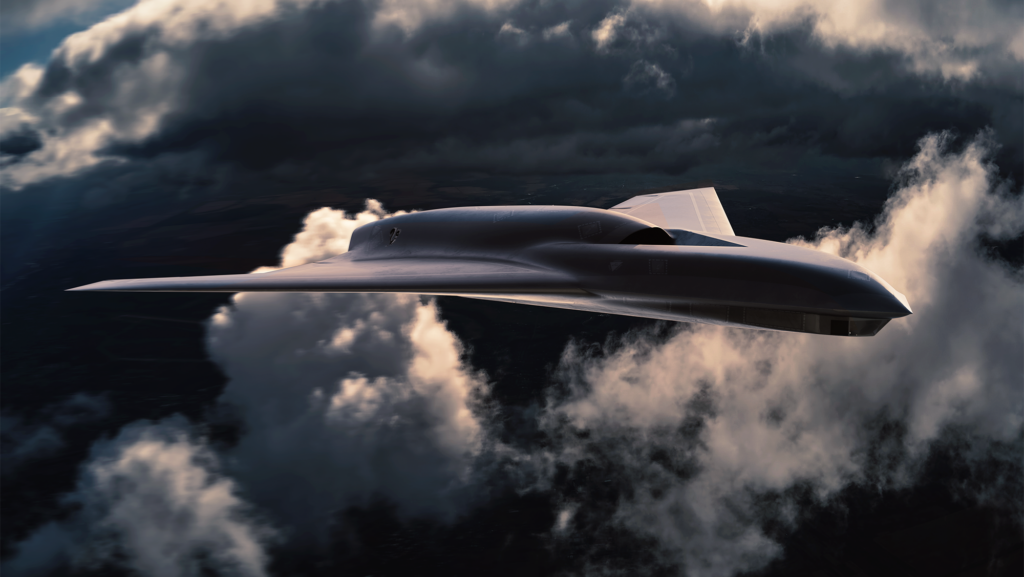
An artist's rendering of the Vectis drone. (Lockheed Martin Skunk Works)
NATIONAL HARBOR, Md. — Lockheed Martin is doubling down on its internal investments for its Vectis stealth drone, announcing today that the company will build an additional four prototypes along with the one currently in production.
The additional aircraft will be used to accelerate testing and validate production processes, said Ron Fehlen, who runs Lockheed’s Skunk Works advanced development division.
“Development work on those additional aircraft is already underway, and we’ll have more specifics to share soon,” he said.
Fehlen added the company will “build and we will fly these four vehicles even more quickly” than the first prototype, which was announced last year and is set to fly by the end of 2027.
Vectis will be center stage for Lockheed this week at the Association of the Air and Space Force conference, with the company showcasing a full scale model of the drone on the show floor.
Lockheed has described Vectis as a large “Group 5” stealth drone, with flexibility as its major selling point. It is designed to be adaptable to multiple mission sets — including air-to-air, air-to-ground and ISR — with payloads and mission systems that can be customized for the customer.
The world’s largest defense company is betting big on Vectis. The company won’t disclose the size of its investment, and Fehlen was tightlipped when asked about potential customers for the drone.
“There is no reason to say, ‘Well, it’s one customer or another,’” he said.
However, when asked whether Lockheed could offer Vectis for the Mass Modular Aircraft program — which would perform the same long endurance ISR and strike mission as the MQ-9 Reaper — Fehlen said “the mission is a little different” and that Vectis is more aligned with efforts to field Collaborative Combat Aircraft, or drones that would partner with fighter jets.
Lockheed is targeting unit costs “to be [at] the CCA competitive price,” he said. (For the first increment of the CCA program, which was won by General Atomics and Anduril this year, the Air Force settled on a $20 million per aircraft cost target.)
With the full scale Vectis model clearly visible in the AFA exhibit hall, Lockheed is releasing several new technical specifications. The tailless aircraft is about 34 feet long, with a wingspan of about 38 feet, making it about as long as an MQ-9 Reaper with a similar wingspan of an F-35.
Fehlen also highlighted the submerged inlet on the top of the aircraft, stating that it helps to reduce drag and prevent debris from being sucked into the aircraft — a boon for maintainers having to upkeep the aircraft if it were to be deployed to an austere environment.
Production of the first prototype is currently ongoing, with Lockheed showing reporters multiple photos of the airframe being assembled.
“How fast are we really going? This team, when kicked off, took a design on a napkin … and then two months later, they were in the wind tunnel validating the design,” he said. “We had the first digital build in six months, and the first part release in eight months.”
The company is using a technique called “minimal tooling determinate assembly” to simplify the process of manufacturing the airframe and cut costs, with Fehlen likening the process to putting together furniture from Ikea.
“It’s a technique that really enables an increased level of affordability and speed through really reducing the amount of touch labor required and increasing the first pass yield,” he said. “We’ve seen, in many cases, an 80 percent reduction in labor hours to build up the aircraft itself.”
The lower wing skin of the first Vectis prototype. (Lockheed Martin Skunk Works)
这是艺术家绘制的Vectis无人机效果图。(洛克希德·马丁公司臭鼬工厂)
马里兰州国家港——洛克希德·马丁公司今天宣布,将加倍投资其 Vectis 隐形无人机的内部研发,除了目前正在生产的一架原型机外,还将再生产四架原型机。
洛克希德·马丁公司臭鼬工厂先进研发部门负责人罗恩·费伦表示,新增的飞机将用于加快测试和验证生产流程。
他说:“这些额外飞机的研发工作已经在进行中,我们很快就会公布更多细节。”
费伦补充说,该公司将“以比第一架原型机更快的速度制造并试飞这四架飞行器”,第一架原型机于去年宣布,预计将于 2027 年底试飞。
本周,Vectis 将成为洛克希德公司在空军和太空部队协会会议上的焦点,该公司将在展厅展示该无人机的全尺寸模型。
洛克希德·马丁公司将Vectis描述为一款大型“第五类”隐形无人机,其主要卖点是灵活性。该无人机设计用于执行多种任务,包括空对空、空对地和情报、监视与侦察(ISR),其有效载荷和任务系统可根据客户需求进行定制。
全球最大的国防公司对Vectis寄予厚望。该公司拒绝透露投资规模,而当被问及无人机的潜在客户时,Fehlen也守口如瓶。
他说:“没有理由说,‘嗯,这是某个顾客的问题’。”
然而,当被问及洛克希德公司是否可以为大规模模块化飞机项目提供 Vectis 无人机(该项目将执行与 MQ-9“死神”无人机相同的长时间 ISR 和打击任务)时,费伦表示“任务略有不同”,Vectis 更适合部署协同作战飞机,或者与战斗机协同作战的无人机。
他说,洛克希德的目标是使单机成本“达到CCA项目的竞争价格”。(今年,通用原子公司和安杜里尔公司赢得了CCA项目的第一阶段,空军设定的单机成本目标为2000万美元。)
在AFA展厅中,洛克希德·马丁公司展出了全尺寸的Vectis模型,并同时发布了多项新的技术规格。这款无尾飞机长约34英尺,翼展约38英尺,长度与MQ-9“死神”无人机相仿,翼展则与F-35战斗机相似。
费伦还重点介绍了飞机顶部的水下进水口,并表示这有助于减少阻力,防止碎屑被吸入飞机——如果飞机要部署到条件艰苦的环境中,这对维护人员来说是一大福音。
目前第一架原型机的生产正在进行中,洛克希德公司向记者展示了多张机身组装过程的照片。
“我们到底进展有多快?这个团队最初只是在餐巾纸上画了个设计图……两个月后,他们就进风洞验证设计了,”他说。“我们用了六个月完成了第一个数字模型,八个月就发布了第一个零件。”
该公司采用了一种名为“最小工装确定性装配”的技术来简化机身制造过程并降低成本,费伦将这个过程比作组装宜家家具。
他说:“这项技术确实能够大幅降低成本并加快速度,因为它能显著减少所需的人工操作,并提高一次通过率。在很多情况下,我们已经看到飞机组装所需的人工时间减少了80%。”
第一架Vectis原型机的下翼蒙皮。(洛克希德·马丁公司臭鼬工厂)