To counter China, America’s next CCA needs a different mission为了对抗中国,美国的下一部《气候变化协议》需要承担不同的使命。
The Center for Strategic and Budgetary Assessments' Greg Malandrino argues in this op-ed that a fight with China will require CCAs for defense as well as offense.
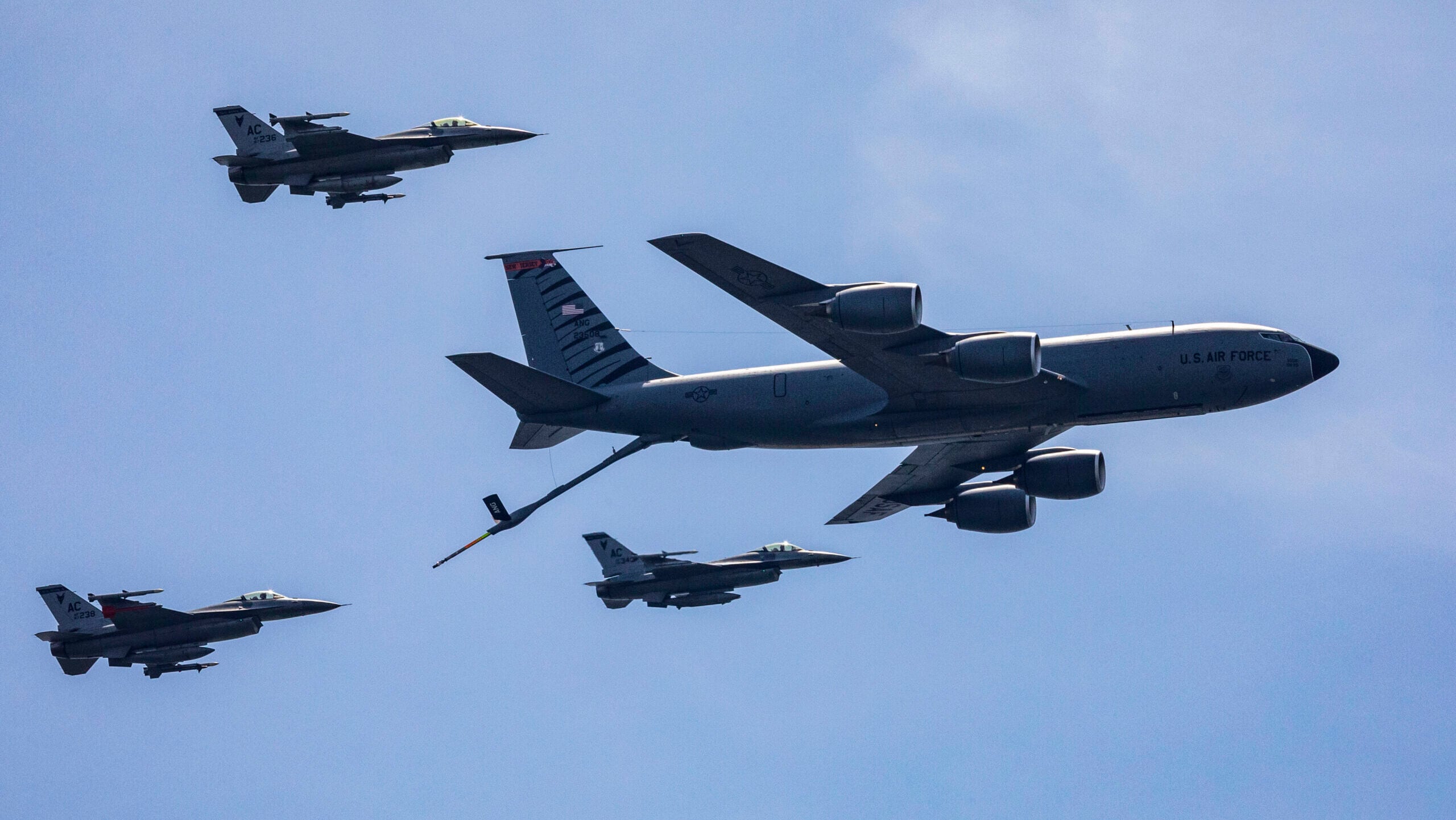
A U.S. Air Force KC-135R Stratotanker with the New Jersey Air National Guard’s 108th Wing and F-16 Fighting Falcons with the 177th Fighter Wing simulate a mid-air refueling during the 2019 Atlantic City International Airshow “A Salute To Those That Serve” at Atlantic City, N.J., Aug. 21, 2019. (New Jersey National Guard photo by Mark C. Olsen)
The wars in Ukraine and Iran offer insights into modern war, such as the balance between offense and defense or between interceptors and one-way attack drones, but there’s a key aspect of the next-generation battlefield that the fights lack: widespread aerial combat between opposing air forces — a likely key component of a potential US-China war.
Establishing temporary US air superiority in that war will require more than fighter-based firepower. Contemporary air-to-air combat relies on airborne early warning (AEW) and aerial refueling aircraft. These high-value airborne assets (HVAA) provide the critical information and fuel for air combat in the Western Pacific, but are easy to track and have few defenses. It is no wonder, then, that the People’s Liberation Army Air Force (PLAAF) has devoted considerable effort towards targeting and destroying US HVAA using extended-range air-to-air missiles like the PL-17 .
To safeguard its HVAA, the Air Force can acquire more fighters, develop new HVAA, or use space-based sensing . Or it can, and should, make protection of HVAA the primary mission of the second increment of its Collaborative Combat Aircraft program.
CCAs capable of defending HVAA aircraft for long-range air-to-air engagements would break the firepower-versus-protection paradox, enhance the capability to inflict aerial attrition on the PLAAF, and establish air superiority.
Traditional Approaches to Firepower And Protection
Since its inception, the Air Force has pursued air superiority through firepower, emphasizing qualitative advantages across its fighters, missiles, and pilots. Contemporary investments align with these preferences. These include alternative concepts such as increment one CCAs operating with F-35 Lightning IIs. Additionally, the Air Force is developing the F-47 , a sixth-generation fighter aircraft, and arming it with ever-longer-range missiles.
The PLAAF’s growing size and capabilities, however, make traditional firepower-matching efforts problematic. Although the F-47 will outclass the J-20C Mighty Dragon , the PLAAF may be rapidly closing a capability gap with its J-36 and J-50/XDS prototypes. Numbers may matter too. The Air Force is planning to purchase 187 F-47s, whereas the PLAAF has at least 300 J-20s and an unknown number of future fighters. The resulting quantitative disadvantage may leave even the most cutting-edge mixed-US fighter fleet outnumbered. Furthermore, prioritizing fighter firepower at the expense of HVAA protection leaves these aircraft critically exposed.
The Air Force sets the standard for advanced fighter aircraft. Yet aerial combat effectiveness also requires HVAA, specifically AEW and refueling aircraft. These large aircraft have significant signatures and rely on outmoded self-defense systems, making them difficult to protect. Safeguarding these aircraft requires operating them outside the range of threats or flying dedicated HVAA protection sorties using fighter aircraft.
This defensive mission tethers fighters to these vulnerable aircraft, curtailing fighter freedom of action. Tasking U.S. fighter aircraft with this defensive mission also reduces the number of fighters available for offensive missions. As offensive forces are reduced, the attrition rate inflicted on the Chinese fighter force likely decreases as well. Protection missions then become a protection tax that the Air Force must pay to retain its long-range air-to-air kill chains.
Consider the following rudimentary calculations based on the International Institute for Strategic Studies 2026 Military Balance for the US (1,780) and Chinese (1,650) fighter forces. Assuming the Air Force commits two-thirds of its fighter force to fighting the PLAAF and flies 100 HVAAP orbits with four fighters per orbit, it may incur a total HVAAP tax of 400 fighters, leaving it with approximately 787 fighters for other counter-PLAAF missions. Similarly, estimating the PLAAF’s own protection tax could leave the PLAAF with 1,305 fighters available for other missions. Comparing these two rough estimates yields a nearly 2:1 numerical advantage to the PLAAF, a disadvantage that could be challenging to overcome even for the most qualitatively superior US fighter force.
However, prioritizing offensive missions would leave U.S. HVAA dangerously exposed. The destruction of U.S. AEW and refueling aircraft would cede dramatic first-look, first-shot, and range advantages to the PLAAF. Failing to resolve this paradox could collapse US long-range air-to-air kill chains and cede air superiority to the Chinese.
CCAs For Protection And Firepower
Rethinking the Air Force’s traditional HVAA protection tactics via CCA Increment Two offers promise for resolving the firepower-versus-protection dilemma. A CCA favoring endurance over fighter-like performance, with a significant missile payload tailored to engage not only PLAAF HVAA and fighter aircraft, but perhaps even Chinese PL-17 missiles, could tip the balance. Long-range, networked, high-risk aerial combat benefits from flying CCAs with a resilient datalink and a semi-autonomous engagement capability.
The number of missiles per aircraft is a key measure of firepower in missile-centric aerial combat. Historical trends in beyond-visual-range combat suggest that destroying a single aircraft requires multiple missiles, meaning aircraft with larger missile payloads likely have a combat advantage. Increment One CCAs appear likely to carry two AIM-120s . For HVAA protection CCAs, developing smaller missiles and carrying additional weapons externally could increase total missile capacity. Maximizing missile payload is likely to increase the size and cost of each CCA but may yield an outsized return by increasing aircraft payload and range. Investing less in signature reduction and aircraft speed may help constrain rising aircraft unit costs.
Rather than a highly capable, manned fighter, a larger CCA with minimal signature reduction, built for long-duration, extended-range missions, and carrying an increased missile payload represents a superior defensive option. Furthermore, incorporating an active counter-missile capability could fundamentally alter long-range aerial combat.
A CCA built for HVAA protection missions could free Air Force fighters for offensive counterair missions while bridging the firepower gap. CCAs capable of protecting HVAA could shore up the crucial long-range engagement information and fuel US fighters require, thwart a key objective of the PLAAF’s systems destruction warfare ( SDW ), and simultaneously unleash US fighters to inflict increased attrition. Exploring the potential for terminal missile engagements may even tilt the balance in the defender’s favor.
A force of 150 CCAs, each carrying four-to-six missiles, would add an additional 600-900 missile rails for long-range air-to-air engagements. Assuming two missiles are shot at a single target, this force may produce up to 450 successful engagements.
Earlier, the estimated US HVAA protection tax was 400 fighters. Making a one-for-one swap from the previous force assumptions, 400 HVAAP CCAs could dramatically reduce the tax on firepower and restore near-quantitative fighter parity. In lower-risk scenarios, the proposed CCA’s range, endurance, and payload could be tailored to a range of alternative missions.
Air-to-air combat relies on first-look and first-shot advantages but increasing sensor fusion makes remaining undetected difficult. As missile ranges increase, air forces face an additional dilemma: either build longer-range weapons or explore novel options for survival within missile launch ranges. An active missile defense system could address situations in which avoiding a missile engagement is improbable — another potential defensive CCA mission. This concept could negate billions spent on counter-HVAA kill chains, reduce the protection tax, and spark a new aerial competition.
This terminal defense concept may also counter the PLAAF’s long-range surface-to-air missiles (SAMs), such as the HQ-9 . A CCA capable of engaging incoming long-range air-to-air missiles may also defeat long-range SAMs. Active terminal engagement could upend the attack-versus-suppression dilemma against integrated air defense systems. An aircraft capable of establishing a limited protection bubble may also help protect and escort electronic attack, strike, and airlift aircraft into previously denied areas.
Militaries have always faced the challenge of balancing firepower and protection. The novel concept of specialized CCAs designed to maximize missile payload and provide adequate endurance for HVAA protection could break this paradox. By doing so, it offers promise for upscaling a tactical advantage over the PLAAF for strategic effect.
Greg Malandrino is a Senior Fellow at the Center for Strategic and Budgetary Assessments. He is a retired fighter pilot with over 25 years of naval service. His last job on active duty was in the Office of the Secretary of Defense’s Office of Net Assessment (ONA), where he served as the Senior Military Advisor to the Director, producing strategic-level insights for senior DoD officials.
2019年8月21日,在新泽西州大西洋城举行的2019年大西洋城国际航展“致敬军人”上,隶属于新泽西州空中国民警卫队第108联队的美国空军KC-135R同温层加油机和隶属于第177战斗机联队的F-16“战隼”战斗机进行了空中加油模拟。(新泽西州国民警卫队照片,摄影:马克·C·奥尔森)
乌克兰和伊朗的战争让我们得以了解现代战争,例如进攻与防御之间的平衡,或者拦截机与单向攻击无人机之间的平衡,但这些战争缺乏下一代战场的一个关键方面:敌对空军之间的大规模空中作战——这很可能是潜在的美中战争的关键组成部分。
在那场战争中,美国要想取得暂时的空中优势,仅靠战斗机火力是不够的。现代空战依赖于空中预警机和空中加油机。这些高价值空中资产(HVAA)为西太平洋空战提供关键信息和燃料,但它们易于追踪且防御能力薄弱。因此,中国人民解放军空军投入大量精力,使用PL-17等远程空空导弹来打击和摧毁美国的高价值空中资产也就不足为奇了。
为了保护其高价值航空武器系统(HVAA),空军可以采购更多战斗机、研发新型HVAA或利用天基传感技术。或者,它也可以(而且应该)将保护HVAA作为其协同作战飞机计划第二阶段的首要任务。
能够保护 HVAA 飞机进行远程空战的 CCA 将打破火力与防护之间的悖论,增强对中国人民解放军空军造成空中损耗的能力,并建立空中优势。
火力与防护的传统方法
自成立以来,美国空军一直致力于通过强大的火力夺取空中优势,强调战斗机、导弹和飞行员等方面的品质优势。当前的投资也与这些偏好相符。这些投资包括一些替代方案,例如采用F-35“闪电II”战斗机的增量式作战能力(ICA)。此外,空军正在研发第六代战斗机F-47,并为其配备射程更远的导弹。
然而,解放军空军日益增长的规模和能力使得传统的火力匹配策略难以奏效。尽管F-47的性能将优于歼-20C“巨龙”,但解放军空军凭借其歼-36和歼-50/XDS原型机,可能正在迅速缩小与歼-20C的实力差距。数量也可能至关重要。美国空军计划采购187架F-47,而解放军空军至少拥有300架歼-20,并且未来还将采购数量不明的战斗机。由此造成的数量劣势,甚至可能使最先进的美制混合战斗机机队在数量上处于劣势。此外,优先考虑战斗机火力而牺牲高空防空能力,会使这些飞机面临严重的攻击风险。
空军制定了先进战斗机的标准。然而,空中作战效能也需要大型空中预警机(HVAA),特别是预警机和空中加油机。这些大型飞机特征明显,且依赖过时的自卫系统,因此难以保护。保护这些飞机需要将其部署在威胁范围之外,或者派遣战斗机执行专门的HVAA护航任务。
这项防御任务将战斗机束缚在这些易受攻击的飞机周围,限制了战斗机的行动自由。让美国战斗机执行这项防御任务也会减少可用于进攻任务的战斗机数量。随着进攻力量的减少,对中国战斗机造成的损耗率也可能随之降低。因此,保护任务就成了空军为了维持其远程空对空打击链而必须付出的“保护税”。
根据国际战略研究所发布的《2026年军事平衡报告》,对美国(1780架)和中国(1650架)的战斗机数量进行了如下粗略计算。假设美国空军将三分之二的战斗机用于对抗中国人民解放军空军,并执行100次高空巡逻任务(HVAAP),每次巡逻出动4架战斗机,那么其高空巡逻任务的总消耗量可能达到400架,剩余约787架战斗机可用于其他反制中国人民解放军空军的任务。同样,如果估算中国人民解放军空军自身的保护任务消耗量,则剩余约1305架战斗机可用于其他任务。比较这两个粗略估算,可以看出中国人民解放军空军在数量上拥有近2:1的优势,即使对于美国战斗机部队而言,这种劣势也难以克服。
然而,优先执行进攻性任务将使美国的高空空中作战能力(HVAA)处于危险的暴露状态。美国预警机和加油机的损毁将使解放军空军在先发制人、先发制人和射程方面获得巨大的优势。如果不能解决这一矛盾,美国的远程空战打击链可能会崩溃,并将制空权拱手让给中国。
用于防护和火力的CCA
通过“CCA第二阶段”重新思考空军传统的HVAA防护战术,有望解决火力与防护之间的两难困境。CCA应优先考虑续航能力而非战斗机性能,并配备大量导弹载荷,不仅能够拦截解放军空军的HVAA和战斗机,甚至可能拦截中国PL-17导弹,这或许能够扭转战局。远程、网络化、高风险的空战将受益于配备可靠数据链和半自主交战能力的CCA。
在以导弹为中心的空战中,每架飞机的导弹数量是衡量火力的一个关键指标。超视距空战的历史趋势表明,摧毁一架飞机通常需要多枚导弹,这意味着导弹载荷更大的飞机可能具有作战优势。第一阶段的CCA(战斗航空运输机)很可能携带两枚AIM-120导弹。对于高空防空导弹(HVAA)CCA而言,开发更小的导弹并通过外部携带更多武器可以提高总导弹运载能力。最大化导弹载荷可能会增加每架CCA的尺寸和成本,但通过增加飞机的有效载荷和航程,可能会带来巨大的收益。减少对降低特征信号和提升飞机速度的投入可能有助于控制不断上涨的飞机单价。
相比高性能有人驾驶战斗机,更大尺寸、特征信号降低幅度最小、专为执行长时间、远距离任务而设计、并能携带更多导弹载荷的CCA(近程空中作战飞机)才是更优的防御选择。此外,如果能加入主动反导能力,则可能从根本上改变远程空战的格局。
专为高空防空导弹系统(HVAA)保护任务而设计的空中作战指挥中心(CCA)能够解放空军战斗机,使其能够执行进攻性反空作战任务,同时弥补火力差距。具备保护HVAA能力的CCA能够保障美军战斗机所需的关键远程交战信息和燃料,挫败解放军空军系统摧毁战(SDW)的关键目标,并同时释放美军战斗机,使其能够造成更大的损耗。探索末端导弹拦截的可能性甚至可能扭转战局,使防御方占据优势。
一支由150辆CCA(每辆携带4至6枚导弹)组成的部队,将额外配备600至900个导弹发射架,用于远程空对空作战。假设每次向同一目标发射两枚导弹,这支部队最多可成功完成450次空战。
此前,美国高空攻击航空器(HVAA)的保护成本估计为400架战斗机。如果按照之前的兵力假设进行一对一替换,400架HVAAP协同作战飞机(CCA)可以显著降低火力成本,并恢复接近战斗机数量的均势。在风险较低的情况下,拟议的CCA的航程、续航时间和有效载荷可以根据不同的任务进行调整。
空战依赖于先发制人和先发制人的优势,但传感器融合技术的进步使得保持隐蔽变得愈发困难。随着导弹射程的增加,空军面临着新的困境:要么研发远程武器,要么探索在导弹射程内生存的新方案。主动导弹防御系统可以应对那些几乎不可能避免导弹交战的情况——这也是另一种潜在的防御性空中作战任务。这一概念有望减少数十亿美元用于反制高射速攻击武器的投入,降低防御成本,并引发新的空中竞争。
这种末端防御概念或许也能对抗解放军空军的远程地空导弹,例如HQ-9。能够拦截来袭远程空空导弹的近程防御飞机(CCA)或许也能击落远程地空导弹。主动末端拦截能力可能会颠覆针对一体化防空系统的进攻与压制两难困境。能够建立有限防护区的飞机或许还能帮助保护和护送电子战飞机、打击飞机和运输飞机进入此前被封锁的区域。
军队一直面临着火力与防护平衡的挑战。新型的专用作战指挥中心(CCA)旨在最大限度地提高导弹有效载荷,并为高空空导弹(HVAA)提供足够的续航能力,从而打破这一悖论。如此一来,它有望在战略层面提升对中国空军的战术优势。
格雷格·马兰德里诺是战略与预算评估中心的高级研究员。他是一位退役战斗机飞行员,拥有超过25年的海军服役经验。他服役期间的最后一份工作是在国防部长办公室下属的网络评估办公室(ONA),担任主任的高级军事顾问,为国防部高级官员提供战略层面的分析。