In the age of drones, a bigger fence around your facility doesn’t protect you anymore在无人机时代,在你的设施周围加装更高的围栏已经无法保护你了。
Drones, cyberattacks and downstream threats are forcing critical infrastructure operators to rethink traditional perimeter security and adopt layered, AI-driven defenses.
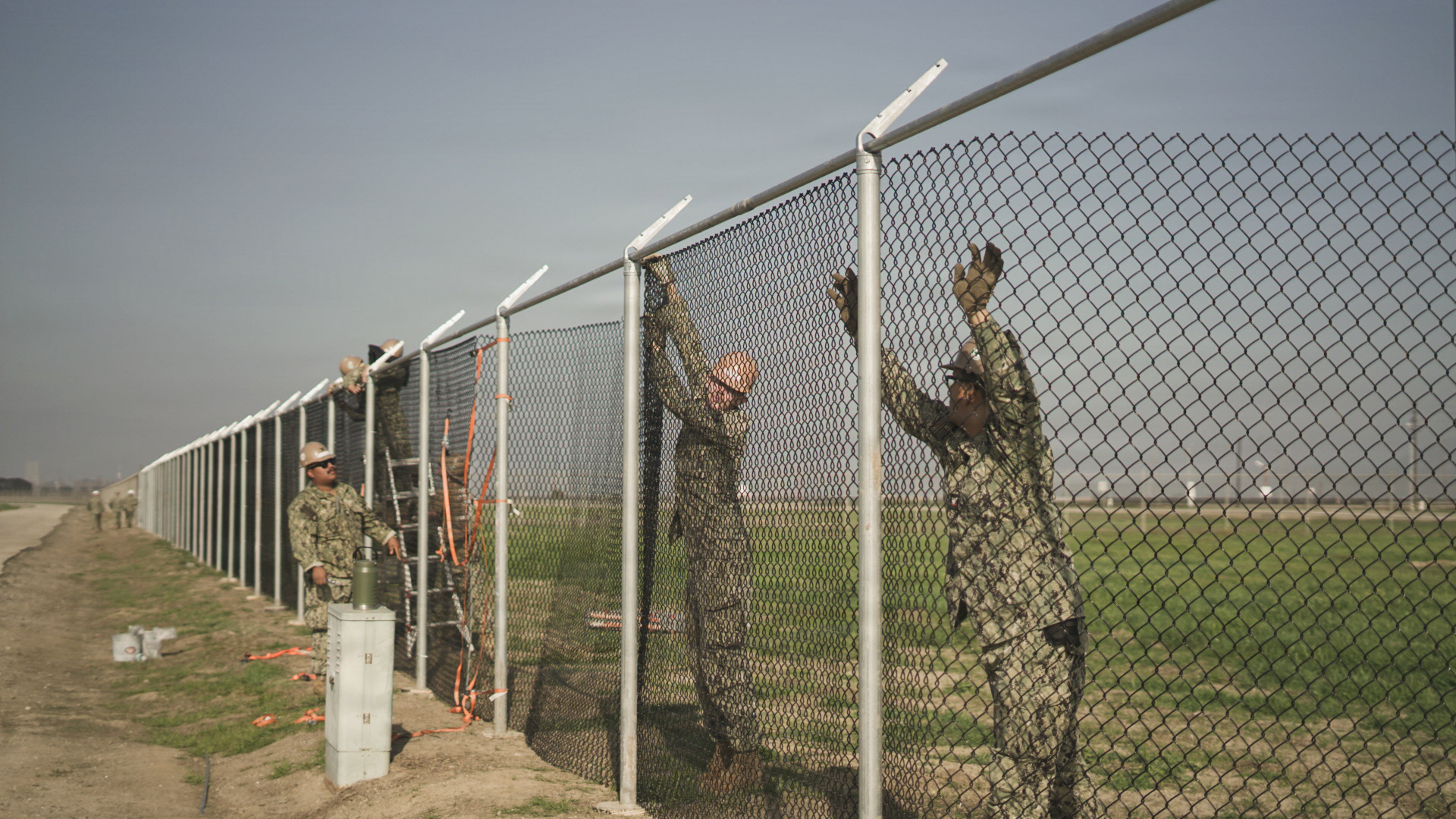
Sailors assigned to NMCB-5 install sections of security perimeter fencing as part of the Point Mugu Airfield Security Enclave project. (Photo by Katie Cadiao/ Naval Facilities Engineering Systems Command (NAVFAC) Southwest.)
Securing facilities both inside and outside the US is becoming increasingly complex, as new threats such as drones mean the old model of “gates, guards and guns” is no longer sufficient.
Protecting against constantly evolving, adaptable threats is driving a need for more and better data, but that creates its own challenge: keeping personnel informed and aware of threats without being overwhelmed by massive amounts of data while being able to identify whether a blip on a radar is a flock of birds, a hobbyist flying a harmless drone or something potentially dangerous.
It’s not just drones. AI-driven cyberattacks are becoming ever more common and facilities face not only the threat of a direct attack, but downstream incidents such as attacks on data centers or power stations that could paralyze a facility.
“We’re facing these threats that no longer have a prepositioned posture in terms of who the threat is coming from or where it’s coming from,” said Jason Rahimitabar, Executive Vice President of LEXSO (Layered Extended Security Operations) at Constellis . “It is multi-domain, it is air, land, sea, space, cyber, and it is now more easily accessible to our adversaries.”
Defending against such a wide array of threats is not easy, but it is doable. It requires a combination of technology, personnel and adaptivity to be able to quickly identify potential threats and respond to them effectively.
The changing face of threats
Conflicts in Ukraine and Iran have highlighted an economic issue when it comes to protecting facilities, equipment and people. The explosion of cheap, expendable drones allows for adversaries or rogue actors to launch waves of attacks in an attempt to overwhelm defense systems, and when those drones are shot down they are often being destroyed with effectors that are much more expensive.
“You have all these cheap drones that can cost 50 bucks and you’re mitigating it with something that’s costing anywhere from $15,000, up to $4 million per round” Rahimitabar said. “The economics just doesn’t work.”
That same conundrum exists outside of the frontlines. A military installation in the continental United States can be targeted with drones as easily as frontline installations can, as evidenced by a recent incident where Barksdale Air Force Base was overflown by drones in multiple instances. Although no damage was done, it highlighted one of the challenges of present-day security, which is that it’s no longer sufficient to build defense out; they have to be figuratively built up, as well.
That doesn’t mean building a taller fence. Instead, it’s about having systems in place to track, identify and intercept airborne threats, which is made more difficult by the maneuverability and small size of readily available drones. They aren’t easy to pick up with sensors or radar, and they don’t follow a set flight path or have to stay a certain distance from the ground.
“That threat from a $50 drone that someone can buy online or at a hardware store, you don’t mitigate the threat through a gate, guard or a gun,” said Rahimitabar. “You need counter-UAS measures and UAS tracking and detection that makes it a more complex picture, and it extends out the need of where you actually detect threats. You’re used to seeing the threat right on the perimeter line and if somebody jumps over that fence, they are a threat. But now because of how fast and how capable UAS are, you actually have to detect them much further out to be able to mitigate their potential risks.”
Quickly identifying whether a drone is actually a threat is critical, because not every drone is dangerous. Facilities that are not isolated may have hobbyist drone pilots in the area who are undertaking harmless activity such as flying a drone in a nearby park, but if the drone wanders off course or gets too close to the perimeter, it can trigger a security alert. Activating counter-UAS measures in that case is not only expensive, but a potential public relations headache.
The economic calculus becomes less important when a drone is identified as dangerous. While it may be disproportionately expensive to take down an adversarial drone, the value of what is being protected matters, as well. Spending a lot of money to destroy an innocuous drone doesn’t make sense, but doing so to protect the lives of people or critical infrastructure certainly does.
Tracking and identifying drones or other threats requires excellent sensor capabilities, and that is one of the key capabilities that LEXSO is built around, said Rahimitabar. It is designed to integrate multiple sensing technologies including radar and LIDAR, and is built to be sensor agnostic. The system provides real-time data through a unified operating picture that operators can use to quickly identify potential threats and decide how to respond based on the information available to them.
“It brings all of those sensors into an orchestrated layer,” Rahimitabar said. “It simplifies the interface for the operator to be able to make decisions in near real time, action those threats and make sure that they’re not actioning the false alarms, which is just as important as actioning the threats. And you have this single pane of glass, if you will, that allows you to do that regardless of the sensor type or sensor manufacturer.”
Constellis’s LEXSO interface identifies and locates possible security threats in a single user interface. (Illustration courtesy of Constellis.)
Defending a single facility is a relatively straightforward proposition. But modern facilities rely on off-site power generation, communications infrastructure and data centers to run effectively, and they are increasingly becoming targets of opportunity for those looking to hamstring a facility. Notably, in the recent Iran conflict two Amazon Web Services data centers in the United Arab Emirates were targeted, highlighting that threats are not contained to single sites, Rahimitabar said.
“Because of the interconnected world that we live in right now, that could be a commercial site like a data center, like a water storage facility, like a power facility. If you look up and down the supply chain of how the military operator will work, you can then track it now to commercial installations, commercial infrastructure and that is actively being targeted.”
That means that security must be comprehensive to consider all factors instead of being isolated to only thinking about the physical footprint of the facility. Security personnel at a facility not only need to be able to protect that facility, but also be able to communicate with other facilities that provide critical resources and first responders.
Rahimitabar shared a recent example where LEXSO was meeting with a government customer, and the meeting didn’t just include the head of security. Fire and safety was represented, as was search and rescue because the facility is located on a waterway. Information technology personnel were also there because of cybersecurity concerns, and IT infrastructure is critical to security operations. For all of those departments, having a common operating picture is crucial to ensure everyone is working from the same information.
“If you don’t answer it as a holistic problem, then you’re actually losing sight of where the threat could be coming from and how best to mitigate,” said Rahimitabar. “Having all those stakeholders and not changing around the common operating picture on each of the stakeholders is important.”
AI-driven security management
Data is critical to effective security. Being able to actually use that data instead of drowning in it, however, is even more critical. Saturating your coverage area with sensors only offers so much benefit if your operators are overwhelmed by the influx of data and can’t figure out what it’s all telling them quickly enough to make good decisions.
Artificial intelligence (AI) helps with that by quickly sorting through data and presenting it in a form that operators can understand and draw accurate conclusions from. In the case of LEXSO, layers of security measures all report to the same system, then that information is processed and presented to operators. That capability matters because AI can process massive amounts of data far faster than humans, and it can quickly compare against previous data to help identify what exactly is going on, said Rahimitabar.
“Because we have a layered approach to where we’re getting multiple pings, maybe it’s a radar, maybe it’s visual line of sight that the camera got, maybe it’s an acoustic sensor that heard a noise,” he said. “What AI can do is process the level of confidence through the layered approach to those sensors and give it to the operator, the human in the loop. Instead of AI just saying that, ‘yes, that is a person and they have a drone and it’s dangerous,’ it can confirm that information through four different layers of data, four different types of sensors.
Securing facilities entails a number of challenges, including ever-changing threats, downstream attacks and managing data effectively to ensure that all stakeholders have a clear understanding of potential threats and how to respond to them. Those are big tasks, but can be handled through a commitment to the idea that security is a holistic endeavor that is constantly changing, not a static operation.
“We haven’t fully adapted to this complex environment in terms of realizing that the security posture of critical infrastructure is not ready, nor does it have budgets yet to be able to handle the threat we’re talking about,” Rahimitabar said. “We have siloed our security operators and that security budget into just being the guards at the front gate, and we haven’t thought through the complexity of the problem and evolved that level of thinking of what they should truly be securing.”
That complexity makes security a constantly evolving challenge, but by offering capabilities such as sensor integration, AI-driven data management and a single interface for operators to quickly identify and respond to threats, LEXSO offers its customers the flexibility and adaptability needed to meet whatever security challenges they face.
“The true discriminator for LEXSO is that we solve these problems based on the customer need, but we have a foundational system that allows us to do it rapidly,” said Rahimitabar. “By being super flexible, by being device agnostic, by making sure that we understand our customer needs and can deploy anywhere, we make sure that we solve that problem with our customer and understand what’s the quickest and cheapest path to being super proficient and effective in their security posture.”
隶属于第五海军机动建设营(NMCB-5)的水兵们正在安装安全围栏,这是穆古角机场安全区项目的一部分。(照片由凯蒂·卡迪奥/海军设施工程系统司令部(NAVFAC)西南分部提供。)
由于无人机等新威胁的出现,保障美国境内外设施的安全变得越来越复杂,这意味着“大门、警卫和枪支”这种旧模式已经不再足够。
为了防范不断演变、适应性强的威胁,我们需要更多更好的数据,但这同时也带来了新的挑战:如何在不被海量数据淹没的情况下,让工作人员了解并意识到威胁,同时还要能够识别雷达上的光点是一群鸟、业余爱好者在操控无害的无人机,还是潜在的危险事物。
不仅仅是无人机。人工智能驱动的网络攻击正变得越来越普遍,设施不仅面临直接攻击的威胁,还面临下游事件的威胁,例如对数据中心或发电站的攻击,这些攻击可能导致设施瘫痪。
Constellis公司负责LEXSO(分层扩展安全运营)的执行副总裁Jason Rahimitabar表示:“我们面临的这些威胁不再具有预先设定的态势,我们无法确定威胁来自何方。它们是多域的,涵盖空中、陆地、海洋、太空和网络空间,而且现在我们的对手更容易接触到这些威胁。”
抵御如此多种类的威胁并非易事,但并非不可能。这需要技术、人员和适应能力的综合运用,才能快速识别潜在威胁并有效应对。
威胁的演变
乌克兰和伊朗的冲突凸显了在保护设施、设备和人员方面存在的经济问题。廉价且消耗性无人机的激增使得敌对势力或不法分子能够发动一波又一波的攻击,试图突破防御系统;而当这些无人机被击落后,通常需要使用成本高昂的武器进行摧毁。
拉希米塔巴尔说:“现在市面上有很多价格低廉的无人机,每架只要50美元,而你却要用每轮花费1.5万美元到400万美元不等的武器来应对。这在经济上根本行不通。”
同样的难题也存在于前线之外。美国本土的军事设施与前线设施一样容易成为无人机攻击的目标,最近巴克斯代尔空军基地多次遭到无人机飞越的事件就证明了这一点。虽然没有造成任何损失,但这凸显了当今安全面临的挑战之一:仅仅在外部建设防御工事已远远不够;防御体系也必须在精神层面得到加强。
这并不意味着要建更高的围墙。而是指要建立相应的系统来追踪、识别和拦截空中威胁,而无人机机动性强、体积小巧,使得这项工作更加困难。它们难以被传感器或雷达探测到,而且飞行路线不固定,也不需要与地面保持特定距离。
“那种价值50美元的无人机,人们可以在网上或五金店买到,这种威胁你无法通过大门、保安或枪支来消除,”拉希米塔巴尔说道。“你需要反无人机系统措施以及无人机跟踪和探测,这使得威胁形势更加复杂,也扩大了你实际探测威胁的范围。过去,你习惯于在边界线上发现威胁,如果有人翻过围栏,那就是威胁。但现在,由于无人机的速度和性能都非常出色,你必须在更远的距离就探测到它们,才能降低它们的潜在风险。”
快速识别无人机是否构成威胁至关重要,因为并非所有无人机都具有危险性。一些设施并非完全封闭,其附近可能有一些业余无人机飞行员,他们可能在进行一些无害的活动,例如在附近的公园里飞行无人机。但如果无人机偏离航线或过于靠近警戒线,则可能触发安全警报。在这种情况下启动反无人机系统措施不仅成本高昂,而且还可能引发公关危机。
当无人机被认定为危险目标时,经济考量的重要性就降低了。虽然击落敌方无人机的成本可能过高,但所保护对象的价值同样重要。花费巨资摧毁一架无害的无人机毫无意义,但如果是为了保护人民生命或关键基础设施,这样做就完全合理。
拉希米塔巴尔表示,追踪和识别无人机或其他威胁需要卓越的传感器性能,而这正是LEXSO系统的核心功能之一。该系统旨在集成多种传感技术,包括雷达和激光雷达,并且具有传感器兼容性。它通过统一的作战图提供实时数据,操作人员可以利用这些数据快速识别潜在威胁,并根据现有信息决定应对措施。
拉希米塔巴尔说:“它将所有传感器整合到一个协调的层面上。它简化了操作员的界面,使他们能够近乎实时地做出决策,应对威胁,并确保不会对误报做出反应——这与应对威胁同样重要。而且,无论传感器类型或制造商如何,你都可以通过这个单一的界面完成这些操作。”
Constellis 的 LEXSO 界面可在单一用户界面中识别并定位潜在的安全威胁。(插图由 Constellis 提供。)
保护单个设施相对简单。但现代设施的高效运行依赖于外部发电、通信基础设施和数据中心,因此它们正日益成为那些企图瘫痪设施者的攻击目标。拉希米塔巴尔指出,值得注意的是,在最近的伊朗冲突中,位于阿联酋的两座亚马逊网络服务(AWS)数据中心遭到袭击,这表明威胁并非局限于单个地点。
“由于我们现在生活在一个互联互通的世界,目标可能是商业场所,比如数据中心、蓄水设施或发电厂。如果你沿着军方行动的供应链一路追踪,就会发现目标现在正是商业设施和商业基础设施,而这些正是他们积极瞄准的目标。”
这意味着安保措施必须全面考虑所有因素,而不能仅仅局限于设施的物理占地面积。设施的安保人员不仅需要能够保护该设施本身,还需要能够与其他提供关键资源和应急响应人员的设施进行沟通。
拉希米塔巴尔分享了一个最近的例子:LEXSO 与一位政府客户会面,参会人员不仅限于安保负责人,还包括消防安全部门和搜救部门的代表,因为该设施位于水道沿岸。此外,由于网络安全方面的考虑,信息技术人员也出席了会议,因为信息技术基础设施对安全运营至关重要。对于所有这些部门而言,拥有统一的运行图至关重要,以确保每个人都基于相同的信息开展工作。
拉希米塔巴尔说:“如果你不把它当作一个整体问题来回答,那么你实际上就忽略了威胁可能来自哪里以及如何最好地缓解威胁。让所有利益相关者都参与进来,并且保持对每个利益相关者的共同关注,这一点至关重要。”
人工智能驱动的安全管理
数据对于有效的安全至关重要。然而,更重要的是能够真正利用这些数据,而不是被数据淹没。如果操作人员被海量数据淹没,无法快速理解数据含义并做出正确决策,那么即使覆盖区域内遍布传感器,其益处也十分有限。
人工智能 (AI) 通过快速筛选数据并将其以操作员能够理解的形式呈现,从而帮助操作员从中得出准确的结论,进而解决这一问题。以 LEXSO 为例,多层安全措施的数据都报告给同一个系统,然后这些信息被处理并呈现给操作员。Rahimitabar 表示,这种能力至关重要,因为人工智能处理海量数据的速度远超人类,而且它可以快速与历史数据进行比较,从而帮助识别究竟发生了什么。
“因为我们采用的是分层式方法,可以接收到多个信号,可能是雷达信号,可能是摄像头的视线信号,也可能是声学传感器捕捉到的声音,”他说道。“人工智能可以处理这些传感器通过分层方式传递的置信度信息,并将其传递给操作员,也就是人机交互系统。人工智能不会仅仅简单地说‘是的,那是一个人,他/她有无人机,这很危险’,而是可以通过四个不同的数据层、四种不同类型的传感器来确认这一信息。”
保障设施安全面临诸多挑战,包括不断变化的威胁、下游攻击以及有效管理数据,以确保所有利益相关者都清楚了解潜在威胁及其应对措施。这些都是艰巨的任务,但只要秉持“安全是一项持续变化的整体性工作,而非静态操作”的理念,就能迎刃而解。
拉希米塔巴尔表示:“我们尚未完全适应这种复杂的环境,没有意识到关键基础设施的安全态势尚未就绪,也没有足够的预算来应对我们所谈论的威胁。我们把安保人员和安保预算局限在门口,没有深入思考问题的复杂性,也没有提升他们真正应该保护的内容的思考水平。”
这种复杂性使得安全成为一个不断变化的挑战,但通过提供传感器集成、人工智能驱动的数据管理以及为操作员提供快速识别和应对威胁的单一界面等功能,LEXSO 为客户提供了应对任何安全挑战所需的灵活性和适应性。
Rahimitabar表示:“LEXSO真正的优势在于,我们能够根据客户需求解决这些问题,并且我们拥有一个强大的基础系统,使我们能够快速完成任务。我们凭借高度的灵活性、设备兼容性,确保充分了解客户需求并能够随时随地部署,从而确保与客户共同解决问题,并找到最快捷、最经济的途径,帮助他们高效、专业地提升安全防护能力。”