Australia’s anti-submarine frigate program sails rough seas澳大利亚反潜护卫舰项目面临重重挑战
Analysts have criticized the program, citing the frigate design’s weight growth, scheduling delays and what they view as an inadequate number of VLS cells.
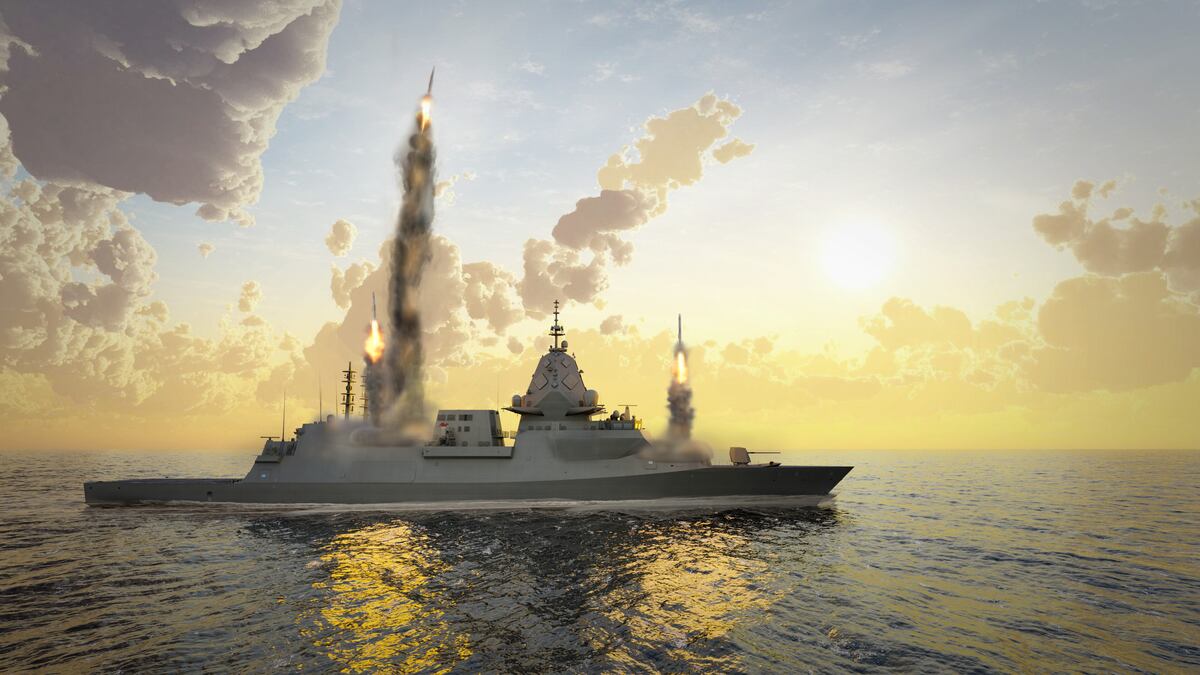
MELBOURNE, Australia — The shipbuilder for a $30 billion Australian program is pushing back against criticism over the design and capabilities of the anti-submarine warfare frigate.
Analysts have lambasted the program, citing the frigate design’s weight growth, scheduling delays and what they view as an inadequate number of vertical launching system cells. Furthermore, in May, Australia’s auditor general slammed the acquisition process in an Australian National Audit Office report , citing serious flaws.
The first phase of the Sea 5000 program involves the production of the ships for the Royal Australian Navy. The government of Prime Minister Anthony Albanese received an independent study of the planned surface fleet on Sept. 29, but its findings will not be made public until the end of the first quarter of 2024.
Former U.S. Navy Vice Adm. William Hilarides conducted the study following recommendations in Australia’s most recent Defence Strategic Review, which called for an enhanced, long-range strike capability, among other things.
But in the meantime, BAE Systems Australia’s managing director for maritime business has pushed back against critics, telling reporters at the Indo Pacific International Maritime Exposition in November that the future frigate recently completed its preliminary design review.
“It still meets all of [Australia’s] key 23 performance criteria [for] speed, range, endurance, seakeeping [and] underwater radiated noise, so I would challenge you to determine why it is still referred to as too heavy and too slow,” Craig Lockhart said. “In fact, it’s still [capable of] 27 knots-plus. And when we get the first ship in the water and get upwards of 31 or 32 knots in the real testing trials, then it will become our model benchmark.”
Under the current plan, Australia is seeking to build nine frigates based on the British Type 26 Global Combat Ship design, but featuring an indigenous phased array radar from CEA Technologies and a Saab Australia-made 9LV combat system.
The Australian government chose this modified design, known as the Hunter class, in 2018. BAE Systems Australia is the prime contractor for the Hunter-class frigate program, having beat out Italian firm Fincantieri’s FREMM pitch and Spanish shipbuilder Navantia’s offering of a modified F100 variant.
BAE is currently completing a series of prototyping activities at a purposely designed shipyard in Osborne, South Australia.
The changes to the baseline Type 26 design have resulted in a reduced design margin in terms of weight; the vessel will now displace almost 10,000 tons — an increase over the originally planned 8,800 tons. This is what drove analysts to claim the Hunter-class frigates will not meet the original specifications, as it will end up too big, too heavy and too slow.
In anticipation of future security threats to Australia, as forecast in the Defence Strategic Review, Lockhart revealed at November’s expo that the firm has been working on a modified Hunter design, with some high-end anti-submarine warfare equipment removed and the number of vertical launching system cells increased from 32 to 96. VLS cells are used to launch missiles from ships.
Lockhart said that because production for the frigates will take place in three batches, each including three ships, the latest design — dubbed Hunter Guided Missile Frigate — could be the first vessel in the second batch, which would come with additional options in terms of technological features.
BAE replaced a flexible mission bay in the back half of the ship with a new strike module that houses 64 VLS cells and four quad-pack launchers for the Kongsberg-made Naval Strike Missile. Lockhart said the new strike module is designed for the American-made MK 41 VLS but can accommodate the MK 57 VLS used on the U.S. Navy’s Zumwalt-class destroyers.
A Kongsberg-made Naval Strike Missile launches from the U.S. Navy littoral combat ship Coronado during testing in 2014 off the coast of Southern California. (MC2 Zachary D. Bell/U.S. Navy)
“You would need to go to a 13,000-ton ship like the [U.S. Navy’s] Arleigh Burke-[class destroyer] to get the same capability, which is too big and too slow” he said. “Whereas the Hunter Guided Missile Frigate gives us that capability and it retains enough [anti-submarine warfare] capability to do a very good job.”
But Marcus Hellyer, the chief researcher at the consultancy Strategic Analysis Australia, said the removal of the mission bay impacts the ship’s anti-submarine warfare role “by eliminating its ability to operate a second helicopter and potentially its towed array sonar.”
“VLS cells have become a convenient proxy to assess the combat power of warships. By this standard, the Hunter-class frigate’s 32 VLS cells fall short of other warships of a similar size,” Hellyer told Defense News. “The critics’ case is that the Hunter is very poor value for money for such a small number of cells and resultant combat capability.”
“But it’s a more complex issue than simply numbers,” he added. “VLS cells are used primarily for air defense missiles and then land-strike missiles. The primarily role of the Hunter is ASW [anti-submarine warfare], so does it need more than 32 cells? But if the primary role of the Hunter is ASW, why did [the Department of] Defence require significant design changes that are primarily about enhancing its air defense capabilities?”
Getting your money’s worth
For its part, the Australian National Audit Office report, released in May, described the Defence Department’s management of the frigate acquisition process as only “partly effective.”
“Defence’s procurement process and related advisory processes lacked a value for money focus,” the report noted, “and key records, including the rationale for the procurement approach, were not retained.”
“Contract expenditure to date has not been effective in delivering on project milestones, and the project is experiencing an 18-month delay and additional costs due in large part to design immaturity,” it added. “Defence did not conduct an effective limited tender process for the ship design. The value for money of the three competing designs was not assessed by officials.”
Australian Defence Department Secretary Greg Moriarty attends a hearing before lawmakers on June 2, 2021. (Sam Mooy/Getty Images)
Defence Secretary Greg Moriarty responded to the report in November, acknowledging failures in the department’s tender process.
“Planning for procurement fell into a process of disjointed advice to government that did not include deliberate steps to maintain clear coherent goals and a procurement method commensurate with the scale, scope and risk of the procurement,” Moriarty said.
Then on Dec. 5, a secret document made available to lawmakers revealed the program’s selection process focused on high-end capabilities at the expense of value for money, which went against Australia’s Commonwealth Procurement Rules.
“The Department [of Defence] did not fulfil the requirements of the CPRs in relation to achieving value for money,” the document read. “The review team considers that it was highly improbable all members were sufficiently familiar with the procurement process to make an informed opinion as to which tender best supported the achievement of project objectives on value for money.”
And this, said Hellyer, is another area in which program observers find fault.
“To the critics, [the Department of] Defence has asked for a ship that does everything, resulting in something that doesn’t do anything particularly well in light of its very high cost,” he said.
Nigel Pittaway is the Australia correspondent for Defense News.
澳大利亚墨尔本——一家为澳大利亚价值 300 亿美元的项目建造反潜护卫舰的造船商正在反击外界对其设计和性能的批评。
分析人士猛烈抨击了该项目,指出护卫舰设计重量增加、工期延误以及垂直发射系统单元数量不足等问题。此外,澳大利亚审计长在5月份发布的一份澳大利亚国家审计署报告中也对该采购流程进行了严厉批评,指出其存在严重缺陷。
“海洋5000”计划的第一阶段是为澳大利亚皇家海军建造舰艇。总理安东尼·阿尔巴尼斯领导的政府于9月29日收到了一份关于计划中的水面舰队的独立研究报告,但其研究结果要到2024年第一季度末才会公布。
美国海军前中将威廉·希拉里德斯根据澳大利亚最新国防战略评估中的建议进行了这项研究,该评估除其他事项外,还呼吁增强远程打击能力。
但与此同时,BAE Systems Australia 的海事业务总经理反驳了批评者,他在 11 月的印度太平洋国际海事博览会上告诉记者,未来的护卫舰最近完成了初步设计审查。
“它仍然满足澳大利亚23项关键性能标准,包括速度、航程、续航力、适航性和水下辐射噪声,所以我想请你们解释一下,为什么它仍然被认为太重、太慢,”克雷格·洛克哈特说道。“事实上,它仍然能够达到27节以上的航速。当我们第一艘船下水并在实际测试中达到31或32节以上的航速时,它将成为我们的标杆之作。”
根据目前的计划,澳大利亚正寻求建造九艘基于英国 26 型全球作战舰设计的护卫舰,但配备 CEA Technologies 的国产相控阵雷达和 Saab Australia 制造的 9LV 作战系统。
澳大利亚政府于 2018 年选择了这种改进型设计,即猎人级护卫舰。BAE 系统澳大利亚公司是猎人级护卫舰项目的主承包商,击败了意大利芬坎蒂尼公司的 FREMM 方案和西班牙造船商纳凡蒂亚公司改进型 F100 方案。
BAE目前正在南澳大利亚奥斯本的一个专门设计的造船厂完成一系列原型制作活动。
对26型护卫舰基本设计的修改导致其重量方面的设计余量减少;该舰排水量将接近1万吨,比最初计划的8800吨有所增加。正是这一点促使分析人士断言,猎人级护卫舰将无法达到最初的设计规格,因为它最终会过大、过重且速度过慢。
为了应对国防战略评估中预测的澳大利亚未来可能面临的安全威胁,洛克哈特在11月的展会上透露,该公司一直在研发改进型的“猎人”导弹系统,移除了一些高端反潜作战设备,并将垂直发射系统单元的数量从32个增加到96个。垂直发射系统单元用于从舰艇上发射导弹。
洛克哈特表示,由于护卫舰的生产将分三批进行,每批包括三艘舰艇,因此最新设计——被称为“猎手导弹护卫舰”——可能是第二批中的第一艘舰艇,该批舰艇将在技术特性方面提供额外的选择。
BAE系统公司用一个新型打击模块替换了舰艇后半部分的灵活任务舱。该模块包含64个垂直发射单元和4个四联装发射器,用于发射康斯伯格公司制造的海军打击导弹。洛克哈特表示,新型打击模块是为美国制造的MK 41垂直发射系统设计的,但也可兼容美国海军朱姆沃尔特级驱逐舰上使用的MK 57垂直发射系统。
2014年,一枚由康斯伯格公司制造的海军打击导弹从美国海军濒海战斗舰“科罗纳多”号上发射,地点位于南加州海岸附近。(MC2 Zachary D. Bell/美国海军)
他说:“要想获得同样的能力,你需要一艘像美国海军阿利·伯克级驱逐舰那样排水量达13000吨的舰艇,但这艘舰艇太大,速度也太慢。而猎人导弹护卫舰既具备这种能力,又保留了足够的反潜作战能力,能够出色地完成任务。”
但澳大利亚战略分析咨询公司首席研究员马库斯·赫利尔表示,拆除任务舱会影响该舰的反潜作战能力,“因为它消除了该舰操作第二架直升机以及可能操作拖曳阵列声呐的能力”。
“垂直发射单元已成为评估军舰作战能力的便捷指标。按照这一标准,猎人级护卫舰的32个垂直发射单元逊于其他同等规模的军舰,”赫利尔告诉《防务新闻》。“批评者认为,猎人级护卫舰的垂直发射单元数量如此之少,作战能力却如此之弱,性价比极低。”
“但这不仅仅是数字的问题,”他补充道。“垂直发射单元主要用于防空导弹,其次是陆基导弹。猎人无人机的主要任务是反潜作战,那么它真的需要超过32个单元吗?但如果猎人无人机的主要任务是反潜作战,那么国防部为什么要求进行重大设计变更,而这些变更的主要目的是为了增强其防空能力呢?”
物有所值
澳大利亚国家审计署在 5 月份发布的报告则将国防部对护卫舰采购过程的管理描述为“部分有效”。
报告指出,“国防部的采购流程和相关咨询流程缺乏物有所值的关注,而且关键记录,包括采购方法的理由,都没有被保留下来。”
报告补充道:“迄今为止,合同支出未能有效实现项目里程碑,项目已延期18个月,并产生额外成本,这主要是由于设计不成熟造成的。国防部没有就舰艇设计进行有效的有限招标程序。官员们也没有评估三个竞争设计方案的性价比。”
2021年6月2日,澳大利亚国防部长格雷格·莫里亚蒂出席议员听证会。(图片来源:Sam Mooy/Getty Images)
国防部长格雷格·莫里亚蒂在 11 月份对该报告作出回应,承认国防部的招标过程存在失误。
莫里亚蒂说:“采购规划陷入了向政府提供零散建议的境地,没有采取任何措施来保持清晰连贯的目标,也没有采取与采购规模、范围和风险相称的采购方法。”
12 月 5 日,一份提供给立法者的秘密文件揭露,该项目的遴选过程侧重于高端能力,而忽视了性价比,这违反了澳大利亚联邦采购规则。
文件指出:“国防部未能满足《公共采购规则》中关于物有所值的各项要求。审查小组认为,所有成员都充分熟悉采购流程,从而能够就哪份投标书最能支持项目物有所值目标的实现做出明智的意见,这种可能性极低。”
赫利尔说,这也是节目观察员们认为存在问题的另一个方面。
“批评人士认为,国防部要求建造一艘功能齐全的舰艇,结果却造出了一艘考虑到其高昂造价而功能却都不突出的舰艇。”他说道。
Nigel Pittaway 是《国防新闻》驻澳大利亚记者。