Iran’s other would-be WMD program lies in ruins following strikes by Israel and the US伊朗的另一项大规模杀伤性武器计划在以色列和美国的打击下彻底摧毁。
“It almost seems like an afterthought and lower priority to the war planners,” said Jim Lamson, a former Iran analyst for the CIA of 23 years.
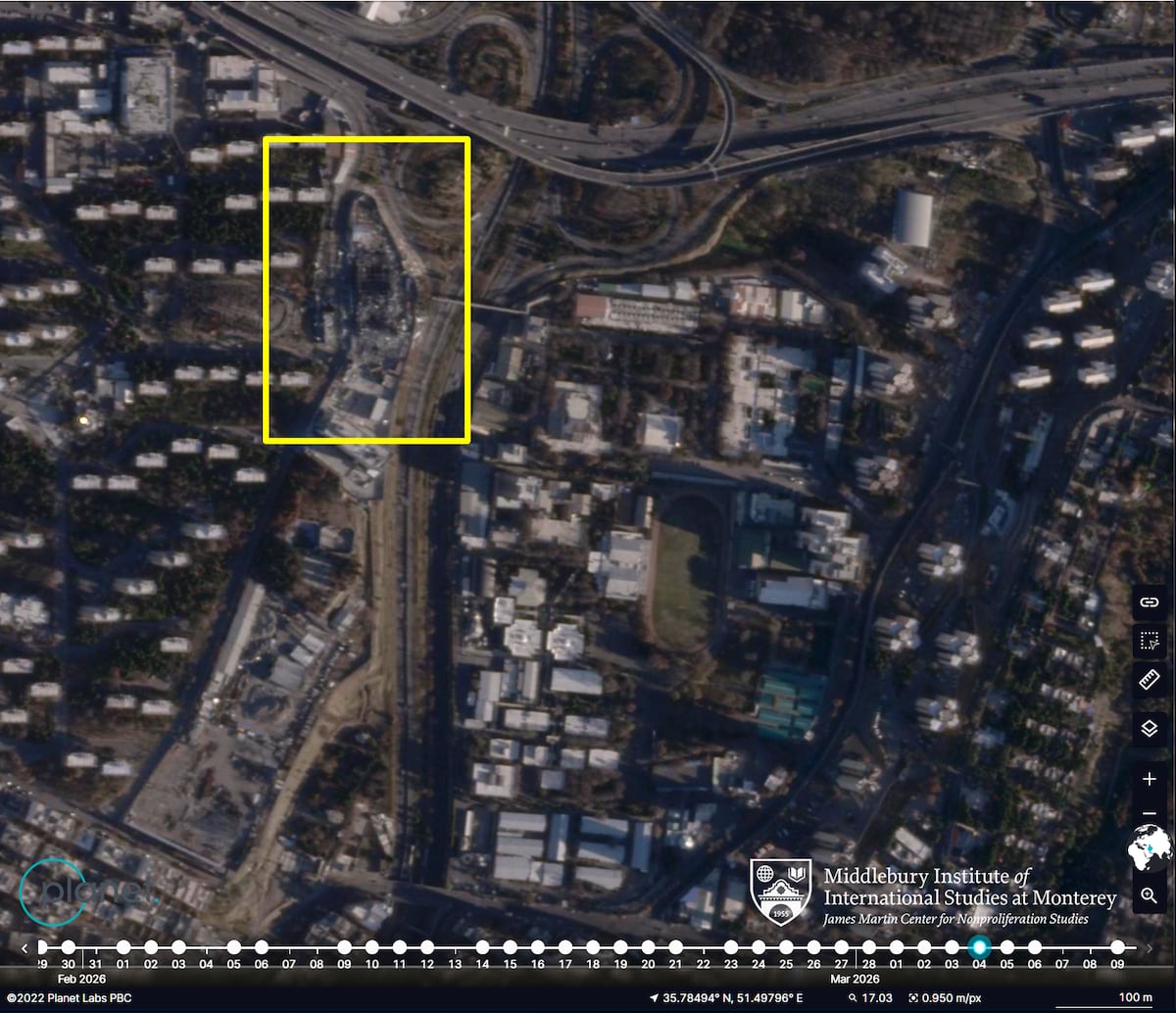
BERLIN — Iranian facilities affiliated with chemical and biological weapons research have been hit by the United States and Israel without much fanfare, satellite imagery and the analysis of images shared on social media show.
Among the sites destroyed in recent weeks are key sites operated by the Iranian Ministry of Defense, the Iranian Revolutionary Guards Corps and hybrid entities that straddle civilian and military applications.
In some cases, the Israeli armed forces publicized the strikes either as early warnings or after the fact; in others, they were not publicized at all and were only detected by researchers using satellite imagery and ground-truth photos trickling out of Iran.
“It almost seems like an afterthought and lower priority to the war planners,” said Jim Lamson, a former Iran analyst for the CIA of 23 years who is now a visiting fellow at the Department of War Studies with King’s College London and senior research associate at the California-based Center for Nonproliferation Studies.
“To me, it doesn’t look like a real robust CBW-specific campaign,” he said, using the acronym for chemical and biological weapons.
Many of the sites that were struck, like the headquarters of the Organization of Defensive Innovation and Research (SPND) or the Malek Ashtar University of Technology, were hit for their roles in the nuclear and missile programs rather than their chemical and biological research, according to Israeli messaging.
This missing focus is not without reason: The chemical and biological threat from Iran may simply not be what some pundits have long made it out to be, Lamson said.
And it’s in line with the U.S. government’s own longstanding assessment. While Washington has warned that Tehran has long dabbled in research regarding these weapons of mass destruction, there has not been talk of any significant arsenal, stockpile or deployment capability for these tools in decades.
Iran is also a full member of both the Biological and the Chemical Weapons conventions. Defensive research – such as manufacturing agents to develop countermeasures and antidotes – is permitted under both pacts, though the line between defensive and offensive applications is blurry.
While the U.S. government in its own publications has repeatedly declared Iran non-compliant with its CWC obligations, Washington has for decades not outright accused Tehran of stockpiling an arsenal of chemical weapons. Instead, since the early 2000s, the State Department and CIA have softened the language to say that Iran “maintains the capability to produce CW agents.”
In its annual compliance reports, the U.S. has focused on historical transfers to Libya in the 1970s and 1980s, failure to fully declare its holdings of riot-control agents – which are illegal as a weapon of war, but legal for domestic use – and what it calls the incomplete declaration of production facilities. In 2024, it added that Iran had allegedly weaponized pharmaceutical-based agents such as fentanyl.
Others in the think-tank world have persistently described Iran’s program as a real threat that should be addressed. In a memo penned days before U.S. President Donald Trump launched attacks on Iran on Feb. 28, the Washington-based Foundation for Defense of Democracies highlighted the continued concerns with Iran’s research and access to chemical weapons, including the threat that they may be proliferated to its proxies in the region or used against its own people to crush uprisings.
Andrea Stricker, the foundation’s nonproliferation program deputy director, also cited intelligence assessments from the mid-2000s that suggested Iran had maintained an undeclared stockpile of chemical weapons.
Lamson has been tracking the Iranian sites involved in these programs since before the first waves of strikes in 2025, in which a handful of them were destroyed, but many more were left unharmed.
The Iranian chemical and biological programs, he said, were likely intended to maintain a “threshold capability” similar from its pre-war nuclear stance: having the dual-use industries and research established so that if Iran made the decision to manufacture the weapons, the breakout time would be relatively short.
But, at present, “this does not look like a dedicated offensive CBW program with production, agents and delivery systems to me,” he said.
Within Iran, the threat perception that the U.S. or Israel – which is not a signatory of the Biological Weapons Convention and has not ratified the Chemical Weapons Convention – may use these weapons of mass destruction against Iran is very real.
It’s a deep-seated fear, rooted in the Iran-Iraq war of the 1980s, during which Iraq, at the time supported by many Western countries and using Western-imported gear, launched thousands of chemical attacks against both Iranian soldiers and civilians. More recently, senior government officials in Tehran have alleged Western biological warfare against government targets in statements ranging from fearful to conspiratorial and often conveniently timed to distract from domestic failings.
As a result of the perceived threat, some factions in Iran’s government have pushed for a more active development of chemical and biological capabilities, and a broader consensus on maintaining capable defensive research abilities exists within the relevant policy elites.
What results is a latent capability, in the form of disparate institutes and industrial sites, that have some chemical and biological weapons applications, but no centralized, large-scale BWC program.
The lack of prominence in the shifting explanation for the war is puzzling, argues Lamson.
“If the U.S. and Israel really had concerns over chemical and biological weapons, like they’ve said over the years, why wasn’t it a stated threat, a justification, leading up to it?” he asked. In both the Iraq wars of 1991 and 2003, Lamson pointed out, the military and even Israeli civilians had been equipped with gas masks and other gear to mitigate CBW attacks coming their way.
“Unless it was done very quietly, we haven’t seen that in this instance, which to me, again, reflects the fact that Israel and the U.S. for whatever reason, weren’t that concerned that there were going to be actual CW and BW used against them,” Lamson said.
Linus Höller is Defense News' Europe correspondent and OSINT investigator. He reports on the arms deals, sanctions, and geopolitics shaping Europe and the world. He holds master’s degrees in WMD nonproliferation, terrorism studies, and international relations, and works in four languages: English, German, Russian, and Spanish.
柏林——卫星图像和社交媒体上分享的图像分析显示,美国和以色列对伊朗与化学和生物武器研究有关的设施发动了袭击,但并未引起太多关注。
最近几周被摧毁的地点包括伊朗国防部、伊朗革命卫队以及兼具民用和军事用途的混合实体运营的关键地点。
在某些情况下,以色列武装部队会公开这些袭击,要么作为预警,要么事后公布;而在另一些情况下,这些袭击根本没有公开,只是研究人员利用卫星图像和从伊朗流出的地面照片才发现的。
“这似乎成了战争策划者事后才想到的、优先级较低的事情,”吉姆·拉姆森说道。他曾在美国中央情报局担任伊朗问题分析师 23 年,现在是伦敦国王学院战争研究系的访问学者,也是位于加利福尼亚州的防扩散研究中心的高级研究员。
“在我看来,这看起来不像是一场真正强有力的针对化学和生物武器的专项行动,”他说道,这里他使用了化学和生物武器的缩写。
根据以色列方面的说法,许多遭到袭击的地点,例如国防创新与研究组织(SPND)总部或马利克·阿什塔尔科技大学,是因为其在核武器和导弹计划中的作用,而不是因为其化学和生物研究而遭到袭击。
拉姆森表示,这种关注缺失并非没有原因:来自伊朗的化学和生物威胁可能根本不像一些专家长期以来所描述的那样严重。
这与美国政府长期以来的评估相符。尽管华盛顿方面警告称,德黑兰长期以来一直在进行大规模杀伤性武器的研究,但几十年来,从未有关于德黑兰拥有任何大型武库、库存或部署能力的报道。
伊朗是《生物武器公约》和《化学武器公约》的正式成员国。两项公约均允许进行防御性研究,例如制造用于研发反制措施和解毒剂的制剂,但防御性和进攻性用途之间的界限模糊不清。
尽管美国政府在其官方出版物中多次宣称伊朗不遵守《化学武器公约》的义务,但几十年来,华盛顿从未直接指责德黑兰囤积化学武器。相反,自2000年代初以来,美国国务院和中央情报局的措辞有所缓和,称伊朗“具备生产化学武器的能力”。
美国在其年度合规报告中重点关注了伊朗在20世纪70年代和80年代向利比亚的历史性武器转移、未如实申报其持有的防暴剂(这些防暴剂作为战争武器属于非法,但在国内使用合法)以及其所谓的生产设施申报不完整等问题。2024年,美国又补充说,伊朗涉嫌将芬太尼等药物制剂武器化。
智库界的其他人士也一直将伊朗的化学武器计划描述为必须应对的现实威胁。在美国总统唐纳德·特朗普于2月28日对伊朗发动攻击前几天,总部位于华盛顿的保卫民主基金会在一份备忘录中强调了对伊朗化学武器研发和获取的持续担忧,包括这些武器可能扩散到其在该地区的代理人,或被用来镇压本国人民的起义。
该基金会防扩散项目副主任安德里亚·斯特里克还援引了 2000 年代中期的情报评估,这些评估表明伊朗一直保有未申报的化学武器库存。
拉姆森从 2025 年第一波打击之前就开始追踪参与这些计划的伊朗基地,当时少数基地被摧毁,但更多基地毫发无损。
他说,伊朗的化学和生物计划很可能是为了保持与战前核立场类似的“门槛能力”:建立两用工业和研究,以便如果伊朗决定制造武器,突破时间相对较短。
但他表示,目前“在我看来,这不像是一个专门的进攻型CBW项目,没有生产、代理人和交付系统”。
在伊朗国内,人们普遍认为美国或以色列(既不是《生物武器公约》的缔约国,也没有批准《化学武器公约》)可能会对这些大规模杀伤性武器对伊朗使用,这种威胁感非常真实。
这是一种根深蒂固的恐惧,源于上世纪80年代的两伊战争。当时,伊拉克在许多西方国家的支持下,使用西方进口的装备,对伊朗士兵和平民发动了数千次化学武器袭击。最近,德黑兰的高级政府官员也声称西方对伊朗政府目标发动了生物战,他们的言论从恐惧到阴谋论,不一而足,而且往往时机恰当,意在转移人们对国内执政失败的注意力。
由于感受到威胁,伊朗政府内部一些派别推动更积极地发展化学和生物能力,相关政策精英内部也普遍认同保持强大的防御研究能力。
其结果是,存在着一些潜在的能力,以分散的研究所和工业场所的形式存在,这些机构和场所拥有一些化学和生物武器应用,但没有集中、大规模的生物武器计划。
拉姆森认为,在对战争原因的解释不断变化的过程中,缺乏突出地位是令人费解的。
“如果美国和以色列真的像他们多年来所说的那样,对化学和生物武器感到担忧,为什么在战争爆发前没有公开提出威胁或给出理由呢?”他问道。拉姆森指出,在1991年和2003年的伊拉克战争中,军方甚至以色列平民都配备了防毒面具和其他装备,以应对可能发生的化学和生物武器袭击。
拉姆森说:“除非是悄悄进行的,否则我们还没有看到这种情况发生。在我看来,这再次反映出以色列和美国出于某种原因,并不太担心会真的对他们使用化学武器和生物武器。”
林努斯·霍勒是《防务新闻》的欧洲记者和开源情报调查员。他报道影响欧洲乃至全球的军火交易、制裁和地缘政治。他拥有大规模杀伤性武器不扩散、恐怖主义研究和国际关系三个硕士学位,并精通英语、德语、俄语和西班牙语四种语言。